Search This Blog

Sunday, February 3, 2019

Doctors-in-training need better nutritional education

Obesity is a global epidemic, and its prevalence is increasing in every part of the world. While we have new medications and complex surgical techniques that promote weight loss, the awareness of healthy eating habits and dietary education are still the most important factors in helping control body weight.
Unfortunately, nutrition knowledge appears confined largely to books and exams; as the doctors barely engage in nutrition counseling with patients. In teaching hospitals, where residents work closely with patients, it is important that the residents develop a comprehensive knowledge of nutrition science and apply that knowledge to clinical practice. But they are under the misconception that nutrition counseling is not their role, it is rather the function of dieticians. Inadequate knowledge of nutrition or not feeling competent enough to address nutritional concerns is also commonly seen among health care providers.
However, this brings up an interesting point: Are physicians themselves (including residents) healthy enough to provide this counseling? Are they, in fact, the models of healthy living their patients believe them to be? It is a well-known fact that physicians’ attitudes and personal habits may have a significant impact on their practice of nutrition and lifestyle counseling. If the physicians are consuming a high-calorie diet, eating fast food, avoiding home cooked meals due to busy schedules (while having time to go out and eat) and simply unable to differentiate between real food and “food-like substances,” can they provide proper nutrition education to their patients?
As health care providers, we encounter patients almost every day who are paying the price of their poor eating habits. Acute conditions are treated in the inpatient setting, where abnormal lab values are fixed, and the patient is discharged with recommended follow-up with primary care. In the outpatient setting, the discharge notes are reviewed, medication refills provided, and referrals made. However, in most cases, other than questioning the restricted elements of a diet such as sodium or fluid intake, inquiry of the patient’s daily eating habits — availability of food, affordability of fresh produce, meal preparation at home versus consuming fast food — is largely overlooked by physicians. This is regretful because, as the literature supports, patients consider clinic physicians to be the credible source of nutrition and desire to discuss their dietary plans with their primary provider.
There is an urgent need for nutritional knowledge among young physicians-in-training and a more urgent need for physicians to promote healthy eating habits to their patients. Encouraging healthy eating choices among residents will, in turn, foster the importance of educating patients regarding lifestyle changes. Rather than going out and having pizza and drinks, residents can also have fun gathering at one place and prepare meals and enjoy doing it all together. Residency programs can have healthy meals during the noon conferences and lectures to promote healthy eating behaviors among the physicians-in-training.

The Science Behind Ketogenic Diets, Or Why We Get Fat And What To Do About It

The internet is abuzz with anecdotes telling of the amazing benefits of a ketogenic (or “keto”) diet. Nothing new there, then, as every year is marked by the rise and fall of a new diet fad – most amplified by the social media echo-chamber but with little to commend them.
This time, though, it caught my attention.  Not just because I am a modestly overweight 52 year old whose love for food and drink is slightly stronger than my desire to be skinny, and as a result someone who has been on a diet every January for at least 20 years and now knows he needs he miracle.  But because of the science behind it.
For a start, I first began reading about ketogenic diets thanks to Ethan Weiss, M.D., a prominent UCSF cardiologist on Twitter, whose scientific acumen I respect.  If he believes in the benefits of ketosis, then I should definitely look a little closer.  After 20 years of January diets, my own experience suggested that nothing made any difference: you only lost weight if you took in less calories than you used, and if you took in less calories than you used then you were hungry. Simple as that.  Could it be that a ketogenic diet really was different?
Well, the principle makes sense.  Bizarrely named “ketone bodies” are actually molecules that act as the body’s natural back-up fuel supply when glucose is scarce.  Normally, we only enter ketosis (where ketone bodies accumulate in the blood) when we starve ourselves – not just overnight or by missing a meal, but for several days at time.  Our metabolism then switches to fat-burning, and converts stored fat molecules into ketone bodies that can power our muscles and brain because the glucose has run out. Being in ketosis, then, does sound like a great way to burn off the fat.  On the other hand, not eating for days doesn’t sound much fun.
But it turns out you don’t need to starve yourself to get into ketosis.  All you need to do is remove carbohydrate from the diet (not just refined carbs, such as sucrose or high fructose corn syrup, but all carbs, including complex carbs and starches too).  Once the body has no source of glucose, it has to switch to ketosis because the brain needs either glucose or ketone bodies to survive.  So no matter how much protein or fat you eat, the body still has to break down fat to ketone bodies to keep you going.
A ketogenic diet, then, is any diet that switches your metabolism to ketosis.  And the ones doing the rounds at the moment aren’t the first or the only diets to do that.  It is several decades since the Atkins Diet rose to prominence – and I witnessed first-hand the weight loss some friends achieved on Atkins.  The Atkins diet is a ketogenic diet, because it removes carbs from the diet and replaces them with protein.  The surprising finding was that Atkins followers discovered they were much less hungry than they expected, suggesting that calories from protein made you feel more satisfied for longer.  Feeling fuller translates to willingly eating less, and in the end impressive weight loss.
In dieting, though, there is no such thing as a free lunch (or so I thought).  Adherence to the Atkins diet has side-effects, and most worrying is the impact on nitrogen balance from taking in so much protein. There is a very real risk of dehydration, and over the longer term, kidney stones from the need to excrete so much excess nitrogen as urea.
So what about the 21st century version? Keto today replaces the carbs with fats rather than protein.  A typical Atkins regimen had 75% of calories from protein, 25% from fat and <5% from carbs.  By contrast, today’s keto diets advocate 75% of calories from fat, 25% from protein and <5% from carbs.  As protein intake isn’t changed from a typical “balanced” diet, any side-effects from nitrogen imbalance are neatly side-stepped.
But what about all that fat? Surely that’s got to be unhealthy? Well, no. Most instructive are the lipid profiles of Antarctic explorers who have crossed the continent on foot, dragging their own food on sledges.  That’s only possible with food that has the highest possible calorie to weight ratio – which means eating essentially nothing but butter.  And after months on an all-butter diet the level of LDL-cholesterol (often called “bad cholesterol”) actually declines significantly.  That isn’t as surprising as it sounds – while in ketosis, fats are being moved from stores towards the liver (where the ketone bodies are made) and that’s the job of HDL-cholesterol.  LDL-cholesterol typically moves excess fat from the liver to the stores in the rest of the body (hence in the opposite direction).  So in ketosis, you would expect a lipid profile normally considered healthier (higher HDL and lower LDL) no matter how much fat was being consumed.
But if the benefits of Atkins on weight came from the reduced hunger thanks to the sustaining properties of protein, then you shouldn’t get that unless you bulk up the protein component of the diet. It turns out, though, that the reduced hunger results from the state of ketosis itself.  How you achieve it doesn’t really matter.
So the science stacks up – theoretically, at least, I couldn’t find a flaw in the modern ketogenic diet.  So I gave it a try in place of my usual “low-everything” calorie restricted January diet.
On 1st January, I weighed in at a portly 196lbs, which on my 5’9” frame amounts to a BMI between 29 and 30 (so only a smidgeon under “obese”).  The “Deliciously Keto Cookbook” by Molly Pearl & Kelly Roehl duly arrived from Amazon, and my carb intake immediately fell below 5%.  As I sat eating rib-eye steak for breakfast, topped with chili-butter, along with scrambled eggs and cheese, it was hard to believe I was on any kind of diet.  If, like me, you think food needs to have fat in to taste good then you are going to find keto one easy regimen to follow.
I typically work-out every day for 30minutes, on a Concept 2 indoor rowing machine, and to help the diet along, I increased that to 45minutes, allowing me to row 10km (without leaving the comfort of the gym).  That exercise probably helped rid my body of stored carbohydrate (your liver stores quite a lot of carbohydrate as glycogen, ready for quick release to power your muscles) quicker than normal, and within 48 hours I had achieved Nirvana (well, ketosis anyway).  Using urine dipsticks, my ketone body level was sustained above 6 mmoles/litre, equivalent to a “deep” ketosis.
And there it has stayed for a month, while I enjoyed the delights of burgers topped with brie, jumbo prawn salads with avocado and sour cream dressings and creamy pork stroganoff with zucchini ribbons.  Three fat-laden meals every single day.
First the benefits: once ketosis was well-established three days in, I found I was never hungry.  I had no desire whatsoever to snack between meals (usually a big weakness), and gradually over a month I found myself thinking less and less about food – to the point missing lunch altogether was something that could happen “by accident”.
I also found my concentration and focus dramatically improving.  I had never had so much energy, and productivity went through the roof. Running on the back-up batteries (the ketone bodies) is so much better than fuelling yourself with carbs.  Why was that? Quite simply because the levels never decline (at least for a chubby person like me, with a boundless supply of internal fat stores to burn).  By contrast, when you eat carbs, the excess is immediately squirreled away as fat (for a rainy day) so that blood glucose levels fall a few hours after eating and that triggers the urge to eat again, but also a feeling of declining energy and concentration (that “late afternoon dip” us ‘carbavores’ recognise only too well).
And eating less did indeed translate into impressive weight loss (14lbs gone in under a month), mostly from the unsightly and unhealthy abdominal fat deposits, so my waistline shrunk two notches on my belt too.  That’s about twice as much weight-loss as my usual miserable January diet can achieve by making me constantly hungry.
There were even some unexpected benefits I noticed.  For example, the amount of plaque on my teeth reduced to almost zero (presumably because the plaque bacteria need the dietary carbs to feed off).
To be honest, I feel like a teenager again.
What about the downsides? Aside from annoying my friends with constant tales of the benefits of a ketogenic diet (the newly converted are always the noisiest proselytizers), there were only two downsides I could think of.
The first is simply practical.  Keeping carbs below 5% of total calories is a challenge.  You have to check the carbohydrate content of everything that you eat, and you find sneaky carbs hiding in almost everything pre-prepared. Eating out at restaurants becomes a challenge, and as a guest with friends and family almost impossible (unless they are also on a ketogenic diet or are incredibly accommodating).  As a result, planning and preparing food becomes a significantly greater demand on your time and resources than it was before.
On the same lines, you do have to exert accurate portion control too – as the meals, high in fat, have a high calorie density, you can unintentionally eat too many calories.  And even the keto diet can’t break the physical laws of the universe such as the conservation of energy – to lose weight you have to eat less calories than you need.  It just means you feel great while doing it.
The second downside was simpler to avoid – but I had been slow to heed the warnings I had been given. It is hard to get enough fibre while following a ketogenic diet, principally because most natural fibre sources also contain too much available carbohydrate (fibre is typically an insoluble or indigestible carbohydrate polymer, so its unsurprising it naturally co-exists with digestible carbs).  The solution is simple: take a fibre supplement – for me, I need 7 or 8 grams a day – from the first day you switch to a ketogenic diet.
At the end of my experiment, I decided to observe the impact of eating some carbohydrate after almost a month being essentially carb-free.  Just 50g of carbs in one sitting (equivalent to a very small baked potato) immediately killed ketosis.  Within 3 hours, urinary ketone body levels had fallen to essentially undetectable – hunger returned and the “mental fog” started to descend.
Of course, it then took almost 72 hours to re-establish “deep” ketosis after just one (in my case deliberate) moment of weakness.  Three days of feeling a bit rubbish, lacking in energy, because I was denying my body its usual glucose fuel and the back-up batteries, the ketone bodies, were yet to cut in.  Success on a ketogenic diet, therefore, clearly requires the kind of discipline typically associated with a Zen master.
This experiment illustrates very nicely the problem a “balanced” diet causes for the metabolism of a modern human.  Ketosis is slow to establish but very quick to turn off – a phenomenon scientists call hysteresis.  And there are very good evolutionary reasons for this set up: while a good fuel, glucose and other carbohydrates can damage the proteins that make up your cells and tissues.  If glucose levels are allowed to get too high, the damage may be irreparable (as can happen in diabetes).  To avoid that, at least in healthy people, the body makes insulin as soon as blood glucose levels start to rise – and insulin caps the level of glucose in the blood by instructing the liver to convert the excess into fat.  At the same time, however, that insulin turns of ketosis (which is why ketosis ended so quickly after I ate a baked potato). That ensures you are not laying down fat and burning fat at the same time (which would be a highly inefficient use of food resources).
In prehistory, evolution tuned our metabolism so we didn’t immediately start tucking in to our fat stores the moment food became scare.  Individuals who did that would find that when a potentially catastrophic food shortage occurred they would have less fat stored and so be the first to succumb. Of course, today, when for most people in developed countries, availability of calories is unlimited this hysteresis that once made us efficient now makes us fat.  Every ounce of excess carbohydrate is stored away as fat, but those stores are not re-accessed as soon as your glucose is depleted.  Instead you are left feeling hungry and lacking in energy for a while – and with fast-food fries within easy reach it’s just too tempting to re-fuel with carbs again.
Ketosis was, once upon a time, key to giving humans a survival advantage.  The science, and my personal experience, suggests it can indeed do the same for individuals today.  If you havent tried it yet, maybe you should.

Will Juul Will Be Enough For Altria?

Juul vaping cartridge sales were on fire this past year, giving Wells Fargo a buzzy feeling about Altria Group Inc. MO 0.53% following this week’s earnings report. But Morgan Stanley wasn’t convinced vaping will offset the continuing decline in traditional cigarettes.
Altria reported fourth-quarter adjusted earnings per share of 95 cents, roughly in line with Street expectations. But the part of its report that got the most notice was the spike in Juul Labs revenue, which passed $1 billion, seven times what it was the previous year. The legacy Big Tobacco company’s earnings call was closely watched because it was its first since acquiring a 35-percent stake in Juul last year.
The Analysts
Wells Fargo Securities analyst Bonnie Herzog was the more bullish on Altria, reiterating an Outperform rating and a $65 price target, seeing strong opportunity for the company once known for Marlboros with its stake in Juul.
Morgan Stanley’s Pamela Kaufman was decidedly more bearish and kept her Underweight rating and $45 price target on the stock, saying vaping won’t offset (and will even help speed up) the demise of the cigarette.
Altria shares traded at $48.96 Friday afternoon.
Wells Fargo
Herzog likes the high visibility of Juul and the opportunity she sees for the vaping company to boost overall Altria fortunes. The rest of the market, Herzog said, is missing the degree to which the product could save a company previously pinned to what some see as a dying tobacco industry.
“We…are incrementally more bullish on MO’s decision to acquire a 35 percent stake in JUUL,” Herzog wrote in a note. She acknowledged a speed-up in the decline of cigarette sales, but said Juul’s strong U.S. share and margin growth, along with good prospects internationally, present upside that is underestimated.
Herzog did acknowledge some uncertainties, including the possibility of stronger federal regulations on e-cigarettes. But, she said, strong Juul growth internationally combined with a working cost reduction program in the larger Altria operation should enable earnings growth for several years to come.
Morgan Stanley
Kaufman isn’t yet hooked on Juul.
Kaufman noted that Altria expects Juul’s international business to represent about half the company’s revenue by 2023, but is more concerned about the risks.
“While MO will benefit from JUUL’s growth, we see risk from higher cigarette cannibalization, the impact from lower nicotine caps/lower barriers to entry in international markets, and FDA risk,” Kaufman wrote in a note. Even modeling in Juul growth, Kaufman said, Morgan Stanley believes “the contribution will be offset by weaker growth in MO’s core business.”

Raymond James Raises PT On Scotts Miracle-Gro Following Q1

Analysts at Raymond James reiterated their rating on Scotts Miracle-Gro Co SMG 0.17%, even though the company’s fiscal first quarter results were “somewhat” below their expectations. Nevertheless, the analysts saw a number of “encouraging” signs in the earnings report.

The Analyst

Joseph Altobello reiterated his Outperform rating on the Scotts Miracle-Gro and raised the price target from $71 to $80.

The Thesis

Scotts Miracle-Gro posted an adjusted net loss of $1.39 per share, which was 29 percent lower than Raymond James’ estimate of $1.15 and below the consensus of $1.25. Altobello pointed out that the miss was mostly due to temporary Cost of Goods Sold and non-operating items such as a lower tax rate and diluted share count.
The company’s earnings of $298.1 million grew by 35 percent on the year, slightly lower than the 38 percent the analyst had expected.
Altobello also pointed out that Scotts Miracle-Gro’s U.S. consumer segment enjoyed a 9-percent sales growth during the quarter, which was above their estimates of a 1-percent growth.
The cannabis-focused Hawthorne subsidiary grew its sales by 84 percent, versus Raymond James’ expectations of 108 percent. Hawthorne sales were boosted by the acquisition of Sunlight Supply, but on a comparable basis the sales fell by less than 10 percent on the year, which is an improvement from the previous quarters’ drops of 30-40 percent.
In this way, Altobello said, Scotts Miracle-Gro is showing solid trends for its U.S. consumer segment and the integration of Sunlight is well on track to provide synergies of around $0.60 per share.

Geron, Mesoblast, Supernus called buys

Supernus Pharmaceuticals (NASDAQ:SUPN) resumed with Buy rating and $55 (48% upside) price target at Janney.
Mesoblast Limited (NASDAQ:MESO) initiated with Buy rating and $6.50 (43% upside) at H.C. Wainwright.
Geron (NASDAQ:GERN) upgraded to Buy with a $3.25 (216% upside) price target at B. Riley FBR. Shares up 10% premarket.

Saturday, February 2, 2019

Two Ways for Startups and Corporations to Partner

Although some large corporations invest in or acquire startups, a growing approach to corporate innovation involves partnering with small, high-growth companies. When a large corporation partners with a start-up the result should, in theory, be a win-win. Corporations possess resources and legitimacy that startups aspire for, while startups have agility and novel ideas that corporations value. For information technology (IT) corporations, the motive may partly be the adoption of their technology platforms as building blocks; for non-IT corporations a driver could be pain points resulting from disruptive digitalization.
But vast interorganizational asymmetries mean it is often not straightforward for such different firms to collaborate. Disparities in size, structure and power make it difficult for startups to connect with the right department and individuals within a large corporation. It is therefore imperative for corporations to provide startups with viable interfaces. In my research I have discovered two such approaches: cohorts and funnels.
In a cohort, a set of startups participate in a programmatic initiative, such as an accelerator, over a pre-specified period, usually a few months. Peer engagement among the startups is often a key part of the process. While gaining entry into a cohort may be competitive, once in, participating startups generally complete the process. To illustrate, Microsoft established accelerators that provide cohorts of startups with four months of access to technological and business infrastructure, mentoring, and network-building opportunities, culminating in a demo day attended by Microsoft managers and partners, as well as external investors. Also, Bayer’s Grants4Apps (G4A) program offers a 100-day accelerator program for digital health startups based in its premises in Berlin. SwissRe’s insuretech accelerator, launched first in Bangalore, is yet another example.
By contrast, in a funnel, many fewer startups complete the process than begin it. Startups get screened out as the process unfolds, often not being aware of other startups that are participating. A funnel essentially has a built-in contest for a limited set of collaborative opportunities. To illustrate, SAP Startup Focus was established to work with promising startups developing new applications on the corporation’s database platform (SAP HANA) and help accelerate their market traction with its enterprise customers. Around 15% of startups are then provided technical assistance to build enterprise-centric solutions, with a further subset that successfully validated their solutions then receiving go-to-market support. Another example is BMW’s Startup Garage which offers startups the opportunity to work with it as a “venture client” on an innovation project after screening them for technical quality, strategic fit and the potential to become a market leader through a stage-gate process. Also operating as a funnel is Unilever Foundry which puts forward challenges, frequently relating to digital marketing, that start-ups are invited to pitch solutions for.
While the mere existence of a cohort or funnel does not guarantee partnering success, creating an effective interface gives startups a first port of call that overcomes the difficulty of establishing a connection in the first place and increases the odds of meaningful relationships ensuing by giving both parties a shared understanding of the nature of collaboration that might be feasible. Executing an effective startup partner interface calls for genuine and thoughtful effort – not mere lip service – from corporations. Here are three lessons.
Ensure fit with partnering goals. Although neither interface is inherently superior, they are qualitatively distinctive. Cohorts have the advantage of being able to, potentially, give rise to previously unconsidered opportunities through brainstorming and experimentation. Funnels can be especially effective at delivering tangible outcomes based on perceived pain points because of the process of elimination leading to joint activity with a startup that is tightly aligned with the corporation’s agenda. Thus one factor in choosing between a cohort and funnel might be how diffuse or specific the underlying partnering goals are. As the sophistication of startup partner interfaces grows, corporations may also seek to balance the benefits of cohorts and funnels. For instance, a funnel-based interface might selectively add a cohort dimension, such as Unilever Foundry’s Level 3 co-working space in Singapore.
 Span boundaries externally and within. A corporation’s partner interface, be it a funnel or cohort, is only as good as its ability to connect high-quality external startups with relevant internal line managers. Once an interface is created, the team running that unit must be skilled at building bridges with entrepreneurs, whose decision-making styles and strategic orientations may differ considerably from those of managers in large corporations. They must also be able to connect startups with their own corporation’s business unit leaders who have the ability to realize the prospect of collaborating with startups, yet may view this as a distraction. Co-locating an internal innovation team with external startups in a corporate accelerator, as Infiniti Lab has done in Hong Kong, may help in spanning boundaries.
Make adjustments to the interface. Ongoing tweaking can continuously improve the interface. In the second year of Bayer’s G4A program, the cohort’s scope was broadened to include global startups and internal employees’ startup ideas. The following year, a more concerted effort was made to link the expertise of the startups with Bayer’s areas of interest. In other cases, more fundamental changes may ensue. Microsoft switched from accelerators to scaleups, no longer welcoming early-stage startups but rather seeking to nurture more mature ones. And some interfaces may run their course. SAP has recently retired the Startup Focus program, merging it with SAP PartnerEdge, its flagship partner engagement program for partners of all types.
Following these lessons can yield effective interfaces that are more likely to produce successful corporation-startup partnering outcomes, like the recent collaboration around a proof of concept in the area of B2B online transactions between Silicon Valley-based startup Crowdz and Barclays Bank. This was the result of that startup’s stint in the Barclays London accelerator, part of an ongoing multi-location program that reflects all three lessons above, run by the corporate accelerator specialist Techstars.
Corporations are increasingly battling for the hearts and minds of the best startup partners – and building an effective interface is vital to a winning strategy.

A Standard and Clean Series A Term Sheet

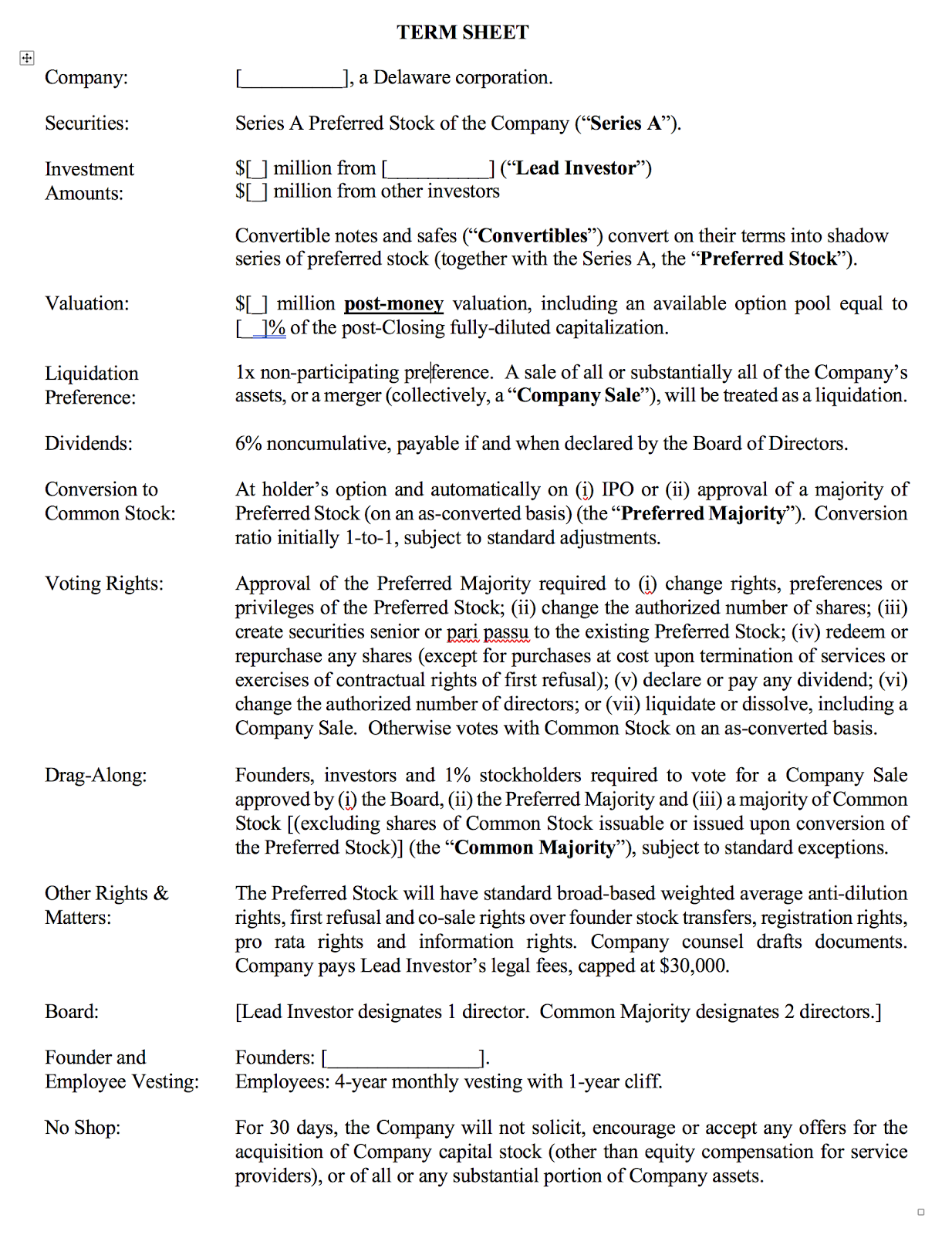
While working with companies in YC’s Series A program, we’ve noticed a common problem: founders don’t know what “good” looks like in a term sheet. This makes sense, because it is often, literally, the first time in their careers that they’ve seen one. This puts founders at a significant disadvantage because VCs see term sheets all the time and know what to expect. Because we’ve invested in so many founders over the years and have seen hundreds of Series A term sheets, we know what “good” looks like. We work with our founders to understand where terms diverge from “good”, what they can do about that divergence, and when and how it makes sense to negotiate.
Below is what a Series A term sheet looks like with standard and clean terms from a good Silicon Valley VC. Bracketed items (besides the names of the company and lead investor) are always or frequently negotiated. Items not in brackets are sometimes negotiated, but this has more to do with the idiosyncratic features of the company or the situation, and generally aren’t terms that parties intend to heavily bargain over during the negotiation.
One of the critical things you’ll notice is that we didn’t put in standard pricing. While the lead in a Series A round generally wants 20% of the company, pricing can flex up and down depending on the leverage held by each side. We think price is an important term, but too specific to each raise to try to create a standard. We’re more concerned with terms around control and structure that are less familiar to founders, and therefore more prone to cause confusion and trouble.
Note: this term sheet doesn’t belong to any particular VC — we drafted it — but it does substantively reflect what we see most often. Founders with a lot of negotiating leverage can sometimes do better, and the converse is true too.
You can also download the Word version of the doc here.
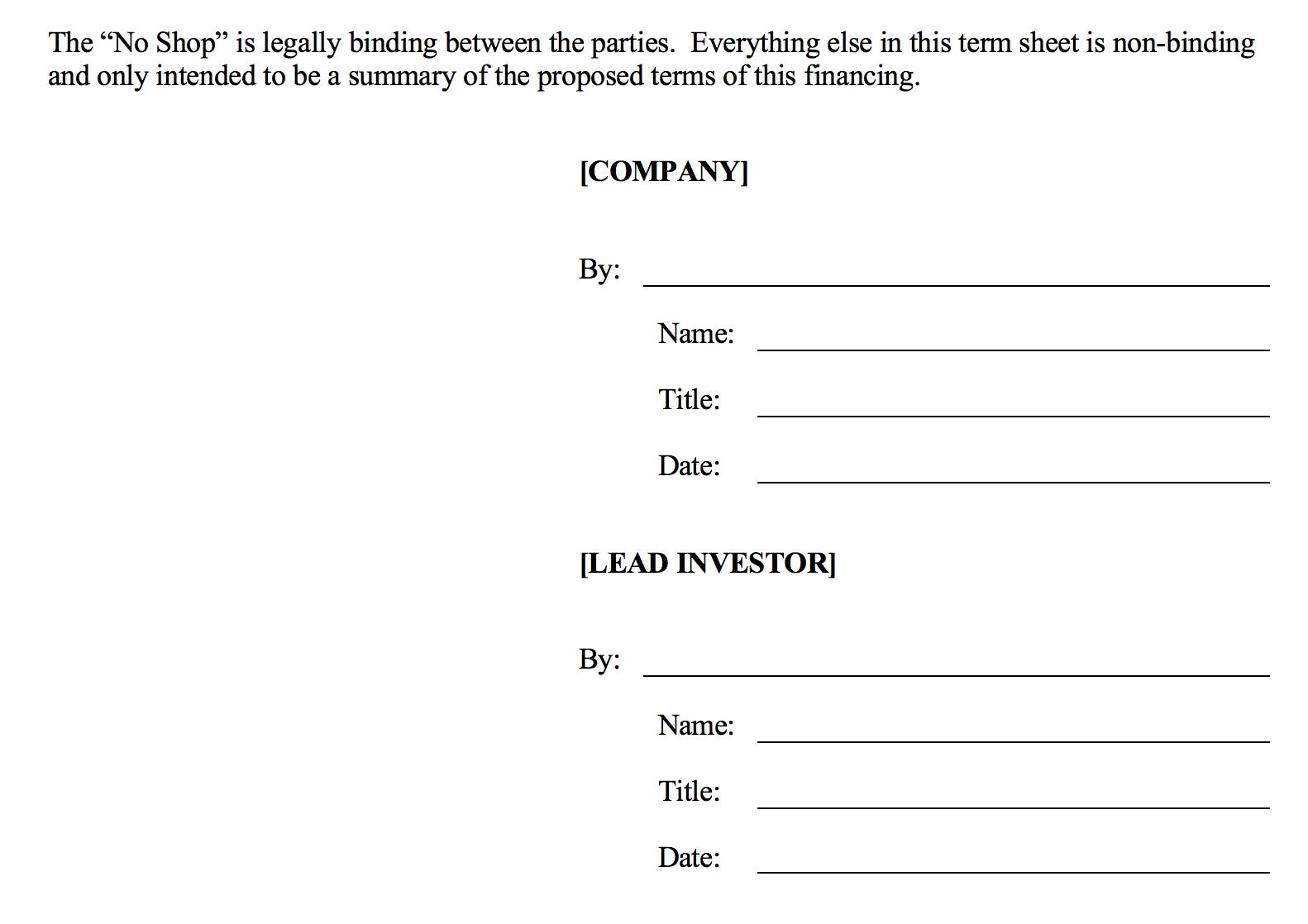
It may be surprising to see everything covered in a single page.1 This wasn’t always the case, but became common over the last decade as some investors decided to make their term sheets more user friendly by shortening the legalese as if to say, “We aren’t going to get bogged down in the minutiae. We’re going to make this easy, friendly, standard and fast.”
This leads us to the most important thing to understand about the term sheet: it’s another way in which your Series A investor might be telling you something. A contract allocates risks between the parties, so the terms the investor insists on can sometimes say a lot about the investor’s perceived risks. These perceived risks show up in a couple of ways.
The first way relates to control terms. We don’t mean the set of investor vetoes in the “Voting Rights” section, which are pretty standard fare,2 but rather issues of board composition and the investor’s ability to block or dictate operational decisions made by the board. The board structure in this term sheet is founder-friendly because the founders retain board control 2-1.3 The way in which founders most often lose control at the Series A is with a 2-2-1 board structure, i.e. 2 founders, 2 investors and an independent board member. The loss of board control is most significant because it means the founders can be fired from their own company.4Another way in which founders lose some control is a term that doesn’t appear in the standard example above, which is a separate provision that says the investor director’s approval is required for operational decisions like setting the annual budget, hiring/firing executives, pivoting the business, adding new lines of business, etc. When boards are set up to take power away from founders, the investor’s outward justification will frequently be reasons of governance or accountability. But the more power that’s taken away, the more it’s undeniable that the investor is attempting to structure away a perceived risk. So when an investor says that they’re committed to partnering with you for the long-term – or that they’re betting everything on you – but then tells you something else with the terms that they insist on, believe the terms.
The other way perceived risks manifest is if a term sheet includes non-standard or “dirty” economic terms. Here, the term sheet example is instructive not for what it contains but what it doesn’t. Examples of such terms would be:
  • Liquidation preference greater than 1x — the investor gets back more than its invested capital first.
  • Participating preferred — the investor double-dips by getting its money back plus its pro rata portion of exit proceeds, rather than choosing between the two.
  • Cumulative dividends — the investor compounds its liquidation preference every year by X%, which increases the economic hurdle that has to be cleared before founders and employees see any value.
  • Warrant coverage — the investor gets extra fully diluted ownership without paying for it at the agreed upon valuation.
These are all ways of adding structure to reduce typical venture risk, either directly by boosting the investor’s downside economics, or indirectly by juicing the upside outcomes. The investor is essentially saying, “I’m sort of afraid of losing my money.” It can also foreshadow how they might behave when things aren’t going well, such as pushing you to sell when you don’t want to, or dial back risk when it’s important to take it. Good investors would rather address economic risks by negotiating valuation, and are otherwise happy to give standard terms because they know that the real money in venture is not made with structure, but by building long-term value, which they are confident in their ability to help you do.
The last thing to remember is that your Series A documents are a foundation and precedent for the terms of future rounds. Good foundations make the next term sheet and financing round fast and simple, as future investors just step into the same straightforward terms. Doing the opposite complicates future fundraises, such as future investors asking for the same structure-heavy terms, existing investors refusing to drop terms that subsequent investors want removed as a precondition of investing, etc. Unwinding bad terms is difficult, and oftentimes impossible.
That said, the point is to get a clean deal, not to cycle a lot to get the perfect deal. No one ever built an enduring company just by winning their Series A negotiation. Also, even if you can’t get everything right or the way you want it, you always have the power to execute. If you do that, the value you build can outrun suboptimal terms or establish leverage to renegotiate later. So don’t lose sight of the ultimate goal: closing fast and getting back to work.
Notes
1. Some great investors still send longer term sheets, but this has more to do with their preference for going a bit deeper into the details at this stage, rather than deferring this until the definitive documents. The definitive documents are derived from the term sheet and are the much longer (100+ pages) binding contracts that everyone signs and closes on. It’s common to negotiate a few additional points at this stage, though deviation from anything explicitly addressed in the term sheet is definitely re-trading. Also, in a few places, this term sheet refers to certain terms as being “standard.” That may seem vague and circular, but term sheets frequently do describe certain terms that way. What that really means is that there’s an accepted practice of what appears in the docs for these terms among the lawyers who specialize in startups and venture deals, so make sure your lawyer (and the investor’s lawyer) fit that description.↩
2. The two most impactful investor vetoes in this section are the veto on a financing, which is covered by clauses (ii) and (iii), and the veto on a sale of the company, which is in clause (vii). We point these out because the concrete implications of these clauses aren’t facially obvious, and because most term sheets use similar technical jargon for these vetoes.↩
3. The founders implicitly control those 2 seats because they’re designated by a majority of common, and founders generally control a majority of common for a long time. In even more founder-friendly term sheets, those 2 seats may be designated by the founders themselves (as individuals).↩
4. Whether being fired from the company as an employee also triggers the removal of the founder from the board is a separate question and depends on what was negotiated in the financing documents. Sometimes a founder’s right to vote her shares to appoint a director will be conditioned on the founder being currently employed by the company. Whenever conditions are attached to your rights to vote on anything, make sure to ask your lawyer to walk you through the various scenarios in which those conditions matter and how they can hurt you.↩
This is not legal advice.