Search This Blog

Sunday, March 17, 2019

Barriers in Cannabis Research and Analysis

The world of cannabis is at an important moment. After decades of criminalization, the drug has been subject to a wave of legalizations, in various locations around the world and within the United States, for both recreational and medical use. But this new era of legal cannabis has resulted in several fields being left to play catch up. In the United States, many state’s laws are now out of step with federal legislation and the rapid pace of change along with the legal discordance between individual states means there is a lack of standardization in cannabis production and testing that is ideally needed to ensure safe cannabis use and foster an environment for medical research.
Pittcon 2019, taking place in Philadelphia, Pennsylvania on March 17-21, will take a look at these pressing issues within the industry while highlighting how recent advances in analytical technologies can help assist and advance the rapid developments in this field. Demonstrating the wide range of parties with interest in this space, the conference will bring together chemists, systems engineers and patient advocates along with representatives from the leading companies delivering tools to meet the growing demand for cannabis analysis.

Challenging times

While there has been a rapid change of pace in cannabis laws, those who wish to see access to cannabis expanded or conduct medical research on the drug may find themselves frustrated. In particular, in the United States, the previously mentioned conflict between state and federal laws can come between scientists and their ability to legally obtain marijuana for research. This impediment to research means that although medical cannabis is legal in many states, there is not a large body of evidence to support its use for a number of medical conditions.
For the field of cannabis production, the increased demand and emergence into the mainstream has created a need for standardized procedures throughout the process from “seed-to-sale”, to ensure consistent, safe and high-quality product.

The role of analysis

One major concern with the emergence of legalized cannabis is the necessity to verify what is actually present in a particular cannabis product. This includes the profile of the cannabis, such as its strain, potency and aromatic profile, as well as ensuring the absence of potentially harmful contamination like heavy metals, pesticides and residual solvents. Here, analytical methods have a clear and critical role to play.

For example, nuclear magnetic resonance (NMR) spectroscopy is a useful method for analysis of cannabis samples and can be used to rapidly determine factors such as location, strain and quality. At Pittcon 2019, Andrew Fornadel from Shimadzu Scientific Instruments will describe analytical workflows using ICP-MS for the detection of heavy metals, such as cadmium and lead, which can accumulate within cannabis plants and be harmful to health. Jack Henion from Advion will also show the utility of single quadrupole mass spectrometry for detecting pesticides in cannabis samples.

Safety first

Particularly in the medical cannabis arena, safety is a major issue that needs to be addressed. If cannabis is going to gain traction as a therapy to be used alongside conventional medicine, then it will need to undergo the same rigors as pharmaceutical drugs to ensure patient safety. At Pittcon 2019, you can hear from Lori Dodson, deputy director of the Maryland Medical Cannabis Commission, who will explain how her organization have developed regulations for the production, dispensing and testing of medical cannabis and the challenges they have faced along the way.

Where next?

A major focus of the cannabis analysis program at Pittcon 2019 will be on the call for greater standardization across the industry. Katherine K Stenerson of Merck will outline workflows that can  used for some of the most common tests performed on cannabis: potency, pesticide residue and terpene profiling, The conference will also introduce the patient perspective, with a talk from Tracey Ryan, a mother who became involved in medical cannabis research after sourcing the drug for her daughter who was diagnosed with an incurable brain tumor as a baby.

The cannabis analysis program at Pittcon 2019

Pittcon will be taking place in Philadelphia, Pennsylvania March 17-21, 2019. In addition to the talks mentioned above as part of the symposia program, the Pittcon expo will be attended by all of the major companies operating in the analytical space. Confirmed exhibitors include Shimadzu, Bruker, Phenomenex. Advion and Merck (previously known as Millipore Sigma). Given the pace of change in this industry, there is no better time to get up to date with the latest developments in the field of cannabis analytical research, and no better place to do it than at this year’s Pittcon.

References

About Pittcon


Pittcon® is a registered trademark of The Pittsburgh Conference on Analytical Chemistry and Applied Spectroscopy, a Pennsylvania non-profit organization. Co-sponsored by the Spectroscopy Society of Pittsburgh and the Society for Analytical Chemists of Pittsburgh, Pittcon is the premier annual conference and exposition on laboratory science.
Proceeds from Pittcon fund science education and outreach at all levels, kindergarten through adult. Pittcon donates more than a million dollars a year to provide financial and administrative support for various science outreach activities including science equipment grants, research grants, scholarships and internships for students, awards to teachers and professors, and grants to public science centers, libraries and museums.
Visit pittcon.org for more information.

Why Video of New Zealand Massacre Can’t Be Stamped Out

As Brenton Tarrant drove away from the New Zealand mosque where he allegedly went on a shooting spree, only 10 people were tuned into his live broadcast of the rampage on Facebook Live, according to archived versions of his page.
But the video, which shows dozens of people inside the Al Noor mosque in Christchurch being gunned down, has likely been viewed millions of times in various formats across the internet. The footage was recorded, repackaged and reposted on mainstream sites, fringe destinations with looser restrictions and in the web’s darkest corners only accessible with special software.
Facebook Inc. and Google’s YouTube were still working this weekend to keep the video off their own sites.
The vast cloning of the footage underlines a stark reality in the era of live online broadcasting: These videos can’t be cut off.
Artificial intelligence software isn’t powerful enough to fully detect violent content as it is being broadcast, according to researchers. And widely available software enables people to instantly record and create a copy of an online video. That means the footage now lives on people’s phones and computers, showing how little control the major tech platforms have over the fate of a video once it airs.
Archived versions of Mr. Tarrant’s Facebook page indicate the video was removed only minutes after it stopped airing, according to social-media intelligence company Storyful, which viewed archived versions of his page. Facebook said it was alerted by New Zealand police shortly after the live stream began.
But by then, it was too late. Anyone with a link to the video could have recorded it.
Facebook said that in the first 24 hours after the attack it blocked or removed 1.5 million copies of the video from its site. About 80% of those videos were cut off while they were being uploaded to Facebook. That means 300,000 versions of the video still sneaked through.
YouTube, owned by Google parent Alphabet Inc., said it has taken down tens of thousands of postings of the video, while Twitter Inc. said it suspended Mr. Tarrant’s account and was working to remove the video.
Facebook, Twitter and YouTube have stepped up their investments in artificial intelligence tools and human moderators to detect and remove content that violates their guidelines. These internet giants have made progress in stamping out terrorist propaganda from Islamic State militants, for example. They employ a shared database of terrorist content that is assigned digital fingerprints called “hashes” that detect visual similarities and automatically prevent the content from being uploaded.
But these tactics can be circumvented if the footage is doctored. Versions of Mr. Tarrant’s video, for example, were edited to imitate a first-person shooter game and appeared on Discord, a messaging app for videogamers.
The software can also struggle to catch videos that aren’t the original, such as a recording from a mobile phone camera of the video playing in a web browser. To try to tackle this, Facebook says it is employing audio technology and also hashing other uploads.
Live online broadcasting, which is exploding in popularity, compounds the problem because it is challenging to monitor in real time. The algorithms aren’t yet equipped to decipher reality from fiction, or detect certain moving images like guns held in different positions.
Over the weekend, links to different versions and clips of the rampage were readily available on multiple fringe sites such as Gab, BestGore.com and DTube, an alternative to YouTube that has little to no moderation. Links on the storage site Dropbox were being circulated and still active Sunday.
The video was given a supercharged boost because of the way Mr. Tarrant promoted it. Before the shooting spree, Mr. Tarrant apparently posted his alleged intention to attack the mosque, and provided links to the live stream and an accompanying manifesto filled with white supremacist conspiracy theories on 8chan, an anonymous messaging forum favored by extremist groups.
Part of the calculation, say internet researchers, was to take advantage of 8chan’s culture of archiving sensitive videos. By giving a heads up to the 8chan community about the attack and then posting a link to the live stream, Mr. Tarrant ensured that the video couldn’t be permanently deleted.
“You have these groups of people who consider themselves quasi movements online and they believe they own the internet and as a result these calls to action are almost rote memory,” said Joan Donovan, director of the Technology and Social Change Research Project at Harvard University’s Shorenstein Center. “They’re just part of the culture, so if someone says that they’re going to commit some kind of atrocity then you will see this downloading and reuploading practice happen.”
That could explain why, according to YouTube, the site has seen an unprecedented volume of attempts to post original and modified versions of the shooting video. A YouTube spokeswoman said that if it appears a criminal act will take place the website will end a live stream and may terminate the channel showing it. YouTube now has 10,000 workers devoted to addressing content that violates its rules.
Facebook appears to have become quicker at removing live broadcasts after facing criticism it took too long after other violent incidents. In 2017, a man in Thailand broadcast the murder of his infant daughter and the video remained on the site for roughly 24 hours.
This time, Facebook said its content-policy team immediately designated the New Zealand shooting as a terrorist attack, meaning any praise or support of the event violates the company’s rules and is removed.
But it is still having to improvise. Facebook said it initially allowed clips and images showing nonviolent scenes of Mr. Tarrant’s video to stay up, but it has since reversed course and is now removing all of his footage. On Sunday, New Zealand’s government emphasized it was a crime to distribute or possess the video because it considers it objectionable under law.
Highlighting the game of Whac-A-Mole, a two-minute clip of the video showing people getting shot was still viewable on Facebook as of Sunday afternoon.

Icahn School Dean Dennis Charney, MD, Coinvented Depression Therapy Spravato

Dennis S. Charney, MD, Anne and Joel Ehrenkranz Dean of the Icahn School of Medicine at Mount Sinai, is a co-inventor of a method of treatment for patients suffering from treatment-resistant depression which is patented and part of the drug application for Janssen’s SPRAVATO™(esketmine) CIII nasal spray, which was approved today by the U.S. Food and Drug Administration (FDA). This could bring relief to millions of patients with this condition.
Treatment-resistant depression (TRD) is a devastating disease and has a profound impact on people’s lives. An estimated one-third of people in the United States with major depressive disorder have TRD, which places an ongoing emotional, functional, and economic burden on the individual, their loved ones, and society.1,2,3 TRD is a critical unmet health need associated with greater morbidity, higher health care costs, and various comorbid conditions. In fact, individuals with TRD have been reported to pay more than twice as much in medical costs, were twice as likely to be hospitalized, and had six times higher hospital-related expenditures. 3,4,5
Delivered in the form of a nasal spray, esketamine works differently than the three classes of antidepressants that are currently on the market. The drug works on the N-methyl-D-aspartate (NMDA) receptor, an ionotropic glutamate receptor in the brain. In contrast, widely used antidepressants target different neurotransmitters—serotonin, serotonin and norepinephrine, and norepinephrine and dopamine—and can take weeks or even months to work. These drugs are considered ineffective in at least 30 percent of cases.
“As a researcher, you strive to come up with new treatments for the patient, especially in terms of finding answers to the most debilitating diseases,” said Dr. Charney, who is also President for Academic Affairs, Mount Sinai Health System. “To know that you oversaw the early development of an approach that can make a difference in the lives of countless individuals is extremely rewarding.”
Dr. Charney is an international expert in neurobiology and the treatment of mood and anxiety disorders, and we commend him and his colleagues for their work in changing the paradigm for patients with treatment-resistant depression,” said Kenneth L. Davis, MD, President and Chief Executive Officer of the Mount Sinai Health System. “Through his commitment to innovation and science, he has inspired countless researchers to leverage new technologies and create new discoveries to benefit the lives of patients around the world—while at the same time leading the Icahn School of Medicine at Mount Sinai to unparalleled growth and high national rankings.”
The new treatment received overwhelming support of an FDA advisory panel on February 12, 2019.

Fires Hit Exxon, Phillips 66 Refineries in Texas, Cal.

The third-biggest refinery in the U.S. suffered a fire Saturday near Houston, hours after a Los Angeles plant was partially shut by a blaze, potentially boosting gasoline prices from Texas to California.
Exxon Mobil Corp.’s Baytown, Texas, refinery was fighting a furnace fire at a gasoline hydrofiner, which removes sulfur from fuel to meet clear-air regulations, people familiar with the matter said. Phillips 66 shut a crude unit Friday night at its Carson plant after a fire.
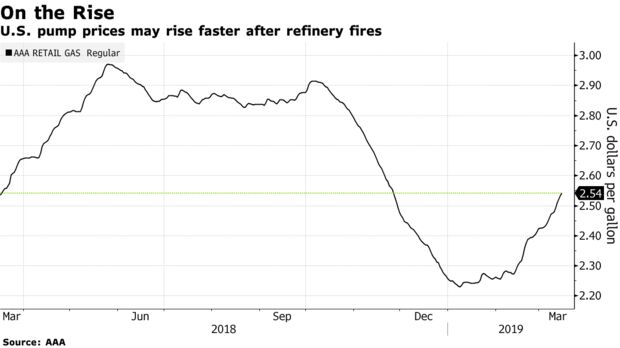
The fires, which come at a time when gasoline inventories are in decline with a number of refineries closed for seasonal maintenance, threaten to further increase gasoline pump prices that have already risen 31 cents a gallon since early January to edge above year-ago levels.
U.S. pump prices may rise faster after refinery fires
Los Angeles prices are especially sensitive to disruptions at local refineries because the area relies on a special California-blended fuel, and the state is largely isolated from the bulk of the U.S. refining system.
The crude unit remains shut for a damage assessment and the company doesn’t want to speculate on how long it will be down, Phillips 66 spokesman Dennis Nuss said Saturday in an email. The rest of the Carson and Wilmington plants continue to operate, he said. Exxon’s emergency response teams are working to put out the fire in Texas, company spokeswoman Sarah Nordin said in an email. There were no injuries reported in either incident.

Carson Fire

The California fire occurred at about 7:30 p.m. local time Friday, was “knocked down” about two hours later and eventually put out at around 10:30 p.m., said Michael Pittman, a supervising firefighter at the Los Angeles county fire department.
Crude oil leaked from a reflux line resulting in the fire, although the exact cause is being investigated, Phillips 66 said in a filing to California regulators. Firefighters arrived at the facility and found crude pumps burning, and set about ensuring that the flow of oil ceased, Pittman said.
In December, wholesale prices in the area surged to their highest relative to New York futures in three years after disruptions at two refineries in the area. Pump prices in Los Angeles were $3.37 a gallon as of Saturday, compared with the nationwide average of $2.54 nationwide, according to AAA. Houston prices were $2.34 a gallon.
Exxon’s Baytown refinery, which can process 560,500 barrels a day of crude oil into gasoline, diesel and other fuels, is conducting maintenanceon its largest crude unit and related units that was expected to continue through March, according to people familiar with the matter. It trails Motiva Enterprises LLC’s Port Arthur and Marathon Petroleum Corp.’s Galveston Bay refineries, also in Texas, as the nation’s largest.
Phillips 66’s entire Los Angeles refinery system includes plants at Wilmington and Carson with a combined capacity of 139,000 barrels a day, according to data compiled by Bloomberg.

SI-Bone to increase sales force, grow academic medical center presence in 2019

SI-Bone reported a 15 percent revenue increase last year, as well as a $17.5 million net loss.
During the fourth-quarter and full-year earnings conference call last week, CEO Jeffrey Dunn discussed the company’s strategic plan in the coming year, as transcribed by Seeking Alpha.
Mr. Dunn expects the company’s sales force expansion, surgeon training and incremental reimbursement coverage to drive increased utilization of its products in the U.S. The company finished out 2018 with 45 mature reps in the U.S. direct sales organization that have a technical skill set in spine or interventional pain management.
“In 2019, we’re focused on growing sales in new territories through the addition of direct sales reps and more deeply entertaining exiting territories through the addition of clinical support specialists,” said Mr. Dunn. “To that effect, we plan to add 10 to 15 sales reps during the year to large or unpenetrated territories. We also plan to aggressively increase our number of clinical support specialists, adding 25 to 30 new specialists, throughout the year to support smaller and rapidly growing territories.”
The company also added three regions, now covering 10 in the U.S., and promoted three top direct sales reps to regional sales directors during the first quarter of this year to effectively scale the U.S. sales organization.
SI-Bone reported 450 active surgeons in the fourth quarter of 2018 and aims to increase that to 550 by the end of this year. The company also received FDA clearance of the iFuse Bedrock technique recently for adult deformity surgeries, allowing surgeons to place an iFuse implant on each side of the sacrum from a posterior approach for those procedures.
“We believe that this is an exciting step forward since many long fusions are performed at leading academic institutions around the world,” said Mr. Dunn. “Our team is now engaged with many of these institutions, such as Duke, Rush, Scripps, NYU, University of Minnesota, Barrow Neurological Institute and Hospital for Special Surgery in New York. We’re now seeing significant interest in the SI joint at these leading academic institutions.”
The company plans to roll out the iFuse Bedrock slowly, and Mr. Dunn doesn’t see a large amount of revenue tied to the company’s efforts in adult deformity. However, as academic medical centers engage with the sacroiliac joint associated with deformity issues, there will be a “trickle down” effect of surgeons continuing to pay attention to the sacroiliac joint.
“[We’re expecting] some surgeries that will be de novo where these surgeons in academic centers, the fellows and residents that we are training across the country, will pay attention to the sacroiliac joint, and all these pieces will come together, adding revenue,” said Mr. Dunn. “But most importantly, if we could get 7,500 surgeons and all the fellows and residents, and supporting peripheral folks, to pay attention to the SI joint, that will drive growth in a very significant way because of awareness.”
Over the next year, the company plans to expand its commercial team both in the U.S. and internationally, and ramp up efforts for education and reimbursement. There are five new payers that recently decided to reimburse for minimally invasive sacroiliac joint fusion.
“We are highly confident more are coming,” said Mr. Dunn. “We have seen drafts of additional payer policies that I did not mention today that show, let’s just say, progress in moving from non-exclusive to exclusive. We also have information that other payers will come on.”

Skin moisturizer could reduce risk of disease

According to a small pilot study, moisturizing our skin might reduce the risk of developing a range of chronic conditions, including heart disease, diabetes, and even Alzheimer’s disease.
The skin is our largest organ. One of its primary functions, of course, is to protect our insides from the dangers outside.
It also detects heat and cold, helps to regulate our internal temperature, and allows us to sense touch.
Despite its huge size, scientists do not often consider the skin’s role in chronic disease.
However, a group of researchers from the University of California San Francisco (UCSF), are bucking the trend. They are focused intently on understanding the role of skin in age-related chronic disease.
As people age, levels of inflammation in their bodies steadily increase. Scientists refer to this as inflammaging. Cytokines are important drivers of this inflammation, and the scientists involved in the current study want to understand whether the skin might be involved.

Inflammaging and the skin

Scientists have already outlined a relationship between inflammation and a range of conditions, including type 2 diabetesatherosclerosisAlzheimer’s disease, and osteoporosis.
In the past, scientists thought that the immune system or the liver drove inflammaging. However, according to a new study that the Journal of the European Academy of Dermatology and Venereology recently published, the skin might play a significant role, too.
The inflammation must come from an organ big enough that very minor inflammation can affect the whole body. Skin is a good candidate for this because of its size.”
Senior author Dr. Mao-Qiang Man
Dr. Man, who is a research scientist in the Department of Dermatology at UCSF, continued, “Once we get old, we have dermatological symptoms like itchiness, dryness, and changes in acidity. It could be that the skin has very minor inflammation, and because it’s such a large organ, it elevates circulating cytokine levels.”

Skin and chronic disease

As we age, skin becomes drier and less reliable. Age also affects the skin’s permeability, meaning that it has trouble keeping water in and pathogens out. A reduction in skin moisture allows small cracks to appear, which sparks the release of cytokines into the blood supply.
In younger skin, cytokines help to repair cracks in the skin. Older skin, however, is more difficult to fix, which means that the body continually releases these inflammatory messengers; once they are in the blood, they can travel around the body.
Dr. Theodora Mauro, the lead author of the newest paper, explains, “Until recently, the scientific community didn’t believe that skin could contribute to systemic inflammation and disease. But in the last 5 years, studies of psoriasis and dermatitis have shown that skin inflammation from these diseases likely increases the risk of heart disease.”
Of course, aging skin is far more common than dermatitis or psoriasis; therefore, according to Dr. Mauro, “the overall risk to the population from aging skin could far outweigh that seen from skin diseases.”
She believes that “[d]ecreasing inflammation simply by treating the skin dysfunction seen in aging could have profound health effects.”

Can we reduce the risks of inflammaging?

In their recent study, the scientists set out to measure the impact of aging skin on inflammation and, importantly, to see whether they could reduce signs of inflammation using a skin moisturizer.
The proof-of-concept preliminary pilot study involved just 33 participants aged 58–95.
The researchers measured cytokine levels at the start of the study; then, for 30 days, the participants applied moisturizer all over their bodies twice a day. After the study period, the researchers looked for changes in their cytokine levels.
Specifically, the scientists measured three cytokines that have links to age-related inflammatory diseases: interleukin-1 beta, interleukin-6, and tumor necrosis factor alpha.
Dr. Mauro and Dr. Man formulated the moisturizing cream following their previous studies. It includes three types of lipids: cholesterol, free fatty acids, and ceramides.
As expected, applying moisturizer for 30 days reduced the levels of all three cytokines in the blood. The cytokine levels were also lower than those in a control group of similarly aged adults who had not used the cream.
According to the authors, the participants’ cytokine levels were equivalent to people in their 30s.
Because this experiment used a particularly small sample, researchers will need to carry out much larger trials before they can reach reliable conclusions. Firstly, future studies will need to confirm that they can replicate the effect that they measured.
Secondly, they will need to demonstrate that a reduction in circulating cytokines has significant health benefits in the long run.
It is also worth noting that, as the authors disclose, two of the scientists involved in the study work as consultants for a South Korean company called Neopharm, Ltd., which produces the moisturizer used in the trial.
Follow-up research will, no doubt, begin soon. Whether the scientists replicate the findings or not, the topic of skin inflammation and chronic disease is sure to enjoy further scrutiny.
As the United States population ages, one can’t help but hope that an intervention as simple as applying moisturizer might ward off age-related disease.

Gilead Stock Could Surge to $84, Says Analyst

Gilead (GILD) was down on Thursday, but RBC Capital Markets argues that investors are being too downbeat about the drug maker’s sales trajectory.
The Back Story. Gilead stock is down more than 19% in the past 12 months, although the company is hardly the only biotech to take it on the chin in 2018. Yet today, with the shares up just 3% year to date, Gilead’s position is lonelier, as the SPDR S&P Biotech ETF (XBI) and the iShares Nasdaq Biotechnology ETF (IBB) are both up double digits in 2019.
Along with downbeat earnings, investors are worried about some of Gilead’s best-known franchises: Successful treatments like its HIV drug, are seeing sales declines, and while analysts are upbeat about replacementsproducts in its pipeline haven been churning out mixed data lately.
What’s New. On Thursday, RBC’s Brian Abrahams reiterated an Outperform rating and $84 price target on Gilead stock. He writes that while he understands the concern about whether or not Gilead will be able to sustain its HIV cash flows long term—given political scrutiny of drug price and generic pressure—but he’s reassured by the company’s ongoing innovation and successes. He points to the recent data about its injectable HIV capsid inhibitor (a treatment that seeks to interfere with an enzyme or protein that HIV-infected cells need to make new viruses). The product, GS-6207, “shows underappreciated potential to transform HIV treatment and catalyze a next growth phase for GILD’s HIV franchise.”
Looking Ahead. Abrahams believes that a long-acting injectable drug like GS-6207 would allow Gilead to hold on to its pricing power, keep some patients on its branded treatment regimen, and grab more market share, the net present value to Gilead could “upwards of $20 billion, on top of the company’s current valuation which we believe reflects little beyond its existing commercial therapies.”
That leaves him bullish on the stock, and “confident in the company’s ability to leverage its cash flows to drive innovation and profits long term.”