Taiwan’s military on Wednesday fired its new mobile HIMARS rocket system, which is widely used by Ukraine, simulating an attack on an invading Chinese force and demonstrating its ability to “shoot-and-scoot” by avoiding counter strikes
China, which views democratically governed Taiwan as its own territory, has never renounced the use of force to bring the island under its control, and its warplanes and warships operate almost daily around the island.
Taiwan test fired its Lockheed Martin-made High Mobility Artillery Rocket Systems, or HIMARS, for the first time last year off its east coast.
Wednesday marked the first time it has fired the precision weapon on the west coast, in central Taiwan‘s Taichung.
The military said the drill was to demonstrate the HIMARS’ mobility and ability to “shoot-and-scoot” — withdrawing after firing to avoid being locked onto by enemy radar — so “greatly improving battlefield survivability”.
“Our HIMARS demonstrated the solid combat capabilities of the unit and successfully completed this training,” company commander Ko Ming-pin said.
HIMARS is one of Ukraine’s main strike systems and has been used multiple times during the war with Russia.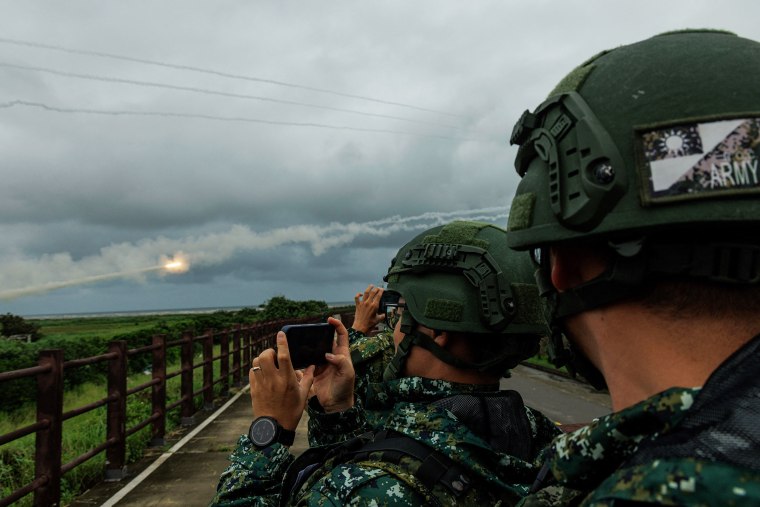 Taiwanese soldiers record footage and look on during an M142 High Mobility Artillery Rocket System (HIMARS) live-fire training exercise in Taichung on Wednesday.Cheng Yu-chen / AFP via Getty Images
The beaches and mud flats on Taiwan‘s west coast, directly facing China across the Taiwan Strait, are seen as the most likely location for an attempted landing by the Chinese military in the event of any invasion.
Taiwan’s military is modernising to enable it to fight an asymmetric war with more mobile weapons that can still pack a punch like the HIMARS, to turn the island into a “porcupine” that is hard to attack and can survive a Chinese assault.
With a range of about 190 miles, HIMARS could strike coastal targets in China’s southeastern province of Fujian on the other side of the Taiwan Strait.
Taiwan test fired its Lockheed Martin-made High Mobility Artillery Rocket Systems, or HIMARS, for the first time last year off its east coast.
Wednesday marked the first time it has fired the precision weapon on the west coast, in central Taiwan‘s Taichung.
The military said the drill was to demonstrate the HIMARS’ mobility and ability to “shoot-and-scoot” — withdrawing after firing to avoid being locked onto by enemy radar — so “greatly improving battlefield survivability”.
“Our HIMARS demonstrated the solid combat capabilities of the unit and successfully completed this training,” company commander Ko Ming-pin said.
HIMARS is one of Ukraine’s main strike systems and has been used multiple times during the war with Russia.
Taiwanese soldiers record footage and look on during an M142 High Mobility Artillery Rocket System (HIMARS) live-fire training exercise in Taichung on Wednesday.Cheng Yu-chen / AFP via Getty ImagesThe beaches and mud flats on Taiwan‘s west coast, directly facing China across the Taiwan Strait, are seen as the most likely location for an attempted landing by the Chinese military in the event of any invasion.
Taiwan’s military is modernising to enable it to fight an asymmetric war with more mobile weapons that can still pack a punch like the HIMARS, to turn the island into a “porcupine” that is hard to attack and can survive a Chinese assault.
With a range of about 190 miles, HIMARS could strike coastal targets in China’s southeastern province of Fujian on the other side of the Taiwan Strait.
The weapon would be used with Taiwan‘s domestically developed Thunderbolt-2000 launchers so Chinese forces could be targeted as they left port or attempted to land on Taiwan‘s coast.
Thunderbolts were fired on the first day of the drill on Tuesday.
Taiwan‘s government rejects China’s sovereignty claims, saying only the island’s people can decide their future.
Thunderbolts were fired on the first day of the drill on Tuesday.
Taiwan‘s government rejects China’s sovereignty claims, saying only the island’s people can decide their future.

No comments:
Post a Comment
Note: Only a member of this blog may post a comment.