Here are five ASC acquisitions and partnerships announced in March 2019:
SCF RC Funding IVpurchased the building housing Little Rock-based Arkansas Maxillofacial Surgery Center for nearly $2.5 million.
Montecito Medical Real Estateclosed on a multiholding medical office building portfolio transaction.
CNL Healthcare Properties II will sell the medical office building housing Orlando, Fla.-based Mid-America Surgery Center to HCP Medical Office Buildings for $15.4 million.
Zhalunglu-MT purchased a 7,365-square-foot surgery center in League City, Texas.
New York City-based Schweiger Dermatology Group acquired the Exton, Pa.-based Dermatology & Skin Surgery Center.
The percentage of surgeries completed in the inpatient setting has dropped since 2005, and analysts expect the decline will continue, according to an Advisory Board report.
A new breed of online health-care startups is testing the boundaries of medical marketing, advertising prescription drugs for unapproved uses to college students with stage fright and men seeking to improve their sexual performance.
Hims Inc. markets sertraline, a generic version of the antidepressant Zoloft, to treat premature ejaculation. “Ending the bedroom fun a little too soon? Sertraline can help treat premature ejaculation so sex can last longer for both you and your partner,” the company said in an Instagram post.
Kick Health, another startup, sells the blood-pressure drug propranolol to treat anxiety, an off-label use. Kick says on its website that the pill can help you “nail the interview,” “speak confidently,” or even “just say hi.”
While some doctors will prescribe the two drugs for those uses, and both drugs have clinical data showing they may help some patients with the conditions, sertraline and propranolol haven’t been cleared by the U.S. Food and Drug Administration for those purposes. With some of their ads, marketing copy and social media posts, the startups are pushing the boundaries of how prescription drugs can be marketed, according to pharmaceutical and legal experts interviewed by Bloomberg.
The Forhims website.
Source: forhims.com
“It’s not clear to me that this is totally kosher,” said Patricia Zettler, a former FDA lawyer and a law professor at Georgia State University.
Under FDA rules, pharmaceutical companies and distributors can’t make claims that haven’t been approved by drug regulators. Known as off-label marketing, the practice has led to hundreds of millions of dollars in fines and legal settlements from companies. Doctors, however, can legally prescribe whatever they want off-label — including using a blood-pressure drug to treat nerves, or an antidepressant for premature ejaculation — even if the FDA hasn’t cleared those uses.
After a new fundraising round in January, San Francisco-based Hims was valued at about $1 billion, according to Pitchbook, a venture capital research firm. Kick, which is also based in San Francisco, declined to say how much it had raised. The companies said that their businesses are platforms, and that it’s up to the doctors they work with to make medical decisions about the drugs they sell.
A Gray Area
The rules for U.S. drug marketing were written at a time when online prescription drug startups didn’t exist. Hims and Kick don’t make drugs, but instead charge patients for a consultation with a doctor through an app or online. They then sell the drug, often a less-expensive generic, to the patient. Their marketing, with cheeky ads on social media and public transportation, touts a variety of pharmaceutical and wellness treatments for men and women, with the ease of never having to step into a medical office.
Whether Hims and Kick are breaking drug-promotion rules may depend on whether they’re selling the services of a physician who can prescribe a drug as they see fit, or whether the startups are directly advertising a prescription drug that comes with benefits and risks.
The Gokick website.
Source: gokick.com
“If you have this third party that has nothing to do with the manufacturer then they can say almost whatever they want,” said Nathan Cortez, a health law expert at Southern Methodist University. But the startups could still get in trouble for things like exaggerating the benefit of a drug, or downplaying the risk. “Legally, there is a gap here and the gap has always been a problem. The gap is between who can who can regulate the practice of medicine, and who can regulate products and manufacturers.”
Kick makes a familiar tech-industry argument: They don’t make the medicine; instead, they’re a platform to connect a service (doctors, who can prescribe what they want) to customers (patients).
“We never touch the drugs. We’re not a distributor,” Kick founder and Chief Executive Officer Justin Ip said in an interview. “I wish it was 100 percent crystal-clear. We’ll see how things go, but we think we’re on the right side of the law. If not, we’ll be happy to adjust.”
The FDA declined to comment on Hims’s and Kick’s marketing. “The FDA works to ensure that prescription drug information communicated by these entities is truthful, non-misleading and accurate. Generally, FDA monitors company promotion and communications regarding prescription drugs through its surveillance operations,” said Nathan Arnold, an agency spokesman.
For patients, the distinction between advertising medical care from a doctor and marketing a drug may not be quite so clear. Hims’s website features a black button urging men to “Buy Propranolol.” Its sister company, which markets to women under the brand Hers, also promotes the drug, and has faced some blowback.
“Nervous about your big date? Propranolol can help stop your shaky voice, sweating and racing heart beat,” Hers said in one social media post. In a March 12 follow-up post, the company said it had pulled the message. “We’ve permanently removed that ad and are working with our medical team to ensure that all copy is safe and accurate for the consumer moving forward.”
Hims said that it’s a platform for doctors, who make the judgment about when it’s medically appropriate to prescribe, not the company.
“Only a licensed physician is in the position to know the risks and benefits of a certain medication and whether it’s the best option for a patient,” Hims said in a emailed statement. “We created the hims and hers platform to help make that conversation possible without judgement or stigmatization.”
Beta-blockers impede the effects of adrenaline, making the heart beat more slowly and reducing blood pressure. That also has the effect of stemming the physical symptoms of anxiety, making the drugs a popular prescription for some people with high-pressure jobs, like concert musicians.
But without conducting clinical trials and gaining FDA approval for the drug to treat anxiety as well, drugmakers aren’t allowed to tout its ability to treat that condition. Side effects of propranolol can include dizziness, weight gain, an irregular heart beat and difficulty breathing, according to the FDA’s label for the medicine.
Zoloft and its generic equivalents belong to a class of drugs known as serotonin-reuptake inhibitors. They’ve been approved to treat depression, obsessive-compulsive disorder and other mood disorders. While there’s clinical data showing they can help with premature ejaculation, the FDA hasn’t approved the use. Zoloft also comes with a warning on its label, saying that in younger patients it can bring on suicidal thoughts and behaviors.
Digital Doctor’s Office
Outside health care, other startups have pushed legal or regulatory boundaries while creating new industries — and won. When Airbnb Inc. and Uber Technologies Inc. began offering lodging and transportation, respectively, both faced efforts by regulators to curtail their businesses even as their popularity grew with consumers. Both are expected to IPO at multibillion-dollar valuations this year.
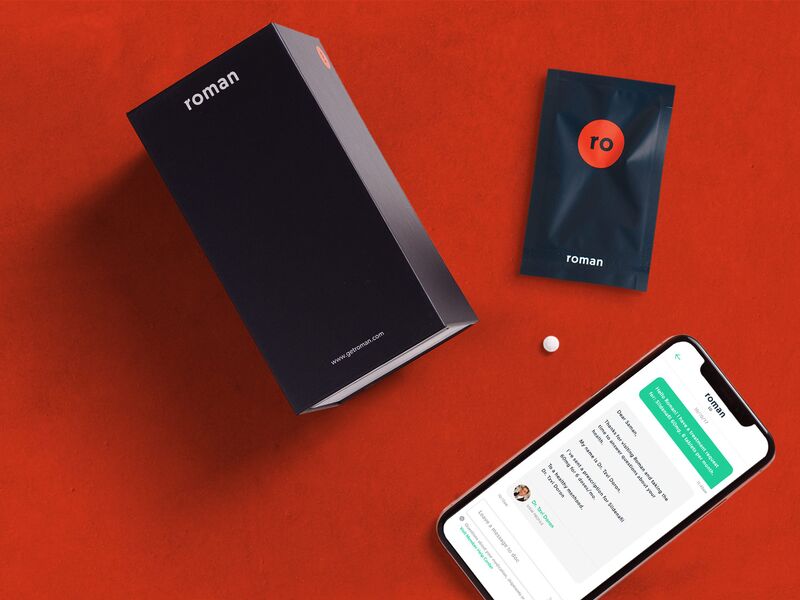
Unlike Kick, which for now only sells propranolol, Hims and another well-funded startup, Roman Health Medical LLC, offer a variety of treatments for many conditions, and have framed themselves as digital doctors’ offices where multiple treatments are available. Roman in its marketing copy advertises treating specific conditions, while Hims more often advertises specific drugs, sometimes noting that the usages are “off-label.”
Sildenafil from Roman
Source: Roman
“If they were saying, ‘We’ll connect you to the best doctors to treat social anxiety, that’s one thing,” said Zettler, the law professor, referring to Kick. “It’s another to say, ‘We’ll connect you to a doctor to prescribe a specific drug, and ship you that drug.’”
In a statement, Roman said that it doesn’t charge patients for a drug before a physician consultation.
Selling a Disease
Nicolas Terry, the director of the Hall Center for Law and Health at Indiana University’s law school, said brands like Kick, with their sleek approach to selling medication, run the risk of “disease mongering,” especially for conditions as common as being nervous about a date or giving a presentation in college.
Kick’s website pitches propranolol as the “insider’s edge to performing anxiety,” and “prescription-strength confidence.” On Hims’ website for propranolol, an image of a bearded, tattooed man reclining in a chair holding an apple appears alongside text saying the drug can help get your mind “in game time mode” when “your body is somewhere else completely.” Hers’s website for propranolol suggests women could take it for help “manifesting your badassery.”
“There is cause for concern here,” Terry said. “What they do is suggest a normal pathology is a sickness.” Terry said he is worried such an approach doesn’t make customers aware of all the risks associated with a prescription.
“Propranolol is old and dirt cheap, but this is an exaggeration of benefits and failure to disclose risk,” he said.
Robert Attaran, a professor of cardiology at the Yale School of Medicine, is listed as an adviser to Kick on the company’s website and consulted with the company before it launched. He said beta blockers are generally safe, low-risk drugs, especially at the doses given for anxiety. But Attaran stressed the need for any online patient to get a full evaluation before receiving a prescription to make sure it’s safe.
“Various technologies are emerging to cut out the middlemen in medicine. It’s a trend that’s coming right or wrong,” Attaran said. “But it can be a slippery slope.”
The easier it becomes for patients to get drugs, he said, the greater the chance something like an underlying medical condition is missed. He said his concerns are greater for a drug like Zoloft than beta blockers.
As antidepressants like Zoloft have become popular as a way to treat premature ejaculation, some doctors have raised concerns that the potential side effects aren’t worth the risk. One 2015 study of other related drugs used for the condition found that 70 percent of men stopped using one medicine, dapoxetine, citing side effects and limited efficacy.
Zettler, the former FDA attorney, said other aspects of these companies’ marketing may also be problematic.
“Is that Instagram ad truthful and non-misleading? If it’s talking about benefits of the drug, it should also should be talking about risks,” she said. “It’s not exactly clear whether in these quasi-direct-to-consumer models if their very beautiful marketing is complying with all of the rules around prescription drugs.”
Antibiotics were one of the 20th century’s most important scientific discoveries, but their usefulness is quickly fading. Overuse has led to bacteria developing resistance to the drugs, which could drive us towards a future where once-simple infections become life-threatening again. Now, researchers at Purdue University have found that blue light can weaken a particularly nasty “superbug” and make it vulnerable to even mild antiseptics again.
Staphylococcus aureus is a common bacteria that’s mostly pretty harmless, but certain strains can cause more problems. Methicillin-resistant Staphylococcus aureus (MRSA) is a particularly troublesome bug that’s most dangerous to people whose immune systems are already compromised, meaning it can wreak havoc in hospitals and retirement homes. Unfortunately it’s getting harder and harder to treat – it’s not just resistant to methicillin as its name suggests, but also an ever-growing list of other common antibiotics.
New antibiotics are in the works, but of course eventually bacteria will inevitably develop resistances to those too. So scientists are trying to find longer-term solutions that superbugs won’t be able to adapt to, such as material surfaces that tear them apart or nanoparticles that produce toxic molecules when triggered by light.
In a similar vein, the Purdue researchers have developed their own form of light therapy. The team found that MRSA can be weakened through “photobleaching” – essentially sapping the color of the bacteria by exposing it to blue light. Since these pigments are part of how the bugs can infect a host, this can reduce their ability to cause harm.
“When you bleach something in the wash machine, you’re extracting the color using chemicals,” says Mohamed Seleem, an author of the study. “What we’re doing here is similar, but we’re using blue light.”
The light itself isn’t killing the MRSA – instead, it lowers its defenses enough for drugs and other molecules to finish it off, even those that the bugs would normally be resistant to. In tests on mice with MRSA-infected wounds, the researchers found that mild antiseptics like hydrogen peroxide were effective at destroying bacteria weakened by blue light.
The team has patented a device that uses this technology to treat MRSA-infected wounds. The idea is that it would take the form of a small box with a light in it, which shines through a hole onto the wound. Importantly, the light has been found to be safe on mammalian cells.
“This new tool can treat any superficial wound infected with MRSA, which are typically very difficult to treat,” says Seleem. “The device itself is very small and easy to use. We’re hoping that in the next few years, anyone could carry it around in their purse.”
The first quarter of 2019 started off strong with 17 digital health mergers and acquisitions, including five over the course of two days at the end of February. The quarter’s acquisitions included moves by ClassPass and Teladoc to bolster emerging international businesses with the acquisitions of GuavaPass and Médecin Direct, respectively, as well as a number of consolidation deals in niche digital health markets, such as AbleTo’s acquisition of Joyable. Still others represented novel synergies between similar but distinct companies, like Crossover Health’s purchase of Sherpaa. Finally, we saw another major private equity deal as Qualcomm divested itself of its Qualcomm Life business.
Read on for 17 digital health mergers and acquisitions from Q1 2019. And let us know if we missed one — we’ll update this article. As usual, they’re ordered first by price tag, with the undisclosed deals sorted chronologically.
Remote patient monitoring company BioTelemetry announced in January plans to acquire startup Geneva Healthcare, maker of remote monitoring for implantable cardiac devices, for $45 million in upfront cash with additional performance-based earn-out considerations of no less than $20 million.
Biotelemetry will gain access to Geneva’s cloud-based platform, which has the ability to aggregate data from device manufacturer systems. This gives physicians a platform to remotely keep track all of their patients that have implantable cardiac devices such as pacemakers, defibrillators and loop recorders, while also providing the doctors with the results of routine checks and monitoring.
New York-based startup AbleTo acquired fellow virtual mental health startup Joyable for an undisclosed sum in the tens of millions.
As part of the deal, AbleTo users will gain access Joyable’s mental health coaching app. AbleTo connects it users with a nationwide network of behavioral health providers, who use the company’s structured treatment protocols to treat the user’s condition. Currently it has 600 therapists and coaches in its network. The companies said that by combining its products, it will be able to expand its services.
Online fitness membership platform ClassPass acquired GuavaPass, a similar competing service active in Asia and the Middle East, for $4.2 million. Along with ClassPass assuming control of GuavaPass’s operations, GuavaPass CEO Jeffrey Liu, President Rob Pachter and a number of GuavaPass employees will be joining ClassPass. Both services allow users to pay a single subscription price for access to local classes for yoga, cycling, Pilates and other workouts using a mobile app.
Medical messaging company Medici announced the acquisition of Chiron Health, an Austin-based telehealth company.
Medici is a medical communication tool that lets patients communicate with multiple providers. The system was designed so that a user could not only have his or her providers on the system but also their loved ones physicians, for example their child’s pediatricians. This new acquisition will give Medici access to Chiron Health’s platform, which was designed to facilitate provider-patient video visits. Those visits can be uploaded to five compatible EHR systems. The HIPAA compliant system caters to physician-run practices. The plan is to integrate Chiron’s capabilities, as well as its full team into Medici’s current system.
Clinical information tool EBSCO Health announced the acquisition of HealthDecision, a clinical decision support and shared decision making tool for clinicians and patients. As part of the deal EBSCO Health will get HealthDecision’s educational resources, which includes a visual representation of medical outcomes. The tools were designed to help facilitate provider-patient conversations around treatment plans.
PerfectServe, a Tennessee-based medical communication and collaboration platform, announced two acquisitions in the digital health space. The first is CareWire, which is a mobile patient communication platform. The second is Lightning Bolt Solutions, an artificial intelligence-run physician shift scheduling technology designed for hospital and healthcare system. PerfectServe said that the new acquisitions will help “the company’s strategy to unify the entire care team across the continuum, from inpatient, to outpatient, to patients at home.”
Private equity firm Francisco Partners acquired Qualcomm Life, the Qualcomm subsidiary focused on medical device connectivity. The terms of the acquisition were not disclosed. Qualcomm Life will spin out as a new company under the name Capsule Technologies — the name of a clinical data management company that Qualcomm acquired in 2015. The new Capsule Technologies will continue to use the Capsule and 2net brands for its medical device connectivity offerings.
“FP’s acquisition will help Qualcomm Life (now CapsuleTech) continue to deliver market leading products and services to its world class customer base,” Rick Valencia, former president of Qualcomm Life, said in a statement.
Crossover Health, which provides medical services to large employers, Apple and Facebook among them, acquired Sherpaa, an asynchronous telehealth company that has also mostly focused on serving employer populations. The terms of the deal were not disclosed, but Sherpaa founder Dr. Jay Parkinson and his team will all become part of Crossover Health.
For Crossover Health, founded in 2010, the move to buy Sherpaa is an effort to address the changing nature of workforces, which are rarely anymore concentrated in one or even a handful of cities. With Sherpaa’s technology, Crossover Health will be able to offer a tiered system that provides in-person care to employees at a central site and comparable virtual care to remote employees.
CareLinx, a digital health company focused on in-home care, acquired Optimal Aging, a fledgling startup still being incubated at Providence St. Joseph Health. The terms of the deal were not disclosed.
Optimal Aging is a program that coordinates non-clinical services like home care, transportation and meal support for accountable care organizations and Medicare Advantage Plans. The program actually incorporates CareLinx’s technology, and has since its Seattle-area launch in 2016.
Guidewell Connect, a consumer engagement company that shares a parent company (Guidewell) with health insurer Florida Blue, acquired Onlife Health, a health and wellness technology platform, from Blue Cross Blue Shield of Tennessee and Cambia Health Solutions. The terms of the deal were not disclosed.
Onlife offers member engagement services that include wellness and chronic condition management programs, via both its My Journey app and other non-digital modalities. Post-acquisition, Onlife will be available to health plan and employer clients in 19 states, according to a statement from the companies. Guidewell intends to keep Onlife’s management intact. It will become a subsidiary of Guidewell Connect.
Healthcare software and services company WellSky (previously known as Mediware) announced yesterday the acquisition of Health Care Software (HCS), which specializes in clinical and financial software for long-term care settings. The terms of the deal were not disclosed. Although HCS will keep its New Jersey office and continue operations, the company will gradually transition into the WellSky brand.
According to WellSky, the acquisition provides the company with new analytics and care management tools, which will allow it to pursue new market opportunities as well as increase its offerings for existing clients.
Interoperable health IT company Medsphere Systems Corporation announced that it is set to acquire Wellsoft, a company that specializes in ED information systems. As part of the deal Medsphere will be acquiring Wellsoft’s signature product, the Emergency Department Information Systems (EDIS), which is targeted at improving workflow in EDs and urgent care centers.
Medsphere plans to create a comprehensive platform for urgent care centers that will employ the technology from Wellsoft as well as Medsphere’s RCM Cloud revenue cycle suite.
Senior-focused EHR and health software company PointClickCare Technologies acquired post-acute care management company QuickMar.
As part of the deal, PointClickCare will control QuickMar’s signature product, the CareSuite Manager. The system includes an EHR and electronic medication administration record (eMAR) that is targeted at post-acute care centers. The system has the ability to manage assessments, care plans, resident billing, behavioral management and charting notes.
Zoll Medical Corporation, the medical device and software company that makes the LifeVest wearable defibrillator acquired patient charting and revenue cycle management company Golden Hour.
The companies, which both offer charting and services related to the emergency medical services market, will now be able to combine their efforts. Zoll Medical has so far focused on working with larger operations, while Golden Hour has focused on a smaller organization. This acquisition will give the former the opportunity to work with EMS agencies of all sizes.
Earlier in the quarter, Zoll also acquired Payor Logic a patient receivable and insurance discovery company for providers. Both deals had undisclosed terms.
Teladoc Health has announced another acquisition that will bolster its growing international line of business. The US virtual care company will acquire Paris, France-based MédecinDirect, which provides confidential medical consultations via phone and internet. The terms of the acquisition were not disclosed, but Teladoc said “the acquisition will be immaterial to Teladoc Health’s financial results.”
MédecinDirect will become the French office of Teladoc, which now operates in the UK, Australia, Canada, Spain, Portugal, Hungary, China, Chile and Brazil in addition to the United States. What MédecinDirect offers Teladoc Health is a large existing client base that will give the company a comfortable foothold in a new country. Existing MédecinDirect customers will gain access to the full range of Teladoc services.
The CMS finalized a rule on Friday that would give Medicare Advantage plans more flexibility to offer additional telehealth services to seniors as part of their basic benefits package starting in 2020.
The rule, proposed in October 2018, allows seniors to use telehealth services in their homes, rather than being required to go to a healthcare facility.
While previously Medicare Advantage plans could include additional telehealth services only as a supplemental benefit to be paid for with rebate dollars or enrollee premiums, they will now be able to include telehealth as a basic government-funded benefit beyond what the original Medicare program offers. The change was called for by the Bipartisan Budget Act of 2018.
“Today’s policies represent a historic step in bringing innovative technology to Medicare beneficiaries,” CMS Administrator Seema Verma said in the announcement. “With these new telehealth benefits, Medicare Advantage enrollees will be able to access the latest technology and have greater access to telehealth.”
The CMS also said it is streamlining grievance and appeals process for patients enrolled in certain dual-eligible special needs plans and affiliated Medicaid managed care plans, as required by the Bipartisan Budget Act.
And to better integrate benefits for dual-eligible patients, the CMS is finalizing a new minimum criteria for Medicare and Medicaid integration in the so-called D-SNPs starting in 2021. It will require D-SNPs to either cover Medicaid long-term services and supports or behavioral health services through a capitated payment from a state Medicaid agency, or D-SNPs will have to notify a state Medicaid agency of its hospital and skilled nursing facility admissions for a group of high-risk, full-benefit dual-eligibles.
The CMS did not address in the final rule a dramatic change to the way it audits Medicare Advantage plans, given it extended the comment period to April 30. But it notes it will address the audits in later rulemaking.
In the October proposal, the agency also told insurers it wants to start recouping payments to Medicare Advantage plans based on a risk-adjustment data validation audit methodology proposed back in 2012. Under that methodology, the CMS would extrapolate the results of an audit of a sample of enrollees across the entire plan population, which could dramatically increase the recoupments of improper payments to plans.
Within healthcare, ambulatory healthcare services assumed its usual position as the top hirer, adding 27,000 jobs in March, up 27% from February. Home healthcare services reported the most job growth within the ambulatory sector, adding 8,000 jobs, a 70.2% spike from February. Physicians’ offices boosted their numbers by 7,000 jobs, up 126% over the prior month, and dentists’ offices added 5,100 jobs, up 96%.
Hospitals added 13,600 jobs in March, up more than 220% from February, a month in which hospital hiring was weak.
Nursing and residential care facilities added 8,500 jobs in March, up significantly from just 1,100 new jobs in February. Within that sector, community care facilities for the elderly added 3,800 jobs, a vast improvement from February in which it shed 500 jobs.
The overall U.S. unemployment rate remained at 3.8% in March, and total nonfarm payroll employment grew by 196,000 jobs.
Healthcare, which grew by 398,000 jobs over the past 12 months, added more jobs in March than professional and technical services, which added 34,000 jobs. Employment in food services and drinking places trended up last month, adding 27,000 jobs. Construction employment changed little in March, adding 16,000 jobs. Computer systems design added 12,000 jobs during the month.