The average gym membership costs about $700 annually. Walmart’s is a lot cheaper.
The retailer, which brought in $514 billion in revenue in 2019, announced
it’s rolling out gym memberships to its 1.5 million U.S. employees and
their families starting a $9 a paycheck, which is about $234 a year
based on 26 paychecks annually.
A Walmart spokesperson confirmed to FOX Business that employees are paid bi-weekly.
Users can visit Walmart’s gym page to find access to 9,000 facilities in all 50 states.
“We’re committed to providing associates and their families
access to high-quality medical coverage along with tools and resources
to manage their health and well-being,” Senior Vice president of U.S.
Benefits Adam Stavisky said in a statement “The Walton Life Fitness Pass
is another example of how we’re working to help our associates and
their families.”
Walmart’s gesture is not uncommon for big companies that want to keep their employees happy. Earlier this week, airline Delta announced it would give its 90,000 employees a bonus worth about two months’ salary on Valentine’s Day, a total value of $1.6 billion.
Walmart’s stock is up more than 17 percent on the year. https://www-foxbusiness-com.cdn.ampproject.org/c/s/www.foxbusiness.com/lifestyle/walmart-debuts-gym-memberships-for-a-9-a-paycheck.amp
Eight Chinese city governments announced on Jan. 23 that they have initiated a quarantine to curb the outbreak of a new type of viral pneumonia.
Major sightseeing locations were also shut down by local authorities
to avoid mass gatherings of people as the disease, caused by a new
strain of coronavirus, continues to spread.
Meanwhile, five more provinces announced their first diagnosed
cases—meaning the only regions that remain free of the disease are
Qinghai and Tibet.
We are now seeing second and third generation spread,” Dr. David
Heymann, assistant director-general for Health Security and Environment
at the World Health Organization (WHO), told CNN on Thursday.
Heymann explained that patients infected after handling animals at the fresh food market in Wuhan
that is linked to the outbreak belong to the first generation. Patients
who were infected through contact with an initial patient, belong to
the second or third generation.
Heymann warned that now the virus can spread through contact with an infected person who is sneezing or coughing.
Quarantined Cities
The central Chinese city of Wuhan, where the outbreak started in
December, has 11 million residents. Beginning at 10 a.m. Thursday local
time, the city was under lockdown,
with all public transportation, including subways, ferries, and
intercity buses suspending operations. The city’s airports and train
stations were also closed.
A few hours later, governments of nearby cities within Hubei
Province—Huanggang, Ezhou, Chibi, Zhijiang, Xiantao, Lichuan, and
Qianjiang—also announced their quarantines.
Huanggang City health authorities said that all theaters, internet bars, indoor entertainment sites, and resorts will also be closed.
Also on Thursday, the Hubei provincial education bureau announced that it would postpone the start of the new school term for all primary and middle schools in the province.
Closings
Worried that the virus can easily spread in crowded places, local governments around China also closed down famous tourist sites.
In the capital Beijing, the administrators of Forbidden City announced that the museum will be closed indefinitely beginning on Jan. 25.
Near Beijing, the Tanzhe and Jietai temples; Miaofeng Mountain, a Taoist site of worship; and other tourist sites would also be closed beginning Jan. 24.
During the Lunar New Year festivities, when the entire country goes
on public holiday from Jan. 24 to Jan. 30, people often go to temples to
burn incense and wish for good luck in the new year.
Hangzhou is the capital city of Zhejiang Province, a scenic town and
one of China’s hottest tourist destinations. On Jan. 23, the city
government announced that all major sightseeing locations, temples, and museums would be closed from Jan. 24.
On the same day, the Central Academy of Fine Arts in Beijing and Shanghai University announced
that due to the new disease, college entrance examinations for
prospective students that were planned for February would be postponed.
The schools said they will notify students when they decide on a future
date. https://www.theepochtimes.com/chinese-authorities-shut-down-schools-tourist-sites-as-viral-pneumonia-spreads-to-nearly-all-parts-of-china_3214253.html
The Food and Drug Administration issues a warning
to healthcare providers and facilities over cybersecurity
vulnerabilities in certain electronic health care data equipment made by
General Electric (NYSE:GE) that may introduce risks to patients while being monitored.
The flaw affects some GE Healthcare Clinical
Information Central Stations and Telemetry Servers, which are used
mostly for monitoring patient data such as temperature, heartbeat, blood
pressure and patient status, typically from a central location in a
facility such as a nurse’s workstation.
The vulnerabilities could “allow an attacker to
remotely take control of the medical device and to silence alarms,
generate false alarms and interfere with alarms of patient monitors
connected to these devices,” the FDA says.
Many Medicare patients with new episodes of low back pain receive care inconsistent with current guidelines – including high use of opioids and advanced imaging tests, reports a study in the February issue of Medical Care. The journal is published in the Lippincott portfolio by Wolters Kluwer.
Opioids are prescribed to nearly one-third of older adults with “new
and persistent” Low Back pain – in most cases without trying
guideline-recommended pain medications or physical therapy, according to
the new research by Dan Pham Ly, MD, MPP, of Harvard University. He
comments, “This study raises concerns about excessive use of low-value
and potentially harmful treatments for the common problem of LBP in
older adults, with under-use of evidence-based, guideline-recommended
treatments.” Many Medicare Patients Don’t Receive Evidence-Based Treatments for New LBP
The study used Medicare claims data on more than 162,000 older adults
with new LBP from 2011 through 2014. About 70 percent of patients were
women; average age was approximately 77. None had received previous
opioid treatment. The analysis included information on multiple visits
for LBP over the course of a year, providing data on the timing and
sequence of care.
Over half of patients (54 percent) made only one healthcare visit for
LBP. That’s consistent with evidence that many new episodes of LBP are
self-limiting. As stated in the current American College of Physicians guidelines, most patients with LBP “improve over time regardless of treatment.”
Advanced imaging studies – computed tomography (CT) or magnetic
resonance imaging (MRI) scans – were used in about 15 percent of
patients overall, and 29 percent of those with two or more LBP visits.
In about half of cases, CT or MRI scans were performed within six weeks.
That’s contrary to an American Academy of Family Physicians statement that most patients don’t need advanced imaging studies for initial evaluation of LBP.
Opioids were prescribed to about one-fourth of patients overall,
including one-third of those with two or more LBP visits. In contrast,
LBP guidelines suggest that other pain relievers – including
nonsteroidal anti-inflammatory drugs (NSAIDs), such as naproxen or
ibuprofen – should be tried before opioids.
Physical therapy was prescribed to only 11 percent of patients
overall and 17 percent of those with two or more visits. Evidence
suggests that early use of physical therapy can avoid the use of opioids
in patients with LBP.
Most patients treated with opioids had not received a prescription
NSAID or physical therapy. Chronic opioid use developed in about one
percent of patients overall, and nearly two percent of those with two or
more visits.
Low back pain is a common reason for healthcare visits – in a given
year, about ten percent of people will develop a new episode of LBP.
Studies examining trends in LBP treatment found increasing use of
opioids, and decreased use of NSAIDs, up to 2010. The new analysis
focused on more recent patterns in evaluation and treatment of LBP in
Medicaid patients, including data on repeated visits over one year.
“Many patients who develop new LBP receive guideline non-concordant
care such as early advanced imaging and opioids before other modalities
like PT and prescription NSAIDs,” Dr. Ly writes. At least in the first
half of the past decade, one-third of patients making two or more LBP
visits received opioids – often without having tried other recommended
treatments.
Dr. Ly calls for future studies examining barriers to
guideline-recommended treatments for LBP in older adults – particularly
physical therapy and NSAIDS. He also points out that pain management can
be challenging in older adults, highlighting the need for studies to
compare the safety and effectiveness of medication options.
Officials in Texas
are investigating a suspected case of 2019 Novel Coronavirus, the virus
that’s hit China and spread to multiple other countries.
The patient is a student at Texas A&M. The male patient traveled
from Wuhan, the city at the epicenter of the outbreak, within the past
14 days.
“Health care providers were aware of public health guidance on novel coronavirus
and quickly recognized that the patient met the criteria for
coronavirus testing and is being kept isolated at home, while the
precautionary testing is done,” the Brazos County Health Department said
in a statement.
“If there is a confirmed case, we will promptly announce it.”
At a press conference Thursday afternoon, Dr. Eric Wilke of the
department said that the patient is “self-isolated.” Asked if the
student lives on campus, the official declined to answer. The student
likely attended classes before being isolated. It was not clear how many
people he’d been in contact with.
The patient “is doing well” and “was doing well last night,” he
added. Health officials consider the patient, who is between 20 and 30
years old, low risk.
The department urged people who traveled to Wuhan to call authorities
or seek medical care if they develop flu-like symptoms like fever,
coughing, shortness of breath, and a sore throat.
People should call their healthcare provider before traveling to get medical care, the district said.
Brazos County, which has a population of around 225,000, sits south of Dallas between Austin and Houston in southeast Texas.
The first confirmed case of the 2019 Novel Coronavirus was confirmed
this week in Washington State, federal officials said. The patient
recently returned from Wuhan and sought treatment at a medical facility. A
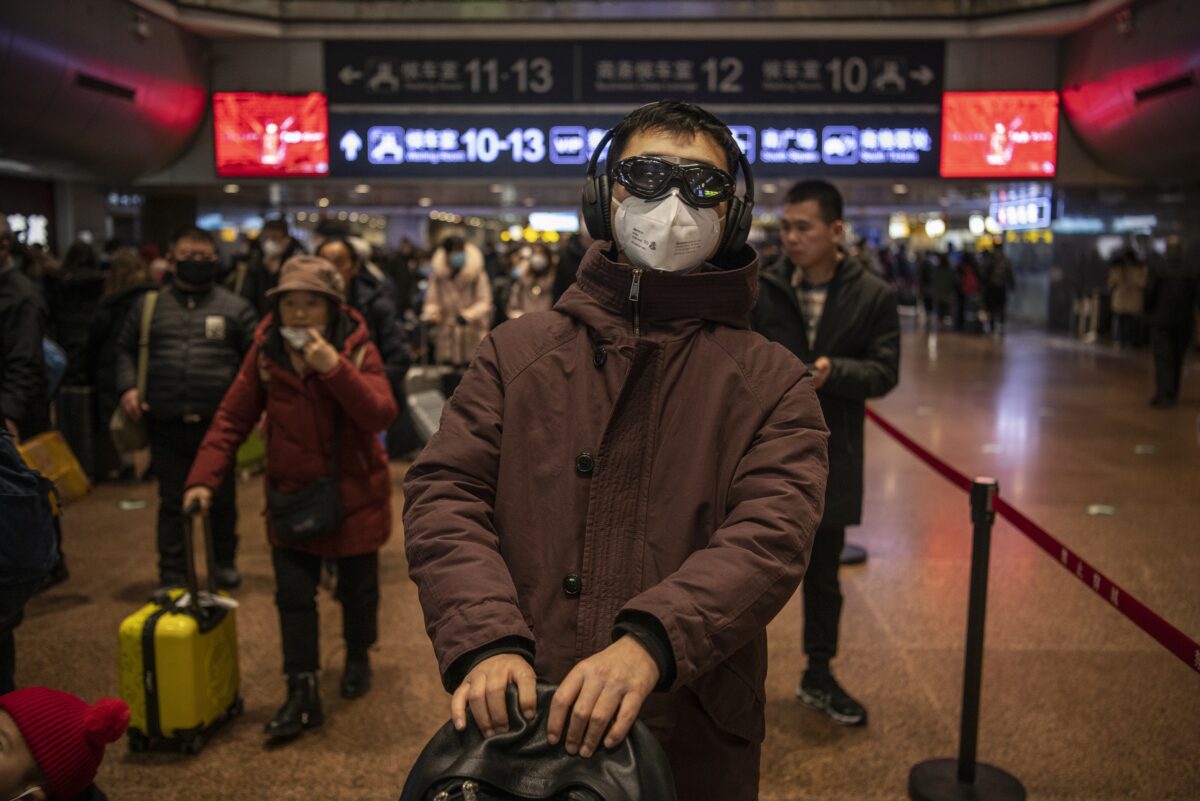
Chinese man wears a protective mask and glasses before boarding a train
at a railway station in Beijing, China on Jan. 23, 2020. (Kevin
Frayer/Getty Images)
“While originally thought to be spreading from animal-to-person,
there are growing indications that limited person-to-person spread is
happening. It’s unclear how easily this virus is spreading between
people,” the Centers for Disease Control and Prevention (CDC) said in a
statement about the first confirmed case.
A person who flew into Los Angeles
on Wednesday and displayed symptoms of an illness potentially
resembling coronavirus and was sent a hospital for precautionary testing
Thursday.
Later on Thursday, U.S. authorities told people to avoid traveling to Wuhan.
“There is an ongoing outbreak of respiratory illness caused by a
novel (new) coronavirus that can be spread from person to person,” the
CDC said in a travel notice.
“Chinese officials have closed transport within and out of Wuhan,
including buses, subways, trains, and the international airport.
Preliminary information suggests that older adults and people with
underlying health conditions may be at increased risk for severe disease
from this virus.”
The agency did not say to avoid nonessential travel to other parts of China.
The World Health Organization (WHO) said at a press conference
Thursday that the coronavirus is not yet a global health emergency,
though it is one inside of China.
“Make no mistake. This is an emergency in China, but it has not yet
become a global health emergency,” said Dr. Tedros Adhanom Ghebreyesus,
the head of WHO, at the press conference.
“I am not declaring a public health emergency of international concern today,” he added.
Eighteen people have died from the coronavirus, all inside of China.
Hundreds of others have been infected, with cases cropping up in Japan,
South Korea, Thailand, Singapore, Vietnam, Hong Kong, and Taiwan, in
addition to the United States and China. https://www.theepochtimes.com/texas-officials-investigating-suspected-case-of-coronavirus_3214031.html
Bayer (OTCPK:BAYRY+4%)
shares rallied into the close on headlines that the company is in talks
to settle cancer cases involving its Roundup weedkiller for $10B.
Mediator Ken Feinberg said last week that he was “cautiously optimistic that a settlement will ultimately be reached.”