Search This Blog

Sunday, August 9, 2020

U.S. health chief arrives in Taiwan on trip condemned by China

U.S. Secretary of Health and Human Services Alex Azar arrived in Taiwan on Sunday as the highest-level U.S. official to visit in four decades, a trip condemned by China which claims the island as its own, further irritating Sino-U.S. relations.
Washington broke off official ties with Taipei in 1979 in favour of Beijing. The Trump administration has made strengthening its support for the democratic island a priority, and boosted arms sales.
Beijing, already arguing with Washington over everything from human rights and trade to the handling of the coronavirus pandemic, has threatened unspecified countermeasures to Azar’s visit. China considers Taiwan a wayward province, to be brought under its control by force if needed.
Azar arrived at Taipei’s downtown Songshan airport on a U.S. government aircraft late in the afternoon, and was met by Brent Christensen, the de facto U.S. ambassador to Taiwan, and by Taiwan Deputy Foreign Minister Tien Chung-kwang.

In accordance with COVID-19 rules, there were no handshakes and all officials wore masks, including Azar, as seen in images broadcast live on Taiwanese television.
Azar is coming to strengthen economic and public-health cooperation with Taiwan and support Taiwan’s international role in fighting the pandemic.
On Monday he will sign a health cooperation memorandum of understanding with Taiwan’s government and visit Taiwan’s Centres for Disease Control.
He is also scheduled to meet President Tsai Ing-wen during his visit.
Azar and his team had to be tested for the coronavirus before and upon arrival. They will have to wear face masks throughout their visit and practice social distancing.
Taiwan’s early and effective steps to fight the disease have kept its case numbers far lower than those of its neighbours, with 480 infections, including seven deaths. Most cases have been imported.
The United States has had more coronavirus cases and deaths than any other country, and the wearing of masks has become a heated political issue, with some people objecting to what they see as an infringement of personal freedom.

Boosting immune system a potential treatment strategy for COVID-19

As the COVID-19 pandemic continues to claim lives around the world, much research has focused on the immune system’s role in patients who become seriously ill. A popular theory has it that the immune system gets so revved up fighting the virus that, after several days, it produces a so-called cytokine storm that results in potentially fatal organ damage, particularly to the lungs.
But new findings from a team of researchers led by scientists at Washington University School of Medicine in St. Louis point to another theory and suggest that become ill because their immune systems can’t do enough to protect them from the virus, landing them in intensive care units. They suggest that boosting immunity could be a potential treatment strategy for COVID-19.
Such a strategy has been proposed in two recently published papers, one published online in JAMA Network Open and the other published online in the journal JCI Insight.
“People around the world have been treating patients seriously ill with COVID-19 using drugs that do very different things,” said senior investigator Richard S. Hotchkiss, MD, professor of anesthesiology, of medicine and of surgery. “Some drugs tamp down the immune response, while others enhance it. Everybody seems to be throwing the kitchen sink at the illness. It may be true that some people die from a hyperinflammatory response, but it appears more likely to us that if you block the too much, you’re not going to be able to control the virus.”
The Washington University researchers have been investigating a similar approach in treating sepsis, a potentially fatal condition that also involves patients who simultaneously seem to have overactive and weakened immune systems.
Hotchkiss points to autopsy studies performed by other groups showing large amounts of present in the organs of people who died from COVID-19, suggesting that their immune systems were not working well enough to fight the virus. His colleague, Kenneth E. Remy, MD, the JCI Insight study’s first author, compares efforts to inhibit the immune system to fixing a flat tire by letting more air out.
“But when we actually looked closely at these patients, we found that their tires, so to speak, were underinflated or immune-suppressed,” said Remy, assistant professor of pediatrics, of medicine and of anesthesiology at Washington University. “To go and poke holes in them with because you think they are hyperinflated or hyperinflamed will only make the suppression and the disease worse.”
After gathering blood samples from 20 COVID-19 patients at Barnes-Jewish Hospital and Missouri Baptist Medical Center in St. Louis, the researchers employed a test to measure the activity of immune cells in the blood. They compared the blood of those patients to 26 hospitalized sepsis patients and 18 others who were very sick but had neither sepsis nor COVID-19.
They found that the COVID-19 patients often had far fewer circulating immune cells than is typical. Further, the immune cells that were present did not secrete normal levels of cytokines—the molecules many have proposed as a cause of organ damage and death in COVID-19 patients.
Instead of trying to fight the infection by further interfering with the production of cytokines, they tried a strategy that has been successful in previous studies they have conducted in sepsis patients.
Hotchkiss and Remy collaborated with researchers in a small study conducted in seriously ill COVID-19 patients who were hospitalized in Belgium. In that study, which was reported on in the JAMA Network Open paper, the COVID-19 patients were treated with a substance called interleukin-7 (IL-7), a cytokine that is required for the healthy development of immune cells.
In those patients, the researchers found that IL-7 helped restore balance to the immune system by increasing the number of immune cells and helping those cells make more cytokines to fight infection.
The research did not demonstrate, however, that treatment with IL-7 improved mortality in COVID-19 patients.
“This was a compassionate trial and not a randomized, controlled trial of IL-7,” Remy explained. “We were attempting to learn whether we could get these working again—and we could—as well as whether we could do it without causing harmful effects in these very sick patients—and there were none. As this was an observational study involving a small number of patients who already were on ventilators, it wasn’t really designed to evaluate IL-7’s impact on mortality.”
Studies focused on boosting immunity and improving outcomes among the sickest COVID-19 patients are just getting underway in Europe, and similar trials are starting in the U.S., including at Washington University.
Hotchkiss said that finding ways to boost the should help not only in COVID-19 patients but when the next pandemic arises.
“We should have been geared up and more ready when this pathogen appeared,” he said. “But what Ken and I and our colleagues are working on now is finding ways to boost the immune system that may help people during future pandemics. We think if we can make our immune systems stronger, we’ll be better able to fight off this coronavirus, as well as other viral and bacterial pathogens that may be unleashed in the future.”
More information: Kenneth E. Remy et al. Severe immunosuppression and not a cytokine storm characterize COVID-19 infections, JCI Insight (2020). DOI: 10.1172/jci.insight.140329
Pierre Francois Laterre et al. Association of Interleukin 7 Immunotherapy With Lymphocyte Counts Among Patients With Severe Coronavirus Disease 2019 (COVID-19), JAMA Network Open (2020). DOI: 10.1001/jamanetworkopen.2020.16485

Pediatric Covid admissions with open schools in 2 first months of the pandemic

According to the United Nations Educational, Science and Cultural Organization, 194 countries had implemented country‐wide school closures by April 1, 2020, in an effort to combat the COVID‐19 pandemic. It is estimated that those closures affected 91.3% of students across the globe. However, Sweden adopted a different approach to the strict lockdowns imposed elsewhere and day‐care centres and schools for children up to 15 years of age remained open. The strategic decision to shift schools to distance learning only for children aged 16 years and older was influenced by multiple factors, including the potential impact on school closures on the availability of the healthcare workforce, the increasing evidence of mainly mild infections among children and the potential negative consequences of school closures for younger children.
While it appears that most children get mild symptoms if they become infected with the severe acute respiratory syndrome coronavirus 2 (SARS‐CoV‐2),1 there have been concerns that they may present with high viral loads and contribute to asymptomatic transmission.2 In addition, the number of admissions could exceed the available paediatric hospital care resources.3 Because many Swedish schools have remained open during the pandemic, there is a unique opportunity to assess the impact of this strategy on the incidence and severity of paediatric admissions.
We carried out a two‐month review of paediatric admissions aged 0‐17 years who tested positive for SARS‐CoV‐2 in the Stockholm region, where approximately 514 000 (24%) of all Swedish children live. This covered March 13, when local transmission was announced, until May 14. We included children of all age groups to allow for comparison of admissions between children who remained in school and teenagers who were affected by school closures. During the study period, a nasopharyngeal sample was collected from close to all paediatric hospital admissions, regardless of why they had been hospitalised, and these were analysed using real‐time reverse transcriptase‐polymerase chain reaction assays for the SARS‐CoV‐2. The patient files were reviewed to identify children who were positive for the virus and to collect data on their background characteristic, the symptoms they presented with, any concurrent illnesses and their outcomes. Ethical approval to conduct the study was obtained from the Central Ethical Research Board in Sweden (EPM #2020‐02487), and a waiver of informed consent was provided because of the minimal risk of the study.
A total of 63 admitted children aged 0‐17 years tested positive for SARS‐CoV‐2 during the study period. Thirty had a primary COVID‐19 diagnosis, corresponding to 0.7% of all admissions due to COVID‐19 in the region. Fourteen children were admitted with another concurrent illness, and 19 children were incidentally found to be SARS‐CoV‐2‐positive, that is the reason for their admission was a non‐infectious cause. The cumulative incidence for hospitalisation with a non‐incidental diagnosis of COVID‐19 among children was nine per 100 000 children. This compares to 230/100 000 hospitalised and 99/100 000 deaths due to COVID‐19 among the adult population in Stockholm (n ≈ 1.84 million) during the same time period.
Table 1 provides an overview of the characteristics of the 63 children. This shows that 39/63 (62%) presented with fever and 32/63 (51%) had respiratory symptoms. We found that four children (6%) required oxygen treatment and one patient with immunosuppression was admitted for intensive care but was never intubated. Infants represented more than half of all symptomatic admissions (16/30, 53%), whereas the proportion of all SARS‐CoV‐2‐positive admitted children aged 16‐18 (10/63, 16%), for whom schools have been operating on distance, were similar to proportions of children aged 1‐5 years (11/63, 17%).
TABLE 1. Characteristics of paediatric admissions in Stockholm region, Sweden, from March 13, to May 14, 2020, based on COVID‐19 diagnosis categories
Number (%)
Primary diagnosis (n = 30)Secondary diagnosis (n = 14)Incidental diagnosis (n = 19)Total COVID‐19 cases (N = 63)
Age
<1 y16 (53)4 (29)1 (5)21 (33)
1‐5 y4 (13)2 (14)5 (26)11 (17)
6‐15 y6 (20)6 (43)9 (47)21 (33)
16‐18 y4 (13)2 (14)4 (21)10 (16)
Median age, years0.57.69.44.7
Gender
Female9 (30)8 (57)9 (47)26 (41)
Chronic illness9 (30)5 (36)11 (58)25 (40)
Asthma3 (10)003 (5)
Haematological/oncological3 (10)1 (7)7 (37)11 (17)
Neurological and multiple3 (10)2 (14)2 (11)7 (11)
Other02 (14)2 (11)4 (6)
Symptom presentation
Asymptomatic01 (7)10 (53)11 (17)
Symptomatic30 (100)13 (93)9 (47)52 (83)
Fever27 (90)7 (50)5 (26)39 (62)
Respiratory22 (73)4 (29)6 (32)32 (51)
Gastrointestinal9 (30)6 (43)1 (5)16 (25)
Hyperinflammationaa Two children with hyperinflammation were admitted during this period: one was only positive for SARS‐CoV‐2 antibodies and is not included in this Table.1 (3)001 (2)
Seizures3 (10)2 (14)05 (8)
Treatment
Oxygen4 (13)004 (6)
Non‐invasive respiratory support3 (10)003 (5)
Intensive care1 (3)001 (2)
Outcome
Recovered30 (100)13 (93)19 (100)62 (98)
Deaths01 (7)01 (2)
  • a Two children with hyperinflammation were admitted during this period: one was only positive for SARS‐CoV‐2 antibodies and is not included in this Table.
Hyperinflammation occurred in one child who has recovered well on follow‐up assessments. One infant with a severe underlying condition arrived at the hospital with cardiac arrest and died after a short history of gastrointestinal illness. The child subsequently tested positive for SARS‐CoV‐2. As three other pathogens were also identified in post‐mortem samples—Streptococcus salivarius and Staphylococcus aureus in blood culture and Klebsiella pneumoniae in nasopharyngeal swab—it is unclear to what extent the SARS‐CoV‐2 infection affected the outcome of this child.
Paediatric admissions accounted for a minor part of the total admissions due to COVID‐19 as a primary diagnosis during the first two months of the pandemic in Stockholm (30/4347, 0.7%). In line with previous research, most children with a primary diagnosis of COVID‐19 were less than one year of age and fever and respiratory symptoms were common, but not universal, symptoms.4
Overall, our results point towards a low incidence of severe illness due to COVID‐19 among Swedish children, even though day‐care centres and primary schools remained open. This suggests that the Swedish strategy did not aggravate the course of the pandemic for children in Sweden, when it is compared to countries with stricter lockdown measures.4 However, the impact on the open school strategy on the overall transmission of SARS‐CoV‐2 within the Swedish society is unknown. The potential degree of SARS‐CoV‐2 transmission from children to the adults and its consequences for adult hospitalisations and deaths is beyond the scope of this report.
Continued assessment of hyperinflammation and other late‐onset complications in children is warranted, given that symptoms may present weeks after the acute infection. Results should be considered in relation to the limited evidence regarding the overall benefit of school closures and the potential risks that school closures pose for children who are already vulnerable.5

ACKNOWLEDGEMENTS

We thank Dr Berit Hammas, Department of Clinical Microbiology, Karolinska University Hospital for excellent collaboration in data collection of SARS‐CoV‐2‐positive paediatric patients.

CONFLICTS OF INTEREST

The authors have no conflicts of interest to declare.
https://onlinelibrary.wiley.com/doi/full/10.1111/apa.15432

With 160 Vax Candidates, Goldman Sees Boom If At Least One OKed By End Of ’20

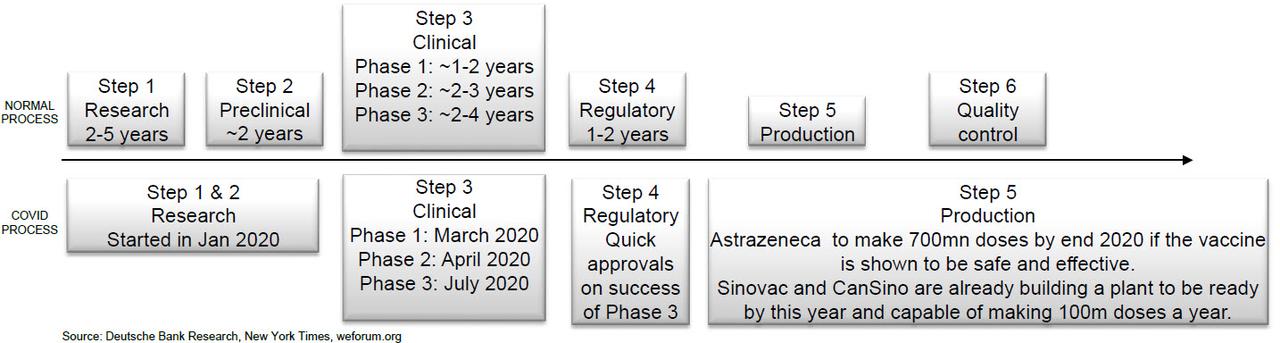
As Deutsche Bank Marion Laboure and Jim Reid wrote last week, whereas vaccines normally require years of testing and additional time to produce at scale, amidst the modern era pandemic scientists are hoping to develop a coronavirus vaccine within 12 to 18 months. The reason for that while normally a vaccine takes years to develop using a traditional process, with covid things are far more accelerated…
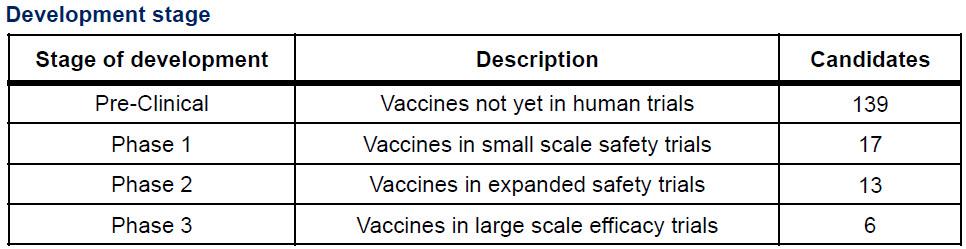
and furthermore, there are already no less than 160 covid vaccine candidates currently in process as the following table shows…
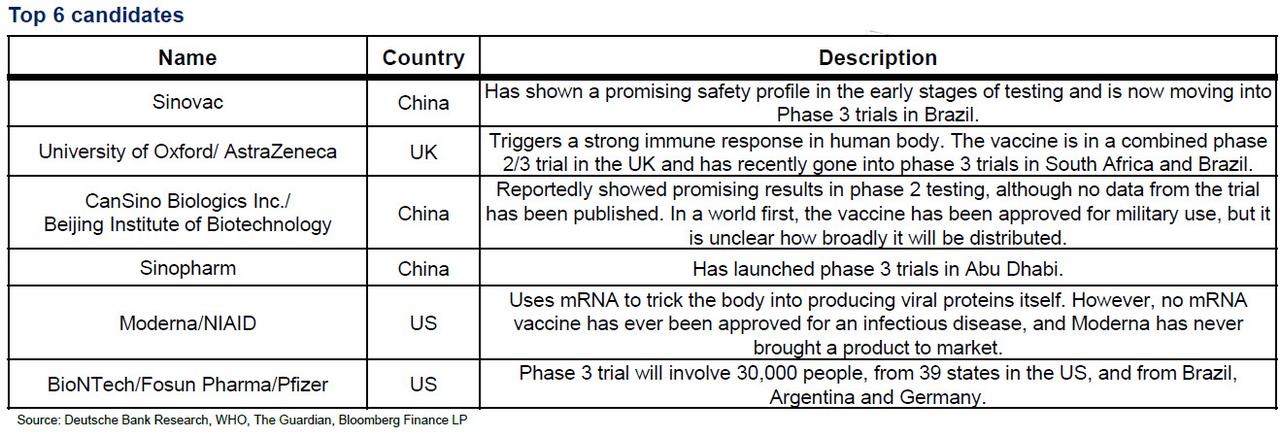
… with the top 6 listed below.
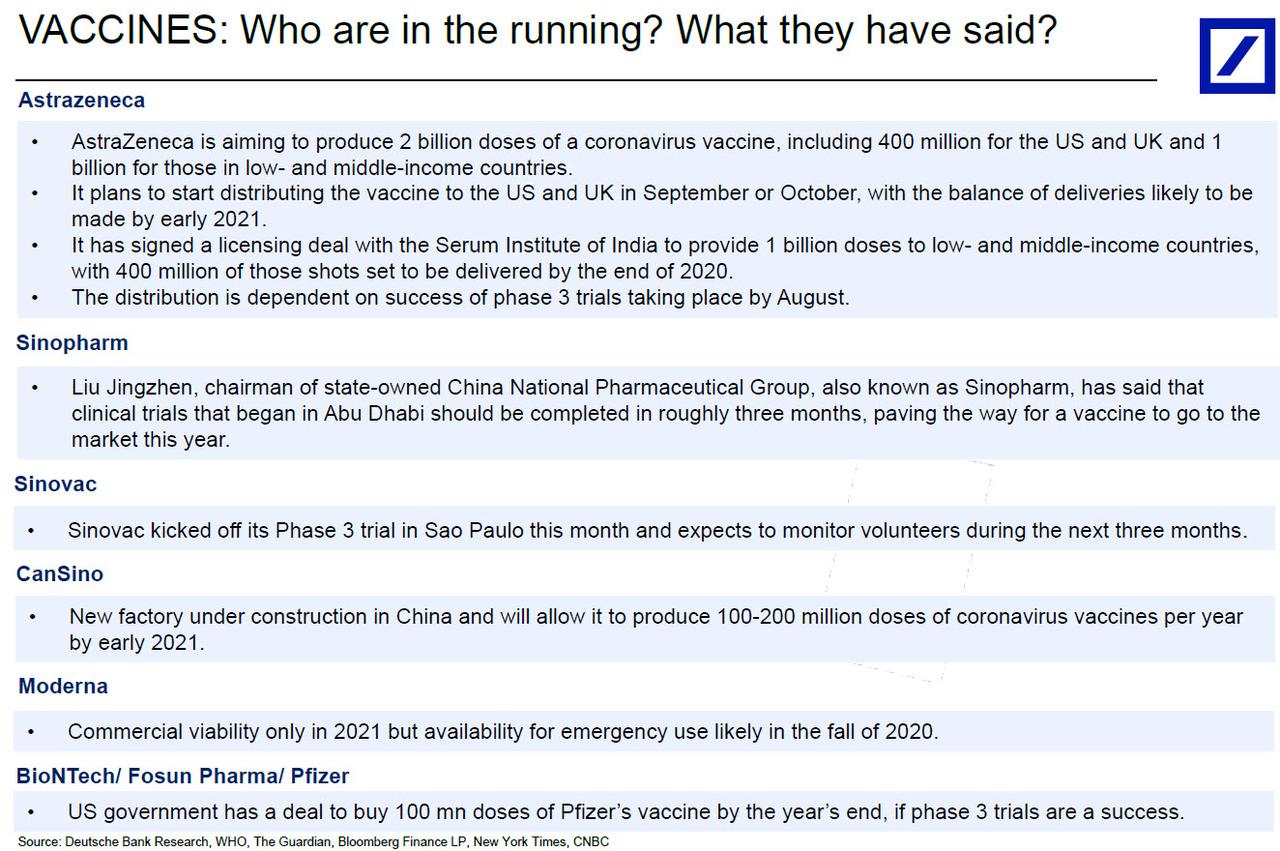
Here is what the top vaccine makers have said publicly about the state of affairs courtesy of Deutsche Bank.
Still, there are caveats and there is a distinct possibility a vaccine may not emerge any time soon as various roadblocks may still emerge as the following bulletin of key dates, timelines and road blocks summarizes:
  • Work began in January 2020 with the deciphering of the SARS-CoV-2 genome. The first vaccine safety trials in humans started in March.
  • All candidates have received regulatory approvals to move quickly to human trials, skipping the years of animal trials that are the norm in developing vaccines. Another way to accelerate vaccine development is to combine phases. Some coronavirus vaccines are now in Phase I/II trials combined together.
  • Meanwhile, SARS and SARS-CoV-2, the virus that causes Covid-19, are roughly 80 percent identical, and both use so-called spike proteins to grab onto a specific receptor found on cells in human lungs. So using the already existing research work of SARS scientists have pushed ahead quickly.
  • Global goal is to develop effective vaccine possibly by early 2021. Researchers of Oxford vaccine candidate have announced that their vaccine could be ready for emergency use as soon as September if phase 3 trials are successful.
  • China’s CanSino vaccine was the first to reach Phase 1 and Phase 2. Sinovac, Sinopharm, Astrazeneca, Moderna, CanSino and Pfizer all reached phase 3 in July.
  • However, researchers caution that less than 10 percent of drugs that enter clinical trials are ever approved by the Food and Drug Administration.
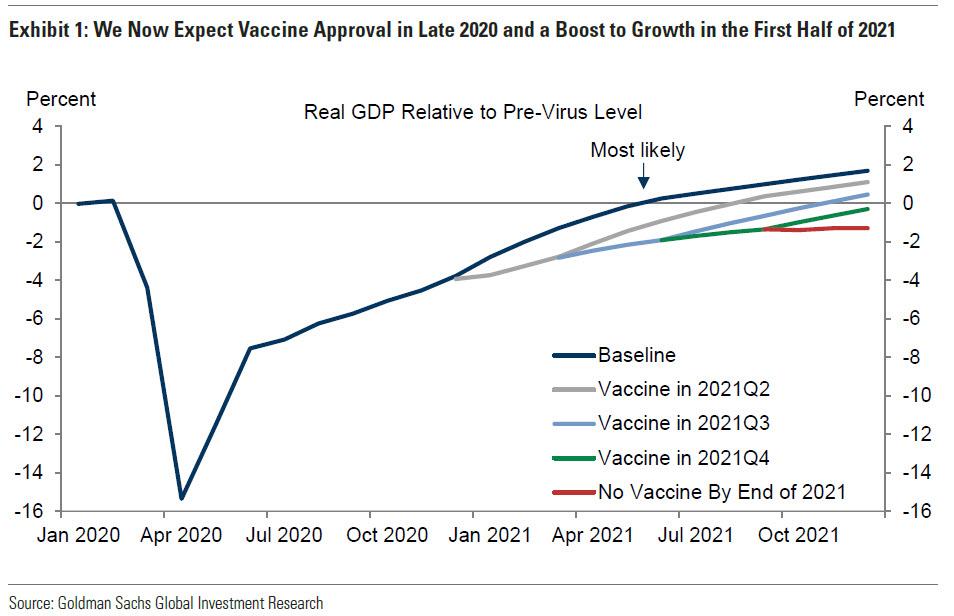
The risk of a failed vaccine however no longer figures in Goldman’s economic forecast, and as Goldman’s Jan Hatzius writes in a report over the weekend, Goldman now expects “that at least one vaccine will be approved by the end of 2020 and will be widely distributed by the end of 2021 Q2. We have incorporated this timeline as our baseline forecast, and now assume  consumer services spending accelerates in the first half of 2021 as consumers resume activities that would previously have exposed them to Covid-19 risk.”
Yet even though polling has shown that only 42% of Americans would submit to a covid vaccine, Goldman is still optimistic enough to upgrade its growth forecast which becomes more front-loaded. Specifically, the bank’s previous GDP forecast reflected a weighted average across possible vaccine scenarios, including the possibility of no vaccine by the end of 2021
Since then the vaccine outlook has since become clearer and more positive according to Hatzius who notes that “the economic benefits for the US appear particularly large due to its leadership in the vaccine race and worse virus control. As a result, we now expect that at least one vaccine will be approved this fall with widespread distribution and positive growth effects felt in the first half of 2021 (dark blue line in Exhibit 1).”
Assuming Goldman’s optimism plays out, and there is an earlier approval of a vaccine, it would have two main effects on the bank’s growth forecast:
  • First, it will accelerate the recovery starting in 2020Q1 as consumers resume high Covid-19 risk activities that could not fully recover prior to a vaccine.
  • Second, the effect of the vaccine is larger in the early approval scenario because it limits scarring effects that could not be undone quickly if the vaccine arrives later.
Following a vaccine approval, Goldman assumes that the rate of recovery for the most affected spending categories doubles and increases by 50% for categories that are moderately affected. This accelerated recovery speed is applied to all of H1 in 2021 but decelerates the recovery in the second half of the year, to reflect growth pulled forward in time.
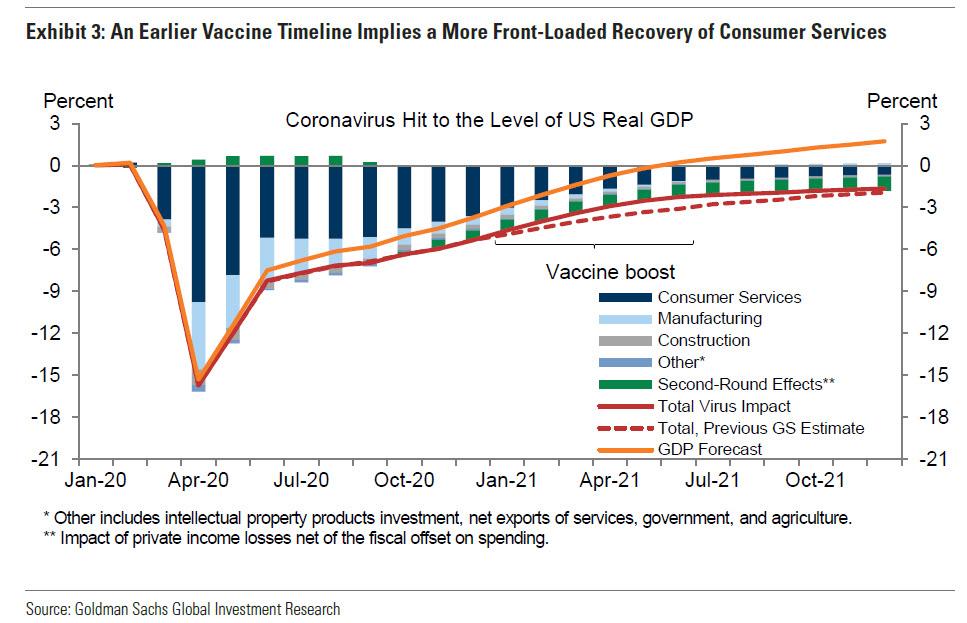
Exhibit 3 shows the new GDP path, which leaves Goldman’s 2020 forecast unchanged, including the assumption that the still-high level of virus spread will keep consumer activity stalled through the end of this month. The updated vaccine outlook is reflected in the rapid decline in the drag from the consumer services sector—shown by the dark blue bars—during the first half of 2021. Under this forecast, the contribution of consumer services spending to the output gap falls to -1.1pp by the end of 2021Q2 (vs. -2.0pp previously). This is partially offset by slower consumer services spending growth in the second half of 2021, leaving our forecast of the level of GDP at the end of 2021 slightly higher. On net, Goldman’s growth forecast “is more front-loaded and modestly upgraded.”
What does this mean in terms of an annualized quarterly GDP basis?
Goldman now expects GDP growth of +10% in Q1 2021, +8% in Q2 2021, +4% in Q3 2021, and +3% in Q4 2021 (vs. +8%, +6.5%, +5%, +4% previously). This raises 2021 growth to +6.2% on an annual average basis (vs. +5.6% previously) and +6.2% on a Q4/Q4 basis (vs. +5.9%).
It also means that if Goldman is correct, and the polls predicting a victory for Biden and a Democratic sweep are also on the money, then Joe Biden faces an impressive first year in the office with near record quarterly GDP gains.
Still, despite these overly optimistic forecast upgrades, Goldman cautions that downside risks have also risen due to Congress’s failure to pass a Phase 4 fiscal package, and while last night’s executive orders postponed the fiscal cliff through August and the bank still expects a package worth around $1.5 trillion to become law by the end of the month, “the risk of no further legislative action has increased and could pose a threat to the budding recovery.”