Search This Blog

Tuesday, August 11, 2020

True NY nursing home death toll in pandemic cloaked in secrecy

Riverdale Nursing Home in the Bronx appears, on paper, to have escaped the worst of the coronavirus pandemic, with an official state count of just four deaths in its 146-bed facility.
The truth, according to the home, is far worse: 21 dead, most transported to hospitals before they succumbed.
“It was a cascading effect,” administrator Emil Fuzayov recalled. “One after the other.”
New York’s coronavirus death toll in nursing homes, already among the highest in the nation, could actually be a significant undercount. Unlike every other state with major outbreaks, New York only counts residents who died on nursing home property and not those who were transported to hospitals and died there.
That statistic could add thousands to the state’s official care home death toll of just over 6,600. But so far the administration of Democratic Gov. Andrew Cuomo has refused to divulge the number, leading to speculation the state is manipulating the figures to make it appear it is doing better than other states and to make a tragic situation less dire.
“That’s a problem, bro,” state Sen. Gustavo Rivera, a Democrat, told New York Health Commissioner Howard Zucker during a legislative hearing on nursing homes earlier this month. “It seems, sir, that in this case you are choosing to define it differently so that you can look better.”

How big a difference could it make? Since May, federal regulators have required nursing homes to submit data on coronavirus deaths each week, whether or not residents died in the facility or at a hospital. Because the requirement came after the height of New York’s outbreak, the available data is relatively small. According to the federal data, roughly a fifth of the state’s homes reported resident deaths from early June to mid July — a tally of 323 dead, 65 percent higher than the state’s count of 195 during that time period.
Even if half that undercount had held true from the start of the pandemic, that would translate into thousands more nursing home resident deaths than the state has acknowledged.
Another group of numbers also suggests an undercount. State health department surveys show 21,000 nursing home beds are lying empty this year, 13,000 more than expected — an increase of almost double the official state nursing home death tally. While some of that increase can be attributed to fewer new admissions and people pulling their loved ones out, it suggests that many others who aren’t there any more died.
However flawed New York’s count, Cuomo has not been shy about comparing it to tallies in other states.
Nearly every time Cuomo is questioned about New York’s nursing home death toll, he brushes off criticism as politically motivated and notes that his state’s percentage of nursing home deaths out of its overall COVID-19 death toll is around 20%, far less than Pennsylvania’s 68%, Massachusetts’ 64% and New Jersey’s 44%.
“Look at the basic facts where New York is versus other states,” Cuomo said during a briefing Monday. “You look at where New York is as a percentage of nursing home deaths, it’s all the way at the bottom of the list.”
In another briefing last month, he touted New York’s percentage ranking as 35th in the nation. “Go talk to 34 other states first. Go talk to the Republican states now — Florida, Texas, Arizona — ask them what is happening in nursing homes. It’s all politics.”
Boston University geriatrics expert Thomas Perls said it doesn’t make sense that nursing home resident deaths as a percentage of total deaths in many nearby states are more than triple what was reported in New York.
“Whatever the cause, there is no way New York could be truly at 20%,” Perls said.
A Cuomo spokesman did not respond to repeated requests for comment. New York’s Department of Health said in a statement that it has been a leader in providing facility-specific information on nursing home deaths and “no one has been clearer in personalizing the human cost of the pandemic.”
A running tally by The Associated Press shows that more than 68,600 residents and staff at nursing homes and long-term facilities across the nation have died from the coronarivus, out of more than 164,000 overall deaths.
For all 43 states that break out nursing home data, resident deaths make up 44% of total COVID deaths in their states, according to data from the Kaiser Family Foundation. Assuming the same proportion held in New York, that would translate to more than 11,000 nursing home deaths.
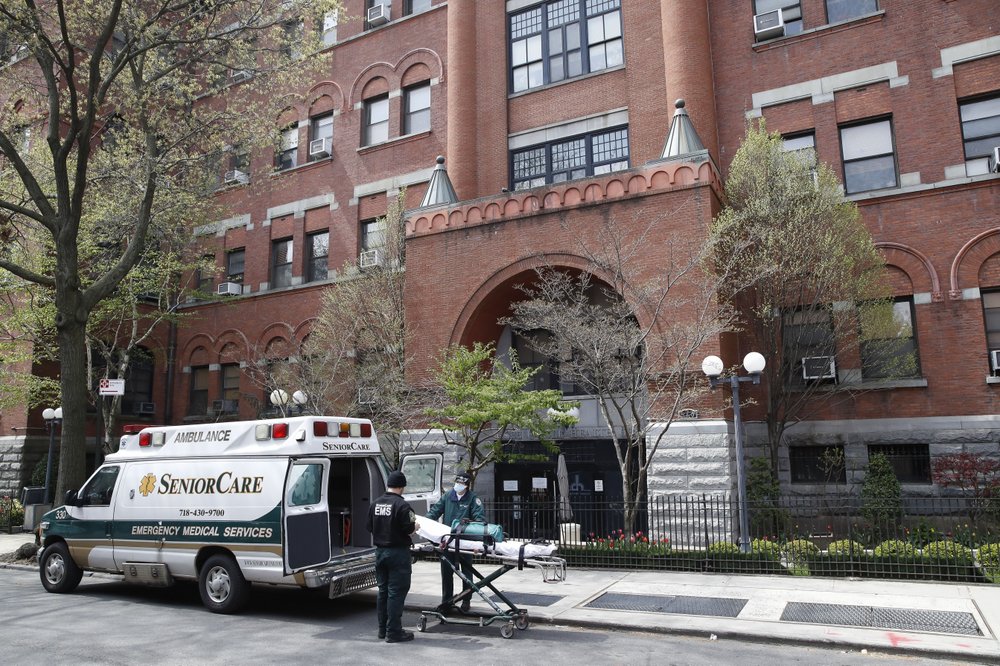
In this April 17, 2020, file photo, emergency medical workers arrive at Cobble Hill Health Center in the Brooklyn borough of New York.

To be sure, comparing coronavirus deaths in nursing homes across states can be difficult because of the differences in how states conduct their counts. New York is among several states that include probable COVID-19 deaths as well as those confirmed by a test. Some states don’t count deaths from homes where fewer than five have died. Others don’t always give precise numbers, providing ranges instead. And all ultimately rely on the nursing homes themselves to provide the raw data.
“Everybody is doing it however they feel like doing it. We don’t have very good data. It’s just all over the place, all over the country,” said Toby Edelman of the Center for Medicare Advocacy, a nonprofit representing nursing home residents.
New York health chief Zucker explained during the legislative hearing that New York only counts deaths on the nursing home property to avoid “double-counting” deaths in both the home and the hospital. And while he acknowledged the state keeps a running count of nursing home resident deaths at hospitals, he declined to provide even a rough estimate to lawmakers.
“I will not provide information that I have not ensured is absolutely accurate,” Zucker said. “This is too big an issue and it’s too serious an issue.”
Zucker promised to provide lawmakers the numbers as soon as that doublechecking is complete. They are still waiting. The AP has also been denied access to similar nursing home death data despite filing a public records request with the state health department nearly three months ago.
Dr. Michael Wasserman, president of the California Association of Long Term Care Medicine, said it is unethical of New York to not break out the deaths of nursing home residents at hospitals. “From an epidemiological and scientific perspective, there is absolutely no reason not to count them.”
Nursing homes have become a particular sore point for the Cuomo administration, which has generally received praise for steps that flattened the curve of infections and New York’s highest-in-the-nation 32,787 overall deaths.
A controversial March 25 order to send recovering COVID-19 patients from hospitals into nursing homes that was designed to free up hospital bed space at the height of the pandemic has drawn withering criticism from relatives and patient advocates who contend it accelerated nursing home outbreaks.
Cuomo reversed the order under pressure in early May. And his health department later released an internal report that concluded asymptomatic nursing home staffers were the real spreaders of the virus, not the 6,300 recovering patients released from hospitals into nursing homes.
But epidemiologists and academics derided the study for a flawed methodology that sidestepped key questions and relied on selective stats, including the state’s official death toll figures.
“We’re trying to find out what worked and what didn’t work and that means trying to find patterns,” said Bill Hammond, who works on health policy for the nonprofit Empire Center think tank. “You can’t do that if you have the wrong data.”

Cuomo shoots down probe into nursing home coronavirus debacle

Gov. Andrew Cuomo on Monday shot down the idea of an independent probe into the coronavirus’ tear through New York nursing homes — while again asserting that criticism of his administration’s response is purely partisan.
State pols from both sides of the aisle have called for investigations into the conditions that led to at least 6,400 COVID-linked deaths in the facilities, including what role a March 25 mandate from Cuomo’s Department of Health barring homes from turning away coronavirus-positive patients may have played.
“No, I wouldn’t do an investigation,” Cuomo flatly told reporters on a Monday conference call.
Despite the bipartisan support for a probe in Albany, the Democrat governor continued to insist that the calls for accountability are politically-motivated.
“I think you’d have to be blind to think it’s not political,” he said. “Just look at where it comes from and look at the sources and look at their political affiliation and … look at what publications raise it and what media networks raise [it]. It’s kind of incredible.”
When a reporter raised the point that an independent probe could be just that — independent — Cuomo swatted down the idea as impossible.
“There is no such thing as a person who is trusted by all Democrats and Republicans,” he said. “That person doesn’t exist.”
The Cuomo administration was let off the hook last month in one inquiry into the matter — conducted by the DOH.
“The department of health review was then reviewed by credible industry experts, right?” Cuomo said Monday. “Well, people don’t think they’re independent experts. Yeah, I know, because nobody’s ever going to agree on who an independent expert is.
“Everybody has their own expert, right? Everybody has their own opinion.”

Mexico to conduct trials for China, U.S. COVID-19 vaccines, eyes production

Mexico aims to conduct late-stage clinical trials for COVID-19 vaccines in development by U.S. and Chinese companies, two of which might base some of their vaccine production in the country, the foreign ministry said on Tuesday.
Mexico has signed memorandums of understanding with Johnson & Johnson, along with Chinese companies CanSino Biologics Inc and Walvax Biotechnology Co Ltd, Foreign Minister Marcelo Ebrard said at news conference.
Ebrard said the trials would start between September and January, depending on approval from Mexico’s food and drug agency.
He said the goal to secure access to the drugs for Mexico, highlighting growing anxiety and “vaccine diplomacy” around the world as developing countries jostle to get timely access to treatments and vaccines.
“This is what worries President (Andres Manuel) Lopez Obrador, that we have it on time,” Ebrard said.
The foreign ministry said CanSino and Walvax were interested in producing an eventual vaccine in Mexico for delivery to the Latin American market.
More than 150 vaccines are being developed and tested around the world to stop the COVID-19 pandemic, with 25 in human clinical trials, according to the World Health Organization.
Russia is the first country to approve a COVID-19 vaccine, which it named “Sputnik V” for foreign markets, an official said on Tuesday.
Mexico has already lobbied in world forums, including at the G20 group of nations and the United Nations, to secure equitable access for an eventual vaccine.
Several other emerging markets in Asia and the Middle East have followed a similar strategy, consultancy Oxford Business Group highlighted in a report on Tuesday.
Large-scale, phase three human testing for the J&J unit Janssen Pharmaceuticals’ candidate could start in the second half of September, the company has previously said.
Johnson & Johnson kicked off early U.S. human safety trials in July after releasing details of a study in monkeys that showed its best-performing vaccine candidate offered strong protection in a single dose.
Walvax’s experimental vaccine is currently under early testing at a Chinese military research institute.
CanSino Biologics’ vaccine candidate is already in clinical trials. The company is also collaborating with Canada’s National Research Council to “pave the way” for future trials in Canada, the research council in May.
Latin America’s second largest economy has suffered more than 50,000 deaths from COVID-19, according to official data, making it the third country with the most deaths globally.
It ranks 13th adjusted for deaths per capita, according to the Johns Hopkins University School of Medicine.

J&J eyes 1B doses of potential COVID-19 shot in 2021, weighs challenge trials

Johnson & Johnson (JNJ.N) could produce 1 billion doses of its potential COVID-19 vaccine next year if it proves successful and would consider injecting healthy volunteers with the novel coronavirus if there are not enough patients for final trials, a company executive said.
J&J kicked off in July early-stage human safety trials for its potential COVID-19 vaccine after releasing details of a study in monkeys that showed its best-performing candidate offered strong protection in a single dose.
It is developing the vaccine in collaboration with its Belgian subsidiary, Janssen.
Large-scale trials are set to start by the beginning of October and J&J aims to have results on the vaccine’s efficacy between the end of this year and mid-2021, Johan Van Hoof, head of vaccines at Janssen, told Reuters on Tuesday in a telephone interview.
Earlier on Tuesday, President Vladimir Putin said Russia had become the first country to grant regulatory approval to a COVID-19 vaccine after less than two months of human testing, and before large-scale trials had been conducted.
Van Hoof said that production of the vaccine had already begun despite the financial risks involved, to make sure it would be available as soon as possible should it prove effective against the new coronavirus.
Several million doses will be ready by the beginning of 2021, with a total capacity of 1 billion shots by the end of the year, he said. He added that the company was likely to favour a single-jab approach, although a final decision on whether a booster would be needed had not yet been made.

ETHICAL ISSUES

Outcomes of large-scale, or Phase III, trials will depend on the incidence of infections, Van Hoof said, with faster results expected with higher virus transmission.
That is why J&J is likely to conduct those trials in the United States and Latin America, the world’s regions currently with the highest number of cases.
If infections drop significantly, J&J is also considering so-called challenge trials, in which volunteers are infected with the virus so that a vaccine candidate can be tested on them.
“We are looking into that possibility,” Van Hoof said, noting though that such trials posed ethical issues that needed to be resolved before they could be conducted. For instance, an effective therapy against the disease should be available to minimise risks for volunteers exposed to the virus.
In May British drugmaker AstraZeneca (AZN.L), which is developing a leading coronavirus vaccine with Oxford University, said it was too early to deliberately expose trial participants to the pathogen, but that may become an option if ongoing tests hit a snag.
Van Hoof said that preparations to stock the virus for possible challenge trials were already underway and J&J was part of ongoing discussions with universities and other bodies involved in these projects.
“We find it a very interesting idea,” he said, adding however, that setting up facilities for such trials would perhaps take longer than testing vaccines on people who are already infected in the community – as long as transmission remained relatively high.

Vir Biotech advancing anti-SARS-CoV-2 antibodies, key milestones this year

Vir Biotechnology (NASDAQ:VIR) Q2 results:
Revenues: $67.0M (+999%). Increase mainly due to GSK and Brii agreements.
Net loss: ($31.2M); loss/share: ($0.27).
Upcoming milestones:
Phase 2/3 study of VIR-7831, a SARS-CoV-2 neutralizing antibody, to launch this month with preliminary data expected before year-end.
Phase 2 study of another SARS-CoV-2 neutralizing antibody, VIR-7832, to launch later this year.
Preclinical studies of VIR-2703, an inhaled SARS-CoV-2-targeting small interfering ribonucleic acid, to be completed by year-end.

Moderna up on $1.5B vaccine supply deal with U.S.

Moderna (NASDAQ:MRNA) has jumped 10.3% after hours following the news that it has a supply agreement with the U.S. government for an initial 100M doses of its COVID-19 vaccine.
The award covers up to $1.525B for the initial doses of mRNA-1273; it contains an option for the government to buy up to an additional 400M doses.
The deal contains incentives for timely delivery of the vaccine.
Combined with the previous award from BARDA of $955M, the announcement brings government commitments for mRNA-1273 up to $2.48B.