Search This Blog

Wednesday, August 12, 2020

CytoDyn bullish on leronlimab in COVID-19 based on success of objective endpoint

Notes from today’s conference call at CytoDyn (OTCQB:CYDY) regarding the results from a Phase 2 clinical trial evaluating leronlimab in COVID-19 patients with mild-to-moderate symptoms.

Company has applied for emergency use of the drug to treat these patients in the U.S.

CEO emphasizing the NEWS2 secondary endpoint which was met, not the primary endpoint which was missed.

Phase 2 was a proof-of-concept study that informed the design of the Phase 3. NEWS2 to be the primary endpoint of the latter.

The advantage of NEWS2 is the reliance on objective parameters instead of patient-reported symptoms that comprised the Phase 2 primary objective.

Premature to know if the ongoing Phase 2 in severely and critically ill COVID-19 patients will be a “single, double, triple or home run.” An interim analysis will be conducted after 195 patients have been treated.


DC-area restaurants using ultraviolet light to counter coronavirus


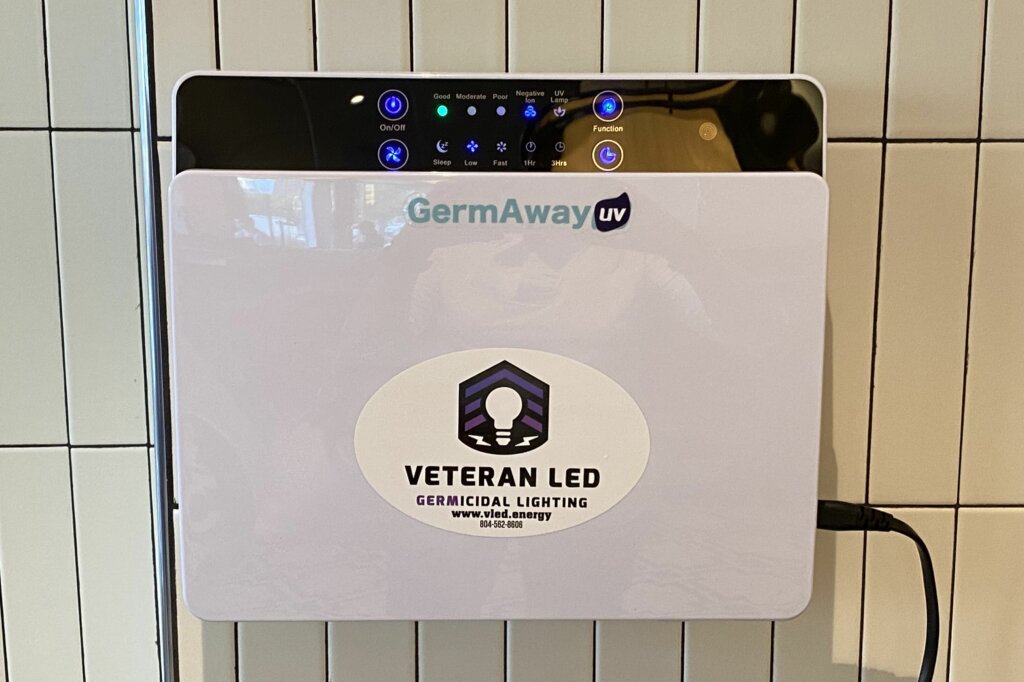
This air purification system is one of many wall mounted units in place throughout the diners. It’s just inside the entryway and next to the host stand.
A wavelength of ultraviolet light known to inactivate close relatives of the novel coronavirus is now an integral part of a cleaning system installed in Silver and Silver Diner locations across the D.C. region.
As of this week, Ultraviolet-C lighting will be used in all 20 Silver and Silver Diner locations. The germicidal irradiation system was installed in air conditioning systems, air purifiers and overhead, and previously proved effective in the fight against SARS, caused by a similar virus.
“UV-C used in HVAC systems inactivates viruses and kills bacteria,” said Chris Rawlings of Richmond, Virginia-based Veteran LED, which installed Silver Diner’s UV-C light-based mitigation efforts. 
“The lights are mounted to the ceiling, and so when the lights turn on, that irradiance field covers as much area as possible, focused on the high touch, high traffic areas of the diner,” Rawlings said.
Because UV-C light is harmful to humans, the overhead lighting systems are on timers to only be used at night when the restaurants are closed.
Newly-installed air purification wall units use UV light, bipolar ionization commonly known as air scrubbing and hepa filters.
“There are multiple units that are installed throughout the diners. There are smaller units and there are some higher occupancy units that are installed front and center when you walk in,” Rawlings said.
Some staff members have also been trained to safely use handheld UV-C lights as needed when preparing for nightly closings.
“You hold it as close to the surface as possible, you wear UV-C safety goggles and a long-sleeved shirt, and we have little indicator strips that tell you that surface is sterilized,” Rawlings said. “It’s usually four to five seconds over each field — you slowly, in a sweeping motion, run it across high-touch surfaces such as doorknobs.” 
UV light is used to disinfect N95 masks for reuse, and it’s used in some hospitals and 
on public transportation to decontaminate surfaces. Rawlings knows of some restaurants that have installed one or two light-based virus fighting measures; he believes Silver Diner is the only restaurant to implement such a layered approach.
“Kudos to them for really embracing the technology and being able to leverage proved technology backed by scientific research,” Rawlings said.
Much like elsewhere, all area Silver Diners have installed plexiglass shields and antimicrobial menus. They’re using an antimicrobial coating said to kills viruses for 90 days, have installed hand-sanitizer stations and are providing employees with masks and gloves.

What to expect from different drugs used in the treatment of COVID-19

Highlights

SARS-CoV-2 is the causative agent of COVID-19.
Currently, there are no effective treatments available against COVID-19.
We have at the moment only palliative pharmacological alternatives.
Some drugs: Chloroquine, Hydroxychloroquine, Antivirals, Plasma, Ivermectin, Anticoagulant.

Abstract

The end of 2019 was marked by the emergence of a new type of coronavirus (SARS-CoV-2), which has killed more than 240,000 people around the world so far. Several clinical studies are being performed to test possible drugs in response to the COVID-19 outbreak; however, there is still no treatment that is completely effective. Our goal in this paper is to bring together the results of main studies carried out with different drugs in order to help spread the knowledge about possible treatments for COVID-19 that have been suggested so far.

FDA OK NS Pharma’s viltolarsen for certain Duchenne patients

Nippon Shinyaku Co., Ltd. (OTC:NPNKF) unit NS Pharma announces the accelerated FDA nod for Viltepso (viltolarsen) for the treatment of patients with Duchenne muscular dystrophy (DMD) amenable to exon 53 skipping, a population representing ~8% of total DMD cases.
Viltolarsen works by masking exon 53 causing cells to “skip” the exon when synthesizing mRNA thereby restoring the reading frame of mRNA and allowing the cell to synthesize a shorter but working dystrophin protein.
Viltepso will compete directly with Sarepta Therapeutics’ (SRPT -0.0%) Exondys 53 (golodirsen), conditionally approved in the U.S. in December 2019.

Moderna shows the value of bulk-buying

The new price for its Covid-19 vaccine is lower than earlier deals – but arguably not by much.
Last week Moderna said the small deals it had done for its Covid-19 vaccine mRNA-1273 came in at $32-37 per shot, markedly higher than any of the other major candidates. It also said bulk sales might allow it to offer the vaccine at a lower price, and true to its word yesterday’s 100 million dose commitment by the US government sees the vaccine priced at around $15 per dose. Investors were thrilled, and Moderna opened up 7.6%, but was later trading up only 1%.
But this price per dose ignores the $955m Moderna has already received from the US taxpayer. If the funding the group has received under the Warp Speed programme is factored in, the US government will actually be paying closer to $25 per shot once this tranche of doses is delivered.
According to Leerink analysts, the US government’s agreement with Moderna includes incentive payments for timely delivery, with some portion of the agreed price at risk should mRNA-1273 fail to secure emergency use authorisation or BLA approval by the end of January 2021. EUA is certainly possible within this time frame given the flexibility of US and global regulatory bodies concerning Covid-19 vaccine candidates.
The risk comes in if trials are delayed or if the interim phase III data expected later this year disappoint. Still, having at least started this phase of testing, Moderna appears to be closer to the goal of US authorisation or approval than any of the other so-called “top six” candidates for which the US government has placed dose orders.
Phase III trials for two others, those from Biontech/Pfizer and Astrazeneca/Oxford University, are imminent, and following early data on Novavax’s NVX-CoV2373 last week that project is slated to enter phase III in September (Novavax claims its place in Covid-19 vaccine race, August 5, 2020). Two of these vaccines, those from Johnson & Johnson and Glaxosmithkline/Sanofi, have not even generated phase I data yet.
The “top six”: US government funding for Covid-19 vaccines
US government financing
Company/orgVaccineTypeDetailDevelopmentDose orders
Moderna/NIAIDmRNA-1273mRNAPh1 data reported; ph3 under wayUp to $955m$1.5bn
(100m doses)
Biontech/PfizerBNT162b1mRNA (modRNA)Ph1 data reported$1.95bn
(100m doses)
Biontech/PfizerBNT162b2mRNA (modRNA)Tolerability better than BNT162b1; ph3 protocol open
Astrazeneca/
Uni of Oxford
AZD1222Chimp adenovirusPh1 data reported; ph3 Aug 2020$1.2bn (300m doses; split not specified)
NovavaxNVX-CoV2373NanoparticlePh1 data reported; ph3 Sep 2020Up to $1.6bn (100m doses; split not specified)
Johnson & JohnsonAd26.COV2-SAdenovirus type 26Ph1 started Jul 2020; ph3 Sep 2020$456m$1bn
(100m doses)
GSK/Sanofi?S-protein antigenPh1 starting Sep 2020; ph3 end 2020$1.1bn*$1bn
(100m doses)
Source: WHO list, EvaluatePharma & company statements. 
At $15 per dose, or $25 if the Warp Speed funding is included, Moderna’s vaccine is still one of the more expensive options. The contract the US has arranged with Pfizer and Biontech for their two candidates – or which BNT162b2 appears the more promising – pegs this at nearly $20 per shot. The vaccine under development by Glaxo and Sanofi comes in at over $20 if the Warp Speed funding is included in the calculation.
By far the best value option, on current showing, is AstraZeneca’s. In May the UK group agreed to provide 300 million doses of AZD1222 in exchange for $1.2bn Warp Speed funding for advanced trials and scaled-up manufacturing. This works out at $4 per shot, in line with the company’s pricing announcement in July (Astra shakes things up with Covid-19 pricing disclosure, July 30, 2020).
Best of the rest
Beyond the top six there are several other vaccines in development – and one has just moved up a step. Arcturus Therapeutics has dosed the first cohort in the phase I/II trial of ARCT-021, formerly designated Lunar-COV19.
This trial is being conducted in Singapore, and comprises two parts. In phase I escalating doses will be administered as a single injection to three cohorts made up of adults between 21 and 55 years old. Based on safety, immunogenicity and T-cell response seen in this group, dose regimens will be chosen for the phase II section, which will also include subjects aged 56 to 80.
This study should yield data in the fourth quarter, but Arcturus seems to be trailing a handful of other potential vaccines, not least that from Merck & Co/Iavi. V590 is the only project outside the top six known to have received funding from Barda – a modest $38m.
The smaller fish: other selected Covid-19 vaccine programmes
Company/orgVaccineTypeDetail
Merck & Co/IaviV590rVSVPh1 starting in 2020
InovioINO-4800DNAImmune responses claimed in ph1
Cansino BiologicsAd5-nCoVAdenovirus type 5Ph1 data reported
Dynavax/
Clover/GSK
SCB-2019Trimerised fusionPh1 data possible Aug 2020
CurevacCVnCoVmRNAPh1 started Jun 2020
ArcturusARCT-021/
Lunar-COV19
mRNAPh1 started Jul 2020
Zydus CadilaZyCoV-DDNAPh1 started Jul 2020
GSK/Medicago
(M Tanabe)
?Coronavirus-like particlesPh1 started Jul 2020
IMVDPX-COVID-19PeptidePh1 starting “summer” 2020
Merck & Co
(ex Themis)
V591Measles virus vectorPh1 starting Q3 2020
Translate Bio/
Sanofi
?mRNAPh1 starting Q4 2020
Source: WHO list, EvaluatePharma & company statements. 
The race to the US market is going to be contested fiercely. The global race, however, has already been won by Russia, with the country’s Ministry of Health saying yesterday it had approved a vaccine developed by the Gamaleya Research Institute of Epidemiology and Microbiology in Moscow after testing in just 76 people.
The so-called Sputnik V vaccine will initially be given to a small number of vulnerable people, with widespread use banned until 2021, presumably so larger trials can be conducted in the meantime. A phase III trial involving more than 2,000 people is to begin this month in Russia, the United Arab Emirates, Saudi Arabia, Brazil and Mexico.
Mass production of the vaccine is to begin in September, but mass production has a different meaning in Russia versus the US: Sputnik V’s manufacturer, Zelenograd-based Binnopharm, says it can make just 1.5 million doses per year.
There is no information available on what kind of governmental funding this project received.
https://www.evaluate.com/vantage/articles/news/pricing/moderna-shows-value-bulk-buying
Moderna shares jump on $1.5 billion U.S. contract for COVID-19 vaccine

Shares of Moderna Inc (MRNA.O) rose more than 5% on Wednesday after analysts said a $1.5 billion coronavirus vaccine supply agreement with the U.S. government could lead to similar deals with other countries.
The United States and Moderna announced the agreement for 100 million doses of its potential COVID-19 vaccine late on Tuesday.

The company’s vaccine candidate, mRNA-1273, is one of the few that have already advanced to the final stage of testing.
The deal confirms Moderna’s experimental vaccine is one of the leading contenders, said BMO analyst George Farmer, who has an “outperform” rating on the stock.
With the U.S. contract now signed, other deals could follow, said Jefferies analyst Michael Yee, who has a “buy” rating.
“We assume other countries … will want to secure deals out of sheer responsibility before the capacity of the major 3-4 players is locked up.”
Effective vaccines and treatments are seen as essential in halting the COVID-19 pandemic, with governments also signing deals for potential vaccines from companies such as AstraZeneca (AZN.L) and Pfizer Inc (PFE.N).
Under the contract, Moderna will provide about 100 million doses, with the price coming to around $30.50 per person for a two dose regimen.
SVB Leerink analyst Mani Foroohar said the price was lower than deals signed by rivals and pointed to increased competition driving down prices in the coronavirus vaccine market.
The U.S. deal would pay out in full if the vaccine achieves certain regulatory milestones before Jan. 31, 2021. (bit.ly/2CjrpKr)
Moderna shares, which have more than tripled and are among the top percentage gainers on the Nasdaq biotech index .NBI this year, were trading at $72.85.

Blood test could determine severe COVID-19 cases, risk of death

Several biomarkers found in blood tests performed on coronavirus patients can allow doctors to detect the more critical cases and help them prevent those infected from getting worse, according to a new study.
Researchers at George Washington University said in the study published in Future Medicine that five biomarkers were linked to greater chances of deterioration and possible death from the illness, Fox News reported.
“This study has identified these five biomarkers as having an association with bad outcomes and not causation in a US cohort,” study authors Drs. Juan Reyes and Shant Ayanian told the news outlet in a statement.
The authors said they decided to embark on the research after early findings in China showed biomarkers associated with poor outcomes in patients stricken by the deadly bug.
The scientists studied the blood of 299 people who tested positive for COVID-19 and then analyzed five biomarkers present in their blood, according to the release, cited by Fox News.
Of the total, 200 patients had all five biomarkers analyzed, including CRP, D-dimer, IL-6, LDH and ferritin, the network reported.
Higher levels of the biomarkers were linked with bleeding disorders and inflammation that showed an increased risk for admission into intensive care units, ventilation support and death, the report said.
The greatest risk of death occurred when the D-dimer level was greater than 3 μg/ml and the LDH was higher than 1200 units/l, the authors said.
“We hope these biomarkers help physicians determine how aggressively they need to treat patients, whether a patient should be discharged, and how to monitor patients who are going home, among other clinical decisions,” said Ayanian, an assistant professor of medicine at the George Washington University School of Medicine and Health Sciences.
Doctors have so far been gauging the severity of the disease progression based on age and pre-existing medical conditions, including obesity, heart disease and a compromised immune system, the authors noted.
But a simple blood test could help guide patients’ treatment, they added.
“In light of the current challenges faced by the pandemic, especially for institutions dealing with an overwhelming number of patients being hospitalized, this study could be useful for clinicians in order to identify sicker patients and aid resource utilization,” the authors told Fox News.