Search This Blog

Saturday, September 11, 2021

Covid-19 dashboard: Cases, deaths and vaccinations

 These charts track recorded covid-19 cases, deaths, deaths per million people, and the percentage of people who are fully vaccinated, broken down by country. We’ve used logarithmic scales to allow us to compare trends between countries. Keep up to date with the latest coronavirus news via our covid-19 daily update.

Data updated weekly. Latest coronavirus data as of 6 September. 


This chart is built using data from Johns Hopkins University and is useful for seeing the trends of outbreaks in different countries. A straight, diagonal line upwards indicates an outbreak that is growing exponentially, while an upwards line that is curving off shows an outbreak is slowing down. The accuracy of the data may be compromised by factors such as limited testing or delays to the reporting of test results. The true number of cases worldwide will be much higher than shown here.


Some countries are better than others at reporting deaths, and the true number worldwide will be much higher than shown here.


Plotting deaths per million people in each country makes it possible to compare which countries have been hit proportionately hardest. The same caveats apply: some countries are better than others at reporting deaths.


The number of fully vaccinated people for countries which report the breakdown of doses administered by first and second dose.


https://www.newscientist.com/article/2276938-covid-19-dashboard-cases-deaths-and-vaccinations/#ixzz76AY7lwJw

BeyondSpring 2nd Quarter 2021 Financial Results, Corporate Update

  BeyondSpring Inc. (the “Company” or “BeyondSpring”) (NASDAQ: BYSI), a global biopharmaceutical company focused on the development of innovative cancer therapies, today announced its financial results for the second quarter ended June 30, 2021 and provided an update on recent corporate events.

“We had a very productive first half of 2021. Importantly, we were thrilled to announce positive data from our registrational trial of plinabulin in 2nd/3rd line NSCLC, which showed significant improvement in overall survival, especially the doubling of 2-year and 3-year survival in the plinabulin and docetaxel arm vs. docetaxel alone. This underscores plinabulin’s immune durable anti-cancer benefit, which could be the gateway for its development in multiple cancer indication in triple IO combos. With the significant survival benefit and significant reduction in severe neutropenia of chemotherapy, we expect that plinabulin’s optimum profile for patient’s need is just beginning to be revealed. These data set the stage for multiple near-term catalysts over the next 6-12 months,” said Dr. Lan Huang, co-founder, chairwoman and chief executive officer of BeyondSpring.

“Our commercial teams are very busy preparing for the potential near-term commercial launch of plinabulin in our first indication in the U.S. At the same time, we have strategically positioned plinabulin for commercial success in Greater China by partnering with Hengrui, the leading oncology R&D and commercial company in China with great synergy in its pipeline with plinabulin. We believe we are truly on the cusp of unlocking the tremendous potential of plinabulin to help many patients in need,” Dr. Huang continued.

Recent Clinical and Corporate Highlights

  • DUBLIN-3 Study (2nd/3rd line NSCLC - EGFR wild type, a global, single-blinded randomized active controlled registrational study, Plinabulin + Docetaxel vs. Docetaxel alone, primary endpoint: Overall Survival):
    Announced positive topline results of plinabulin in combination with docetaxel for the treatment of 2nd/3rd line non-small cell lung cancer (NSCLC) with EGFR wild type.
    • The data showed that, compared to docetaxel alone, the combination met the primary endpoint of increasing overall survival (mean OS, p=0.03; OS log-rank, p<0.04).
    • It also met key secondary endpoints, including significantly improving ORR, PFS, and 24- and 36-month OS (double OS rate vs. docetaxel) rates, and significant reduction in the incidence of Grade 4 neutropenia.
    • OS rate for 48 months is at 10.6% for plinabulin + docetaxel vs. 0% for docetaxel alone.
  • Greater China Partnership on Plinabulin with Hengrui, leading R&D and commercialization company in oncology products in China:
    Announced an exclusive commercialization and co-development agreement between Jiangsu Hengrui Pharmaceuticals Co., Ltd. (or “Hengrui”) and Wanchunbulin, BeyondSpring’s China subsidiary, for plinabulin in Greater China, the key terms of which are outlined below:
    • The NDA filing for plinabulin in China has been accepted with Priority Review for prevention of CIN.
    • Hengrui receives exclusive commercialization and co-development rights to plinabulin in all indications in Greater China.
    • BeyondSpring retains global rights outside of Greater China.
    • Wanchunbulin retains manufacturing rights and is entitled to receive the full amount of sales proceeds, and will pay Hengrui a pre-determined percentage of the net sales of plinabulin in Greater China.
    • Wanchunbulin to receive up to 1.3B RMB (est. US$200M), including an upfront payment of 200M RMB (est. US$30M) and regulatory and sales milestones of up to 1.1B RMB (est. US$170M).
    • Hengrui to pay all commercialization costs, and will pay 50% of clinical development costs for future indications after CIN and NSCLC.
    • Hengrui will make an equity investment of 100M RMB (est. US$15M) into Wanchunbulin at a pre-money valuation of 3.6B RMB (est. US$560M).
  • Plinabulin Triple IO combo in severe cancer indications (Phase 1 and phase 2 IIT Studies):
    • SCLC phase 1 data (plinabulin + Nivolumab + Ipilimumab) presented at ASCO (patients from US sites): 46% ORR for all 2nd/3rd line patients, and 43% for PD-L1 inhibitor failed patients (with long duration of treatment as long as 18 months).
    • Patients with 7 solid tumor types that failed PD-1/PD-L1 inhibitor at MD Anderson: first patient enrolled in June 2021. These 7 cancers include bladder cancer, melanoma, Merkel cell cancer, MSI-H Cancers (of any histology), NSCLC, renal cell cancer, and SCLC.
  • Added Board Member to strengthen commercial readiness for plinabulin
    Strengthened its Board of Directors with the addition of Mr. Brendan Delaney, bringing significant expertise in commercial oncology drug launches.
    • Mr. Delaney currently serves as the Chief Commercial Officer of Constellation Pharma. Prior to this, he was the Chief Commercial Officer of Immunomedics, where he led the buildout of the marketing, sales, market access, and commercial operations teams.

Upcoming Milestones

  • September 20, 2021: ESMO Late-breaking oral presentation on DUBLIN-3
  • November 30, 2021: PDUFA date for plinabulin in CIN prevention
  • 1H 2022: NDA Submission for plinabulin in NSCLC
  • 2022: (Big Ten Cancer Research Consortium, Investigator Initiated study): Phase 2 Data expected in plinabulin + nivolumab + ipilimumab in checkpoint inhibitor-resistant SCLC.
  • 2022: (MD Anderson investigator led study): Phase 1 Data expected in plinabulin + PD-1/PD-L1 inhibitors + radiation in patients with seven cancer types that failed PD-1/PD-L1.

Second Quarter Financial Results

  • Research and development (“R&D”) expenses were $11.3 million for the quarter ended June 30, 2021, compared to $11.0 million for the quarter ended June 30, 2020. The increase was primarily due to higher personnel and non-cash stock-based compensation expenses, which were partially offset by lower clinical development expenses.
  • General and administrative (“G&A”) expenses were $9.0 million for the quarter ended June 30, 2021, compared to $2.6 million for the quarter ended June 30, 2020. The $6.4 million increase was primarily due to higher personnel costs, non-cash stock-based compensation expense, and costs associated with plinabulin pre-commercialization activities.
  • Net loss attributable to the Company was $19.3 million for the quarter ended June 30, 2021, compared to $12.8 million for the quarter ended June 30, 2020.
  • As of June 30, 2021, the Company had cash, cash equivalents, and short-term investments of $76.3 million. The Company believes it has sufficient cash to support its ongoing clinical programs over the next year, including its immuno-oncology pipeline, and to prepare for a potential launch of plinabulin in CIN in early 2022.

Year-to-Date Financial Results

  • R&D expenses were $22.6 million for the six-month period ended June 30, 2021, compared to $24.7 million for the six-month period ended June 30, 2020. The $2.1 million decrease was primarily due to lower clinical development, regulatory and non-cash stock-based compensation expenses that were partially offset by higher personnel costs.
  • G&A expenses were $15.4 million for the six-month period ended June 30, 2021, compared to $5.5 million for the six-month period ended June 30, 2020. The $9.9 million increase was primarily due to higher personnel costs, non-cash stock-based compensation expense, as well as costs associated with plinabulin pre-commercialization activities.
  • Net loss attributable to the Company was $36.3 million for the six-month period ended June 30, 2021, compared to $28.8 million for the six-month period ended June 30, 2020.

Second Quarter 2021 Results Conference Call and Webcast Details
The management of BeyondSpring will host a conference call and webcast for the investment community today, September 10, 2021, at 8:00 am ET. The conference call can be accessed by dialing 877-451-6152 (U.S. and Canada) or +1-201-389-0879 (International). The passcode for the conference call is 13722968 To access the live webcast or subsequent archived recording, click here or visit the “investors” section of the BeyondSpring website at www.beyondspringpharma.com. The webcast will be recorded and available for replay on the company’s website for 90 days.

https://www.biospace.com/article/releases/beyondspring-announces-second-quarter-2021-financial-results-and-provides-a-corporate-update-management-to-host-a-call-today-at-8-00-am-et/

Be a Part of the Next Vaccine Breakthrough with Pfizer

 In anticipation of the upcoming Pfizer mRNA Virtual Career Fair scheduled for Tuesday, September 14, 2021, BioSpace spoke with Philip (Phil) Dormitzer, MD, PhD, Pfizer’s Vice President and Chief Scientific Officer, RNA and Viral Vaccines, who provided insight into the pharmaceutical leader’s mission to deliver up to six innovative vaccines by 2025.

Pfizer is at the forefront of a new scientific era. With the recent development and approval of the world’s first mRNA vaccine, the Pfizer-BioNTech COVID-19 vaccine, and a deep pipeline of innovative vaccines in development, the company is poised to help the world be prepared for current and future global health emergencies as well as to help protect people from infectious diseases. mRNA is an important part of that, and Pfizer is looking to build its team with people who want to be on the ground floor for the next potential big breakthroughs for patients.   

“There are a lot of career opportunities,” Dormitzer said. “I think it's always good to be part of something that is innovative and growing, and that is exactly what RNA is right now. People are learning a science and a skill set that is in tremendous demand.”

He added that there are a number of positions currently available and possibilities for career growth within the company:

“At Pfizer right now, there is an opportunity to really be part of something that is not only successful but is innovative, growing, already having an important impact on human health and which has the potential to have more impact in the future.” 

As the company continues to build on its position of leadership in developing mRNA vaccines, it will apply mRNA technologies and other leading-edge technologies in its efforts to develop best-in-class vaccines for some of the world’s most complex and baffling infectious diseases.

Dormitzer explained that there are plenty of reasons to be excited about the prophylactic and therapeutic potential of mRNA.

“With our COVID-19 vaccine, there has now been definitive proof of concept that RNA vaccines work,” he said. “With that proof of concept, we anticipate not only more RNA-based vaccines in the coming years but increasing our research and development of RNA for potential applications beyond vaccines.”  

According to Dormitzer, mRNA has potential value in areas such as gene editing and antibody expression. From a vaccine standpoint, he explained that one of its biggest advantages is its flexibility.

Dormitzer shared that Pfizer’s Vaccines Research and Development team is highly mission-driven, and for them, this mission to develop the Pfizer-BioNTech COVID-19 vaccine was personal. Much of the development work for our vaccine took place at Pfizer’s Pearl River Vaccines Research and Development headquarters, just 30 miles from Manhattan, so the team had a front-row seat to the devastation happening in the pandemic’s early epicenter.

“When you walked around New York City, it was just obvious that something terrible was going on,” he said. “There was a very strong motivation because this was not a remote thing that was happening. This was happening in the community of the people who were doing the work.”

While Pfizer continues its efforts to help end the COVID-19 pandemic, the work doesn’t stop there. The company boasts an impressive pipeline of novel and next-generation vaccines aimed at helping to prevent serious infectious diseases and improving lives.

In June, the U.S. Food and Drug Administration (FDA) approved Pfizer’s PREVNAR 20™, a pneumococcal 20-valent conjugate vaccine for the prevention of invasive disease and pneumonia associated with 20 Streptococcus pneumoniae (pneumococcus) serotypes in adults. A pediatric vaccine for invasive and non-invasive pneumococcal infections is currently in phase III trials.

Other candidates in late-stage development include a prophylactic vaccine for primary Clostridium difficile infection, a vaccine against meningococcal disease, and a maternal respiratory syncytial virus (RSV) vaccine. Dormitzer is particularly passionate about this one.

“RSV is a major cause of respiratory disease in infants. It is the leading cause of hospitalization of infants in developed countries and a very important cause of infant mortality in lower income countries,” he said.

Scientists have been working since the 1960s to develop a vaccine for RSV, but the key vaccine antigen has two shapes, and early efforts failed because the wrong one was being used. Building on work done at the National Institutes of Health and working with Pfizer’s internal structural biologists, Pfizer was able to stabilize the correct shape of the antigen that we think will help the vaccine candidate provide protection against disease caused by RSV.

“We have early data suggesting that [the vaccine] works very well to help prevent RSV, and now we're doing the large clinical trials to understand and evaluate whether the vaccine candidate is safe and effective,” Dormitzer said.

At Pfizer, this type of innovation is enabled by a team of dedicated individuals.  

Pfizer event_2021

“People who work in vaccines R&D believe in the importance and public health benefits of vaccines. They're passionate about it,” Dormitzer said. “It's also a feeling that you are working in a truly cutting-edge environment, I don’t know a place that is set up better than Pfizer to make the next generation of innovative vaccines.”

There is also an understanding that this kind of work takes a village made up of complementary skill sets.

“We have people who are true experts in their field, and there is tremendous respect for all the capabilities that people have to advance a vaccine, from early-stage research to large scale manufacturing,” Dormitzer said. “It takes people with many different kinds of unique expertise, and what I see is that people have a lot of respect, not only for others in their group but also for the people who have the different sets of skills that are needed to effectively make a vaccine.”

Pfizer is looking to add a variety of unique expertise to its vaccines R&D village. This includes discovery scientists, bacteriologists, virologists, biostatisticians, clinicians and bioprocess and assay development specialists. There is a broad array of opportunities currently available, from entry-level roles to those requiring an advanced degree.

Successful candidates will join our global community of more than 800 talented colleagues in Pearl River, NY, Collegeville, PA or one of several international campuses. The team is mentored by leaders at the forefront of scientific innovation, such as Dormitzer and Kathrin Jansen, Ph.D., Pfizer’s Senior Vice President and Head of Vaccine R&D. Annaliesa Anderson, Ph.D., Pfizer’s Vice President and Chief Scientific Officer, Bacterial Vaccines & Hospital, spearheads the development of vaccines against infectious diseases caused by bacteria, while Bill Gruber, MD, Pfizer’s Senior Vice President, Vaccine Clinical R&D is responsible for the global clinical development of vaccines.    

Although it took a global pandemic to remind many in the general public of the value of vaccines, Pfizer has long possessed the scientific foresight that has made it a leader in vaccine research and development. If it's something you'd like to be part of too, find out more at pfizercareers.com.

https://www.biospace.com/article/be-a-part-of-the-next-vaccine-breakthrough-with-pfizer-/

Apellis finds that one of its twins is evil

 The sellside did its utmost to put a positive spin on the mixed phase 3 data on Apellis’s geographic atrophy project intravitreal pegcetacoplan, released after market close yesterday. This morning's 42% fall in the group’s stock suggests that investors have taken a less rosy view.

Approval of the complement inhibitor is still just about possible, though the blockbuster forecasts appended to pegcetacoplan will surely have to be revised. But more was riding on pegcetacoplan than just approval; Apellis viewed it as a “pipeline in a product”, aiming to expand its use into similar eye conditions. This now looks less likely to work out.

Data from the twin Derby and Oaks trials, in a total of 1,258 patients with geographic atrophy, an advanced form of dry age-related macular degeneration, had been hotly awaited. This intravitreal form of pegcetacoplan has forecast 2026 sales of $1.2bn, according to Evaluate Pharma’s sellside consensus. 

The trials were identical in design, which makes it puzzling that Oaks hit, significantly decreasing the formation of new lesions versus sham treatment, whereas Derby did not. That Derby missed significance narrowly must be particularly galling for Apellis, which did not offer any explanation for the divergent results.

Topline phase 3 data on Apellis's pegcetacoplan
 Reduction in GA lesion growth at 1yr vs pooled sham
TrialPegcetacoplan monthlyP valuePegcetacoplan every other monthP value
Oaks (637 pts)22%0.000316%0.0052
Derby (621 pts)12%0.052811%0.0750
Oaks + Derby (prespecified analysis)17%<0.000114%0.0012
Source: company release.

Pooling the data from Oaks and Derby resulted in statistically significant hits, but it is not clear that the FDA will accept pooled data, especially when one trial is clearly driving the positive combined result.

In any case the magnitude of lesion reductions yielded by this analysis falls short of the 20% threshold doctors would consider meaningful, as mentioned in Apellis’s R&D presentation in June. 

At least there is nothing on the safety side to stand in the way of approval. Exudations – leaking blood vessels in the eye, including the choroidal neovascularisations that were problematic in the phase 2 Filly trial – were seen in 6.0% of patients given pegcetacoplan monthly and 4.1% of those given it every other month, versus 2.4% for sham. 

Apellis wants to file with the FDA in the first half of next year. The regulator has shown itself to be lenient in some cases, so approval cannot be ruled out. Evercore ISI's Umer Raffat called the results “very much approvable”, pointing out that the lack of approved therapies for geographic atrophy. 

Getting doctors and payers on side with lacklustre data might be a tougher proposition.

Then there are Apellis’s later ambitions. The group's stated intention to become the number-one company in the retina space relies on it positioning pegcetacoplan as a therapy to prevent progression of intermediate AMD patients to wet AMD and dry AMD. A phase 3 study had been planned for 2022. 

Whether to go ahead with this is another decision for Apellis to make. 

More data from Derby and Oaks will be presented at the Retina Society meeting, which starts later this month. But it is already clear that pegcetacoplan has followed Roche’s lampalizumab and Gemini’s GEM103 in becoming a complement-targeting project with an unimpressive showing in geographic atrophy. 

The next most advanced agent for this disorder is Alkeus’s ALK-001, whose phase 3 Saga trial could report next year.

https://www.evaluate.com/vantage/articles/news/trial-results/apellis-finds-one-its-twins-evil

Teenage Boys 6 Times More Likely To Suffer Heart Problems From Vaccine Than Be Hospitalized by COVID

 by Paul Joseph Watson via Summit News,

Research conducted by the University of California has found that teenage boys are six times more likely to suffer from heart problems caused by the COVID-19 vaccine than to be hospitalized as a result of COVID-19 itself.

“A team led by Dr Tracy Hoeg at the University of California investigated the rate of cardiac myocarditis – heart inflammation – and chest pain in children aged 12-17 following their second dose of the vaccine,” reports the Telegraph.

“They then compared this with the likelihood of children needing hospital treatment owing to Covid-19, at times of low, moderate and high rates of hospitalisation.”

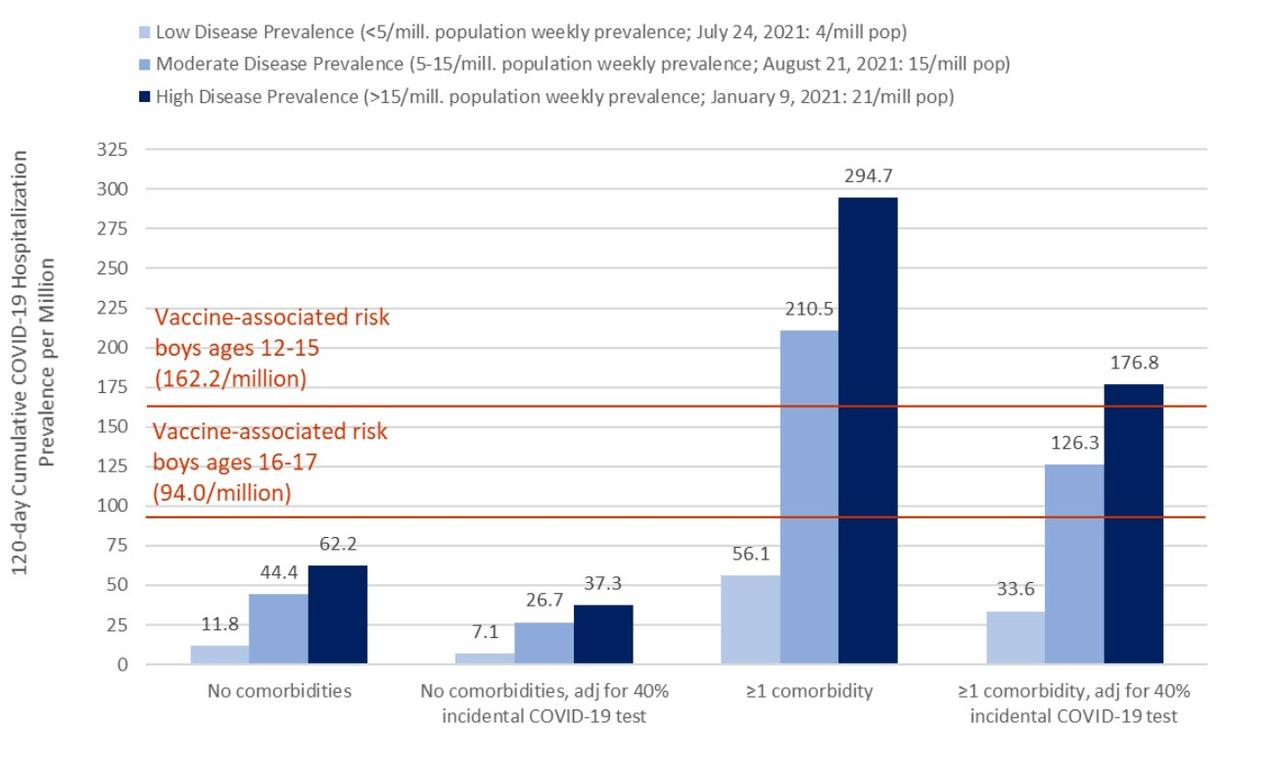
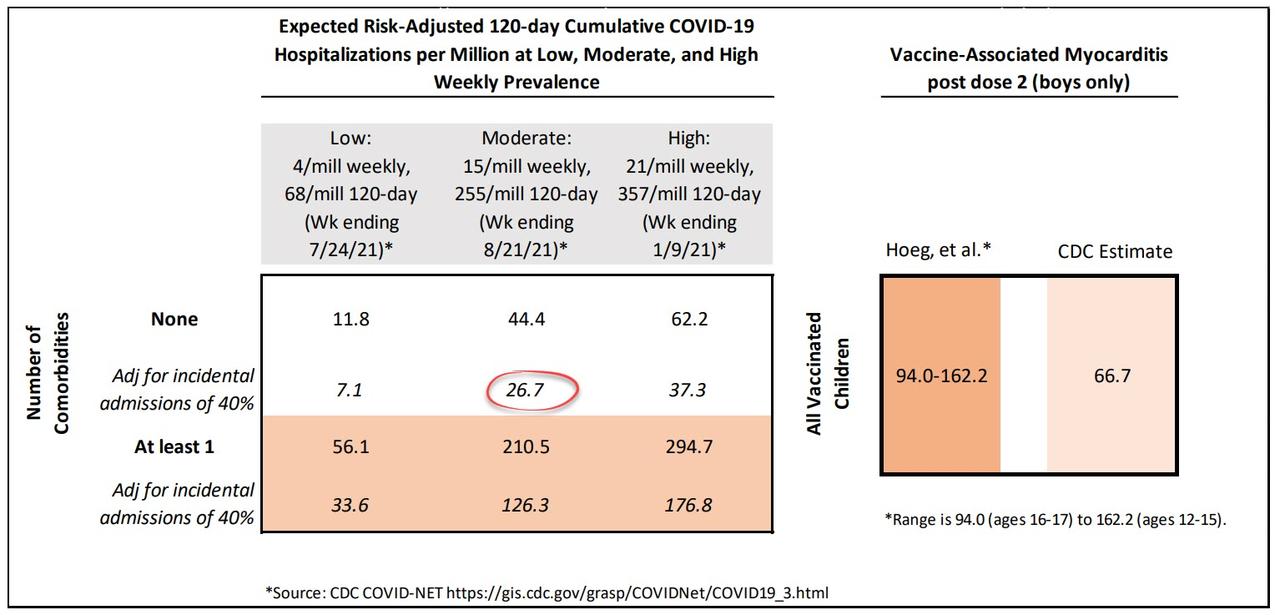
Researchers found that the risk of heart complications for boys aged 12-15 following the vaccine was 162.2 per million, which was the highest out of all the groups they looked at.

Source

This compares to the risk of a healthy boy being hospitalized as a result of a COVID infection, which is around 26.7 per million, meaning the risk they face from the vaccine is 6.1 times higher.

Source

Even during high risk rates of COVID, such as in January this year, the threat posed by the vaccine is 4.3 times higher, while during low risk rates, the risk of teenage boys suffering a “cardiac adverse event” from the vaccine is a whopping 22.8 times higher.

The research data was based on a study of adverse reactions suffered by teens between January and June this year.

In a sane world, such data should represent the nail in the coffin for the argument that teenagers and children should be mandated to take the coronavirus vaccine, but it obviously won’t.

In the UK, the government is pushing to vaccinate 12-15-year-olds, even without parental consent, despite the Joint Committee on Vaccination and Immunisation (JCVI) advising against it.

Meanwhile, in America, Los Angeles County school officials voted unanimously to mandate COVID shots for all children over 12 despite angry objections from parents.

https://www.zerohedge.com/covid-19/study-finds-teenage-boys-six-times-more-likely-suffer-heart-problems-vaccine-be

House Dems propose making permanent expanded ObamaCare subsidies


 House Democrats late Friday night proposed making permanent enhanced ObamaCare subsidies that give people greater help in affording their premiums.

The American Rescue Plan signed by President Biden earlier this year provided larger financial assistance to help with health insurance premiums for Affordable Care Act enrollees but only until 2022.

The House Ways and Means Committee's proposal released late Friday would make that larger financial assistance permanent as part of Democrats' $3.5 trillion social spending package.

The enhanced subsidies lower the percentage of income that any ObamaCare enrollee has to pay for health insurance from around 10 percent to 8.5 percent. Notably, the proposal also allows people who make more than 400 percent of the federal poverty limit (about $100,000 for a family of four) to access the financial assistance for their premiums.

Extending this enhanced financial assistance has been a priority of Speaker Nancy Pelosi (D-Calif.), though there has been some debate with progressives like Sen. Bernie Sanders (I-Vt.) who have prioritized adding dental, hearing and vision benefits to Medicare.

The House bill does not begin Medicare dental benefits until 2028, in part because there is limited money for both the Medicare expansion and making the ACA enhancements permanent.

Previously released sections of the House package would also create a new federal program to expand Medicaid in the 12 GOP-led states that have refused the expansion under the ACA.

study from the Urban Institute released earlier this week found that the Medicaid expansion provision and making the enhanced ACA subsidies permanent would together reduce the number of uninsured people by 7 million, or about one quarter. 

https://thehill.com/policy/healthcare/571805-house-democrats-propose-making-permanent-expanded-obamacare-subsidies

Friday, September 10, 2021

Kroger CEO on margins and dealing with organized crime

 Kroger on Friday said shoppers filled up large baskets of groceries in the fiscal second quarter. They bought bigger items, such as 24-packs of toilet paper. And they replenished fridges frequently, as they cooked more meals at home.

The company’s same-store sales, a key industry metric, were down 0.6% in the three-month period — nearly matching the heightened level of grocery sales during the year-ago period. It raised its outlook for the rest of the year.

Yet shares of Kroger — the country’s largest supermarket operator — fell about 7% on Friday afternoon as investors worried about a less favorable trend: Shrinking profits and squeezed margins.

CEO Rodney McMullen said on an earnings call that “food-at-home trends remain sticky.” He said sales grew year over year in the produce, floral, deli and bakery departments, even as it went up against challenging comparisons.

But the company is under pressure from higher supply chain costs, rising levels of theft and increasing food prices, according to Kroger Chief Financial Officer Gary Millerchip. He said the grocer must pay more for transportation and warehouse space. He said that will continue in the second half of the year.

Plus, the grocer is facing inflation. Like other retailers, Kroger has had to debate when to increase prices for customers and when to eat the cost.

Millerchip said the grocer has discounted products selectively to attract shoppers.

In a research note, J.P. Morgan analyst Ken Goldman questioned that approach. He said Kroger should pass on more of those costs to shoppers, who have gotten used to seeing higher prices everywhere and shown they aren’t scared away by them.

Plus, Goldman said, Kroger’s stock price may be due for a sell-off. It has already run up significantly during the pandemic and hit a record high of $47.99 last week. Shares are up about 34% this year.

McMullen said inflation has had at least one silver lining for the retailer: As shoppers see the price of some consumer packaged goods increase, some are buying similar snacks, food or beverages from Kroger’s private labels.

Kroger expects it will earn $3.25 to $3.35 per share, after adjustments, in fiscal 2021, up from an earlier forecast of $2.95 to $3.10 per share. In the latest quarter, Kroger earned $467 million, or 61 cents per share, on revenue of $31.68 billion. Adjusted earnings of 80 cents a share topped estimates.

https://www.cnbc.com/2021/09/10/kroger-gets-hit-by-higher-costs-offsetting-bigger-grocery-baskets.html