Search This Blog

Thursday, January 27, 2022

Casirivimab + imdevimab prevents progression to symptomatic COVID-19

 For asymptomatic severe acute respiratory syndrome coronavirus 2 (SARS-CoV-2) polymerase chain reaction (PCR)-positive individuals living with an infected household contact, treatment with the subcutaneous casirivimab and imdevimab antibody combination reduces the incidence of symptomatic COVID-19 over 28 days, according to a study published online Jan. 14 in the Journal of the American Medical Association.

Meagan P. O'Brien, M.D., from Regeneron Pharmaceuticals Inc. in Tarrytown, New York, and colleagues conducted a multicenter trial of close household contacts of a SARS-CoV-2-infected index case who were enrolled between July 13, 2020, and January 28, 2021. Results were reviewed from 314 individuals positive on SARS-CoV-2 PCR testing who were randomly assigned to receive one dose of subcutaneous casirivimab and imdevimab (158 participants) or placebo (156 participants).

At baseline, 204 participants were asymptomatic and seronegative and were included in the primary efficacy analysis. The researchers found that subcutaneous casirivimab and imdevimab significantly prevented progression to symptomatic disease compared with placebo (29.0 versus 42.3 percent; odds ratio, 0.54). The number of symptomatic weeks per 1,000 participants was also reduced with casirivimab and imdevimab (895.7 versus 1,637.4 weeks), with a reduction of about 5.6 days in symptom duration per symptomatic participant. There was also a reduction in the number of high viral load weeks per 1,000 participants in association with treatment with casirivimab and imdevimab (489.8 versus 811.9 weeks).

"If, in the future, casirivimab and imdevimab therapy is authorized for use in people who are infected but do not have symptoms, this monoclonal antibody combination could potentially be used in high-risk situations, such as for immunosuppressed individuals who are RT-PCR positive but asymptomatic," write the authors of an accompanying editorial.

Several authors disclosed financial ties to Regeneron Pharmaceuticals, which funded the study together with F. Hoffmann-La Roche.


Explore further

Antibody combo prevents infection from SARS-CoV-2 exposure

More information: Abstract/Full Text

Editorial


https://medicalxpress.com/news/2022-01-casirivimab-imdevimab-symptomatic-covid-.html

How easy is it to update COVID vaccines to tackle new variants?

 Our ongoing battles with COVID variants delta and omicron highlight just how quickly viruses can mutate, and what that can mean for public health. How quickly can we modify COVID-19 vaccines to tackle any new variants that arise?

We also had questions about  for detecting COVID-19, and why it is becoming so difficult for people to obtain  kits.

To learn more about both of these subjects, we spoke with Jennifer Pancorbo, a vaccine manufacturing expert and director of industry programs and research at NC State's Biomanufacturing Training and Education Center.

The Abstract: I know you have a lot of familiarity with influenza vaccine manufacturing, and the fact that each year the flu vaccine is modified to account for whichever flu strains experts think will be prevalent in the coming year. However, I also know that the COVID-19 vaccines are mRNA vaccines and adenovirus vaccines, but the flu vaccines are not. How difficult would it be for COVID-19 vaccine manufacturers to modify their vaccines to account for new strains of SARS-CoV-2, such as the omicron variant?

Jennifer Pancorbo: The difference in vaccine platform technology should not impair the ability of manufacturers to respond to new  of the virus. If anything, the mRNA technology provides a platform for faster response. Unfortunately, responding to yearly changes in the dominant virus strain faces other challenges, in addition to manufacturing capacity.

TA: Can you explain what those other challenges are?

Pancorbo: For one there is a very well established worldwide network for influenza virus surveillance. There is no equivalent for COVID-19. For influenza, there are centers around the world that collect data on strain circulation; experts then use that data to make an educated guess as to which strains will be most likely to present major health threats to the public; and those strains are incorporated into the seasonal vaccine formulation.

In the case of COVID-19, we do not have that rigorous surveillance in place yet. Therefore anticipating a formulation becomes a challenge.

In addition, there is an intricate supply chain network in place for influenza vaccine manufacturing components that gears up months before manufacturing even begins and uses forecasting from previous years to guess demand. Without those systems in place, responding quickly to a new coronavirus strain seems unlikely.

And then there is the risk. The decision about which formulation to manufacture for influenza each year is a calculated risk, based on many years of experience. Without the backup of experience, companies may be less willing to accept the risk for manufacturing a new COVID-19 vaccine that targets a particular strain.

TA: When do you think we might see new COVID-19 vaccines that account for new strains of SARS-CoV-2?

Pancorbo: It is difficult to predict. The virus is mutating quite fast and new strains seem to pop up daily. The surveillance is not there yet. And testing needs to gear up in support of such surveillance, as we know we are in a testing crisis now that may slow all those systems down even further. At this time, our best alternative is to slow down the spread of COVID-19 so that the virus has fewer hosts, which in turn limits its ability to mutate into new strains.

TA: Would any new vaccines effectively be single-dose boosters, or might they also require two shots, as the Pfizer and Moderna vaccines did when people were first vaccinated?

Pancorbo: It would depend on the efficacy of the new vaccine and the risk posed by the new strain. For example, if the new strain does not cause much mortality we can afford a reduced efficacy; but otherwise, we would need to elicit a higher immune response, which may result in the need for two doses again.

TA: How could the development of COVID-19 vaccines that account for new variants impact our ability to vaccinate people around the world who have not yet been vaccinated?

Pancorbo: By regulation, a facility must clear a previous product from the manufacturing floor before they initiate production of a new one. Therefore, to manufacture a new COVID-19 vaccine they must stop manufacturing the previous one; that may result in less availability of old  formulations for those who are not yet vaccinated.

TA: I also wanted to ask a couple questions about rapid tests for COVID-19. First off, how do they work—and how effective are they at detecting COVID-19?

Pancorbo: Most rapid tests are similar in principle to a pregnancy test; they detect the presence of an analyte in the sample, but for detection to occur a minimum threshold must be met. Rapid tests are as reliable as any pregnancy test, if you test too early then you do not have enough analyte present in the sample for a positive; that does not mean the test is bad or inaccurate, it only means it has a minimum limit of detection that must be met for it to work.

If you run a rapid test and get a negative result, you can conclude that at the time of testing you do not have enough viral load for detection either because you are negative or because your infection has not progressed enough yet.

Is it possible to have a false negative? Yes, but that reason is less likely than the two I already mentioned.

TA: Why are people having such a hard time getting their hands on rapid tests right now?

Pancorbo: Several reasons: supply chain limitations, limited workforce due to their own or a family member's infection with COVID, extensive testing due to the new spike of the omicron strain, and lack of planning by our local and federal government, which resulted in less investment in the approval and development of over-the-counter COVID-19 tests.

https://medicalxpress.com/news/2022-01-easy-covid-vaccines-tackle-variants.html

Screening study identifies inhibitor of key COVID virus enzyme

 When the COVID-19 pandemic hit, scientists across the U.S. Department of Energy's (DOE) national laboratory complex turned to the nation's most powerful supercomputers and other tools to discover molecules that might treat the disease. A study published in the Journal of Chemical Information and Modeling reports the discovery of a molecule with significant potential to disable the virus.

The molecule was identified using high-throughput virtual screening—a search through a library of 6.5 million in-stock compounds that could quickly be scaled up for drug production. The team used computer-based molecular docking studies to identify molecules that could bind to certain targets on the virus's main protease (Mpro)—an enzyme the virus uses to make copies of itself. They also conducted high-throughput laboratory screening experiments, structural studies, and molecular dynamics simulations to learn how these potential inhibitors and the enzyme interact. The goal was to find molecules that could jam up the enzyme's function, which would stop the virus from replicating.

The computational team, which included scientists from the Computational Science Initiative (CSI) at DOE's Brookhaven National Laboratory, identified 72 candidate molecules with potential to inhibit Mpro. Other teams ran  experiments testing those molecules' ability to inhibit the virus. Structural studies using, for example, X-ray crystallography revealed how the candidate molecules fit together with the virus enzyme. Additional computer-based simulations provided details about how those interactions alter the enzyme.

The paper describes how the most promising candidate, known as MCULE-5948770040, binds with Mpro and changes its shape in a way that inhibits the enzyme's function. Future experiments will explore whether the molecule can be developed into a new drug for treating COVID-19.

"Scientists from Brookhaven's CSI played an important role in generating and analyzing large volumes of data that led to scientific insight," said Shantenu Jha, one of the corresponding authors on the paper, who holds a joint appointment with Brookhaven and Rutgers University. "CSI folks also established the 'software infrastructure' to support the large-scale computations," he said.

Given the urgency of the pandemic, "this was a very high-intensity project with a great level of 'learning while doing,'" Jha noted.

CSI's Hubertus Van Dam, another study co-author, agreed, saying he was inspired by "tackling, for me, a new set of problems with a new set of methods in a large team."

The team for this paper included scientists from five national laboratories and four collaborating universities, all supported by the DOE Office of Science through the National Virtual Biotechnology Laboratory (NVBL). NVBL is a consortium of DOE national laboratories focused on response to COVID-19, with funding provided by the Coronavirus CARES Act.

Kerstin Kleese Van Dam, director of CSI at Brookhaven, served as leader of Brookhaven's role in the NVBL medical therapeutics project.

"A key weapon in our arsenal in the fight against COVID-19 are medicines to treat those infected," she said. "The NVBL medical therapeutics project brought to bear the combined might of DOE scientists, and key experimental and computational facilities to discover new COVID treatments.

"This paper describes not only some of our successes, but also gives a glimpse behind the scenes at the scientific ingenuity needed to make those exciting discoveries possible."


Explore further

Journeying 'inside' the COVID-19 viral protein to attack a weak point

More information: Austin Clyde et al, High-Throughput Virtual Screening and Validation of a SARS-CoV-2 Main Protease Noncovalent Inhibitor, Journal of Chemical Information and Modeling (2021). DOI: 10.1021/acs.jcim.1c00851
https://phys.org/news/2022-01-screening-inhibitor-key-covid-virus.html

Confidence declines in CDC and Dr. Anthony Fauci, survey finds

 Confidence declines in CDC and Dr. Anthony Fauci, survey finds

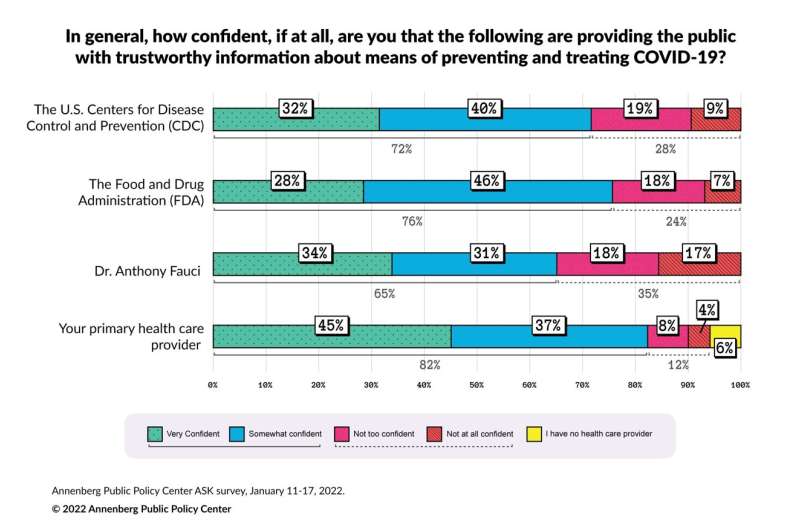
Public confidence in health authorities (Very confident to not at all confident) from Annenberg Public Policy Center ASK survey conducted January 11-17, among 1,656 U.S. adults. Credit: Annenberg Public Policy Center

Battered by waves of COVID-19 and confusion over shifting government messages about it, Americans' confidence in the Centers for Disease Control and Prevention (CDC) declined in January with drops both among groups of Democrats/Democratic-leaning independents and Republicans/Republican-leaning independents, according to January survey data from the Annenberg Public Policy Center of the University of Pennsylvania.

Confidence that the CDC is providing the public with trustworthy information about the means of preventing and treating COVID-19 fell from 77% only two months ago, in November 2021, to 72% in January 2022.

In addition, the  found for the first time a significant drop in  in Dr. Anthony Fauci, who as director of the National Institute of Allergy and Infectious Diseases (NIAID) has been the target of withering attacks in conservative media outlets throughout the nearly two-year pandemic. Confidence in Fauci dropped to 65% in January 2022, a statistically meaningful drop over the nine months since April 2021, when it was 71%.

"Overall confidence remains high but has eroded for both Dr. Fauci and the CDC, with the CDC decline more recent and that of Dr. Fauci more gradual," said Kathleen Hall Jamieson, director of the Annenberg Public Policy Center (APPC). "This is deeply concerning, because voices that speak for the best available science need to be trusted and heard as we navigate the pandemic."

Confidence declines in CDC and Dr. Anthony Fauci, survey finds
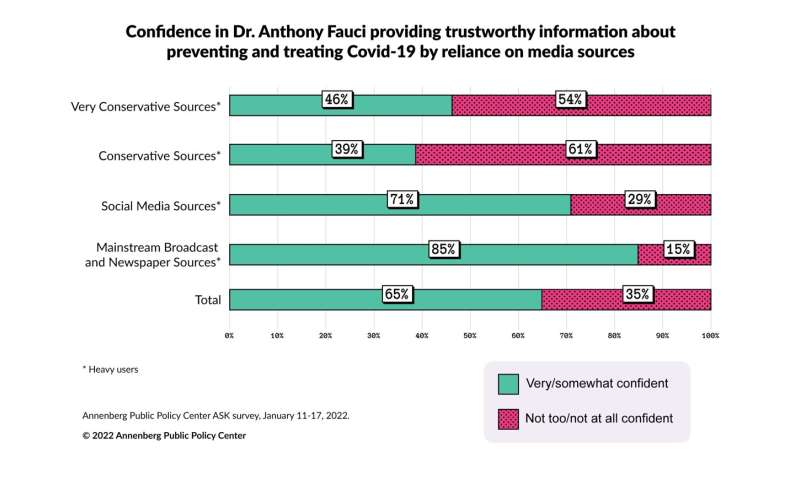
Confidence in Dr. Anthony Fauci, by reliance on different media sources -- very conservative, conservative, social media, mainstream broadcast and newspaper. From Annenberg Public Policy Center ASK survey conducted Jan. 11-17, 2022, among 1,656 U.S. adults. Credit: Annenberg Public Policy Center

The January survey

The January data are from the fifth wave of the Annenberg Science Knowledge (ASK) survey, a nationally representative sample of U.S. adults empaneled by the Annenberg Public Policy Center in April 2021 to track attitudes and behavior in the pandemic. APPC first began tracking beliefs about the novel coronavirus and vaccination with cross-sectional surveys in March 2020.

The current survey was conducted January 11-17, 2022, among a national probability sample of 1,656 U.S. adults. The data were weighted to represent the target U.S. adult population. The margin of error for the total sample is ± 3.3 percentage points at the 95% confidence level. The panel survey, conducted for APPC by independent research firm SSRS is a follow-up to surveys in November 2021, September 2021, June 2021 and April 2021 with the same group of respondents.

Confidence declines in CDC and Dr. Anthony Fauci, survey finds
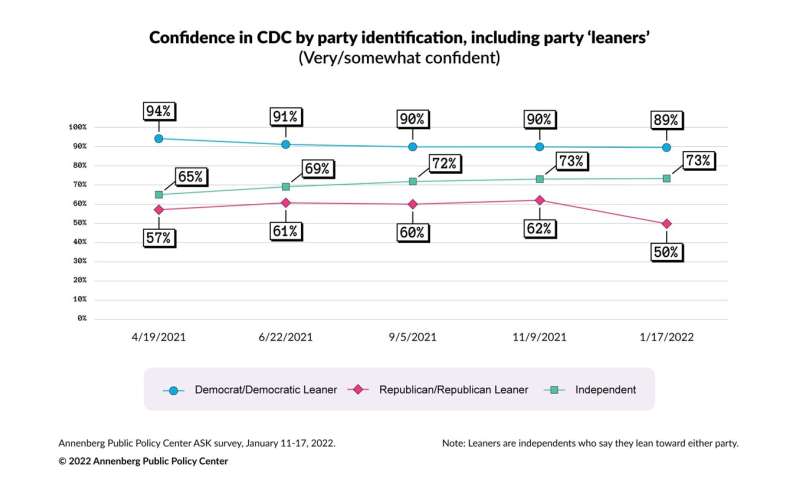
Confidence in the CDC by party and party "leaners" in five waves of the Annenberg Public Policy Center ASK survey from April 2021 to January 2022. See the Appendix linked in the news release for details on the first four waves. Credit: Annenberg Public Policy Center

Trust in health care authorities

The survey found that an individual's primary health care provider continues to be the most trusted source of information about the means of preventing and treating COVID-19.

  • Primary health care provider: 82% are confident their primary health care provider is providing trustworthy information about COVID-19, statistically unchanged since April 2021. However, the small percentage of those who say they are not confident in their health care provider increased to 12% from 8% in November, a significant change;
  • Food and Drug Administration: 74% are confident the FDA is providing trustworthy information on COVID-19, unchanged over the past nine months;
  • Centers for Disease Control and Prevention: As noted above, 72% are confident the CDC is providing trustworthy information on COVID-19, down from 77% in November, and 28% are not confident in the CDC, up from 23% in November;
  • Dr. Anthony Fauci: As noted above, 65% are confident Fauci is providing trustworthy advice on COVID-19, down from 71% in April 2021, and 35% say they are not confident in Fauci, up from 29% in April 2021.

Democrats, Republicans, and 'leaners'

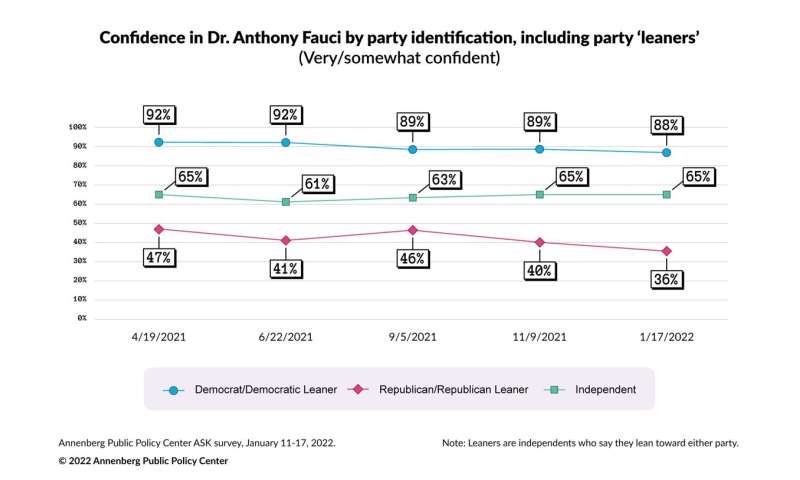
The changes in confidence can be seen in breakdowns by self-identified party affiliations when including respondents who "lean" toward one party or the other. The party leaners are respondents who said they considered themselves independent or neither Republican nor Democrat, but answered a follow-up question by indicating that they thought of themselves as either "closer to the Democratic party" or "closer to the Republican party."

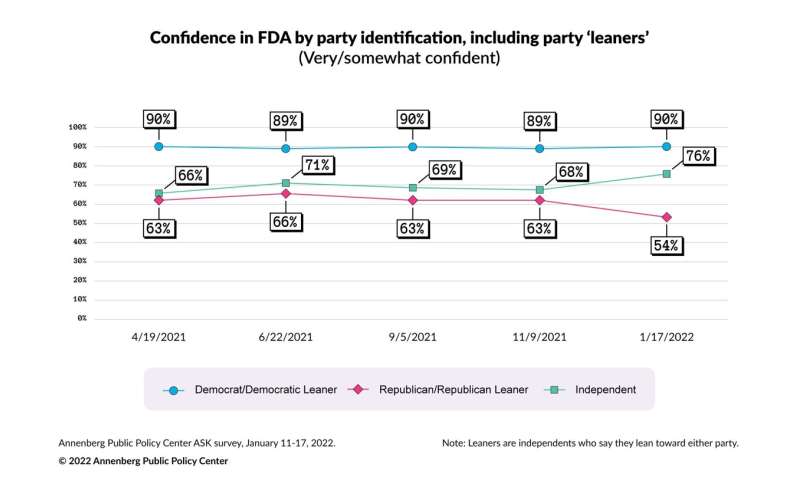
  • FDA: Support for the FDA has been consistently high at about 90% throughout the survey period for Democrats and Democratic leaners. But among Republicans and Republican leaners, support dropped significantly from 63% in November 2021, where it had been for most of the time since April, to 54% in January 2022.
  • CDC: Among Democrats and Democratic-leaning respondents, a drop in confidence in the CDC occurred over the nine-month survey period. Confidence among this group, which has also been very high, fell from 94% in April 2021 to 89% in January, a significant change. Among Republicans and Republican-leaning respondents, confidence in the CDC dropped significantly from 62% in November to 50% in January 2022.
  • Fauci: Support for Fauci has been extremely high among self-identified Democrats and those who lean Democratic. That support eroded gradually, from 92% in April 2021 to 88% in January 2022, a significant change. Among self-identified Republicans and those who lean Republican, confidence in Fauci was much lower to start—47% in April 2021—and dropped significantly to 36% in January 2022.
Confidence declines in CDC and Dr. Anthony Fauci, survey finds
Confidence in Dr. Anthony Fauci by party and party "leaners" in five waves of the Annenberg Public Policy Center ASK survey from April 2021 to January 2022. See the Appendix linked in the news release for background on the different waves. Credit: Annenberg Public Policy Center

Media use and confidence in health authorities

As past waves of the survey have found, people who are heavier users of conservative and very conservative media have significantly less confidence in Fauci, the CDC, and the FDA, both when compared with the overall sample and with heavier users of other types of media.

Fauci has been the target of attacks in conservative media outlets for many months, and as noted in a November survey release, on one night in November, a Fox News viewer would have seen Fauci likened to the Nazi doctor Josef Mengele and the Italian fascist dictator Benito Mussolini. The CDC likewise has been the focus of attacks in conservative media over its vaccination and masking guidance and most recently, in January it was hit by accusations in conservative media that it "lied" about the extent of COVID-19 casualties, based in part on a deceptively edited video clip of CDC director Rochelle Walensky.

The survey found that among heavier users of:

  • Very conservative sources such as Newsmax, One America News (OAN), Gateway Pundit, Parler, or Telegram: 46% have confidence in Fauci, 54% in the CDC, 60% in the FDA, and 78% in their primary health care provider;
  • Conservative media such as Fox News, Mark Levin, or Breitbart: 39% have confidence in Fauci, 52% in the CDC, 60% in the FDA, and 88% in their primary health care provider;
  • Social media such as Facebook, Twitter, Instagram, or YouTube: 71% have confidence in Fauci, 80% in the CDC, 78% in the FDA, and 87% in their primary health care provider;
  • Mainstream broadcast/print media such as CBS News, NBC News, ABC News, the Associated Press, or the news pages of The Wall Street Journal or The New York Times: 85% have confidence in Fauci, 89% in the CDC, 90% in the FDA, and 95% in their primary health care providers.
Confidence declines in CDC and Dr. Anthony Fauci, survey finds
Confidence in the FDA by party and party "leaners" in five waves of the Annenberg Public Policy Center ASK survey from April 2021 to January 2022. See the Appendix linked in the news release for background on the different waves. Credit: Annenberg Public Policy Center

The January survey did not find significant changes since the November survey in these data.

9 new coronavirus species found

 A former UBC post-doctoral research fellow led an international research team in re-analyzing all public RNA sequencing data to uncover almost ten times more RNA viruses than were previously known, including several new species of coronaviruses in some unexpected places.

This planetary-scale database of RNA viruses can help pave the way to rapidly identify virus spillover into humans, as well as those viruses that affect livestock, crops, and endangered species.

Dr. Artem Babaian (he/him) is behind the Serratus Project collaboration. It published the stunning results of the research in the journal Nature this week.

Working with the Cloud Innovation Centre, a public/private collaboration between UBC and Amazon Web Services, the Serratus Project was able to build a "ridiculously powerful" supercomputer on AWS equivalent in power to 22,500 CPUs, said Babaian.

The supercomputer read through 20 million gigabytes of publicly available gene sequence data from 5.7 million  around the world, searching for a specific gene that indicated the presence of an RNA virus. The samples have been collected and freely shared within the world research community over 13 years and include everything from ice-core samples to animal dung.

Researchers with the Serratus Project found 132,000 RNA viruses (where just 15,000 were known previously) and nine new species of coronaviruses. Babaian estimates that without the CIC and the AWS Cloud, it would take a traditional supercomputer well over a year and hundreds of thousands of dollars to perform the 2,000 years of CPU time necessary for this analysis. Serratus accomplished it in 11 days for $24,000.

"We're entering a new era of understanding the genetic and spatial diversity of viruses in nature, and how a wide variety of animals interface with these viruses. The hope is we're not caught off guard if something like SARS-CoV-2—the novel coronavirus that causes COVID-19— emerges again. These viruses can be recognized more easily and their natural reservoirs can be found faster. The real goal is these infections are recognized so early that they never become pandemics," said Babaian, who holds a Ph.D. in medical genetics from UBC and is now a Banting Fellow at the University of Cambridge.

"If a patient presents with a fever of unknown origin, once that blood is sequenced, you can now connect that unknown virus in the human to a way bigger database of existing viruses. If a patient, for example, presents with a viral infection of unknown origin in St. Louis, you can now search through the database in about two minutes, and connect that  to, say, a camel in sub-Saharan Africa sampled in 2012."

Babaian, 32, had been conducting genetic research into cancer with BC Cancer when the COVID-19 pandemic hit and he switched gears.

The work, which the understated Babaian says started as a "fun side project," began March 3, 2020, when he and his climbing partner friend, UBC engineering student Jeff Taylor, sketched out the idea "on the back of a napkin," said Babaian.

"I should have kept that napkin," he noted.

Babaian approached UBC's Cloud Innovation Centre for help shortly after. Serratus, named after Serratus Mountain in the Tantalus Range in British Columbia, which he and Taylor viewed during a climb in 2020, was born.

Babaian recalled he was sitting on his wife's nursing chair when the first results started to flash up on his laptop, indicating that Serratus was not only working, but producing data almost incomprehensibly fast.

"It was probably the most exciting scientific period of my life," he said. "There are two types of fun. Type 1 is smiling and fun. Type 2 is when you're miserable while doing it but the memory shines, like rock climbing. In many ways Serratus is Type 2 fun. You just kind of have to believe it's going to work out."

Babaian said he would not have been able to do this work without the support of the UBC Cloud Innovation Centre.

"The Cloud Innovation Centre was really there unlocking the doors for us," he said. "We had an idea and they brought in experts from their networks to make it come to life. Now the global community can benefit from all this previously untapped research."

"Artem approached us with an innovative vision. The power of the Cloud Innovation Centre is that we pair our in-house innovation and technology teams from UBC with those from Amazon Web Services," said Marianne Schroeder, director of the UBC Cloud Innovation Centre. "It was our great privilege to support the realization of this vision; helping to find a technology solution for complex problems is what we do."

The Centre, which launched right before the pandemic in January 2020, supports challenges that focus on community health and wellbeing. To date, the team has published more than 20 projects including reference architecture and deployment guides all available open source.

"While the public cloud as we know it has been around for 15 years, the last few years of innovation at Amazon Web Services have really made genomics research possible in a new way," said Coral Kennett, who heads up the Centre for Amazon Web Services. "We were able to give Artem access to compute power for pennies a query. We highly encourage the research community to submit their projects and ideas to the Cloud Innovation Centre so that more  comes to light benefitting the community."


Explore further

Researchers use artificial intelligence to guide the search for the next SARS-like virus

More information: Robert C. Edgar et al, Petabase-scale sequence alignment catalyses viral discovery, Nature (2022). DOI: 10.1038/s41586-021-04332-2
https://phys.org/news/2022-01-team-coronavirus-species.html

Omicron survives over 21 hours on skin, more than 8 days on plastic: Study

A study conducted by the researchers from the Kyoto Prefectural University of Medicine in Japan has now claimed that the Omiron variant of coronavirus can remain alive on skin and plastic more than the earlier variants of the virus like Alpha, Beta, Delta and Gamma. The study is yet to be peer-reviewed and has been posted recently on BioRxiv. According to the findings, Omicron can remain alive on the skin for over 21 hours and more than eight days on any plastic surface. This might be the reason why Omicron is spreading faster compared to other strains, the study said.

For the study, the researchers compared the survival time of the other variants and concluded that the Alpha, Beta, Gamma and Delta variants could remain alive on plastic surfaces for 56 hours, 191.3 hours, 156.6 hours, 59.3 hours, and 114 hours, respectively.

Omicron, on the other hand, can survive on a plastic surface for 193.5 hours, more than 8 days.

On skin samples, the average virus survival times were 8.6 hours for the original version, 19.6 hours for Alpha, 19.1 hours for Beta, 11 hours for Gamma, 16.8 hours for Delta and 21.1 hours for Omicron, the study claimed.

The findings also include the effectiveness of ethanol on all variants. Although Alpha, Beta, Delta, and Omicron variants showed a slight increase in ethanol resistance in response to increased environmental stability, all VOCs on the skin surface were completely inactivated by 15-second exposure to 35 per cent ethanol, it said, asserting that santisiting hands frequently is highly recommended.

Omicron is the latest variant of SARS-CoV-2, which was first identified in South Africa on November 24, 2021. Since then, the variant has been spreading at an unprecedented spread replacing Delta, and led to a fresh surge of the pandemic across the world. 

https://www.hindustantimes.com/world-news/omicron-survives-over-21-hours-on-skin-more-than-8-days-on-plastic-study-101643185076600.html

ResMed CEO: Clogged supply chains still a problem but expected to ease this summer

 Component shortages continued to curb growth potential of San Diego sleep apnea giant ResMed— though it looks like the lingering supply chain woes could begin to ease heading into summer.

That’s the prediction of ResMed Chief Executive Mick Farrell, who has been publicly imploring chip suppliers and government officials to prioritize delivery of components for medical devices above orders for phones, electric vehicles and consumer electronics.

“I don’t think we are going to get a Defense Production Act (declaration) to move the force majeure on contracts,” said Farrell in an interview. “But the suppliers have been responding. We have been getting some modest increase in supply, which you saw in the quarter. We grew 16 percent on devices.”

ResMed, which makes ventilators, sleep apnea machines, respiratory masks and other products, has been redesigning certain products to accommodate more plentiful components. It is also validating new suppliers with internal compliance teams and regulators.

Farrell expects those efforts to slowly begin bearing fruit in the March and June quarters before delivering significant benefits in the second half of the year.

“There are a bunch of projects going on, but when I look at them it gives me strong confidence,” said Farrell. “We had some come to fruition in December, some in March, but in the June quarter I think a bunch of these projects will free up supply.”

In the meantime, ResMed posted solid financial results for its fiscal second quarter.

Revenue grew 13 percent year over year to $895 million. Net income came in at $202 million, or $1.37 per share. That’s up 12 percent compared with last year.

Still, profit margins shrunk due to higher component and freight costs.

ResMed has occasionally chartered commercial jets to get its products from overseas manufacturing sites to U.S. distribution centers in hopes of avoiding backups at shipping ports. Farrell said freight costs can be five- to 10-times higher now than they were prior to the pandemic. The company as added a $12 temporary surcharge to devices to help cover its additional expenses.

The supply shortages also hamstrung ResMed from fully cashing in on surging demand created when top competitor Philips recalled 3.3 million CPAP machines last June.

Philips isn’t expected to return to the CPAP market with new machines until the end of this year. Farrell said ResMed’s revenue should increase between $300 million and $350 million in 2022 because of the Philips recall. But some analysts say the potential for ResMed was much larger — closer to $700 million — if not for supply woes.

https://www.sandiegouniontribune.com/business/story/2022-01-27/resmed-ceo-clogged-supply-chains-are-still-a-problem-but-likely-to-improve-this-summer