Search This Blog

Friday, January 28, 2022

3rd Dose of Pfizer-BioNTech and Moderna Vaccines in Preventing COVID-19 Hospitalization

 What is already known about this topic?

For adults aged ≥18 years who received 2 doses of an mRNA COVID-19 vaccine, third doses are recommended. However, the associated benefits in preventing COVID-19 hospitalization are incompletely understood.

What is added by this report?

In a study of hospitalized adults, compared with receipt of 2 mRNA COVID-19 vaccine doses, receipt of a third dose increased vaccine effectiveness against hospitalization among adults without and with immunocompromising conditions, from 82% to 97% and from 69% to 88%, respectively.

What are the implications for public health practice?

Administration of a third COVID-19 mRNA vaccine dose as part of a primary series among immunocompromised adults, or as a booster dose among immunocompetent adults, provides improved protection against COVID-19–associated hospitalization.

COVID-19 mRNA vaccines (BNT162b2 [Pfizer-BioNTech] and mRNA-1273 [Moderna]) provide protection against infection with SARS-CoV-2, the virus that causes COVID-19, and are highly effective against COVID-19–associated hospitalization among eligible persons who receive 2 doses (1,2). However, vaccine effectiveness (VE) among persons with immunocompromising conditions* is lower than that among immunocompetent persons (2), and VE declines after several months among all persons (3). On August 12, 2021, the Food and Drug Administration (FDA) issued an emergency use authorization (EUA) for a third mRNA vaccine dose as part of a primary series ≥28 days after dose 2 for persons aged ≥12 years with immunocompromising conditions, and, on November 19, 2021, as a booster dose for all adults aged ≥18 years at least 6 months after dose 2, changed to ≥5 months after dose 2 on January 3, 2022 (4,5,6). Among 2,952 adults (including 1,385 COVID-19 case-patients and 1,567 COVID-19–negative controls) hospitalized at 21 U.S. hospitals during August 19–December 15, 2021, effectiveness of mRNA vaccines against COVID-19–associated hospitalization was compared between adults eligible for but who had not received a third vaccine dose (1,251) and vaccine-eligible adults who received a third dose ≥7 days before illness onset (312). Among 1,875 adults without immunocompromising conditions (including 1,065 [57%] unvaccinated, 679 [36%] 2-dose recipients, and 131 [7%] 3-dose [booster] recipients), VE against COVID-19 hospitalization was higher among those who received a booster dose (97%; 95% CI = 95%–99%) compared with that among 2-dose recipients (82%; 95% CI = 77%–86%) (p <0.001). Among 1,077 adults with immunocompromising conditions (including 324 [30%] unvaccinated, 572 [53%] 2-dose recipients, and 181 [17%] 3-dose recipients), VE was higher among those who received a third dose to complete a primary series (88%; 95% CI = 81%–93%) compared with 2-dose recipients (69%; 95% CI = 57%–78%) (p <0.001). Administration of a third COVID-19 mRNA vaccine dose as part of a primary series among immunocompromised adults, or as a booster dose among immunocompetent adults, provides improved protection against COVID-19–associated hospitalization.

During August 19–December 15, 2021, a period in which the SARS-CoV-2 B.1.617.2 (Delta) variant was predominant, adults admitted to 21 hospitals in 18 states within the Influenza or Other Viruses in the Acutely Ill Network (IVY Network) who received testing for SARS-CoV-2 were included in a VE analysis. The analysis start date of August 19, 2021, was one week after the EUA of a third dose for persons with immunocompromising conditions. VE against COVID-19 hospitalization was compared between two groups: 1) adults who had completed a 2-dose mRNA vaccination series and were eligible for but had not received a third dose; and 2) adults who were eligible for and had received a third dose ≥7 days before illness onset. VE was calculated for 2-dose and 3-dose recipients by comparing odds of antecedent vaccination between COVID-19 case-patients and control patients who did not have COVID-19. Case-patients had COVID-19–like illness§ and received positive SARS-CoV-2 test results by a nucleic acid amplification test (NAAT) or antigen test within 10 days of illness onset. Control patients were hospitalized with or without COVID-19–like illness and received negative SARS-CoV-2 test results by NAAT.

Patients or their proxies were interviewed regarding patient demographic and clinical characteristics, and medical record searches were completed to collect information about chronic medical conditions. Information about receipt of prior COVID-19 vaccination doses, including dates, locations, and vaccine product received, was obtained through self-report and review of source documentation (including state vaccination registries, medical records, and vaccination cards). A patient was considered to be vaccinated if vaccination could be verified through source documentation or by self-report, including dates and location. Three vaccination groups were considered: 1) unvaccinated patients, who had received no COVID-19 vaccine doses before illness onset; 2) 2-dose mRNA vaccine recipients, who were eligible for but had not received a third vaccine dose or had received a third dose <7 days before illness onset; and 3) 3-dose mRNA vaccine recipients, who received a third dose ≥7 days before illness onset. Patients were excluded if they were admitted to the hospital ≤7 days after EUA authorization of a third dose, received one or more vaccine doses but did not qualify for inclusion in the 2-dose or 3-dose vaccine group, received a non-mRNA vaccine (e.g., Ad26.COV2.S [Janssen (Johnson & Johnson)]), or if verification of vaccination was pending.

VE against COVID-19–associated hospitalization was estimated using logistic regression, comparing the odds of being vaccinated versus being unvaccinated among case-patients and controls using the equation VE = 100 × (1 − adjusted odds ratio). The regression model included case-patient or control status as the outcome variable and an indicator variable for vaccination group (unvaccinated, 2-dose recipient, or 3-dose recipient), and was adjusted for admission date, region of hospital (U.S. Department of Health and Human Services or U.S. Census Bureau), age group (18–49, 50–64, or ≥65 years), sex, and self-reported race and ethnicity. Separate models were generated for immunocompetent adults and adults with immunocompromising conditions. To compare VE among 2-dose versus 3-dose mRNA vaccine recipients, post hoc comparisons were performed with the pwcompare function in Stata with a two-sided significance threshold of p<0.05. Analyses were conducted using Stata software (version 16.0; StataCorp). This activity was determined to be public health surveillance by each participating site and CDC and was conducted consistent with applicable federal law and CDC policy.**

During August 19–December 15, 2021, the IVY Network enrolled 4,094 adults aged ≥18 years. After excluding 1,142 patients (619 because they did not belong to an included vaccination group, 386 because the patients had received a non-mRNA vaccine or vaccination verification was incomplete, and 137 because they met other exclusion criteria), 2,952 hospitalized patients were included (1,385 case-patients and 1,567 non–COVID-19 controls). Among all participants, median age was 62 years, 49% of patients were female, 58% were non-Hispanic White, and 36% had an immunocompromising condition. Among the 1,385 case-patients, 931 (67%), 408 (29%), and 46 (3%) had received 0, 2, and 3 mRNA vaccine doses, respectively. Among 1,567 non–COVID-19 controls, 458 (29%), 843 (54%), and 266 (17%) had received 0, 2, and 3 mRNA vaccine doses, respectively. Among patients without immunocompromising conditions (Table 1), 2- and 3-dose recipients were similar in terms of age (median = 69 and 72 years, respectively) but differed in self-reported race/ethnicity distribution (a higher percentage of non-Hispanic White persons were among 3-dose recipients; p = 0.008) and U.S. Census Bureau region of the admitting hospital (p = 0.030). Two-dose recipients were less likely to report working in health care settings (5%) than were 3-dose recipients (10%) (p = 0.023) and were more likely to be enrolled as a COVID-19 case-patient (31%) than were 3-dose recipients (8%) (p<0.001). Among patients with immunocompromising conditions (Table 2), 2-dose recipients were more likely to be enrolled as a case-patient (34%) than were 3-dose recipients (20%) (p<0.001). VE against COVID-19 hospitalization among adults without immunocompromising conditions was 82% (95% CI = 77%–86%) for 2 doses and 97% (95% CI = 95%–99%) for 3 doses (p<0.001) (Table 3). VE against COVID-19 hospitalization among adults with immunocompromising conditions was 69% (95% CI = 57%–78%) for 2 doses and 88% (95% CI = 81%–93%) for 3 doses (p<0.001). In a sensitivity analysis among patients with moderately to severely immunocompromising conditions defined by CDC†† (7), VE was 65% (95% CI = 49%–76%) for receipt of 2 doses, and 87% (95% CI = 78%–92%) for receipt of 3 doses (p<0.001).

Discussion

In a multistate network, adults vaccinated with 2 or 3 doses of a COVID-19 mRNA vaccine were protected against COVID-19–associated hospitalization. Significantly higher VE was observed in adults who received a third mRNA vaccine dose either as part of a primary vaccine series (immunocompromised persons) or as a booster dose (immunocompetent persons) compared with those who had received 2 doses. These findings underscore the importance of immunocompromised adults obtaining a third mRNA vaccine dose ≥28 days after the second vaccine dose and of immunocompetent adults receiving a third (booster) dose currently recommended ≥5 months after the second dose.§§

This study was conducted during a period of SARS-CoV-2 Delta variant predominance (8). VE against the B.1.1.529 (Omicron) variant of SARS-CoV-2 might be lower than for other variants that have circulated widely, possibly because of immune evasion. Early evidence suggests that a third mRNA vaccine dose elicits markedly stronger neutralizing antibody responses to the Omicron variant compared with responses to 2 vaccine doses (9), and increases VE against severe disease following infection with the Omicron variant (10). The effectiveness of 3 doses of COVID-19 mRNA vaccines against a range of disease severity associated with the Omicron variant needs to be carefully evaluated in different populations.

The findings in this report are subject to at least six limitations. First, 2-dose and 3-dose vaccine recipients were similar in terms of most demographic and clinical characteristics but might have differed with respect to exposure risk for SARS-CoV-2 infection or risk factors for severe COVID-19. Therefore, residual or unmeasured confounding was possible. Second, VE associated with newly emergent variants, including Omicron, was not assessed. Third, VE was not assessed against SARS-CoV-2 infection or mild illness. Fourth, most 3-dose mRNA vaccine recipients were vaccinated within several weeks of enrollment and durability of protection will require future analysis. Fifth, VE associated with a fourth mRNA vaccine dose, recommended as a booster dose in immunocompromised individuals ≥5 months after dose 3, was not assessed. Finally, although medical centers in 18 states were included in the analysis, patients might not be representative of the general U.S. population.

Among adults with and without immunocompromising conditions who were eligible to receive a third dose of COVID-19 mRNA vaccine, third doses were found to increase protection beyond that of a 2-dose vaccination series for the prevention of COVID-19 hospitalization. Administration of a third COVID-19 mRNA vaccine dose as part of a primary series among immunocompromised adults, or as a booster dose among immunocompetent adults, provides improved protection against COVID-19 hospitalization.

https://www.cdc.gov/mmwr/volumes/71/wr/mm7104a2.htm

Three, four or more: what’s the magic number for booster shots?

 Late last year, studies showed that third shots (boosters) of COVID vaccines were effective at providing a little extra protection from infection — particularly in the face of the Omicron variant. Some countries are now offering fourth doses, but scientists say that endless boosting might not be a viable strategy, nor is it how these vaccines were meant to be used.

“We’re in totally uncharted territory for vaccinology,” says Danny Altmann, an immunologist at Imperial College London. “We’ve stumbled into a de facto programme of frequent mRNA boosters as an emergency measure, but this really doesn’t feel like the way to go.”

In early January, Israel began offering fourth doses to older and immunocompromised people and to health-care workers, hoping to shield vulnerable groups from a wave of Omicron infections, says Ran Balicer, a public-health physician at the Clalit Health Institute in Tel Aviv. This week, preliminary data from Israel revealed that a fourth dose reduces the risk of infection and severe disease.

But researchers are debating whether a third dose will be enough to confer lasting immunity against Omicron and emerging variants in most people — or whether a fourth dose, or even regular boosters, will be needed, as they are for influenza.

Some researchers say that the answer depends on the desired effect — whether boosters are intended to prevent infections and slow transmission of the virus, or whether the goal is to reduce severe disease and keep people out of hospital. Others point to evidence that extra doses could broaden the immune response enough to recognize new variants. Most agree that we need new vaccines that offer wider protection against future variants.

Limitations of boosters

Omicron changed the thinking around boosters, says Alejandro Balazs, an immunologist at the Ragon Institute in Cambridge, Massachusetts. That’s because, faced with the variant, people previously regarded as fully vaccinated now have “an antibody response that is insufficient to prevent infections”, he says.

As Omicron outbreaks have spread, boosters have been used to ramp up levels of neutralizing antibodies, curbing cases and easing strain on hospitals1,2. But the concern is that boosters don’t block infections for long.

Data from Israel — collected between June and November last year when Delta was dominant — and detailed online ahead of peer review, indicate that the immunity from a third (mRNA booster) shot wanes within months, mirroring the decline after two doses3.

Real-world data from the United Kingdom, collected in late 2021, suggest that immunity from boosters might decrease even faster against Omicron than against Delta. However, another laboratory study, posted as a preprint which has yet to be peer reviewed, suggests that neutralizing antibodies elicited by a third dose could sustain protection against Omicron infections for up to four months4.

Because protection from boosters might be short-lived, rolling out endless doses — potentially at the expense of immunizing unvaccinated people in low-income nations — is not a “viable or reasonable” long-term global strategy, says Kanta Subbarao, a virologist at the Peter Doherty Institute for Infection and Immunity in Melbourne, Australia.

And, in a statement released on 11 January, the World Health Organization warned that “a vaccination strategy based on repeated booster doses of the original vaccine composition is unlikely to be appropriate or sustainable”.

Repeated booster doses of existing vaccines also probably offer only diminishing returns in terms of protection against future strains, says Miles Davenport, a computational immunologist at the University of New South Wales in Sydney, Australia. New vaccines that target specific variants are likely to be much more effective, he adds.

Whether four shots boost levels of infection-blocking antibodies any higher than a third dose remains to be seen, Davenport says, but that hasn’t deterred nations including Chile, Cambodia, Denmark and Sweden from offering fourth doses to specific groups.

The preliminary data released from Israel this week, on study participants aged over 60, does, however, suggest that a fourth dose, at least four months after a third shot, revives antibody levels, doubles resistance against Omicron infection and triples protection against hospitalizations, compared with only three shots.

A medic prepares a dose of the Pfizer-BioNTech vaccine

A medic prepares a fourth, booster dose of the Pfizer-BioNTech vaccine at a nursing home in Netanya, Israel.Credit: Jack Guez/AFP/Getty

Broad, long-lasting protection

Other studies, which looked at different parts of the body’s immune response, suggest that a third shot might already provide long-lasting immunity in most cases. Protection against severe illness seems more durable and is probably due to memory B cells and T cells, which remain capable of battling Omicron even as antibody defences decline5,6.

Real-world data from the United States, the United Kingdom and Israel show that a third (booster) shot of an mRNA vaccine protects most people against hospitalization for up to five months against Delta — and for three months or more against Omicron7,8,9. This more durable immunity “also wanes, but to a lesser extent”, says Balicer, meaning that a third shot might be enough to prevent people getting critically ill.

Work led by Balazs further suggests that a third dose of an mRNA vaccine (which are used largely in the West) not only restores antibody levels but also potentially broadens responses to variants10. After that booster, “the antibodies actually see Omicron now, where they effectively didn’t see it before”, he says.

“Hopefully, this third shot is enough” for most people to prevent severe disease and offer some protection against infection, Balazs adds. But some studies suggest that people who are immunized with inactivated-virus vaccines — such as China’s CoronaVac and Sinopharm jabs, which are widely used in middle- and low-income nations — might need two additional doses of an mRNA vaccine to combat Omicron.

Altmann says that, with differing levels of natural immunity from past infections in communities worldwide, and with people having had many combinations of vaccines, “we may need to take a deep breath and re-evaluate which approaches really give the most enduring immunity when overlaid on what we have so far”.

Better solution than endless boosters

Rather than administering endless booster shots, says Balicer, a better way to slow the pandemic would be to develop new vaccines that “have a longer, enduring effect, and that allow adequate protection against multiple existing and emerging strains”.

The first data on Omicron-specific vaccines are expected within months — although even that might be too late given how quickly the variant spreads. A pan-coronavirus vaccine that covers all strains as well as related viruses would be preferable, but “whether this will be possible isn’t yet clear,” says disease ecologist Marm Kilpatrick at the University of California Santa Cruz. “There is always substantial uncertainty when dealing with viral evolution.”

Peter McIntyre, an infectious-disease specialist at the University of Otago in Dunedin, New Zealand, argues that, until we have new vaccines, strategies should prioritize protecting individuals against severe illness, boosting to shield vulnerable groups and using antivirals to keep people out of hospital.

“We need to keep our focus very firmly on protection against severe disease,” he says. “That is the yardstick we should be judging ourselves by.”

doi: https://doi.org/10.1038/d41586-022-00200-9

https://www.nature.com/articles/d41586-022-00200-9

Where did Omicron come from? Three key theories

 Little more than two months after it was first spotted in South Africa, the Omicron variant of the coronavirus SARS-CoV-2 has spread around the world faster than any previous versions. Scientists have tracked it in more than 120 countries, but remain puzzled by a key question: where did Omicron come from?

There’s no transparent path of transmission linking Omicron to its predecessors. Instead, the variant has an unusual array of mutations, which it evolved entirely outside the view of researchers. Omicron is so different from earlier variants, such as Alpha and Delta, that evolutionary virologists estimate its closest-known genetic ancestor probably dates back to more than a year ago, some time after mid-2020 (ref. 1). “It just came out of nowhere,” says Darren Martin, a computational biologist at the University of Cape Town, South Africa.

The question of Omicron’s origins is of more than academic importance. Working out under what conditions this highly transmissible variant arose might help scientists to understand the risk of new variants emerging, and suggest steps to minimize it, says Angela Rasmussen, a virologist at the University of Saskatchewan Vaccine and Infectious Disease Organization in Saskatoon, Canada. “It’s very difficult to try to mitigate a risk that you can’t even remotely wrap your head around,” she says.

The World Health Organization’s recently formed Scientific Advisory Group for the Origins of Novel Pathogens (SAGO) met in January to discuss Omicron’s origins. The group is expected to release a report in early February, according to Marietjie Venter, a medical virologist at the University of Pretoria in South Africa, who chairs SAGO.

Ahead of that report, scientists are investigating three theories. Although researchers have sequenced millions of SARS-CoV-2 genomes, they might simply have missed a series of mutations that eventually led to Omicron. Alternatively, the variant might have evolved mutations in one person, as part of a long-term infection. Or it could have emerged unseen in other animal hosts, such as mice or rats.

For now, whichever idea a researcher favours “often comes down to gut feeling rather than any sort of principled argument”, says Richard Neher, a computational biologist at the University of Basel in Switzerland. “They are all fair game,” says Jinal Bhiman, a medical scientist at the National Institute for Communicable Diseases in Johannesburg, South Africa. “Everyone has their favourite hypothesis.”

Craziest genome

Researchers agree that Omicron is a recent arrival. It was first detected in South Africa and Botswana in early November 2021 (see ‘Omicron takeover’); retrospective testing has since found earlier samples from individuals in England on 1 and 3 November, and in South Africa, Nigeria and the United States on 2 November. An analysis of the mutation rate in hundreds of sequenced genomes, and of how quickly the virus had spread through populations by December, dates its emergence to not long before that — around the end of September or early October last year2. In southern Africa, Omicron probably spread from the dense urban province of Gauteng, between Johannesburg and Pretoria, to other provinces and to neighbouring Botswana.

Omicron takeover: Line chart showing the prevalence of Omicron in genomes uploaded to a database from various regions.

Source: GISAID

But because Johannesburg is home to the largest airport on the African continent, the variant could have emerged anywhere in the world — merely being picked up in South Africa because of the country’s sophisticated genetic surveillance, says Tulio de Oliveira, a bioinformatician at the University of KwaZulu-Natal in Durban and at Stellenbosch University’s Centre for Epidemic Response and Innovation, who has led South Africa’s efforts to track viral variants, including Omicron.

A technician wearing protective overalls works in a laboratory studying the omicron SARS-CoV-2 variant.

PhD student Upasana Ramphal in the laboratory of Tulio de Oliveira at the University of KwaZulu-Natal in Durban, whose group has led efforts to track Omicron and other variants in southern Africa.Credit: Joao Silva/NYT/Redux/eyevine

What stands out about Omicron is its remarkable number of mutations. Martin heard about it when he took a phone call from de Oliveira, who asked him to look at the craziest SARS-CoV-2 genome he had ever seen.

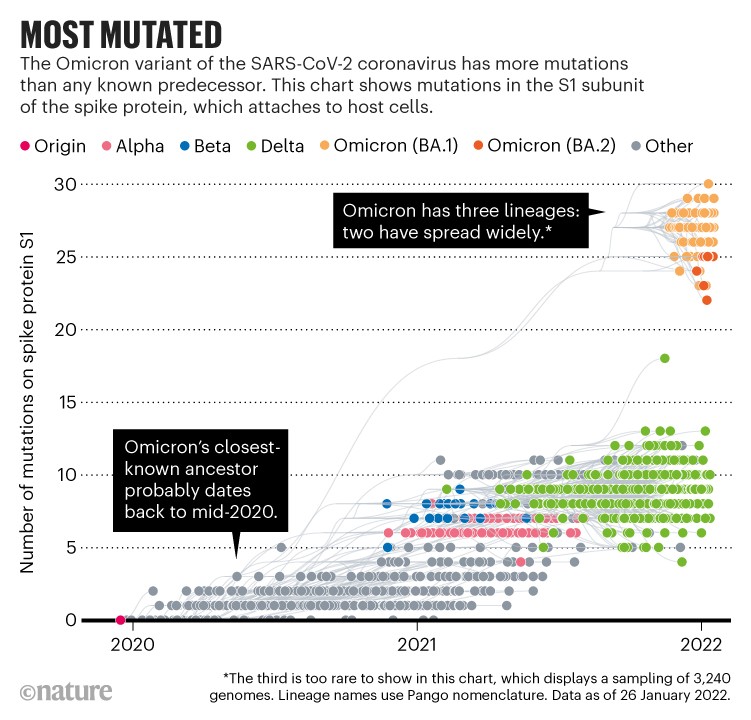
The variant has more than 50 mutations when compared with the original SARS-CoV-2 virus isolated in Wuhan, China (see go.nature.com/32utxva). Some 30 of these contribute to changes in amino acids in the spike protein1, which the coronavirus uses to attach to and fuse with cells. Previous variants of concern have had no more than ten such spike mutations. “That is a hell of a lot of changes,” says Neher (see ‘Most mutated’).

Most mutated: Scatter plot showing the number of mutations on spike protein S1 of the SARS-CoV-2 coronavirus over time.

Source: Nextstrain

Researchers have seen many of these mutations before. Some were previously known to give the virus an increased ability to bind to the ACE2 receptor protein — which adorns host cells and is the docking point for SARS-CoV-2 — or to help it evade the body’s immune system. Omicron forms a stronger grip on ACE2 than do previously seen variants3. It is also better at evading the virus-blocking ‘neutralizing’ antibodies4 produced by people who have been vaccinated, or who have been infected with earlier variants. Other changes in the spike protein seem to have modified how Omicron enters cells: it appears to be less adept at fusing directly with the cell’s membrane, and instead tends to gain entry after being engulfed in an endosome (a lipid-surrounded bubble)3.

But more than a dozen of Omicron’s mutations are extremely rare: some have not been seen at all before, and others have popped up but disappeared again quickly, presumably because they gave the virus a disadvantage1.

Another curious feature of Omicron is that, from a genomic viewpoint, it consists of three distinct sublineages (called BA.1, BA.2 and BA.3) that all seem to have emerged at around the same time — two of which have taken off globally. That means Omicron had time to diversify before scientists noticed it. Any theory about its origins has to take this feature into account, as well as the number of mutations, notes Joel Wertheim, a molecular epidemiologist at the University of California, San Diego.

Silent spread

Researchers have explained the emergence of previous variants of concern through a simple process of gradual evolution. As SARS-CoV-2 replicates and transmits from person to person, random changes crop up in its RNA sequence, some of which persist. Scientists have observed that, in a given lineage, about one or two single-letter mutations a month make it into the general viral circulation — a mutation rate about half that of influenza. It is also possible for chunks of coronavirus genomes to shuffle and recombine wholesale, adds Kristian Andersen, an infectious-disease researcher at Scripps Research in La Jolla, California. And viruses can evolve faster when there is selection pressure, he says, because mutations are more likely to stick around if they give the virus an increased ability to propagate under certain environmental conditions.

Some scientists think that person-to-person spread would not be conducive to accumulating as many changes as Omicron has since mid-2020. “It does seem like a year and a half is a really short period of time for that many mutations to emerge and to apparently be selected for,” says Rasmussen.

But Bhiman argues that enough time has elapsed. She thinks the mutation process could have occurred unseen, in a region of the world that has limited genomic sequencing and among people who don’t typically get tested, perhaps because they didn’t have symptoms. At some point in the past few months, she says, something happened to help Omicron explode, maybe because the progress of other variants — such as Delta — was gradually impeded by the immunity built up from vaccination and previous infection, whereas Omicron was able to evade this barrier.

Although researchers have submitted almost 7.5 million SARS-CoV-2 sequences to the GISAID genome database, hundreds of millions of viral genomes from people with COVID-19 worldwide have not been sequenced. South Africa, with some 28,000 genomes, has sequenced less than 1% of its known COVID-19 cases, and many nearby countries, from Tanzania to Zimbabwe and Mozambique, have submitted fewer than 1,000 sequences to GISAID (see ‘Missing genomes’).

Missing genomes: Bar chart showing percentage genomes sequenced as percentage of reported COVID-19 cases in various regions.

Source: GISAID

Martin says that researchers need to sequence SARS-CoV-2 genomes from these countries to get a better sense of the likelihood of unobserved evolution. It is possible that the three sublineages of Omicron each separately arrived in South Africa from a region with limited sequencing capacity, he says.

But de Oliveira says the scenario that Omicron evolved unseen through person-to-person transmission is “extremely implausible”. Intermediate steps in Omicron’s evolution should have been picked up in viral genomes from people travelling from countries that do little sequencing to those that do a lot.

“This is not the nineteenth century, where you take six months to go from point to point by sailboat,” says Sergei Pond, a computational evolutionary biologist at Temple University in Philadelphia, Pennsylvania.

And Andersen adds that, because some of Omicron’s mutations haven’t been seen before, the variant might have evolved in an environment not involving person-to-person chains of transmission. Some of the changes in Omicron don’t match any seen even in the broader viral group of sarbecoviruses, which includes the virus that causes severe acute respiratory syndrome (SARS). For example, one particular site on the genomes of all known sarbecoviruses encodes a serine amino acid, but a mutation in Omicron means the variant has a lysine at that position1, which changes the biochemistry of that region, Andersen says.

However, says Jesse Bloom, a viral evolutionary geneticist at the Fred Hutchinson Cancer Research Center in Seattle, Washington, SARS-CoV-2 has not yet explored all of its possibilities in people. “The virus is still expanding in the evolutionary space.”

Chronic infection

An alternative incubator for fast-paced evolution is a person with a chronic infection. There, the virus can multiply for weeks or months, and different types of mutation can emerge to dodge the body’s immune system. Chronic infections give the virus “the opportunity to play cat and mouse with the immune system”, says Pond, who thinks it is a plausible hypothesis for Omicron’s emergence.

Such chronic infections have been observed in people with compromised immune systems who cannot easily get rid of SARS-CoV-2. For example, a December 2020 case report described a 45-year-old man with a persistent infection5. During almost five months in its host, SARS-CoV-2 accumulated close to a dozen amino-acid changes in its spike protein. Some researchers suggest Alpha emerged in someone with a chronic infection, because, like Omicron, it seems to have accumulated changes at an accelerated rate (see go.nature.com/3yj6kmh).

“The virus has to change to stick around,” says Ben Murrell, an interdisciplinary virologist at the Karolinska Institute in Stockholm. The receptor-binding domain, where many of Omicron’s mutations are concentrated, is an easy target for antibodies, and probably comes under pressure to change in a long-term infection.

Health workers in protective overalls stand outside a building placed under lockdown in Hong Kong during the omicron wave

Health workers stand outside a building under lockdown in Hong Kong, amid a rise in Omicron coronavirus cases.Credit: Louise Delmotte/AFP/Getty

But none of the viruses from individuals with chronic infections studied so far has had the scale of mutations observed in Omicron. Achieving that would require high rates of viral replication for a long time, which would presumably make that person very unwell, says Rasmussen. “It seems like a lot of mutations for just one person.”

Further complicating the picture, Omicron’s properties could stem from combinations of mutations working together. For example, two mutations found in Omicron — N501Y together with Q498R — increase a variant’s ability to bind to the ACE2 protein by almost 20 times, according to cell studies6. Preliminary research by Martin and his colleagues suggests that the dozen or so rare mutations in Omicron form three separate clusters, in which they seem to work together to compensate for the negative effects of any single one1.

If this is the case, it means that the virus would have to replicate sufficiently in a person’s body to explore the effects of combinations of mutations — which would take longer to achieve than if it were sampling the space of possible mutations one by one.

One possibility is that multiple individuals with chronic infections were involved, or that Omicron’s ancestor came from someone with a long-term infection and then spent some time in the general population before being detected. “There are a lot of open questions,” says Rasmussen.

Proving this theory is close to impossible, because researchers would need to be lucky enough to find the particular person or group that could have sparked Omicron’s emergence. Still, more comprehensive studies of SARS-CoV-2’s evolution in chronic infections would help to map out the range of possibilities, says Neher.

Mouse or rat

Omicron might not have emerged in a person at all. SARS-CoV-2 is a promiscuous virus: it has spread to a wild leopard, to hyenas and hippopotamuses at zoos, and into pet ferrets and hamsters. It has caused havoc in mink farms across Europe, and has infiltrated populations of white-tailed deer throughout North America. And Omicron might be able to enter a broader selection of animals. Cell-based studies have found that, unlike earlier variants, Omicron’s spike protein can bind to the ACE2 protein of turkeys, chickens and mice3,7.

One study found that the N501Y–Q498R combination of mutations allows variants to bind tightly to rat ACE2 (ref. 6). And Robert Garry, a virologist at Tulane University in New Orleans, Louisiana, notes that several other mutations in Omicron have been seen in SARS-CoV-2 viruses adapting to rodents in laboratory experiments.

The types of single-nucleotide substitution observed in Omicron’s genome also seem to reflect those typically observed when coronaviruses evolve in mice, and do not match as well with the switches that are observed in coronaviruses adapting to people, according to a study of 45 mutations in Omicron8. The study noted that, in human hosts, G to U substitutions tend to occur in RNA viruses at a higher rate than C to A switches do, but that Omicron does not show this pattern.

It is possible, then, that SARS-CoV-2 could have acquired mutations that gave it access to rats — jumping from an ill person to a rat, possibly through contaminated sewage — and then spread and evolved into Omicron in that animal population. An infected rat could later have come into contact with a person, sparking the emergence of Omicron. The three sublineages of Omicron are sufficiently distinct that, according to this theory, each would represent a separate jump from animal to human.

A large population of animals with infections lasting longer than in humans could give SARS-CoV-2 room to explore a wide diversity of mutations and “build up a large ghost population of viruses that no one knows about”, says Martin, who says he finds this ‘reverse zoonosis’ theory convincing. Changes that make the virus better at spreading in its animal host won’t necessarily affect its ability to infect people, he says.

An animal reservoir could also explain why some of the mutations in Omicron have been rarely seen before in people, says Andersen.

In the dark

But others say that even a single viral jump from an animal to a person is a rare event — let alone three. Meanwhile, the virus has had plenty of opportunities to slip between people. And although some of Omicron’s mutations have been seen in rodents, that doesn’t mean they can’t happen or haven’t occurred in people, too, and have simply been missed.

Murrell also points out that SARS-CoV-2 didn’t immediately go through a period of accelerated evolution after jumping to people for the first time. When it spread to mink and deer, it did pick up changes, but not as many mutations as Omicron has accumulated, says Spyros Lytras, an evolutionary virologist at the University of Glasgow, UK. This means that the evidence isn’t sufficient to suggest Omicron’s predecessor would have undergone rapid selection after finding a new home in the wild.

To confirm this theory, researchers would need to find close relatives of Omicron in another animal, but they haven’t been looking — “something that has been horribly neglected”, says Martin. Since the pandemic began, researchers have sequenced fewer than 2,000 SARS-CoV-2 genomes isolated from other animals, mostly from mink, cats and deer.

Now that Omicron has taken off, how it evolves in people could offer more clues about its origins. It might, for instance, shed mutations that, in retrospect, are found to have helped it adapt to a different animal host, or in a person with a chronic infection. But it could also not change by much, leaving researchers in the dark.

The answer to Omicron’s emergence will probably be one or a combination of the three scenarios, says Bloom. But, he adds, researchers are far from explaining the processes that brought Omicron here, let alone predicting what the next variant will look like.

And many scientists say they might never find out where Omicron came from. “Omicron really shows us the need for humility in thinking about our ability to understand the processes that are shaping the evolution of viruses like SARS-CoV-2,” says Bloom.

Nature 602, 26-28 (2022)

doi: https://doi.org/10.1038/d41586-022-00215-2

https://www.nature.com/articles/d41586-022-00215-2

Ottawa police get reinforcements as anti-vax convoy arrives

 Police in Canada’s capital have called in reinforcements as a planned anti-vaccine mandate protest began to swell in numbers.

Several thousand people are expected in Ottawa as part of group demanding an end to vaccine mandates and COVID-19 restrictions. Some of the group’s leaders are calling for a peaceful event, but statements from some associated with the group have included threats of violence.

Ottawa police are working with national security agencies to identify any potential threats to public safety, Chief Peter Sloly said during a press briefing on Friday.

“Even during the course of this conference call we’ve had new intelligence coming in regards to local threats,” he said.

A top Parliament security official has warned lawmakers to lock their doors amid reports their private homes may be targeted.

Trucks and cars began rolling into downtown Ottawa midday Friday, as a planned anti-vaccine mandate protest grew. They have set up in the streets around Parliament Hill for the weekend — and possibly longer.

Trucks and cars lined the north side of the main street outside, far past the Parliament buildings. Thus far the atmosphere has been generally party-like with some setting up barbecues on the sidewalk, and many honking horns, playing instruments and blaring music.

They are, in part, protesting a new rule that took effect Jan. 15 requiring truckers entering Canada be fully immunized against the coronavirus. The United States has imposed the same requirement on truckers entering that country.

While the protest has largely been billed as being against a new vaccine mandate for commercial truck drivers at the border, its origins go back long before that policy was conceived.

The memorandum of understanding being pushed by organizer calls for Trudeau and all provincial governments to eliminate all COVID-19 restrictions and vaccine mandates. The document fails to mention truckers at all.

Robyn May, a business owner from Long Point, Ontario was there with her husband in hockey jerseys, toting anti-Trudeau signs.

“We are not a free country,” May said, adding government mandates forced her business to close at times during the pandemic.

When asked how long she thinks the protest will last, she said she plans to stay until “Justin Trudeau is no longer our prime minister.”

The police chief said there are concerns about “parallel demonstrations,” as some with extreme, far-right and white supremacist views have latched onto the protest as the convoy has crossed the country.

The Canadian government ended the truckers’ exemption to the vaccine mandate, meaning Canadian truck drivers need to be fully vaccinated if they want to avoid a two-week quarantine and pre-arrival molecular test for COVID-19 before crossing into Canada.

Unvaccinated or partially vaccinated foreign national truck drivers who do not have a right to re-enter are turned away at the border and directed back to the United States. The U.S. now also requires Canadian truckers to provide proof of vaccination to enter that country.

The Canadian Trucking Alliance has disavowed the protest and said more than 85% of truckers are vaccinated.

https://apnews.com/article/coronavirus-pandemic-health-canada-ontario-ottawa-7ffa5b13371bf0d6ea86a938205c1e7a

Omicron drives US deaths higher than in fall’s delta wave

 Omicron, the highly contagious coronavirus variant sweeping across the country, is driving the daily American death toll higher than during last fall’s delta wave, with deaths likely to keep rising for days or even weeks.

The seven-day rolling average for daily new COVID-19 deaths in the U.S. has been climbing since mid-November, reaching 2,267 on Thursday and surpassing a September peak of 2,100 when delta was the dominant variant.

Now omicron is estimated to account for nearly all the virus circulating in the nation. And even though it causes less severe disease for most people, the fact that it is more transmissible means more people are falling ill and dying.

“Omicron will push us over a million deaths,” said Andrew Noymer, a public health professor at the University of California, Irvine. “That will cause a lot of soul searching. There will be a lot of discussion about what we could have done differently, how many of the deaths were preventable.”

The average daily death toll is now at the same level as last February, when the country was slowly coming off its all-time high of 3,300 a day.

More Americans are taking precautionary measures against the virus than before the omicron surge, according to a AP-NORC poll this week. But many people, fatigued by crisis, are returning to some level of normality with hopes that vaccinations or prior infections will protect them.

Omicron symptoms are often milder, and some infected people show none, researchers agree. But like the flu, it can be deadly, especially for people who are older, have other health problems or who are unvaccinated.

“Importantly, ‘milder’ does not mean ‘mild,’” Centers for Disease Control and Prevention Director Dr. Rochelle Walensky said this week during a White House briefing.

Until recently, Chuck Culotta was a healthy middle-aged man who ran a power-washing business in Milford, Delaware. As the omicron wave was ravaging the Northeast, he felt the first symptoms before Christmas and tested positive on Christmas Day. He died less than a week later, on Dec. 31, nine days short of his 51st birthday.

He was unvaccinated, said his brother, Todd, because he had questions about the long-term effects of the vaccine.

“He just wasn’t sure it was the right thing to do — yet,” said Todd Culotta, who got his shots during the summer.

At one urban hospital in Kansas, 50 COVID-19 patients have died this month and more than 200 are being treated. University of Kansas Hospital in Kansas City, Kansas, posted a video from its morgue showing bagged bodies in a refrigeration unit and a worker marking one white body bag with the word “COVID.”

“This is real,” said Ciara Wright, the hospital’s decedent affairs coordinator. “Our concerns are, ‘Are the funeral homes going to come fast enough?’ We do have access to a refrigerated truck. We don’t want to use it if we don’t have to.”

Dr. Katie Dennis, a pathologist who does autopsies for the health system, said the morgue has been at or above capacity almost every day in January, “which is definitely unusual.”

With more than 878,000 deaths, the United States has the largest COVID-19 toll of any nation.

During the coming week, almost every U.S. state will see a faster increase in deaths, although deaths have peaked in a few states, including New Jersey, Pennsylvania, Iowa, Maryland, Alaska and Georgia, according to the COVID-19 Forecast Hub.

New hospital admissions have started to fall for all age groups, according to CDC data, and a drop in deaths is expected to follow.

“In a pre-pandemic world, during some flu seasons, we see 10,000 or 15,000 deaths. We see that in the course of a week sometimes with COVID,” said Nicholas Reich, who aggregates coronavirus projections for the hub in collaboration with the CDC.

“The toll and the sadness and suffering is staggering and very humbling,” said Reich, a professor of biostatistics at University of Massachusetts, Amherst.

https://apnews.com/article/coronavirus-pandemic-business-health-california-public-health-83c0a053bfdd615b5ae7170007c2f1f9

NYC To Send COVID Test Kits Home With Every K-12 Student Ahead Of Midwinter Break In Feb.

 The city Department of Education plans to send a COVID test kit home with every K-12 public school student before the midwinter break from February 21st to the 25th.

The tests come via the state, after Governor Kathy Hochul announced earlier this week that all school districts in New York will receive tests to distribute to their students specifically for the break, when families may travel or kids may mingle with relatives or friends.

Hochul said the plan is to avoid another outbreak of COVID that disrupted the beginning of the spring semester, when cases of the highly transmissible omicron variant surged throughout New York City and student attendance plummeted, while large numbers of staffers and teachers were out sick.

“Keeping kids in school is best for their health. We keep them safe by making sure that they have test kits that go home with them if necessary,” Hochul said this week. “And I want to announce that as we're approaching the winter break, schools have different times, but between February and March, I want to make sure that we have enough kits to have every child be able to have a test kit sent home with them before the break. They're exposed during the break, they don't go back to school if they test positive.”

The city DOE said in an email Thursday that they will send a test kit home with all students except for 3K and pre-K kids, the week of February 14th. An inquiry about the number of tests in each kit was not immediately answered, though the DOE has been distributing boxes that contain two tests.

There were 1,033,669 K-12 students enrolled in 2020-2021 according to the most recent state data, including charter school students. Hochul also allocated a million tests for New York City public schools ahead of the winter holiday break in December.

It was not immediately clear if the DOE will require students and staff to show a negative test result before returning to school on February 28th. Chalkbeat reported that “some large school districts, including Washington, D.C. and Los Angeles, have required students and staff to test negative to return to school after a break to help reduce the risk of coronavirus transmission in classrooms.”

The city did not require a negative test result to return to class January 3rd after the winter holidays.


https://gothamist.com/news/nyc-send-covid-test-kits-home-every-k-12-student-ahead-midwinter-break-february