Search This Blog

Wednesday, June 22, 2022

Krystal Biotech Files To Seek Approval For Skin Disease Candidate

 Krystal Biotech, Inc. 

 submits biologics license application (BLA) to the U.S. Food and Drug Administration (FDA) seeking approval of B-VEC (beremagene geperpavec) in the treatment of patients with dystrophic epidermolysis bullosa (DEB).

The BLA submission for B-VEC is supported by data readout from the GEM-3, a multi centre trial and the GEM-1/2, a single-center trial, designed to evaluate the efficacy and safety of B-VEC for the treatment of DEB.

Suma Krishnan, President of Research & Development, commented : “The unmet medical need for DEB patients remains very high and our relentless pursuit of a treatment for this disease continues with the same sense of urgency that we have always had since the founding of Krystal Biotech. We look forward to working with the FDA in its review of our BLA submission."

The Company planning to submit a marketing authorization application to the European Medical Agency (EMA) in the second half of 2022.

B-VEC was granted fast track designation and rare pediatric designation by the FDA, in addition to  EMA’s orphan drug designation and PRIority MEdicines (PRIME) eligibility for the treatment of DEB.

https://www.benzinga.com/general/biotech/22/06/27813435/krystal-biotech-files-to-seek-approval-for-skin-disease-candidate

Edgewise's Dystrophy Candidate Lowers Muscle Damage Biomarkers


  • Edgewise Therapeutics Inc  announced 2-month interim results from the ARCH study of EDG-5506 in adults with Becker Muscular Dystrophy (BMD). 
  • EDG-5506 was well-tolerated with no discontinuations or dose reductions. The most common adverse events observed at the 10 mg dose were dizziness (17%) and somnolence (17%). These were generally transient and typically observed in the first few days of dosing. 
  • All patients have subsequently been dose-escalated to 15 mg daily as per protocol.
  • The 2-month plasma PK data for the 10 mg once-daily dose of EDG-5506 showed exposure levels that were approximately 61% of what was observed in the Phase 1b study (dosed at 20 mg once daily for two weeks). 
  • The reduced exposure for BMD participants in the ARCH study is consistent with the lower dose of 10 mg and a shorter half-life of EDG-5506 in BMD patients, likely associated with a decreased overall muscle mass.
  • EDG-5506 showed a significant decrease in key biomarkers of muscle damage. Notably, creatine kinase and fast skeletal muscle troponin I were reduced by an average of 30% and 68%, respectively, after two months.
  • "We're encouraged by the decrease in biomarkers, particularly in the context of the increased activity observed in BMD patients treated with EDG-5506," said Joanne Donovan, Chief Medical Officer of Edgewise.

New Orleans Grill 1st Business Court Lets Recover Damages For COVID Lockdown Losses

 by Michael Washburn via The Epoch Times (emphasis ours),

Oceana Grill, a popular seafood restaurant in New Orleans, has achieved a first-of-its-kind victory in its long-running legal battle to receive payouts from insurer Lloyd’s of London for loss of revenues during its COVID-19 shutdown beginning on March 20, 2020.

On June 15, a Louisiana state court reversed an earlier decision and ruled in favor of the claim for damages brought by the company owning Oceana Grill, Cajun Conti LLC.

Cajun Conti initiated legal action on that same day that the shutdown went into effect in March 2020, seeking damages under its insurance policy with Lloyd’s of London. But the action was not initially successful. In the first trial of its kind, underwriters for the insurer in February 2021 received a favorable judgment from a state court, denying the plaintiff’s petition for declaratory relief.

The June 15 decision is highly significant for businesses that seek compensation for often massive and crippling losses of revenues suffered when they were forced to curtail their operations or cease altogether as COVID-19 swept the country in the early months of 2020.

But the June 15 ruling does not mean that all such businesses will now be able to pursue claims that insurers and courts had previously refused to entertain. Rather, it is likely to benefit the minority of businesses whose insurance policies do not contain exclusions for the contamination of buildings and food, said John Houghtaling, a name partner of the Metairie, Louisiana-based law firm Gauthier Murphy & Houghtaling, which represented Cajun Conti in the litigation.

I’m not surprised at all by the ruling. The evidence presented at the trial was very compelling,” Houghtaling said.

So far, Cajun Conti’s legal action is the only case of its kind to go to trial, he noted. What sets this case apart from other potential litigation over COVID-related damages is that the counsel for the plaintiff was able to present evidence that the underwriters seeking to defend Lloyd’s of London against the claim were lying, he said.

Houghtaling cited evidence that more than a decade before the onset of COVID-19, representatives of the Insurance Services Office (ISO) met with insurance commissioners across the country, including some in Louisiana, and admitted that insurance policies for business interruption do provide coverage for the contamination of buildings, and the food inside buildings, by viruses.

Read more here...

https://www.zerohedge.com/political/new-orleans-grill-becomes-first-business-allowed-court-recover-damages-covid-19-lockdown

EQT's Galderma announces positive trial results on skin drug

EQT’s Galderma on Wednesday said its injectable drug nemolizumab helped patients suffering from the rare skin disease prurigo nodularis in a trial, potentially underpinning the owner’s ambitions to list the skincare firm.

In a late-stage trial, Galderma’s drug was shown to remove lesions and ease itch in some patients. Itch is a chronic symptom of the potentially debilitating skin disease.

Sources told Reuters in May that EQT is delaying listing plans for Galderma as market volatility and recession fears in Europe cool investor appetite for what could be Switzerland’s biggest flotation in more than two decades.

The listing could happen in the autumn or early next year depending on market conditions, the sources said at the time.

Japan’s Maruho Co. Ltd is also working on a prurigo nodularis treatment while French drugmaker Sanofi is running trials to get its bestselling eczema drug Dupixent also approved for the disease. 

https://financialpost.com/pmn/business-pmn/eqts-galderma-announces-positive-trial-results-on-skin-drug

Polio virus detected in London sewage samples

 The virus which causes polio has been detected in a concerning number of sewage samples in London, health officials have said.

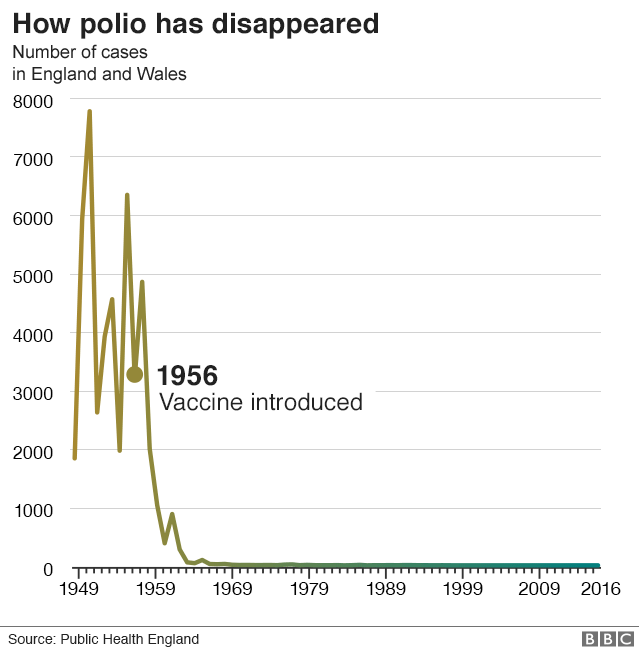
The disease was common in the UK in the 1950s but was eliminated by 2003.

The UK Health Security Agency (UKHSA) says it was probably imported to London by someone who was recently vaccinated overseas with a live form of the virus.

It says the risk is low, but parents should ensure their children have been fully immunised against the disease.

"Most of the UK population will be protected from vaccination in childhood, but in some communities with low vaccine coverage, individuals may remain at risk," said Dr Vanessa Saliba, consultant epidemiologist at UKHSA.

An inactivated polio vaccine is used in the UK as part of the routine childhood programme. It is given to children three times before the age of one, and then again at three and 14 years of age.


Take-up of the first three doses is about 86% in London, well below target levels, with the rest of the UK over 92%.


Health authorities have now declared a national incident and informed the World Health Organization (WHO) of the situation.

Sewage detection

Over the past four months, the UKHSA has found the polio virus in samples collected from the Beckton sewage works, which serves a population of four million in north and east London.

Scientists believe the virus originated from someone who was immunised abroad with the live oral polio vaccine, which hasn't been used in the UK since 2004.

That person then shed traces of the virus from their gut which were detected by the sewage sampling.

In rare cases, that form of the virus can then be transmitted to others and mutate into what is known as "vaccine-derived" polio.

Although weaker than the original or "wild" form of the disease, it can still cause serious illness, including paralysis, in people who are unvaccinated.

A tiny number of samples of the polio virus are detected each year in sewage surveillance, but this is the first time that a cluster of genetically-linked samples has been found repeatedly over a period of months.

Health officials say this suggests there has been some spread between closely-linked individuals in London.

No actual cases of polio have been detected and there have been no reports of rare but serious symptoms in the UK.

Jane Clegg, chief nurse for the NHS in London, said the health service would be contacting parents of children aged under five in London who are not up to date with their childhood jabs.

"Parents can also check their child's vaccination status in their red book, and people should contact their GP practice to book a vaccination should they or their child not be fully up to date," she said.

Chart showing polio cases

Rare disease

Polio is a rare disease and is spread after a person does not wash their hands properly after using the toilet and then touches food or water consumed by others, or in rarer cases by coughing and sneezing.

Most people don't have any symptoms and will fight off the virus without even realising they were infected. A small number will experience flu-like symptoms for up to three weeks.

In a very small number of cases, thought to be between one in 100 and one in 1,000, the polio virus attacks the nerves in the spine and base of the brain.

This can cause paralysis, usually in the legs. If the breathing muscles are affected, it can be life-threatening.


https://www.bbc.com/news/health-61896411

Spain detects first local infection with cholera since 1979

 Spain has detected its first locally acquired case of cholera in over four decades, regional health authorities said on Wednesday, although the infected person has already recovered and no other cases have been reported in the meantime.

A female patient was hospitalised in a private health care facility in Madrid and was later discharged after receiving treatment, a spokesperson for the Madrid health authority said, without providing the hospitalisation dates or other details.

She had been infected after drinking water from a property in Toledo, 75 km south of the capital in the region of Castilla La Mancha, and the property has since been closed for safety reasons, according to health officials in that region.

Cholera is an acute diarrhoeal infection caused by the bacteria Vibrio cholerae and can be deadly if left untreated. It is mainly spread by contaminated food and water.

The last big locally transmitted cholera outbreak in Spain was in 1979 when 267 cases were reported mainly in Barcelona and Malaga. Since then, health authorities only registered a few imported cases each year.

Punctual surges of the disease are not uncommon, especially in developing countries or war zones where treatment often is not available.

According to the World Health Organization, between 1.3 and 4 million cases of cholera are reported worldwide each year.

https://www.breakingnews.ie/world/spain-detects-first-local-infection-with-cholera-since-1979-1323750.html

COVID-19 vaccine scheme for world's poorest pushes for delivery slowdown

 Leaders of the global scheme aiming to get COVID-19 vaccines to the world's poorest are pushing manufacturers, including Pfizer and Moderna, to cut or slow deliveries of about half a billion shots so doses are not wasted.

COVAX, the World Health Organization-led scheme, wants between 400 and 600 million fewer vaccines doses than initially contracted from six pharmaceutical companies, according to internal documents seen by Reuters.

While at first the initiative struggled for shots as wealthy nations snapped up limited supply, donations from those same countries later in 2021, as well as improved output from manufacturers - alongside delivery challenges and vaccine hesitancy in a number of countries – has led to a glut of vaccine in 2022.

COVAX has called for manufacturers to acknowledge the global oversupply situation, and support collective efforts to meet the timing of countries' needs and avoid unnecessary wastage," said a spokesperson for Gavi, the Vaccine Alliance, which runs the initiative alongside WHO.

Gavi wants manufacturers to either reduce the size of the initial orders or at least "re-phase" them, meaning they are delivered at a later date that is more aligned with when countries need them.

Future negotiations might also include getting the variant-specific vaccines currently being tested by manufacturers including Moderna and Pfizer.

While Gavi is close to an agreement with some manufacturers, contract negotiations with other companies are not as advanced, according to sources close to the talks. No deals have yet been agreed.

The biggest orders are with Moderna and Pfizer, alongside the Serum Institute of India, Novavax, Johnson & Johnson and Clover Biopharmaceuticals.

"Being cognisant of local needs, we are seeking to provide pragmatic solutions to requests whenever possible," Pfizer said in an emailed statement, while Novavax said the status of its COVAX deliveries was currently "unclear." Moderna said it had nothing to add at this time.

COVAX follows in the steps of other vaccine buyers in trying to cut deliveries agreed at the height of the pandemic, including European Union governments. Pfizer and Moderna have agreed to delay some shipments.

In total, COVAX has delivered more than 1.5 billion doses in the last 18 months.

However, its initial aims of contributing towards the goal of vaccinating 70 per cent of the population of every country in the world by this month have now effectively taken a back seat to protecting 100 per cent of the most vulnerable -– namely, health workers and the elderly.

While 66.3 per cent of the world's population has now had at least one COVID-19 vaccine dose, the proportion falls to 17.8 per cent in low-income countries, according to Our World In Data.

"What is critical for the global pandemic response now is not a high volume of doses, but tailored supply and support to lower-income countries," said Gavi.

Documents ahead of the organization's board meeting this week, reviewed by Reuters, also show COVAX is considering extending its work to "leverage dose donations" from high-income countries to provide COVID-19 vaccines for children, as well as adults, in some of the countries the scheme supports.

https://www.ctvnews.ca/health/coronavirus/covid-19-vaccine-scheme-for-world-s-poorest-pushes-for-delivery-slowdown-1.5957721