Search This Blog

Thursday, June 23, 2022

Rite Aid ups guidance after revenue beat


  • Retail Comparable Store Prescriptions Increased 0.9 Percent – Comparable Store Non-COVID Acute Prescriptions Increased 11.9 Percent

  • Revenues of $6.01 billion, Compared to Prior Year Revenues of $6.16 billion

  • Net Loss per Share of $2.03, Compared to Prior Year Net Loss per Share of $0.24

  • Adjusted Net Loss per Share of $0.60, Compared to Prior Year Adjusted Net Income per Share of $0.38, Driven by Non-Cash Impairment Charges and Cycling Prior Year COVID Vaccination Benefit

  • Adjusted EBITDA of $100.1 million, Compared to the Prior Year Adjusted EBITDA of $138.9 million

  • Increases Fiscal 2023 Revenue and Maintains Fiscal 2023 Adjusted EBITDA Guidance

Wednesday, June 22, 2022

How to get treated for long COVID in NY and NJ

 Long COVID is a bummer. Even mild infections of the coronavirus are leading to weeks and months of lingering symptoms such as loss of smell, confusion due to mental brain fog, and fatigue.

But severe outcomes, such as heart disorders and kidney disease, are appearing, sometimes well after people have recovered. Vaccines appear to waylay some of the ill effects, but large-scale studies are finding in inoculated people with “post-acute sequelae of SARS-CoV-2 infection” or PASC.

This situation is precarious for the economy, given 20-40% of adults may experience COVID fallout in the long term. Health plans and employers could respond by making sure their employees receive comprehensive care, but that could be expensive, given many long haulers need to see medical specialists.

Researchers at the City University of New York predict that the median case of symptomatic COVID could result in $6,000 in lost productivity over the course of a year. So, for local employees confused about how to get care or navigate insurance, here’s a simple guide.


Visit your primary doctor. Ask for a specialist.

Treating long COVID and PASC remains difficult because the conditions express themselves in so many different ways. An analogy would be brain cancer. More than 120 types of brain tumors exist, and precise treatment can be impeded without timely identification of what’s happening inside the body.

The RECOVER Initiative, a $1.15 billion federal study on long COVID and PASC launched in spring 2022, declares there are “200+ more symptoms and counting.”

Karyn Bishof, president of the COVID-19 Longhauler Advocacy Project, said patients need to be diligent when it comes to knowing the different signs of the disease and finding the right medical professionals to address it.

“Every primary care provider in the country needs to get to a level where they can screen a patient and identify long COVID or its associated conditions,” Bishof said because delays in diagnosis will only slow down the referral to a specialist.

NYC Health + Hospitals has set up an AfterCare resource center, where people can find information on obtaining care through the city’s public health care system. NYU Langone and Mount Sinai also run long COVID treatment centers, and a large list of facilities exists for New Jersey.

Current wait times for specialists can last up to 18 months, Bishof said, so get in early.

If a long COVID patient feels that they’re waiting too long, they can typically file a complaint with the provider, which must respond by law in places like New York and New Jersey. If that fails, they can escalate the issue to local officials, such as those in New Jersey’s Department of Banking & Insurance or New York’s Department of Health.


Make sure your doctor uses the U09.9 code

Long haulers, like many people with chronic disease, will likely face the challenge at some point during their care of proving their “medical necessity.” No specific treatments have been approved to directly address long COVID — and how it impacts organs like the heart, lungs and nervous system. That’s because long COVID studies are mostly in their early stages.

A chicken-egg scenario often arises with getting health plans to cover treatment: Doctors can try known medications or therapies to help those organs, but the insurance companies want evidence that doing so can work.

“Insurance companies will sometimes disallow certain costs as not medically necessary, particularly in situations where there is that kind of gray area about medical necessity,” said Joel Cantor, director of the Center for State Health Policy at Rutgers University, told Gothamist. “That's an ongoing challenge, particularly for folks who have multiple symptoms.”

Medical necessity is initially judged by a person’s physician, and doctors need to document the conditions correctly in order for patients to receive insurance coverage.

An essential part of this process is inputting a code specific for post-COVID disorders — U09.9 — into medical records. This code is part of an international system — curated in part by the CDC — that must be used by any health plan or health care provider using electronic records in the U.S.

The U09.9 code only became effective last October, and Bishof said some medical professionals still aren’t familiar with it, even though it can help justify claims for treatments. Even getting a prescription for routine medications related to COVID-caused symptoms or disease might be difficult without this code.


If you’re denied tests or treatment, file an appeal

Even if a long COVID patient’s primary doctor or specialist deems a treatment plan as a medical necessity, health insurance providers can still deny the claim.

If this happens, Maanasa Kona, an assistant research professor at Georgetown University’s Center on Health Insurance Reforms, said patients can submit additional information to support their need for the disputed services.

Kona said insurance plans use scientific evidence or guidance from physician organizations to define what are necessary treatments. But so little is known about how to treat long COVID so most therapies would be considered unproven.

“Call the insurance company, explain your situation, and ask how to do this,” said Cantor. “They're legally obliged to disclose everything to you — all of your rights.”

Both Cantor and Kona stress that long COVID patients facing medical necessity denials have options to appeal. This applies to people with private insurance or a public plan like Medicaid. They say to first file an appeal with the insurance plan — and ask doctors or health care providers for help.

The appeals process will likely vary depending on coverage. Cantor said people working at larger companies with employer-sponsored plans to work with their HR department. Employees at smaller companies may need to directly contact their insurance broker or ask their employers to act as an intermediary.

If an internal appeal is also denied by the health insurance plan, long COVID patients can seek an independent review from a state regulator. New Jerseyites can request such a review by emailing ihcap@dobi.nj.gov or calling 1-888-393-1062 (or 609-777-9470). New Yorkers can do likewise by visiting the Department of Financial Services website, emailing externalappealquestions@dfs.ny.gov or calling (800) 400-8882.


Some options are disappearing

Patients should be aware that key pandemic-era subsidies that help reduce out-of-pocket health costs are at risk of ending. So patients with long COVID symptoms should not delay in getting care.

The American Rescue plan, ratified in March 2021, allowed people to purchase better health care plans from their state ACA marketplaces. But these subsidies will expire by the end of the year unless renewed. The health policy institute KFF estimates that 3.7 million people would lose extra benefits and many more who are enrolled in the marketplaces would see premiums double.

Likewise in the coming months, millions will likely lose access to Medicaid, the federal and state health plan for people with limited incomes. Prior to COVID-19, states had to conduct annual audits to make sure Medicaid enrollees still qualified for the benefits. But these “eligibility determinations” were paused during the pandemic. Kicking people off health care as a deadly virus spreads could put many more at risk.

Eligibility determinations will return if the country’s public health emergency is declared over by the U.S. Health Secretary — a decision they have made every 90 days since January 2020. The next signature is due in mid-July, but a renewal is expected.

Health policy experts predict that 5 to 14 million people will be determined ineligible for Medicaid whenever the decision goes the other way.


https://gothamist.com/news/how-to-get-treated-for-long-covid-in-ny-and-nj

Corn-Based Ethanol Worse For Environment Than Gasoline: Study

 Contrary to previous belief, corn-based ethanol appears to carry more of a negative environmental impact than gasoline produced with fossil fuels.

New research by the University of Wisconsin-Madison Center for Sustainability and the Global Environment has suggested that ethanol produces more greenhouse gas emissions than gasoline. While past research has indicated the opposite, UW-Madison’s study showed that ethanol is responsible for at least 24 percent more carbon emissions. The study was funded in part by the US Department of Energy and the National Wildlife Federation as the Biden administration reviews the country’s existing biofuel policies. 

This comes as a surprise to anyone who remembers the implementation of the Renewable Fuel Standard (RFS) in 2005. Based on research that previously showed ethanol was better for the environment than gasoline, the RFS dictated that oil refineries must mix approximately 15 billion gallons of ethanol into the nation’s gasoline supply. As the UW-Madison study points out, the RFS now “guides nearly half of all global biofuel production”—which, despite its good intentions, has far-reaching industrial implications that negatively impact Earth.

Because oil refineries required such large quantities of ethanol, corn prices shot up by 30 percent. High demand resulted in an 8.7 percent increase in US corn cultivation—the byproduct of which was an increase in the nation’s nitrogen-based fertilizer use. Tilling the cropland associated with corn production released carbon trapped in the soil. (It’s also worth mentioning that the study points to a negative impact on the nation’s water supply, thanks to an increase in water degradants.) Once these factors are considered alongside the combustion emissions, UW-Madison concluded, ethanol is no longer as attractive a supplement to the US fuel supply as previously thought. 

“The carbon intensity of corn ethanol produced under the RFS is no less than gasoline and likely at least 24 percent higher,” reads the study, published earlier this year in the Proceedings of the National Academy of Sciences.

While most of ethanol’s negative effects appear to be associated with corn cultivation rather than combustion, the effort to reduce carbon emissions must be a holistic one that considers the whole supply chain. The RFS is currently set to impose fuel-mixing requirements through 2022, after which the US Environmental Protection Agency is eligible to propose changes to the nation’s policies. 

https://www.extremetech.com/extreme/337314-corn-based-ethanol-is-actually-worse-for-the-environment-than-gasoline-study-finds

Half Of Americans Didn't Save During Pandemic, Leaving No Savings Cushion Amid Recession Fears

 by Katabella Roberts via The Epoch Times,

Roughly half of Americans did not build up savings during the COVID-19 pandemic, according to a new survey by YouGov, as fears mount that a recession could be looming on the horizon.

YouGov’s survey covered 20,000 adults across 18 major economies including Sweden, Spain, Australia, China, and India, and challenges the idea that households within the world’s major economies have a savings cushion that could bolster spending amid a potential economic downturn.

According to the survey, shared exclusively with Bloomberg, 51 percent of respondents stated that they had not added to their savings during the global pandemic, with Germany seeing the lowest rate of savings at 39 percent, while Italy stood at 40 percent.

The United States, United Kingdom, and Canada also saw results below 50 percent when respondents were asked if they had added to their savings.

Elsewhere, the survey showed that of those who did manage to build up their savings during the pandemic, just 53 percent have managed to hold onto them, while 26 percent have spent the savings on bills or other essential purchases.

Another 13 percent said they spent the cash on holidays and social events after lockdown restrictions were lifted, while 19 percent used their savings on home improvements or to move into a new house.

The latest survey comes as U.S. Treasury Secretary Janet Yellen said June 19 that she expects the U.S. economy to slow in the months ahead, but remained optimistic that a recession is “not at all inevitable,” despite concerns among economists that a downturn is on the horizon.

In an interview with ABC’s “This Week,” Yellen said that consumer spending remains strong, in spite of increased prices for everything from fuel to food, and that bank balances among Americans remain “high,” allowing for them to weather increased inflation.

“It’s clear that most consumers, even lower-income households, continue to have buffer stocks of savings that will enable them to maintain spending,” Yellen said.

“So I don’t see a drop-off in consumer spending as a likely cause of the recession in the months ahead, and the labor market is very strong, arguably the strongest of the postwar period.”

The national saving rate was about 4.4 percent in April 2022, the lowest since September 2008, according to data from the U.S. Bureau of Economic Analysis (BEA) published on May 27.

Separate data from Northwestern Mutual’s 2022 Planning & Progress Study showed that the average amount of personal savings dropped 15 percent from $73,100 in 2021 to $62,086 in 2022, although year-over-year numbers show that savings levels remain high, with 60 percent of those surveyed stating that they’d been able to build up their personal savings over the past two years.

However, inflation has reached a 40-year-high, surging to 8.6 percent in May, leaving Americans splashing out more for everyday essentials.

In an effort to bring down those inflation figures, the Federal Reserve raised its benchmark interest rate three-quarters of a percentage point on June 15 and Fed Chairman Jerome Powell said he expects “either a 50-basis-point or a 75-basis-point increase” at the July meeting.

“Overall economic activity appears to have picked up after edging down in the first quarter,” the Federal Open Market Committee said on June 15. “Job gains have been robust in recent months, and the unemployment rate has remained low. Inflation remains elevated, reflecting supply and demand imbalances related to the pandemic, higher energy prices, and broader price pressures.”

“The Committee is strongly committed to returning inflation to its 2 percent objective,” the statement added.

Despite the concerns that lay ahead, Northwestern Mutual’s report found that 73 percent of American adults say they’ve adopted better financial habits due to the COVID-19 pandemic and all 73 percent expect to continue with those habits going forward, while 35 percent believe inflation will subside this year.

https://www.zerohedge.com/personal-finance/half-americans-didnt-save-during-pandemic-leaving-no-savings-cushion-amid

Biden 'Nanny State' Comes For The Smokers

 One day after the Biden administration said it would develop a rule requiring tobacco companies to reduce nicotine levels in cigarettes, a new report via WSJ said the Food and Drug Administration (FDA) is preparing to order Juul Labs Inc. to take its e-cigarettes off the U.S. market.

WSJ cites people familiar with the matter who said the FDA decision could come as soon as today. 

"The marketing denial order would follow a nearly two-year review of data presented by the vaping company, which sought authorization for its tobacco- and menthol-flavored products to stay on the U.S. market," WSJ notes. 

Juul has spent the last several years attempting to regain the trust of the FDA and the public. The company limited marketing and stopped selling fruity flavors in 2019 -- since then, sales have tumbled. 

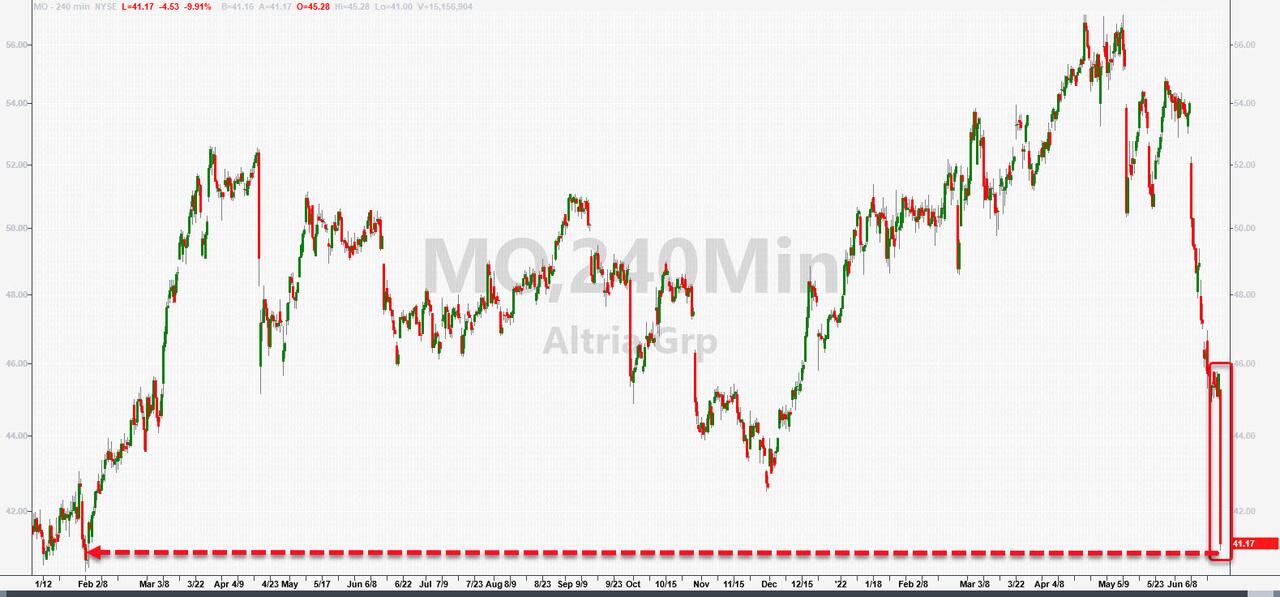
Altria invested $12.8 billion in Juul in December 2018, acquiring a 35% stake. Shares in Altria are down almost 10%, the lowest since February 2021. 

Meanwhile, the Biden administration is also gunning for the percentage of nicotine in cigarettes. As the American Thinker's Andrea Widburg notes:

Not only will this offer dubious health benefits (and I suspect that it will backfire), but it also represents, yet again, the excessive power the Executive Branch has managed to gain, something that's far from what the Founders in their great wisdom envisioned.

The news report isn't complicated:

The Biden administration plans to propose a rule to establish a maximum nicotine level in cigarettes and other finished tobacco products in an attempt to make them less addictive, the White House Budget Office said Tuesday.

The rule, expected in May 2023, would be designed with the goal of making it easier for tobacco users to quit and help prevent youth from becoming regular smokers, according to a document released by the Budget Office.

The proposal comes as the Biden administration doubles down on fighting cancer-related deaths.

In a statement on Tuesday, the U.S. Food and Drug Administration (FDA) said the plan was to 'to reduce youth use, addiction and death.' 

This follows on the heels of the FDA's proposal to ban menthol cigarettes, which are the cigarettes of choice for Blacks, and flavored cigars.  (I have no idea who smokes those cigars.)

My suspicion is that the plan to decrease nicotine may be counterproductive.  While activist White leftists may not believe it, there are people to don't wish to stop smoking.  If each cigarette has less nicotine, they'll simply smoke more cigarettes to get the same rush.  And while nicotine may be the addictive part of cigarettes, it's all the other stuff in the cigarettes that's harmful to health.  If my cynical suspicions are accurate, smoking more cigarettes to get more nicotine will mean more health problems, not fewer.

But there's something else that really irks me about this.  I should note before going farther that I don't have a dog in this fight.  I've never smoked a cigarette and can't stand the smell of either cigarettes or cigars.  If the whole panoply of tobacco products suddenly disappeared from the earth, I would be happy.

However, I am not happy about an Executive Branch that has this much power.  No president should be able to dictate how a product should be made and sold.  This is something that Congress, through the Commerce Clause, should control.

In the same way, the Executive Branch should not be able to affect so drastically the flow of fossil fuels into America.  Our entire way of life is dependent on fossil fuels.  Everything we buy, use, eat, drink, wear, or anything else requires fossil fuels.  Ending fossil fuels means no modern health care, no modern education, no travel, no anything at all.  We will instantly be returned to a dark, grim, narrow world that cannot be saved with limited and expensive wind and solar power (both of which are dependent upon fossil fuels for their manufacturing).

Yet beginning on his first day in the Oval Office, Biden has signed a few pieces of paper that have paralyzed fossil fuel in this country.  He stopped the cheap, easy, and environmentally friendly Keystone Pipeline (giving money to dirty trains and trucks) and stopped drilling and exploration on federal lands.  His administration has done everything possible to damage Americans' access to the energy that underlies this country.

The Founders never intended the Executive Branch to have that kind of power, which drastically affects commerce and should be something Congress debates and votes upon.  The president's job is to enforce the existing laws (laws such as immigration and maintaining a functioning military), not to destroy the energy that keeps America humming.

The fact that Biden wants to destroy the tobacco industry, depriving millions of people of something that gives them pleasure and potentially creating a new health risk, doesn't mean Biden should be able to do so.  Congress must take its power back, or our country risks becoming a pure dictatorship.  The only comforting thought will be that the dictator's new military, complete with transgender troops obsessed with pronouns, "green" ships, and officers focused on Critical Race Theory, won't have the emotional strength to be a Wehrmacht or People's Liberation Army.

https://www.zerohedge.com/markets/fda-order-juul-e-cigarettes-us-markets

DOJ: Maine violates ADA in care of kids with disabilities

 Maine unnecessarily institutionalizes youths with mental health and developmental disabilities because of a lack of sufficient community-based services that would allow them to stay in their homes, the U.S. Department of Justice said Wednesday in declaring a violation of the Americans with Disabilities Act.

The Justice Department conducted its investigation after advocacy group Disability Rights Maine filed a complaint on behalf of a group of children. The rights organization said the children were not able to access community-based services, resulting in institutionalization or risk of institutionalization that violated the ADA.

The Justice Department concurred, saying it found many Maine children with disabilities are unable to live with family because of the state’s lack of community services. That means children in the state enter emergency rooms, come into contact with law enforcement and then remain in institutions when they could otherwise remain in their homes, the department said.

“I hope that the violations identified by the Justice Department can be remedied so that these children and their families are able to obtain quality services in their own communities,” U.S. Attorney Darcie N. McElwee for the District of Maine said in a statement

The Justice Department findings said the state suffers from lengthy waitlists, too few behavioral health providers, and a lack of crisis services and support for foster care parents. That means many children need to enter facilities, including out-of-state facilities and the state-run juvenile detention facility Long Creek Youth Development Center, to receive behavioral health services, the department found.

The Justice Department findings include recommendations for how the state can come into compliance with the Americans with Disabilities Act. The recommendations include using more state resources to maintain a pool of community-based service providers. Another recommendation states Maine should implement a policy that requires providers to serve eligible children and prohibit refusal of services.

The administration of Democratic Gov. Janet Mills said Wednesday that improving behavioral health services for Maine children is one of its goals. The administration also said the shortcomings of the state’s behavioral health system stretch back many years, and the COVID-19 pandemic set back progress.

“We share the strong sense of urgency in ensuring that Maine children with disabilities have timely access to an array of high-quality, evidence-based services that prevent institutionalization whenever possible — and will continue to work diligently towards that end,” said Jackie Farwell, a spokesperson for the Maine Department of Health and Human Services.

Atlee Reilly, legal director for Disability Rights Maine, said that the deficiencies in the children’s behavioral health system in Maine have been well documented and that now it’s time for action.

“We’re grateful for the findings of the Department of Justice,” Reilly said. “We’re not surprised by the findings, because we hear from these families all the time and we hope that these findings will ensure that these longstanding and well-documented problems are addressed with the sense of urgency that they require.”

The Justice Department report says Maine’s lack of behavioral health service has resulted in Long Creek, the state’s only juvenile justice facility, filling the gap. The report states its investigation found that Maine’s “lack of community-based behavioral health services leads to unnecessary and prolonged incarceration.” It says the state is using Long Creek as a “de facto children’s psychiatric facility.”

The future of Long Creek has been a subject of much debate in recent years. Mills vetoed a bill to close the facility last year.

https://apnews.com/article/covid-health-maine-us-department-of-justice-disability-rights-c1b924d0d187ec045ecb1851d0207a92

CDC panel recommends US seniors get souped-up flu vaccines

 Americans 65 and older should get newer, souped-up flu vaccines because regular shots don’t provide them enough protection, a federal advisory panel said Wednesday.

The panel unanimously recommended certain flu vaccines that might offer more or longer protection for seniors, whose weakened immune systems don’t respond as well to traditional shots.

Options include: Fluzone High-Dose, Fluad with an immune booster, or Flublok which is made with insect cells instead of chicken eggs.

The panel’s recommendations usually are adopted by the Centers for Disease Control and Prevention, and become the government’s guidance for U.S. doctors and their patients. This would be the first time the government has stated a flu vaccine preference for older adults.

U.S. officials currently say that all Americans 6 months and older should get a flu vaccine every season.

Flu shots tend to be less effective than other common vaccinations, but they have often been particularly disappointing in seniors. Health officials say there is persuasive research indicating some of the new shots work better in older adults, especially at preventing flu-related hospitalizations. Studies are limited, though, and there’s little research comparing the three new versions.

“These influenza vaccines are better but are not yet the home run that we would love to have,” said panel member Dr. Helen Keipp Talbot of Vanderbilt University,

The new shots have caught on. About 80% of Medicare beneficiaries get the souped-up vaccines each year, mostly the high-dose one, officials said. The new versions can cost roughly three times more than standard flu shots, but they are covered by insurance programs.

Panel members said seniors should get regular flu shots if the newer ones aren’t available.

Also on Wednesday, CDC officials reported the flu vaccine didn’t work all that well this past winter, when most illness were caused by a flu strain that vaccines traditionally do a relatively poor job protecting against. The vaccine was 35% effective in preventing flu symptoms severe enough to require a doctor visit. It was about 44% effective in children, and lower in adults.

https://apnews.com/article/science-health-flu-centers-for-disease-control-and-prevention-0e908c9586ecaa1846fd1c2ec2be1e7d