Search This Blog

Thursday, June 23, 2022

Top Medications Most Often Linked to Headache

 Monoclonal antibodies, antivirals, immunomodulators, and pulmonary arterial vasodilators top the list of drugs that were most frequently implicated as causes of headaches in a federal side effect database that anyone can contribute to, according to a new study presented at the annual meeting of the American Headache Society.

Brett Musialowicz

"Surprising findings included the significant number of immunosuppressants and immunomodulators present in the data," study lead author Brett Musialowicz, a medical student at Robert Wood Johnson Medical School, New Brunswick, New Jersey, said in an interview. "Additionally, our data provides evidence that suggests that several medications belonging to these drug classes were less likely to be associated with medication-induced headaches," raising questions about the mechanism.

Drugs Most Frequently Linked to Headaches

The researchers launched their study to better understand headache as a side effect of medication use, Musialowicz said. They analyzed entries from the Food and Drug Administration's Adverse Event Reporting System for the period from July 2018 to March 2020 and listed the top 30 most commonly reported medications linked to headaches and their reported odds ratio (ROR). According to a website devoted to pharmacovigilance training, ROR refers to "the odds of a certain event occurring with your medicinal product, compared with the odds of the same event occurring with all other medicinal products in the database."

After generic and brand-name data was consolidated, the drug most frequently linked to headaches was apremilast with 8672 reports, followed by adalimumab (5357), tofacitinib (4276), fingolimod (4123), and etanercept (4111). These drugs treat autoimmune disorders such as psoriasismultiple sclerosis, and Crohn's disease.

The other drugs in the top 15 ranked by frequency are treatments for hepatitis C (4 drugs), pulmonary arterial hypertension (4 drugs), arthritis (1 drug), and asthma (1 drug).

Of the top 30 drugs most frequently linked to headaches, the pulmonary hypertension drug epoprostenol — ranked 23rd — had the highest ROR at 12.8. The next highest were the hepatitis C drugs glecaprevir and pibrentasvir, tied at 10th in the frequency analysis and both with an ROR of 9.4.

"Pulmonary arterial dilators and vasodilators are believed to cause headaches by sensitizing extracranial arteries. Clinical evidence suggests there is a vascular component to some types of headache," Musialowicz said. "Monoclonal antibodies are suggested to cause headache by means of an immune response. Several monoclonal antibodies are in trials targeting [the calcitonin gene-related peptide] receptor, which is believed to be involved in migraine headache. These trials will help further elucidate the mechanisms of headache and potential drugs to treat these conditions."

Is the Data Useful?

Stewart Tepper, MD, a neurologist at Geisel School of Medicine at Dartmouth, Hanover, New Hampshire, who's familiar with the study findings, discounted the new research in an interview. He noted that any member of the public can contribute to the federal database of adverse effects (drug manufacturers are required to contribute to it), and the data says nothing about denominators.

"It's not a reasonable way to evaluate adverse effects, to just have everyone and their uncle saying, 'This particular drug did this to me.' It's not in any way useful," he said. However, he added that the database sometimes "gives you a bit of a signal so you can go back and try to get scientifically collected data."

When asked to respond, study coauthor and neurologist Pengfei (Phil) Zhang, MD, of Robert Wood Johnson Medical School, noted that the FDA created the database "for a reason." He also noted that the researchers used a statistical analysis technique — ROR — that was invented to adjust for weaknesses in databases.

No study funding is reported. Musialowicz reported no disclosures. Zhang has received honorarium from Alder Biopharmaceuticals, Board Vitals, and Fieve Clinical Research. He collaborates with Headache Science Incorporated without receiving financial support, and he has ownership interest in Cymbeline. Another author reports research grant support from the American Epilepsy Society and the New Jersey Health Foundation. Tepper reported multiple disclosures.

https://www.medscape.com/viewarticle/976124

Meningococcal Disease Outbreak in Florida Expands: CDC

 The CDC and Florida Department of Health are investigating a growing meningococcal disease outbreak in Florida, which the CDC called "one of the worst outbreaks" of the disease in U.S. history.

At least 24 cases and seven deaths have been reported, mostly among gay and bisexual men, the agency announced Wednesday. Recent data shows that about half of the cases linked to the outbreak are among Hispanic men.

The number of cases in Florida has surpassed the state's 5-year average for meningitis. In response, the CDC says that gay, bisexual, and other men who have sex with men should get a meningococcal vaccine if they live in Florida or talk with their doctor about getting the vaccine, known as MenACWY, if they are traveling to Florida.

In Florida, anyone can get a MenACWY vaccine for free at any county health department during the outbreak, the agency said. People should get vaccinated at least 2 weeks before traveling.

"Getting vaccinated against meningococcal disease is the best way to prevent this serious illness, which can quickly become deadly," Jose Romero, MD, director of the National Center for Immunization and Respiratory Diseases, said in the CDC announcement.

"Because of the outbreak in Florida, and the number of Pride events being held across the state in coming weeks, it's important that gay and bisexual men who live in Florida get vaccinated, and those traveling to Florida talk to their healthcare provider about getting a MenACWY vaccine," he said.

People living with HIV also face increased risks during this outbreak, the CDC said. The MenACWY vaccine is routinely recommended for all people with HIV in the U.S.

In an unrelated cluster of cases with a different subtype of meningococcal disease, college students face higher risks, the CDC said. Officials say college students in Leon County, FL, should get a different shot – the MenB vaccine series – particularly those who live on campus and those in a fraternity or sorority.

People can find a meningococcal vaccine by contacting their doctor's office, pharmacy, community health center, or local health department. Insurance providers should pay for vaccination for those who are recommended to receive a shot during the outbreak, the CDC said.

The CDC also says you should see a health provider right away if symptoms appear, such as a high fever, headache, stiff neck, nausea, vomiting, or a dark purple rash. Symptoms can appear as a flu-like illness but "typically worsen very quickly," the agency said.

People spread meningococcal bacteria through respiratory or throat droplets, like spit. Generally, you can get the disease from close contact, doing things like kissing or being near someone who is coughing, the CDC said.

The disease is caused by the Neisseria meningitidis bacteria, which can show up as meningitis, through inflammation of the lining of the brain and spinal cord, or septicemia, through infection of the bloodstream. The disease is rare and can be treated with antibiotics when caught early, though it "can be deadly," the CDC warned.

"Anyone can get the disease, regardless of sexual orientation, age, race," Sam Crowe, PhD, a CDC epidemiologist, told The New York Times .

New cases are still being reported, he said, and the outbreak is "very much ongoing."

"We want to make sure that gay and bisexual men are aware of the deadly outbreak in Florida and how easy it is to protect themselves – namely vaccination," Crowe said.

SOURCES:

CDC: "CDC Assists with Meningococcal Disease Outbreak Investigation in Florida," "Meningococcal Disease in Florida, 2022."

The New York Times: "An Outbreak of Meningococcal Disease in Florida Is Growing, the CDC Says."

https://www.medscape.com/viewarticle/976126

Promising New Tool for Better Migraine Management in Primary Care

 A new tool can help streamline diagnosis and treatment of migraine in the primary care setting, new research suggests.

Early results from a small pilot study showed that the tool, essentially a medical record "best-practice alert," reduces specialist referrals and MRI studies.

Dr Scott Friedenberg

The idea behind the tool is to give primary care physicians "fingertip access" to prompts on patients' electronic health record (EHR), leading to best migraine management and treatment, co-investigator, Scott M. Friedenberg, MD, vice chair of clinical practice, Geisinger Medical Center, Danville, Pennsylvania, told Medscape Medical News.

When clinicians enter a headache diagnosis into a patient's EHR, a pop-up asks a handful of questions and "prompts them with the right medications so if they just click a button, they can order the medications straight away," Friedenberg said.

The findings were presented at the American Headache Society (AHS) Annual Meeting 2022.

Fewer Referrals, MRI Testing

Researchers reviewed charts for 693 general neurology referrals. About 20% of the patients were referred for headache. In about 80% of these cases, the final diagnosis was migraine and/or chronic daily headache.

The physicians had documented criteria for identifying migraine, such as sensitivity to light, nausea, and missed social activity or work, in fewer than 1% of cases. There's roughly an 80% chance that if a headache meets two of these three criteria, it is a migraine, Friedenberg noted.

About 60% of the participants with headache were referred with no treatment trial. About 20% were referred after having tried two medicines, and 30% were referred after trying one medicine.

"In many cases, we're being asked to evaluate people with primary headache or uncomplicated headache that has not been treated," said Friedenberg.

The investigators developed the tool, and its most recent iteration was tested by 10 physicians at two sites for 3 months. These doctors did not receive education on headache, they were just taught how to use the tool.

Results showed that referrals for neurology consults dropped 77% and MRI ordering dropped 35% after use of the tool. This translated into a savings of $192,000.

However, using the tool didn't significantly affect prescribing habits of the physicians.

Migraine Frequently Undertreated

"When you drill it down, the only thing that changed were medications they were comfortable with, so they increased steroids and nonsteroidal prescribing, but preventives didn't change, narcotics didn't change, and CGRP [calcitonin gene-related peptide] inhibitors didn't change," Friedenberg said.

Although believing patients are "not bad enough to treat" might help explain why clinicians did not change prescribing habits, the reality is that many patients have migraine and should be treated, he added.

Friedenberg pointed out that previous research suggests that 60% or more of patients with a primary headache or migraine are undertreated.

The tool should increase awareness about, and comfort level with, diagnosing and treating migraine among primary care doctors, he noted. "We hope it will make it easier for them to do the right thing and have neurology as a readily available partner," said Friedenberg.

"Primary care doctors are incredibly busy and incredibly pressured, and anything you can do to help facilitate that is a positive," he added.

The researchers now plan to train pharmacists to co-manage headache along with primary care doctors, as is done, for example, for patients with diabetes. This should result in a reduction in physician burden, said Friedenberg.

The next step is to conduct a larger study at the 38 sites in the Geisinger health complex. Half the sites will use the new tool, and the other half will continue to use their current headache management process.

"The study will compare everything from MRI ordering to neurology referrals and prescribing, how often patients go to the emergency department, how often they have a clinic visit, whether the provider is satisfied with the tool, and if the patient's headaches are getting better," Friedenberg said.

Lessons for Clinical Practice

Jessica Ailani, MD, director at MedStar Georgetown Headache Center and associate professor in the Department of Neurology at Georgetown University, co-chaired the session in which the research was presented and called the project "really fantastic."

The study offers "many lessons" for clinical practice and showed that the tool was effective in improving diagnosis of migraine, said Ailani, who is also secretary of the AHS.

"There's a long wait time to see specialists, and most migraine can be diagnosed and basic management can be done by primary care physicians," she told Medscape Medical News.

"The next step would be to work on a way to improve prescriptions of migraine-specific treatments," she added.

Ailani noted that the AHS would be keen to find ways to engage in "collaborative work" with the investigators.

The investigators and Ailani reported no relevant financial relationships.

American Headache Society (AHS) Annual Meeting 2022: Scientific Session 1, OR-5. Presented June 10, 2022.

https://www.medscape.com/viewarticle/975753

Pig-Heart Transplant Case Published With New Details, Insights

 It's a given that the case of David Bennett, Sr, and his transplanted, genetically modified porcine heart will have a lot to teach, and the peer-reviewed publication this week lends welcome authority to some of its earliest lessons.

Bennett lived for 2 months after receiving the heart in the pioneering surgery, and the new case report compiles the available clinical, anatomic, and histologic evidence and other potential clues to the underlying cause or causes of death.

It also describes a mystery that came to light at autopsy: a grossly enlarged heart due to pervasive interstitial edema, and at the cellular level, a peculiar pattern of myocardial damage that included microvascular deterioration and, potentially as a result, cellular necrosis, according to the new report.

The myocardium itself was described as "thickened and stiff," consistent with the "diastolic heart failure" that characterized Bennett's final 10 days and the likely convergence of several underlying processes. Missing, however, was any conventional sign of graft rejection as it is understood clinically or in animal models, the report states.

If a form of tissue rejection was the cause of graft failure, any implicating cellular evidence may simply have been unrecognizable, given the unprecedented nature of the first pig-to-human heart transplantation, the donor animal's multiple anti-inflammatory gene deletions, and partly investigational immunosuppression regimen, speculated Bartley P. Griffith, MD, University of Maryland, College Park.

"I'm betting against it being a fulminant rejection," he told theheart.org | Medscape Cardiology, "because we saw nothing like the [characteristic] platelet deposition or thrombosis of the capillaries."

Griffith, who performed the xenotransplant surgery and led Bennett's postoperative care, is lead author on the case report published June 22 in the New England Journal of Medicine. "Additional studies are under way to characterize the pathophysiologic mechanisms that resulted in this damage," the report states.

The report builds on recent meeting presentations on the case, which, as previously reported, gave cursory details regarding the organ damage and other clinical developments during and after the surgery, including evidence that the transplanted heart contained porcine cytomegalovirus (PCMV).

Similar details also appeared in a third-person account based in part on personal communication with Griffith. The cardiac XTx review that focused on this University of Maryland experience was published June 15 in JACC: Basic to Translational Science, with lead author Jacinthe Boulet, MD, CM, Brigham and Women’s Hospital Heart, Boston.

"The question of how to move XTx forward remains uncertain, and appropriate selection of patients for experimental XTx will be one of the most important challenges to be addressed. The first issue we must contend with is whether we are ready to move to the next XTx in a human. We strongly believe this to be the case," the review states. "Once early experience is gained, with successive iterations of XTx, the bar for success can be raised with maturation of the technology."

Evidence has so far not implicated several other potential mechanisms underlying the graft failure that had been the focus of early speculations. For example, the transplanted pig heart was infected with PCMV, as previously reported. Bennett showed traces of PCMV DNA in his circulation, but no actual virus in his native cells. Still, PCMV remains a suspect.

Bennett also received intravenous immunoglobulin (IVIG) on several occasions to fight rejection, and also severe infections, including a nasty episode of sepsis. A reaction to the IVIG, derived from pooled donor antibodies, could potentially have caused the unusual myocardial damage seen by the University of Maryland team, Griffith observed. Alternatively, the damage might have been partly related to the patient's overall severely diminished condition even before the transplant surgery or his rocky postoperative clinical course.

Indeed, Bennett's condition worsened dramatically on postoperative day 50, and echocardiography showed a striking degree of myocardial wall thickening and heart enlargement, determined to be from edema. "The heart got amazingly stiff but maintained a systolic function that wasn't too terrible, even to the very end. But his heart seemed as though it had swollen overnight," Griffith said. "We had never seen that type of process, the suddenness of this swelling, in our nonhuman primate studies."

The damage to the heart muscle appeared irreversible, based on myocardial biopsy results, so the decision was made to withdraw life support 60 days after the transplant surgery, the report notes.

Among the experience's apparent lessons for future cardiac xenotransplantation, Griffith said, would be to select patients for the surgery who are in a bit more robust condition than Bennett was, who are perhaps ambulatory, not sarcopenic, and not recently on prolonged mechanical circulatory support. "We're going to try to pick a patient who, on the front end, is less critically ill but who is just as likely not to benefit from continued medical therapy" and who isn't a candidate for conventional heart transplantation, he said.

Because of universal efforts to manage conditions like diabetes, hypertension, and vascular disease in the population, and "because these conditions cause many of the cases of organ failure and fuel demand for transplantation, one might wonder whether the advances reported by Griffith and colleagues presage a decreasing demand for organ transplantation," speculates an accompanying editorial from Jeffrey L. Platt, MD, and Marilia Cascalho, MD, PhD, University of Michigan, Ann Arbor.

"We think the answer is no. Since aging is associated with progressive decline in the function of the heart, kidneys, and other organs, advances that extend life expectancy will ultimately increase the prevalence of organ failure and potentially the demand for transplantation."

The donor pig was developed and provided by Revivicor, and the investigational KPL-404 antibody drug used in the experience was provided by Kiniksa. Other disclosures for the case report and editorial from Platt and Cascalho are available at NEJM.com. Boulet reports no relevant relationships; disclosures for the other authors are in their report.

N Engl J Med. Published online June 22, 2022. Full textEditorial

J Am Coll Cardiol Basic Trans Science. Published online June 15, 2022. Full text

https://www.medscape.com/viewarticle/976118

At Military Olympics, October 2019, Wuhan, China, Athletes Caught COVID

 by Jeffrey A. Tucker via The Epoch Times,

It’s going to take far more than a few investigators to piece together the timeline of the great disaster of our times, much less figure out all the parties responsible. As an example, I’ve followed this as closely as anyone but one key date somehow eluded my radar until now.

It is the Military World Games held in Wuhan, China, 2019, drawing athletes from all over the world. In this high profile event, 9,308 athletes from 109 countries competed in 329 events in 27 sports. It is highly likely that COVID was already known to be there, a fact which destroys the timelines of many people on all sides of the issue.

So far there have been no deep investigations into the question. U.S. personnel were never tested. But the fact of widespread sickness after the games was well known by everyone who was there, and this was true in most countries. Doctors examining patients at the time described it as a “bad cold” but the symptoms they reported are unmistakably COVID, of the most severe variety (“wild type”), lasting many weeks with long recovery periods.

This was months before COVID made the headlines, and long before Jeremy Farar and Anthony Fauci claimed to have been made aware of the virus (Dec. 31, 2019). Until now, I’ve believed them. I’m beginning to doubt that.

If these games resulted in vast sickness on the part of so many, with unusual but similar symptoms, surely the possibility of a problem perhaps located in Wuhan would have been widely known in those circles.

Another telling sign that everyone noticed upon arrival in Wuhan in October: the city was empty. The highways had no cars. The retail shops were closed. No one was on the streets. For a city of 11 million, this was spooky. The CCP bragged that they had cleared out the city to make life special for the athletes but it was clearly a first sign of lockdown.

Why?

In a brief moment of journalism, the Washington Post actually ran a competent story by Josh Rogin on the topic in June of 2021, one that elicited no serious follow up. Here it is quoted at length.

The games in Wuhan were the largest in the event’s history, and the Chinese government went all out. The U.S. delegation came with 280 athletes and staff representing 17 sports, ranging from wrestling to golf. (Team USA brought home the bronze in the latter competition.)
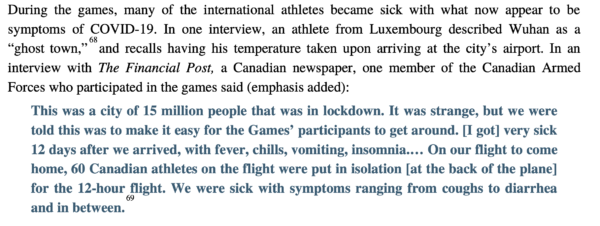
During the two-week event, however, many of the international athletes noticed that something was amiss in the city of Wuhan. Some later described it as a “
ghost town.”

As the covid-19 pandemic took hold worldwide in early 2020, athletes from several countries — including France, Germany, Italy and Luxembourg — claimed publicly they had contracted what they believed to be covid-19 at the games in Wuhan, based on their symptoms and how their illnesses spread to their loved ones. In Washington, military leaders either dismissed the idea out of hand or weren’t aware of it. Meanwhile, no one performed any antibody testing or disease tracing on these thousands of athletes. No one even attempted to find out whether the games in Wuhan was, in fact, the first international pandemic superspreader event.

If more evidence were discovered, it would add to the growing body of evidence that the virus was circulating in Wuhan as early as October 2019, months before the Chinese government acknowledged it to the rest of the world. U.S. intelligence reports have said that researchers at the Wuhan Institute of Virology were hospitalized with covid-like symptoms in November 2019. But U.S. officials have said they have other information suggesting that the outbreak began even earlier.

Nailing down the timeline of the pandemic’s origin is a crucial task ….

These are some of the questions Gallagher is putting to the Pentagon. He noted that Robert Redfield, the former director of the Centers for Disease Control and Prevention, has said he believes that the virus began spreading in Wuhan during September or October of 2019 and that more evidence has emerged that the virus was already present inside the United States by December 2019…

Sen. Roger Marshall (R-Kan.) wrote a separate letter to Health and Human Services Secretary Xavier Becerra on this issue Tuesday, asking whether his department was aware of any U.S. athletes who fell ill after returning from Wuhan. He also wanted to know whether HHS was either looking into the issue or discussing it with the Defense Department.

Of course, there’s no way the U.S. government could have such evidence if they never tested the athletes in the first place. Five senior national security officials from the Trump administration told me that no one even thought to test the U.S. military athletes who returned from Wuhan. At that time, they noted, the conventional wisdom was that covid-19 had broken out in December 2019, not two months earlier.

The State Department’s only consideration of the Wuhan Military World Games came when the Chinese foreign ministry began citing the event in its own propaganda in March 2020. The Chinese asserted that U.S. Army personnel might have brought the virus to Wuhan from Fort Detrick in Frederick, Md., where the U.S. Army bioresearch program is based. That didn’t make sense because the first outbreak was in Wuhan, not Maryland. But the Trump team never took it any further than that.

“We were aware in the administration of the Chinese government’s misinformation campaign accusing the U.S. military of bringing covid to Wuhan at those games, which obviously we didn’t take seriously and didn’t consider to be a good-faith effort to get to the bottom of it,” David Feith, a former State Department official, told me. “To the extent there are now or there were all along credible reports of sick athletes from those games, we should certainly chase them down and learn more.”

Determining the timeline of the outbreak is crucial to understanding the origins of the pandemic — and to getting a clearer focus on the scope of the Chinese government’s coverup. The politics don’t matter. It’s a matter of national security and public health.

This same scenario was reported in a lengthy investigation into the virus’s origins conducted by the House Foreign Affairs Committee, resulting in a report issued August 2021.

The earliest report in English that I can find dates from May 17, 2020. “Inside the Games” reported that “More athletes have revealed that they fell ill during the Military World Games in October when the Chinese city of Wuhan hosted the event months before the COVID-19 outbreak.”

https://www.zerohedge.com/covid-19/military-olympics-october-2019-wuhan-china-athletes-caught-covid

Anebulo Eyes Topline Data for ANEB-001 Phase 2 Trial for Acute Cannabinoid Intoxication

 Anebulo Pharmaceuticals, Inc. (Nasdaq: ANEB), a clinical-stage biopharmaceutical company developing novel solutions for people suffering from acute cannabinoid intoxication (ACI) and substance abuse disorder (the "Company" or "Anebulo"), anticipates releasing topline data from Part A of its ongoing Phase 2 study of ANEB-001 on July 5th. The results of the study, conducted in sixty healthy subjects challenged with delta-9-tetrahydrocannabinol, better known as THC, will be used to design the next step forward in the clinical trial for ANEB-001 as a potential treatment of ACI.

"We anticipate receiving topline data from our CRO late next week and announcing the data on Tuesday July 5," said Simon Allen, Chief Executive Officer of Anebulo. "The data will allow us to prepare for the exciting next phase of development of our potent, small molecule CB1 antagonist as a novel and to our knowledge, the most advanced antidote for ACI in clinical development, an indication for which there is no FDA approved treatment. On behalf of the Anebulo Team, we look forward to presenting the data after the Independence Day Holiday."

https://finance.yahoo.com/news/anebulo-pharmaceuticals-announce-topline-data-200000833.html

Smallpox drugmakers get new orders as monkeypox spreads

 Smallpox medicine makers Siga Technologies and Chimerix Inc said on Thursday they had received new orders for their antiviral drugs that are expected to be used as monkeypox treatments amid a global rise in infections.

More than 3,000 confirmed cases of monkeypox - which belongs to the family of orthopoxvirus that includes smallpox and cowpox - have been reported from 40 countries where the disease is not endemic.

With the numbers rising, the World Health Organization is set to decide on Thursday whether to declare monkeypox a global health emergency.

Siga received orders worth about $13 million for its oral smallpox drug, Tpoxx, and Chimerix got an order worth $9.3 million for its drug Tembexa.

Shares of Siga rose 4%, while Chimerix's shares were up 5%.

Chimerix, which in May agreed to sell the rights of the drug to Emergent BioSolutions, said on Thursday the contract for new orders is expected to be completed before the sale goes through.

Siga's drug, Tpoxx, is approved in the European Union to treat diseases including smallpox, monkeypox and cowpox, while it is only approved to treat smallpox in the United States and Canada.

"We expect a portion of the courses of oral Tpoxx delivered under these orders will be used for the treatment of active monkeypox cases," Siga Chief Executive Officer Phil Gomez said.

https://www.marketscreener.com/quote/stock/SIGA-TECHNOLOGIES-INC-10830/news/Smallpox-drugmakers-get-new-orders-as-monkeypox-spreads-40798219/