A doctor is calling on women who use the contraceptive pill to test their blood pressure every six months, saying it could protect them from strokes, heart and kidney disease.
Dr. Andrew Thompson, medical director at telehealth and prescription service InstantScripts, said there was a concerning lack of awareness of the health risks when prescribing women the pill.
“It can be easy for medical professionals to downplay issues surrounding blood pressure and oral contraception,” Dr. Thompson said.
High blood pressure, or hypertension, generally doesn’t affect people under 40 – the target market for contraceptives.
“However, this is not a reason to remove all precautions as the potential health outcomes for women, if they occur, may be dire,” Dr. Thompson said.
His concern arose after InstantScripts customers questioned the need to provide information on their previous blood-pressure reading to receive a renewed prescription.
Many online telehealth and prescription services are now offering the pill to women without requiring them to come into the doctor’s surgery for a blood test.
Dr. Andrew Thompson is calling on women who use the contraceptive pill to test their blood pressure every six months.Getty Images/iStockphoto
Dr. Thompson said there was a lack of regulation around prescribing the pill and many providers were not asking their patients sufficient questions.
Hypertension is the primary modifiable risk factor for strokes, heart disease and kidney disease and one in five women (20 percent) experience uncontrolled high blood pressure.
While the chances are relatively low, Dr. Thompson says women should still be aware of the dangers.
“It is extremely important that women have a pharmacist or GP check their blood pressure prior to being prescribed oral contraceptive medication,” he said.
He recommends women check their blood pressure every six months.
“Symptoms surrounding high blood pressure can also be easy to miss,” Dr. Thompson said.
“Online providers have a duty of care and responsibility to minimize health risks by ensuring patients are taking all necessary precautionary measures.”
Headaches, fatigue, irregular breathing and chest pain can all have an underlying link to high blood pressure.
International Atomic Energy Agency Director-General Rafael Grossi says that a team of inspectors which arrived Thursday will stay present at the embattled Zaporizhzhia Nuclear Power Plant on an indefinite basis in hopes of ensuring its safe operation. He returned from the site and briefed reporters in Vienna, outlining the looming concerns.
"The gravest risk to the embattled Zaporizhzhia Nuclear Power Plant is physical damage to equipment from shelling that could lead to a release of radiation," he warned.
"It is obvious there is a lot of fighting in general in this part of Ukraine," Grossi said, and observed that "The military activity and operations are increasing in that part of the country, and this worries me a lot."
"It's obvious that the plant, and the physical integrity of the plant has been violated, several times. [Whether] by chance [or deliberately], we don't have the elements to assess that. But this is a reality that we have to recognize, and this is something that cannot continue to happen," he told the Friday press briefing, without assigning blame for which side shelled the facility.
He further affirmed of the IAEA team he led to the site that "six of the agency's experts remain at the plant" to maintain "permanent presence on site... with two of our experts who will be continuing the work."
While no unsafe radiation levels or any kind of leak has yet been detected, Grossi still painted a picture of the crisis at Europe's largest nuclear power plant - which before the war supplied 30% of Ukraine's electricity needs - as a potential disaster waiting to happen if extra measures aren't taken to restore operations up to standard:
Overall, not one of what the nuclear monitoring agency calls the seven pillars of nuclear safety, which include physical integrity, reliable external power and availability of spare parts, remains intact, Grossi said.
He said that most of the shelling of the plant occurred in August, which was when each warring side intensified accusations that the other was behind the attacks.
Some 500 Russian troops have occupied the site since March, with mostly Ukrainian engineers still operating it. He praised the plant's technicians for coping under wartime stresses, saying it is "admirable for the Ukrainian experts to continue to work in these conditions."
Interestingly, the assessment of his team appeared to directly contradict what Ukrainian officials have been alleging regarding Ukrainian engineers being tortured amid a Kremlin orchestrated 'cover up'. The Associated Presswrote:
But on some points, the agency's initial assessment was more optimistic than the picture painted by Ukrainian officials, who had said that engineers and other employees had been subjected to harsh interrogation and even torture, raising stress levels when they returned to work in reactor control rooms and in other critical jobs.
Ukrainian officials have long argued that the plant's engineers should be viewed as hostages who are being hindered from operating or speaking freely, but Grossi's eyewitness account did not in any way back the claims.
Poliohas reappeared in the United States for the first time in a generation. On July 18, the New York State Department of Health told the U.S. Centers for Disease and Control and Prevention it had detected the poliovirus, which can cause paralysis or death in a small percentage of cases, in a young adult from Rockland County outside New York City.
New York authorities subsequently detected the virus in sewage in Rockland and neighboring Orange County—evidence of transmission in the local community.
That first case prompted authorities in the U.K. and Israel to increase their surveillance—they found polio too.
A polio crisis could be brewing. But despite describing polio as “one of the most feared diseases in the U.S.,” the CDC is trying to maintain total government control over testing for the poliovirus. Only the feds and certain states that already do polio testing would be equipped to monitor for the pathogen.
In withholding the testing materials and protocols, private labs—such as Massachusetts-based surveillance startup BioBot—would need to detect and track the virus, the CDC risks allowing the virus to spread unnoticed in some communities, while also limiting study of a potential outbreak.
“They want to do it themselves,” Vincent Racaniello, a professor in the Department of Microbiology and Immunology at Columbia University, told The Daily Beast. “Just as they wanted to control the COVID tests at the beginning of the pandemic.”
The thing is, even the CDC admits that it botched the initial response to COVID. Last week Rochelle Walensky, the CDC director, told the agency’s 11,000 employees that the CDC needed a top-to-bottom overhaul. “To be frank, we are responsible for some pretty dramatic, pretty public mistakes, from testing to data to communications,” Walensky said.
The CDC might be about to repeat some of its mistakes. Amy Kirby, an Emory University epidemiologist who heads the CDC’s National Wastewater Surveillance System, did not respond to a request for comment.
The poliovirus spreads through direct contact with fecal matter. Before the invention of an oral vaccine in the early 1950s and a sweeping campaign of childhood vaccinations, polio outbreaks caused more than 15,000 cases of paralysis in the U.S. alone every year.
Vaccines squashed polio. By the 1970s, the disease had virtually disappeared from all but a handful of the poorest and most remote countries, such as Afghanistan. When it reappeared, it was usually as a result of international travel—and local health authorities quickly isolated the infected and halted further spread.
The CDC tracked the poliovirus in a U.S. community just once between 1979 and 2022. In 2005, the Minnesota Department of Health identified poliovirus in an unvaccinated infant girl in a largely unvaccinated Amish community. Three other kids got sick before the virus was contained.
Today 90 percent or more of people in the richest countries, including the U.S., are vaccinated against polio. But childhood vaccination rates have been slipping as anti-vax attitudes take hold in a growing minority of people. It’s no accident that Rockland County, where the CDC detected the poliovirus last month, has a lower vaccination rate than the rest of the country: around 60 percent.
“The occurrence of this case, combined with the identification of poliovirus in wastewater in neighboring Orange County, underscores the importance of maintaining high vaccination coverage to prevent paralytic polio in persons of all ages,” the CDC stressed in a report it posted last week.
The public-health stakes couldn’t be higher as the world copes not only with the ongoing COVID pandemic, but also with an accelerating outbreak of monkeypox. But potential looming disaster hasn’t motivated the CDC to release to private labs the DNA primers they would need to detect polio. “Essentially no one is allowed to do it except public [i.e. government] health labs,” Rob Knight, the head of a genetic-computation lab at the University of California, San Diego, told The Daily Beast.
Without the primers and other materials, private labs—and researchers associated with those labs—can’t help the government find polio in other communities. Racaniello compared the CDC’s reluctance to widen polio testing to the agency’s equally tight control of COVID testing during the early months of the novel-coronavirus pandemic. “Which did not work out well,” Racaniello noted in a tweet.
The worst-case scenario is that polio spreads for weeks without anyone realizing it—much in the way monkeypox spread unnoticed at first, as many doctors mistook it for herpes or some other sexually transmitted disease.
The CDC’s recalcitrance appears to be bureaucratic. From a technical standpoint, detecting the poliovirus in sewage isn’t any harder than detecting SARS-CoV-2 or any other virus, Knight explained. Take a sample from sewage, run a PCR test.
But in the U.S., the regulations regarding polio are stricter than for other diseases. “From a regulatory standpoint, you have to account for every single sample that might contain polio,” Knight said. Polio surveillance, he added, is a “paperwork nightmare to get set up.”
There’s also the cost factor. Ramping up polio testing at private labs could cost millions of dollars. And the labs might want the government’s help paying for it. CDC leaders may have noted the growing reluctance of the U.S. Congress to pay for COVID testing and concluded that it’s just easier for the CDC to keep polio testing in-house.
But easier doesn’t necessarily mean better, not when public health is concerned. With some effort and a little money, private labs could reinforce the government’s surveillance system. “[It] should not be hard to do wastewater testing,” James Lawler, an infectious disease expert at the University of Nebraska Medical Center, told The Daily Beast. “BioBot and others who are doing surveillance already could stand up quickly.”
Speed and comprehensive surveillance both matter when it comes to infectious diseases. A little effort on the part of the CDC, and some government funding, could make the difference between a once-in-generation polio outbreak that stalls out in a pair of smallish New York counties, or a much wider outbreak potentially affecting the entire U.S.
Just before 2AMon February 28, 2022, after a night partying in upper Manhattan, Edgar Valette, 39, got into his BMW to drive two friends—Kimberly Martinez, 28, and Michael Santos, 30—home. Careening southbound down the Henry Hudson Parkway, helost controlof his powerful vehicle, vaulting over a barrier onto train tracks 500 feet below. The driver and passengers died. Ten weeks later, just before midnight on May 18, 30-year-old Alwayne Hyltonlost controlof his own speeding BMW on the elevated Bruckner Expressway, north of the Manhattan border in the southwest Bronx, plummeting to the roadway below to his death. Not long after that crash, on May 26, just before 7PM, also in the Bronx, an unnamed 25-year-old mansenthis Mercedes hurtling off the New England Thruway, landing on the street below; he, too, perished. Also in May, a 36-year-old man rode his motorcycle down the West Side Highway; as the sun rose, heslammedinto a median barrier, dying on impact. Weeks later, in Queens, a 28-year-old mancrashedhis motorcycle “at a high rate of speed” down the Utopia Parkway into a brick wall, with the same fatal results.
Since the Covid pandemic hit New York City in March 2020, traffic deaths have skyrocketed, just as they have across the country. Locally and nationally, these deaths have paralleled the same double-digit trajectory upward as homicides and drug-overdose deaths. In 2019, 220 New Yorkers died on city streets, near the record low of 206, set the year before. In 2021, 273 people died, a nearly one-quarter increase in two years. In 2022, as of late May, 93 people have died, down slightly from last year, but 12 percent above pre-Covid levels.
Beyond the human toll, this reversal of street safety was a particular blow for former mayor Bill de Blasio, who left office at the end of 2021. De Blasio had made traffic safety a mayoral centerpiece, promising, in his 2013 campaign, significantly to curtail traffic deaths, building on the double-digit reductions that his predecessors, Michael R. Bloomberg and Rudolph W. Giuliani, had made. By the conclusion of de Blasio’s final term, the increased carnage on the roads would appear, at first glance, to have undone all the improvements that he, too, had notched.
Yet the bad raw numbers hide some successes. The changes that the city has made to its streets over the last decade or so—creating room for pedestrians and cyclists and slowing car and truck drivers—have helped pedestrians, especially, who are dying in fewer numbers relative to a decade ago. The city hasn’t made as much progress in protecting cyclists, but nor have cyclist deaths soared during the pandemic—an achievement, considering how much cycling has increased, as New Yorkers avoid the subway and as food-delivery workers serve people eating more takeout.
Who, then, is perishing now in greater numbers? The victims often fit the profile of those killed in the single-car crashes noted above: younger men, drivers or passengers in motor vehicles, often late at night, often speeding. New York’s increase in traffic deaths, in other words, tends to mirror its (and the nation’s) broader public-safety problem: the self-destructive and dangerous behavior of a young male demographic. As with the recent explosion in violent crime, members of this group are taking advantage of a law-enforcement vacuum that lets them get away with ever more antisocial behavior—until it kills them or someone else. Street engineering has mitigated this problem to some degree, and can do more, but it can’t entirely fix it. Policing and other direct enforcement of behavior also have crucial roles to play.
As in many areas of public safety and public health, New York City started the pandemic with an advantage. In 2019, the city’s 220 traffic deaths—whether people in cars, or pedestrians, or cyclists—represented a per-capita rate of about 2.6 per 100,000 residents, just a small fraction of the 11.1 per 100,000 killed nationwide. Among large, urbanized areas, New York stood out for safety, as well. In Miami-Dade County in 2019, for example, the rate was 11 per 100,000; metro Atlanta’s rate was similar. Even among denser northeastern and mid-Atlantic cities, which have long had lower traffic-death rates than the sprawling south and west, New York performed slightly better than Boston, with its 2.8 traffic deaths per 100,000, and much better than Philadelphia, with its 5.7 deaths per 100,000.
Pre-pandemic, New York’s falling traffic deaths made it a national outlier. Between 2011, when traffic deaths hit a modern low nationwide, and 2019, such fatalities across the country rose by 11.9 percent, to 36,355 annually. In Gotham over this period, by contrast, they fell 12 percent. The difference in pedestrian casualties was especially striking. Nationwide, pedestrian deaths began rising in 2010, after having fallen, reasonably steadily, for at least three decades. By 2019, annual pedestrian deaths had risen from their 2009 low by more than half. But in New York, pedestrian deaths fell by 21.5 percent over the same near-decade.
Charts by Alberto Mena
What made the difference? New York’s decade of reengineering its streets to favor walkers and cyclists indisputably saved lives. Bike lanes and new pedestrian islands and plazas narrowed automotive driving lanes, for example, forcing motor vehicles to go slower and giving walkers and cyclists more room to move and cross. As Alex Armlovich, then of the Manhattan Institute, concluded in a 2017 study, “the evidence is clear that Vision Zero”—the aspirational global slogan to achieve zero traffic deaths—“has improved street safety.” Indeed, citywide, as street makeovers expanded, pedestrian deaths fell from 158 in 2009 to a modern pre-pandemic low of 108 in 2017. Such remade streets were good for the safety of people in cars and trucks, too. In 2009, 90 motorists, including motorcyclists, died on city streets; in 2019, the figure was 68.
Enforcement also saved lives. Notes Michael Replogle, deputy transportation commissioner for policy during most of the de Blasio years, “automated and conventional traffic enforcement,” coupled with a lower 25 mph speed limit on non-highway roads, “expanded greatly to discourage aggressive driving.” Automated speed cameras in school zones, introduced by Bloomberg and widened under de Blasio, have slowed drivers over the past decade (even though, until recently, the state legislature required the city to turn the cameras off on weekends and overnight, when the plurality of crashes occur). Crash injuries fell by 13.9 percent in the year after installation. More than half of drivers getting a speeding ticket in a school zone needed only one such $50 citation to change their behavior, never receiving another ticket, city data show.
Police action reinforced the technology. In 2018, the record-low year for traffic fatalities, police issued a modern record-high number of speeding tickets—152,381—that more than doubled the 2012 total. Whether making a purposeful substitution or not, as police retreated from the tactic of stopping, questioning, and frisking young men allegedly behaving suspiciously on foot, they devoted some of these resources to stopping and summonsing young men behaving dangerously in cars.
The law-enforcement role in making traffic safer had begun much earlier, under former mayors David Dinkins and Rudolph W. Giuliani. Between 1990, New York’s record-high year for traffic deaths (and murders), and 2001, when Giuliani left office after eight years, traffic deaths fell from 701 to 393 annually; annual pedestrian deaths fell from 366 to 193. On traffic safety, remembers Giuliani, “We tried to apply the same process we applied to the other problems . . . find out where the most deaths were taking place, and figure out what is needed to reduce it.” Among other initiatives, Giuliani launched a TrafficStat program, similar to CompStat for crime, to create a statistical map of hot spots for traffic crashes. And his administration also cracked down hard on drunk drivers and reckless drivers, seizing their vehicles and charging reckless drivers with misdemeanors, something rarely done. The city seized so many vehicles, Giuliani recalls, “that we didn’t know what to do with the darn cars.”
The pandemic and related shutdowns that began in March 2020 have imperiled these intertwined successes of street engineering and law enforcement. Over the past two years, New York has performed even more dismally when it comes to traffic bloodshed than the rest of America. In 2021, 42,915 people died on the nation’s roads, up 18 percent from 2019—but New York saw an even worse increase of 24 percent. As Mayor Eric Adams said in May 2022, “we’ve seen traffic violence increase drastically in the past two years. This is a real crisis.”
Even amid these grim figures, however, we can glimpse what New York has done right, relative to the rest of the country. The least bad news, relatively speaking, is the pedestrian death toll. In 2021, 126 pedestrians died. This figure is higher than the annual average of 114 between 2017 and 2019—again, nothing to brag about. But the pedestrian death toll nationwide has risen much more. Further, in 2022, through the end of May, 43 pedestrians had died, down from the same period in 2021 and 2019.
One might argue that fewer pedestrians died in 2021, relative to the increase in other traffic deaths, because fewer of them were on the streets. This hypothesis was true, for a while. In 2020, pedestrian deaths reached a record low. No pedestrians died in April 2020, a never-before-achieved feat. Yet absent the extremity of total lockdown, that’s not how pedestrian deaths work. Pedestrians enjoy safety in numbers, not just from violent crime but from dangerous drivers. Large crowds on foot in intersection crosswalks, for example, deter drivers from speeding through turns. This reality is why dense New York has long had a much lower pedestrian death rate compared with other cities, where fewer people walk.
Nor are cyclist fatalities pushing New York’s traffic-death numbers higher. This is a testament to the safety-in-numbers principle, as well as to New York’s improved cycling infrastructure. Bike riding soared by an estimated one-third on major corridors during the first year of the pandemic and has remained elevated since. The Citi Bike cycle-sharing program has smashed all its daily pre-pandemic records, with 72,298 rides daily in April 2022, up 21 percent from three years before; during the summer months, daily Citi Bike ridership reaches the low six figures. Tens of thousands of delivery riders have also taken to the streets, often riding faster-moving electric bikes that put their riders in greater danger. Indeed, of the 26 cyclists who died in 2020 and the 19 who died in 2021, 11 were “e-cyclists” (not including moped riders or riders on other vehicles without pedals). Working cyclists face disproportionate risk, but this changing mix of danger did not push the overall cyclist death toll up.
New York’s network of bicycle lanes works, where it exists. During 2021, none of the cyclists killed was riding in a well-protected bike lane when he died. One Brooklyn cyclist was killed, though—allegedly by a teenage wrong-way truck driver—in a lane where the city had allowed barriers between cyclists and drivers to deteriorate, replacing physical separations with inadequate lane markings. The provisional takeaway is that the city’s bike lanes and other infrastructure are a success; they are just insufficient to keep up with growing demand. As Sergio Solano, a food-delivery cyclist who has helped organize a trade group, El Diario de los Deliveryboys en la Gran Manzana, to advocate for better safety for working cyclists, notes, “putting . . . barriers between cars and cyclists is working,” albeit “very slowly.”
That’s not to say that New York should be satisfied with these numbers. Deaths remain far higher than they are in comparable European cities. In London in 2021, for example, 55 pedestrians and nine cyclists died—less than half of New York City’s totals, despite similar populations. But in New York, experiencing an explosion in the murder rate since March 2020, let’s declare a modest success when we find one: the city has not lost a decade, or more, of progress in keeping pedestrians (and, to a lesser degree, cyclists) safer.
Though cyclist deaths are not driving the current surge in road violence, New York hasn’t made as much progress protecting cyclists as it has pedestrians. (SPENCER PLATT/GETTY IMAGES)
It’s a different story with motor vehicles. In 2020, 122 motorists died, a 52.5 percent increase over the average between 2017 and 2019. In 2021, 113 car and truck drivers (mostly car) and motorcyclists died, a 42.2 percent rise over the pre-Covid level. The trend is continuing in 2022, with 41 motor-vehicle occupants killed through May, up from 25 for the same period in 2019.
Motorcyclists make up a big share of the increase. Though many motorcyclists are responsible hobbyists, and many others aren’t at fault in fatal crashes with cars and trucks, this category of motor-vehicle death has long been a mark of young male recklessness. Before the pandemic, motorcycles made up just 2 percent of registered conveyances in the city but 14 percent of fatal crashes. As the city estimated in 2015, almost all motorcycle crash victims were male, more than half were under 35, and more than four in ten were driving without a license.
Motorcycling has become far more dangerous since the pandemic began. If you’ve spent time in New York City over the past two and a half years, you’ve doubtless observed more cyclists doubled up on motorbikes without helmets, joyriding. In 2020 and 2021, motorcyclist deaths outpaced the annual average between 2017 and 2019. There’s one rough way to quantify the motorcyclist risk-taking that has helped cause these deaths: between 2017 and 2019, according to my calculations derived from a state database of crash factors maintained by the Institute for Traffic Safety Management and Research, just 11 percent of motorcyclists killed in New York City crashes failed to wear a helmet, as required by law. In 2020, the figure rose to 17.8 percent, and in 2021, to 25 percent.
The proliferation of electric mopeds (which, like motorcycles, but unlike electric bicycles, require a license plate, and thus fall into the “motor vehicle” category) adds to the problem. In the summer of 2020, three riders on bike-share mopeds operated by the Revel startup died, two helmet-less, despite city requirements. That fall, a Revel moped rider killed a Manhattan pedestrian, a rare but real example of the danger that fast-moving two-wheeled vehicles can pose (nearly all pedestrians are killed by car and truck drivers).
The most significant increase in the death toll since 2020, though, is borne by people driving or riding in cars or SUVs. Since 2020, New Yorkers on foot, on bicycles, and in other cars and trucks will be familiar with a new urban blight: drag racers, drivers accelerating at light changes, and drivers who seem enraged. This translates into real public-safety deterioration. Between 2017 and 2019, an average of 46 vehicle occupants—drivers or passengers—died annually in car crashes. The pandemic smashed—literally—these historically low numbers. In 2020, the death toll was 71, and in 2021, 64—increases of 54.3 and 39.1 percent, respectively. As of May, the situation was worsening: 33 such motor-vehicle occupants have died so far this year, nearly double the average of 17 in the first five months of 2017, 2018, or 2019.
It’s never been a secret that male drivers—particularly, young male drivers driving their own vehicles—are responsible for most traffic deaths. A 2010 city study found that “80 percent of pedestrian [fatal or serious] crashes involve male drivers, while only 57 percent of New York City driver’s licenses are held by males.” In about eight in ten fatal crashes, drivers were behind the wheel of their own vehicle, not a commercial vehicle such as a taxi. Between 2017 and 2019, in more than one-quarter of fatal crashes (across genders), the driver was under 30.
The gender breakdown hasn’t changed much of late. Men continued to be behind the wheel in more than eight in ten fatal crashes the last two years. The other risk factor, though, has grown even riskier: young drivers. In 2020, drivers under 30 were in 100 fatal crashes, up 42.9 percent from the average between 2017 and 2019 and constituting 31.4 percent of the total. In 2021, the trend, though abated, continued, with young males driving in 28.2 percent of all fatal crashes. Just as fewer motorcyclists are wearing helmets, as the law requires, fewer drivers and passengers in fatal crashes were wearing seatbelts, as similarly mandated—40.8 percent were unbelted in 2021 and 2022, up from 31 percent in the immediate pre-Covid years.
More drivers are speeding: 69 such deaths occurred in 2020, a major increase over the average of 42 annually between 2017 and 2019, followed by a new high of 80 such deaths in 2021. And more are drinking. Though drunk-driving deaths fell in 2020—presumably because bars and restaurants were closed for much of the year—they rose past the pre-pandemic average in 2021, as entertainment venues reopened. Finally, more fatal crashes are occurring at night: 114 in 2021; and 97 in 2020, up from the pre-pandemic average.
As former city traffic commissioner Sam Schwartz says, drivers are “behaving outrageously.” Schwartz visited the scene of that single-car February 2022 Hudson Parkway crash that killed three, including the driver—and found no skid marks. In 2020, one could at least argue that drivers were behaving recklessly by accident. With roads devoid of traffic, people could perhaps speed or lose their attention without fully noticing. By 2021, though, normal traffic levels had returned—and the deathly trips continued.
What was the big factor that changed beginning in 2020, apart from the less trafficked roads and the fact that many newly unemployed and out-of-school teens and young men had extra time for motoring misadventures? It’s not as if New York ripped out its new pedestrian plazas and bike lanes. To the contrary, the city made even more such space for cyclists and walkers, and for diners, via its “open streets” and “open restaurants” recreation and dining programs.
Rather, law enforcement changed. Automated cameras continued to issue fines—nearly 4.4 million tickets in 2020 (numbers for previous years aren’t comparable, as the city greatly expanded the program in 2020). But police-directed enforcement of the laws of the road—against drunk driving, speeding, and general reckless behavior—plummeted. Between 2017 and 2019, the NYPD issued an average of slightly more than 1 million “moving violations”—for speeding, red-light running, and other dangerous driving—annually. In 2020, the figure dropped to 510,000, and in 2021, to 508,000. Just as New York drivers were proving that they couldn’t regulate their own behavior, the city severely curtailed its regulation of that behavior.
On the densest streets and avenues, drivers still find some of their reckless behavior thwarted by bike lanes, pedestrian plazas, speed bumps, frequent red lights and intersections, and other physical obstacles, and the city can and should create more such obstacles. But bike lanes and bus lines, especially those without physical barriers to keep out car and truck drivers, aren’t entirely self-enforcing. As A. Mychal Johnson, founder of South Bronx Unite, a quality-of-life advocacy group, notes of his own truck- and car-dominated neighborhood, “traffic deaths have increased because traffic enforcement is not a priority for the NYPD. They overlook double-parked cars, especially their own, vehicles in bike lanes, delivery trucks double-parked, and trucks traversing through residential areas to avoid congested truck routes.” In early May 2022, the driver of a box truck careening through a mid-Bronx intersection struck and killed 16-year-old Alissa Kolenovic, who was walking to school; weeks later, a truck driver killed a bicyclist on Bruckner Boulevard. In both instances, chaotically designed streets, coupled with negligible enforcement of traffic in a semi-industrial area, were to blame.
The law-enforcement absence is most glaring on limited-access highways and wide arterial roads. “We’ve made strides on intersections,” says Matthew Carmody, a veteran transportation engineer at city planning firm AKRF. “But away from intersections, where you have these long, wide boulevards” and “big distances between intersections . . . [drivers] speed.” Wide roads, including highways, are “empty of traffic many hours of the day.” Crash barriers did not stop Valette and his friends from plunging over an upper Manhattan highway embankment to their deaths.
Bad drivers, like other antisocial actors, have proved since 2020 that they’re not going to control themselves. The Adams administration has taken some welcome steps to do so. Most important, the mayor realizes that traffic violence and violent crime go together. “I’m sending a clear message that this city is not going to be a city of disorder,” hesaid in May, and “vehicle crashes” are a sign of “a city of disorder.” The mayor will revive the Giuliani-era TrafficStat program, pinpointing locations where “people are speeding, driving fast, reckless[ly] driving” for stepped-up police enforcement. The city will also continue to build out speed bumps, new intersection designs that slow traffic with raised markings, and bike lanes.
This spring, the city successfully lobbied the state legislature to let it keep its speed cameras on 24 hours daily. But cameras can’t make up for the human enforcement pullback, especially since, as The City news site reports, drivers are increasingly using bogus or obscured license plates to evade cameras. Police officers must stop drivers with such plates.
The Adams administration can’t ignore the death toll among working delivery cyclists. Most cyclists are independent contractors for apps such as DoorDash and Grubhub. The business model requires them to ride long distances, and quickly, to deliver hot food. A double-digit annual death number that would be unacceptable in any other blue-collar occupation, such as construction, should be unacceptable in this one as well.
As for reckless car and truck operators, repeat dangerous drivers, including the tens of thousands whose vehicles rack up five or more speed-camera violations yearly, should face consequences. Before 28-year-old Tyrik Mott sped the wrong way down Gates Avenue in Brooklyn and killed infant Apolline Mong-Guillemin in her baby carriage in September 2021, his vehicle had racked up 91 speed-camera tickets, as Streetsblog reported. Cops had repeatedly pulled him over, and the state had suspended his license. But Mott kept driving. Similarly, Michael de Guzman, the person charged with drunkenly hitting and killing New York University student Raife Milligan in May 2022, had four speeding violations on his vehicle in just five months. But both still drove with impunity.
To stop such drivers before they kill, Adams should revive the other Giuliani-era program, as well: seizing the vehicles of the most reckless drivers, people caught behaving dangerously several times behind the wheel. “If you get arrested for reckless driving to the point where we charge you with a misdemeanor, we’re going to take your automobile from you,” Giuliani said in 2000. “And we’re going to take it from you . . . because it’ll remind you that this is important. This kills people. It also kills you.” Twenty-two years later, his words are more relevant than ever.
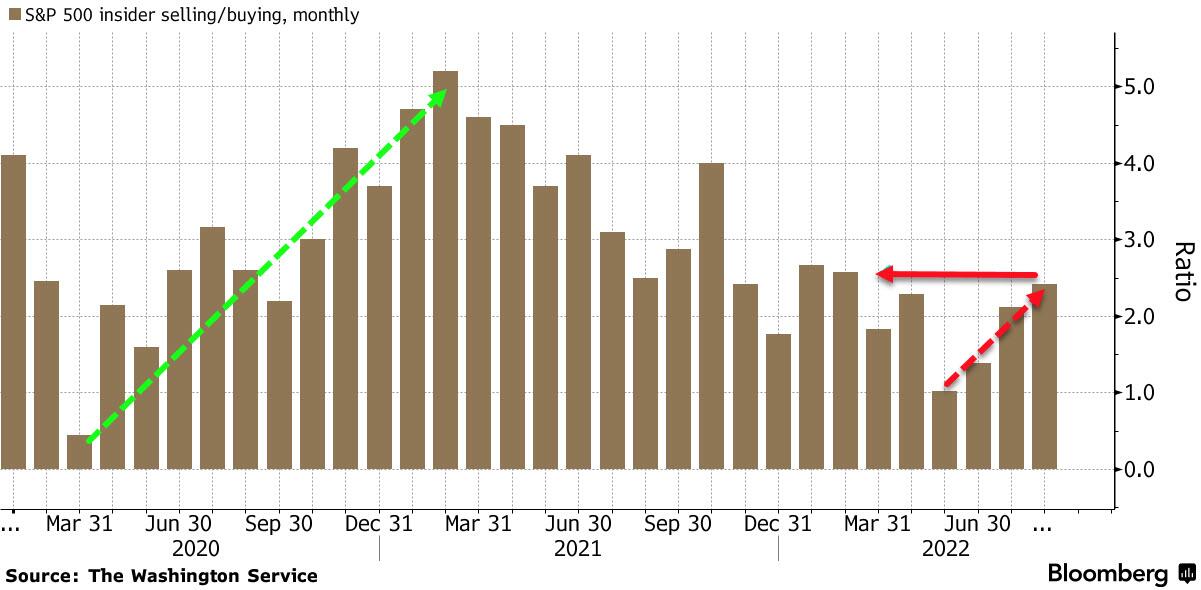
Having aggressively bought the f**king dip off the March 2020 lows, supported a tsunami of free money spewing forth from every government orifice, it appears that 'insiders' have little interest in catching the falling knife now that The Fed has turned its back.
As Bloomberg reports, corporate insiders dumped their own shares aggressively in August, with some 2,150 executives hitting the sell button, the most since November 2021 on a net basis.
“It’s yet another signpost, another signal that there is a high degree of uncertainty around the future,” Quincy Krosby, LPL Financial’s chief global strategist, said by phone.
“The view is that, with regards to both selling and buying, corporate insiders know what they’re doing. It adds to this general sense of uncertainty that’s already out there.”
The surge in insider-selling matches the slumping sentiment toward third-quarter operating margins, with expectations falling to 16.08% from 16.87% over the past eight weeks, data compiled by Bloomberg Intelligence show.
“A tremendous amount of weakness was clearly anticipated ahead of summer’s earnings, but even more is expected, given the pace of negative revisions picked up as the breadth of weakness spread beyond growth in recent weeks to include value stocks,” Gina Martin Adams, chief US equity strategist at Bloomberg Intelligence, said in a note.
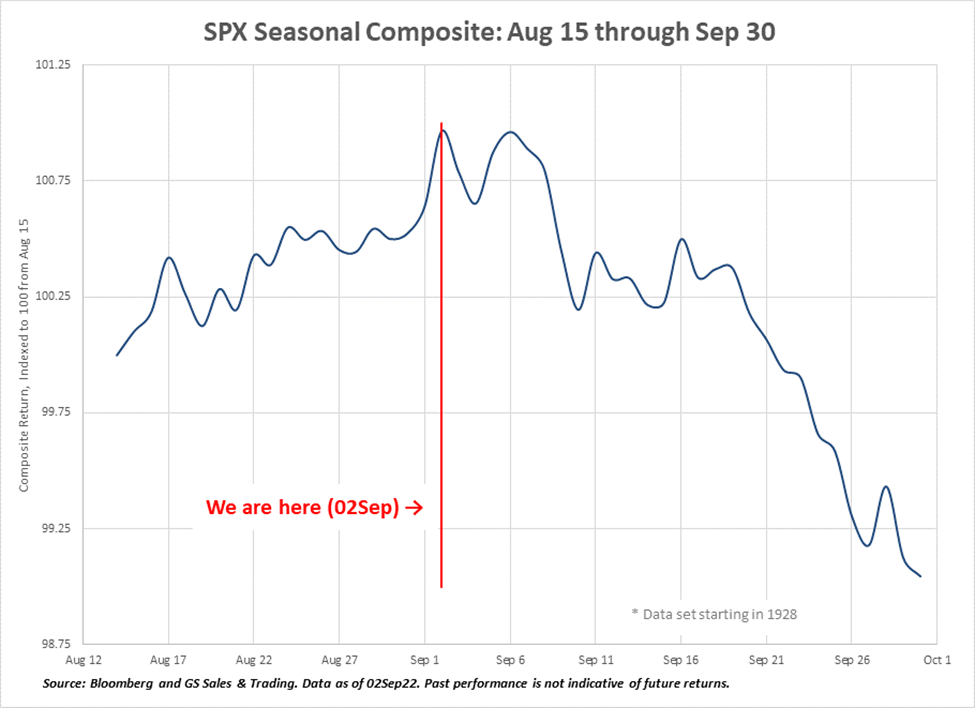
And don't forget, it's that time of the month again...
Finally, we note that it wasn't just 'insiders', global equity funds had outflows of $9.4 billion in the week to Aug. 31, the fourth-largest redemptions this year, according to EPFR Global data cited by BofA. US equities had the biggest exodus in 10 weeks, while $4.2 billion left global bond funds.