Search This Blog

Tuesday, October 18, 2022

5-Day Isolation Period for COVID Makes No Sense

 Welcome to Impact Factor, your weekly dose of commentary on a new medical study. I'm Dr F. Perry Wilson of the Yale School of Medicine.

One of the more baffling decisions the CDC made during this pandemic was when they reduced the duration of isolation after a positive COVID test from 10 days to 5 days and did not require a negative antigen test to end isolation.
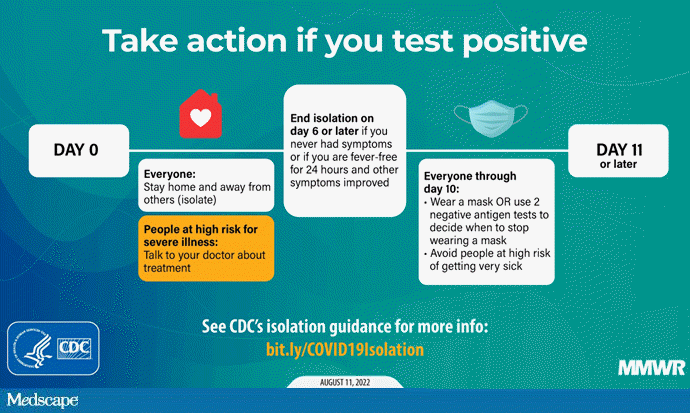


Multiple studies had suggested, after all, that positive antigen tests, while not perfect, were a decent proxy for infectivity. And if the purpose of isolation is to keep other community members safe, why not use a readily available test to know when it might be safe to go out in public again?

Also, 5 days just wasn't that much time. Many individuals are symptomatic long after that point. Many people test positive long after that point. What exactly is the point of the 5-day isolation period?

We got some hard numbers this week to show just how good (or bad) an arbitrary-seeming 5-day isolation period is, thanks to this study from JAMA Network Open, which gives us a low-end estimate for the proportion of people who remain positive on antigen tests, which is to say infectious, after an isolation period.

This study estimates the low end of post-isolation infectivity because of the study population: student athletes at an NCAA Division I school, which may or may not be Stanford. These athletes tested positive for COVID after having at least one dose of vaccine from January to May 2022. School protocol was to put the students in isolation for 7 days, at which time they could "test out" with a negative antigen test.

Put simply, these were healthy people. They were young. They were athletes. They were vaccinated. If anyone is going to have a brief, easy COVID course, it would be them. And they are doing at least a week of isolation, not 5 days.

So — isolation for 7 days. Antigen testing on day 7. How many still tested positive? Of 248 individuals tested, 67 (27%) tested positive. One in four.
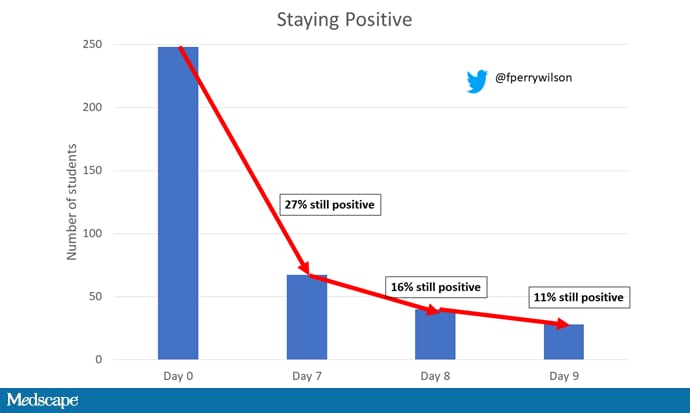


More than half of those positive on day 7 tested positive on day 8, and more than half of those tested positive again on day 9. By day 10, they were released from isolation without further testing.

So, right there we have confirmation that 5 days of isolation without a negative test means you're releasing a decent percentage of infectious individuals back into the population.

There were some predictors of prolonged positivity.
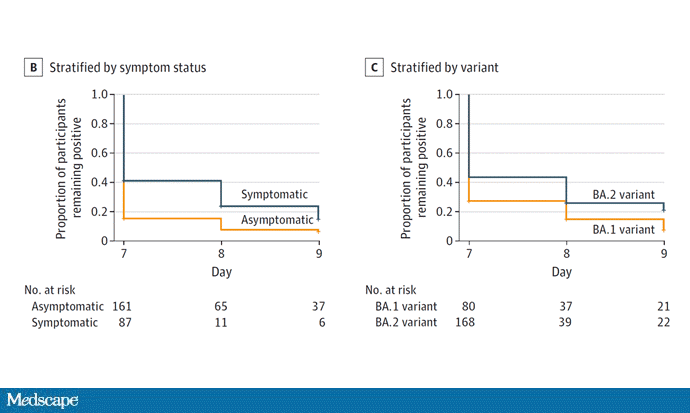


Symptomatic athletes were much more likely to test positive than asymptomatic athletes.

And the particular variant seemed to matter as well. In this time period, BA.1 and BA.2 were dominant, and it was pretty clear that BA.2 persisted longer than BA.1.

This brings me back to my original question: What is the point of the 5-day isolation period? On the basis of this study, you could imagine a guideline based on symptoms: Stay home until you feel better. You could imagine a guideline based on testing: Stay home until you test negative. A guideline based on time alone just doesn't comport with the data. The benefit of policies based on symptoms or testing are obvious; some people would be out of isolation even before 5 days. But the downside, of course, is that some people would be stuck in isolation for much longer.

Maybe we should just say it. At this point, you could even imagine there being no recommendation at all — no isolation period. Like, you just stay home if you feel like you should stay home. I'm not entirely sure that such a policy would necessarily result in a greater number of infectious people out in the community.

In any case, as the arbitrariness of this particular 5-day isolation policy becomes more clear, the policy itself may be living on borrowed time.

F. Perry Wilson, MD, MSCE, is an associate professor of medicine and director of Yale's Clinical and Translational Research Accelerator. His science communication work can be found in the Huffington Post, on NPR, and here on Medscape. 

https://www.medscape.com/viewarticle/982538

AstraZeneca, Ikena Team Up against lung cancer

 Ikena Oncology has entered into a clinical trial collaboration agreement with AstraZeneca to evaluate Tagrisso (osimertinib) with Ikena's IK-930 as a treatment option for patients with EGFR-mutated non-small cell lung cancer, Ikena announced Tuesday.

Tagrisso is a third-generation epidermal growth factor receptor tyrosine kinase inhibitor. Ikena's IK-930 is a novel TEAD inhibitor, which works by targeting the Hippo signaling pathway in patients with unresectable NF2-deficient malignant pleural mesothelioma (MPM).

IK-930 was granted Fast Track designation in June by the FDA for MPM patients. 

Currently, patients with NF2-deficient MPM are treated with a combination of standard-of-care options that include chemotherapy, surgery, immunotherapy and radiation. IK-930 could introduce a novel treatment approach to help patients affected with MPM, AstraZeneca stated.

Patients with NF2-deficient MPM account for 40% of worldwide mesothelioma patients.

“Patients with Hippo-altered cancers are in need of therapies that are effective, safe and significantly improve their quality of life. IK-930 is specifically designed as a paralog-selective TEAD inhibitor that has the potential to provide patients with a differentiated treatment option,” said Mark Manfredi, Ph.D., CEO of Ikena, in a press release.

According to the press release, the ongoing clinical trial will have planned cohorts to explore varying combinations of targeted therapies. One cohort will focus on IK-930's potential to overcome resistance to EGFR inhibitors. 

Of patients who have been treated with and developed a resistance to osimertinib, 50 percent  have actionable mechanisms and available therapies, but 50 percent do not. This leaves a large portion of the patient population without clear treatment options, which is what led to the joint effort between AstraZeneca and Ikena.

Preclinical results showed that when IK-930 was combined with osimertinib, the result was an "increased induction of apoptosis and improved anti-tumor activity in multiple EDGRm tumor models," Ikena stated in the press release.

As part of the agreement, Ikena will provide osimertinib "non-exclusively for evaluation in combination with IK-930 in patients with EGFRm-resistant NSCLC." 

https://www.biospace.com/article/astrazeneca-ikena-team-up-against-nsclc/

Oncology biotech Acrivon Therapeutics files for a $100 million IPO

 Acrivon Therapeutics, a Phase 2 biotech developing precision oncology therapies, filed on Monday with the SEC to raise up to $100 million in an initial public offering.


Through its proprietary precision medicine platform, AP3, Acrivon Therapeutics plans to utilize the creation of drug-specific OncoSignature companion diagnostics to develop its pipeline of oncology drug candidates. Acrivon's lead candidate, ACR-368, is a selective small molecule inhibitor targeting CHK1 and CHK2 in a potentially registrational Phase 2 trial across multiple tumor types, focusing on treatments for platinum-resistant ovarian, endometrial, and bladder cancers. Its ACR-368 OncoSignature test, which has not yet obtained regulatory approval, has been evaluated in two pretreatment tumor biopsy studies collected from patients with ovarian cancer treated with ACR-368 in past Phase 2 clinical trials conducted by Eli Lilly and Company and at the National Cancer Institute.

The Watertown, MA-based company was founded in 2018 and plans to list on the Nasdaq under the symbol ACRV. Acrivon Therapeutics filed confidentially on August 12, 2022. Morgan Stanley, Jefferies, Cowen, and Piper Sandler are the joint bookrunners on the deal. No pricing terms were disclosed.

J&J ooks at job cuts despite weathering inflation impact

 Johnson & Johnson on Tuesday posted better-than-expected third-quarter earnings on strong demand for its cancer drug Darzalex, but said it may still cut some jobs as it contends with inflationary pressure and challenges created by the strong dollar.

J&J Chief Financial Officer Joseph Wolk said the U.S. healthcare conglomerate is looking at "right sizing" itself, particularly as it moves from being a three-segment business to a two segment business through the spinoff of its consumer unit.

That business, which will be called Kenvue and hold many of the company's best known brands like Band-Aid bandages and Tylenol, is set to be spun out late next year.

J&J said it was not immune to the affects of inflation on its business and the impact of a strong dollar, despite "healthcare being more resilient" than most industries. A stronger dollar will reduce 2023 adjusted earnings by between 40 cents and 45 cents, the company said.

"We are looking at making sure that our resources are deployed on those projects, those initiatives, those services that really add the most value for our business," Wolk told Reuters.

Johnson & Johnson shares were marginally down in early trading at $166.29, reversing from their pre-market gains.

The share move was mainly due to macroeconomic and currency concerns which are not unique to J&J, said Edward Jones analyst John Boylan.

The company expects some inflationary pressures to ease next year, but warned higher costs of inventory manufactured in 2022 could weigh on 2023 profit.

Total sales rose 1.9% to $23.79 billion in the third quarter, topping estimates of $23.34 billion, according to Refinitiv IBES data.

Excluding items, J&J earned $2.55 per share, beating Wall Street estimates by 8 cents.

Sales of cancer drug Darzalex jumped nearly 30% to $2.05 billion in the quarter.

The medical devices unit reported a 2.1% rise in sales to $6.78 billion on demand for contact lenses and wound-closure products.

https://www.foxbusiness.com/healthcare/johnson-johnson-looks-job-cuts-despite-weathering-inflation-impact

Exelixis started at Outperform by JMP

 Target $26

https://finviz.com/quote.ashx?t=EXEL&ty=c&ta=1&p=d

E-bikes sold by Amazon and Walmart recalled due to explosion, fire risk

 E-bikes sold by retailers including Amazon, Sears and Walmart are being recalled because the bicycles' lithium-ion batteries can ignite, potentially sparking a fire and burning riders.

About 22,000 e-bikes are involved in the recall, and should not be used until outfitted with a free replacement battery and battery mount, according to a notice posted by the U.S. Consumer Product Safety Commission.

The China-based company that distributes the e-bikes, Ancheer, said it has received six reports involving fire, explosions or sparks, including four that detailed burn injuries.

1-80133.png
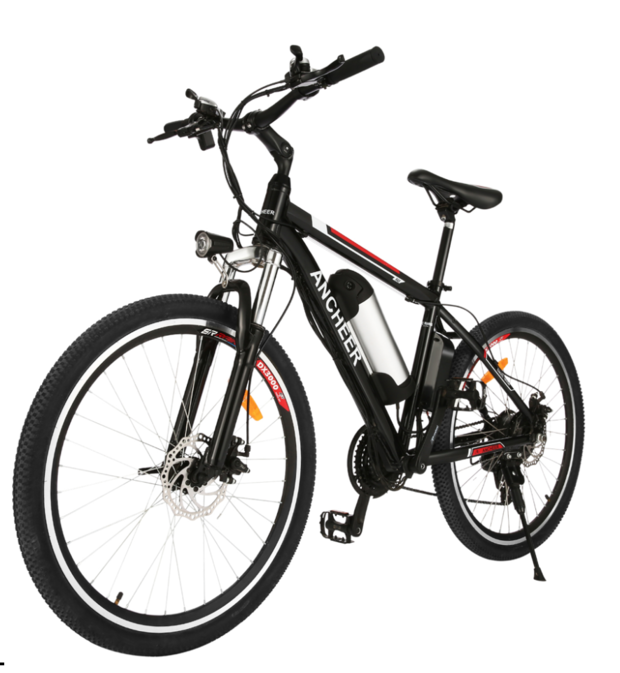
Recalled Ancheer e-bike with water bottle shaped cylindrical battery.U.S. CONSUMER PRODUCT SAFETY COMMISSION

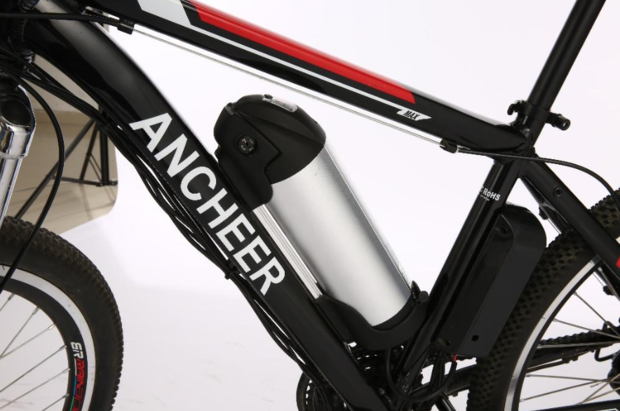
The recall involves black e-bikes with the model number AM001907, which can be found on the packaging and in the instruction manual but not the bike itself. A water bottle shaped cylindrical battery distinguishes the recalled model, which has 26-inch wheels and "Ancheer" printed on its downtube.

The recalled e-bikes were sold online at www.aliexpress.com, www.ancheer.shop, www.amazon.com, www.ebaby.com, www.newegg.com, www.overstock.com, www.rakuten.com, www.sears.com, www.walmart.com and www.wish.com from January 2016 through June 2022 for between $280 and $930.

Ancheer can be reached toll-free at (888) 661-1330 from 9 a.m. to 5 p.m. Eastern time Monday through Friday; by email at service@ancheer.shop; or online at www.ancheer.shop/pages/recalls.

2-80150.png
Close up of water bottle shaped cylindrical battery.U.S. CONSUMER PRODUCT SAFETY COMMISSION

The recall came two days after the release of a CPSC report highlighting an increase in emergency room visits and deaths related to e-scooters, e-bikes and hoverboards. Emergency departments around the U.S. treated more than 77,000 injuries related to the three micromobility products in 2021, up 127% from 34,000 in 2017, CPSC found. 

The agency is aware of 129 fatalities involving the products from 2017 through 2021, with the deaths rising from five in 2017 to 48 last year, the agency said.

"Fires with the lithium-ion batteries that power e-scooters, as well as e-bikes and hoverboards, have been garnering attention from fire departments nationwide, CPSC noted in a news release.

https://www.cbsnews.com/essentials/e-bikes-recall-amazon-walmart-ancheer-explosion-fire-risk/

Inflation is near four-decade high. Why aren't health care costs significantly higher?

 As consumers choose a 2023 health insurance plan from employers in coming weeks, many will find rate hikes are modest when compared to everyday living expenses. It’s the first time in over three decades that overall inflation accelerated at a faster rate than medical costs.  

It might not last long. Just like gas, groceries and used cars, the cost of medical care is rising in the third year of the coronavirus pandemic. 

"There's a lag effect," said Cynthia Cox, vice president and director for the program on the Affordable Care Act for Kaiser Family Foundation, a nonprofit focused on health issues. "The cost of gasoline can change from one day to the next. That's not really how health care prices work."

Health benefits consultant Mercer's survey of more than 1,700 large employers conducted this spring found these companies expected average health benefits costs to increase a modest 4.4% this year, about half the rate of inflation, which reached a 40-year high this summer.

But because prices are rising for medical supplies and prescription drugs and health care workers are commanding higher salaries in a tight labor market, employers are preparing for health care costs to spike. A Mercer survey released Thursday shows 43% of large employers think the cost of health care next year will exceed the amount companies budgeted. 

“We see inflation running fairly hot right across most every sector of the economy,” said Beth Umland, Mercer’s director of research for health and benefits. “It'd be surprising if health care was the lone holdout, which it’s never been.”

Some analysts believe the full force of inflation gripping the economy won't squeeze health care consumers until 2023 or later. Insurers negotiate reimbursement rates with hospitals and doctors and pass those expenses to employers and consumers. With inflation this summer reaching the highest level since the early 1980s, employers and consumers can expect more expensive bills for medical care and insurance premiums. 

Health insurance costs will jump 7.4% next year as employers and consumers absorb bills from doctors, hospitals and drug companies, according to Segal, a benefits and human resources consultant. 

“We'll start to see the impact of inflation on health care costs in the next one to two years,” said Eileen Flick, senior vice president, director of health technical services at Segal.

Mercer projects that large companies will be cautious in passing along higher premiums, deductibles or copayments to employees and their families. More than 7 in 10 large employers won't make workers pay more for coverage, while about 2 in 10 expect to charge workers more for monthly health premiums, Mercer said. 

Umland said the message from most large employers this spring was "loud and clear" that they planned to enhance health benefits rather than trim offerings or charge employees more. Even though health care costs are rising more quickly than they anticipated just a few months ago, most employers believe affordable health benefits are an important tool to recruit and keep workers in a tight labor market. 

Large companies are "reluctant to pass any of these excess costs on to employees, at least in 2023," Umland said. "No guarantee what 2024 will hold."

Hospital profits slump amid higher labor costs

Hospitals are grappling with higher costs from drug expenses, supplies and workers. A Kaufman Hall report analyzing data from more than 900 hospitals found these facilities are in “poor shape” with an average financial loss of less than 1% through August this year.  

The financial crunch is partly due to labor expenses that are up 10.6% this year. Hospitals have struggled to maintain enough workers during the pandemic and have relied on agencies that provide temporary, contract health care workers such as nurses. Surveys predict many nurses plan to leave bedside care. 

Elsevier Health, which provides health research and analytics, reported nearly half of U.S. nurses and physicians planned to leave their position within two to three years. 

Hospitals and nursing facilities have paid lucrative fees to staffing agencies to hire contract nurses and will attempt to pass on those extra expenses to health insurers and employers who provide coverage for about half of all Americans. 

But employers are also dealing with their own financial pressures and are seeking ways to slow runaway health costs, said Elizabeth Mitchell, CEO of Purchaser Business Group on Health. 

Companies that insure about half of all Americans are taking a harder look at how much hospitals and other health facilities are charging.

“We understand hospitals have increased labor costs,” Mitchell said. “So do employers and families.” 

2 in 5 Americans struggle to pay medical bills

While people who are insured through their employer might escape double-digit rate hikes for another year, consumers who directly purchase their own health coverage might not be so lucky. 

A Peterson-Kaiser Family Foundation Health System Tracker analysis of preliminary rate filings in 13 states and the District of Columbia found next year's median proposed rate hike for plans was about 10%. The report analyzed rate filings from 72 health insurers seeking to sell plans on Affordable Care Act marketplaces.

Health insurers must justify those proposed price increases based on how much they expect to spend on health care billings. These reports include rising prices paid to hospitals, doctors and drug companies, as well as how often insurers expect people will visit doctors or hospitals or fill prescriptions. These reports are reviewed by state health insurance regulators who decide whether to grant proposed rate increases.

One health plan, Capital District Physicians Health Plan in New York, warned that consumers would soon need to absorb inflationary costs from doctors and hospitals. In its filing, the insurer said a "correction is imminent." 

Health insurance is no guarantee people are shielded from expensive bills. More Americans have health insurance coverage than ever before: The Affordable Care Act extended health insurance coverage to millions of Americans, and even pandemic plans expanded Medicaid coverage to millions of Americans. 

But even with coverage, 2 in 5 Americans struggled to pay a medical bill or past medical debt, according to a survey by the Commonwealth Fund.

Sara Collins, a senior scholar at vice president at Commonwealth Fund, said the survey shows even insured Americans are struggling with the cost of health care. Insurance plans require people to pay deductibles, co-pays and coinsurance, and those out-of-pocket costs are unaffordable for many.

“These costs are not only leaving people with medical bill problems and medical debt,” Collins said. “They're not enabling people to get the health care that they need.”

https://www.usatoday.com/story/news/health/2022/10/17/inflation-rising-faster-medical-costs/10471194002/