Search This Blog

Thursday, January 5, 2023

Citadel Posts Record $35.5 Bilion In Revenue For Hedge Fund, Securities Operations

 Yesterday we listed some of the best and worst performing hedge funds of 2022: we missed the most important one.

After a stellar 2021, when it generated $16.2 billion in revenue, in 2022 Ken Griffen's Citadel hedge fund - which had $54.5 billion in AUM as of Jan 1 - had a blowout year, and according to the WSJ, it generated about $28 billion in revenue, citing sources. It wasn't immediately clear what exactly is meant by "revenue" here: new funds, services rendered, or unbooked and booked gains, but whatever it is, the number is a lot, and follows an impressive 38.1% return at the company's flagship multi-strategy fund, Wellington. It also far outstripped the hedge fund's prior record of $16.2 billion the year before.

Additionally, Citadel Securities, a separate entity and one of the world’s biggest electronic-trading firms, had $7.5 billion in revenue, also up from the prior record of $7 billion in 2021. Although in a market where there has been virtually no "lit" (or exchange liquidity) and where most trades have gone through internalizers like Citadel, this particular success is easier to comprehend.

And yes, those pointing out that companies which control both a hedge fund and a trading operation are not that different from SBF's empire, which consisted for the FTX exchange and the Alameda hedge fund, are not too far off.

As the WSJ recounts, after its near-death experience in 2008, Citadel has outpaced many rivals in recent years, and each of its hedge funds posted double-digit gains after fees in 2022. Operating under tight risk controls that leave Citadel with little directional exposure to markets, the firm’s 1,000-plus traders make bets across asset classes in markets around the world. The firm doesn’t provide detailed information to clients about significant trades, though earlier in the year it told them it had benefited from successful commodities bets.

As for Citadel Securities, regular readers are quite familiar with it (not lease because of their threat to sue Zerohedge for suggesting it was frontrunning client orderflow just days before securities regulator FINRA accused it of doing just that) as a global market-making operation that handles more than 20% of the shares that change hands in U.S. stock markets each day. The business, which also trades futures, options, Treasuries and currencies, benefits from increased volumes and volatility, as well as reduced liquidity allowing it to pocket huge bid/ask spreads and prosper even when markets fall.

Furthermore, the pandemic-era boom in activity by retail investors benefited Citadel Securities’ so-called retail-wholesaler unit, which executes orders for brokerages such Robinhood and, to a lesser extent, Schwab.

The revenue bonanza will add to Griffen's already considerable fortune who in addition to regularly breaking records in the real-estate and art markets, has emerged as a major GOP donor. Forbes estimates his wealth at around $31 billion.

To be sure, most other hedge funds have had a rougher year. As we noted yesterday, Goldman told its prime-brokerage clients that hedge funds betting on and against stocks lost an average 12.9% for the year, on an asset-weighted basis, while the S&P 500 lost about 18% including dividends.
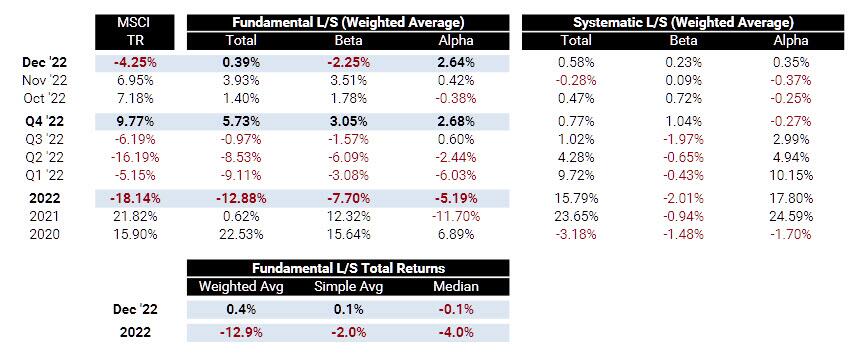
Citadel’s flagship multi-strategy fund, Wellington, returned 38.1% by contrast. Previous reports from the WSJ revealed that commodities made up more than 60% of the second-quarter gross investment gains for Wellington.

But even more remarkably, all of Citadel’s five strategies—fixed income and macro, commodities, equities, quant and credit—were profitable for the year, according to WSJ sources. That was evident in the returns of its three other hedge funds, which notched gains of more than 20%. One of the funds, Citadel Equities, was up 21.4% for the year. Unable to keep up with its newfound wealth, Citadel returned about $8.5 billion in profits to its investors Dec. 31, up from the $7 billion it earlier expected.

Rivals Millennium Management and Point72 Asset Management gained 12.4% and 11.8% for the year, respectively. D.E. Shaw Group’s flagship multi-strategy fund, Composite, returned about 24.7%.

https://www.zerohedge.com/markets/citadel-post-record-355-bilion-2022-revenue-hedge-fund-securities-operations

ChatGPT creator OpenAI in talks for tender offer valuing company at $29 b

 OpenAI, the artificial intelligence research lab behind chatbot ChatGPT, is in talks to sell existing shares in a tender offer that would value the company at about $29 billion, the Wall Street Journal reported on Thursday, citing people familiar with the matter.

The report added that the deal is structured in a way in which venture capital firms Thrive Capital and Founders Fund will buy shares from existing shareholders such as employees.

The deal would attract investment of at least $300 million in share sales, it added.

Billionaire and Tesla Inc CEO Elon Musk founded the research organization with investor Sam Altman.

Microsoft Corp which invested $1 billion in OpenAI in 2019, was working to launch a version of its search engine Bing using the AI behind the now viral ChatGPT, the Information reported on Tuesday..

OpenAI's chatbot is a software application designed to mimic human-like conversation based on user prompts and can respond to a large range of questions while imitating human speaking styles.

The firm expects business to surge as it pitched to investors saying the organization expects $200 million in revenue next year and $1 billion by 2024, Reuters reported in December.

OpenAI declined to comment, while the VC firms did not immediately respond to Reuters request for comment. 

https://finance.yahoo.com/news/1-chatgpt-creator-openai-talks-202428766.html

FibroGen upped to Buy from Neutral by B of A

 Target to $27 from $18

https://finviz.com/quote.ashx?t=FGEN&p=d

Newly Approved Drugs In US Command Over $200,000 On An Average


  • The median annual price of 17 new drugs approved by the FDA since July 2022 reached $193,900, down from $257,000 in 1H of 2022. For the full year 2022, the median price was $222,003.
  • Citing a study published by JAMA, Reuters analysis found that in 2021, the median annual price was $180,000 for the 30 drugs first marketed through mid-July.
  • The analysis includes three recently approved gene therapies, two from Bluebird bio Inc  and one from uniQure N.V. .
  • Bluebird's Zynteglo was priced at $2.8 million, and Skysona had a wholesale cost of $3.0 million.
  • uniQure's Hemgenix's expected price of $3.5 million is higher than the brokerage's estimated $1.9 million.
  • "I don't see anything changing that trend," Dr. Aaron Kesselheim, professor of medicine at Harvard Medical School and Brigham and Women's Hospital, told Reuters. Kesselheim says Congress will eventually have to address excessively high launch prices.
  • The findings follow a recent analysis from U.S. Democratic Representative Katie Porter, which found that the annual price of a newly-launched cancer drug in the U.S. was $283,000 in 2021, up 53% from 2017.
  • Drugmakers also stress that they do not determine what U.S. patients are paying. Many offer savings cards and other programs to reduce out-of-pocket costs.

1 in 5 Young Adults Say They Use Marijuana: Survey

 Nearly 1 in 5 people in the U.S. age 12 or older said they used marijuana in 2021, according to new federal survey results.

Among the 52 million people who said they used marijuana in the past year, young adults ages 18 to 25 were the most likely to report doing so, at 35%. That age group was also the most likely to report having a mental illness in the past year, at 34%.

The findings were part of the annual National Survey on Drug Use and Health released Wednesday by the Substance Abuse and Mental Health Services Administration. 

"As the findings make clear, millions of Americans young and old faced mental health and substance use challenges – sometimes both at once – during the second year of the pandemic," U.S. Department of Health and Human Services Secretary Xavier Becerra said in a statement.

The survey took place both in person and online, and due to changes in how it was done, officials said the data cannot be accurately compared to the results of previous years. But there were many signs that drug use and mental illness increased with the start of the COVID-19 pandemic.

Overall, the 2021 survey results showed that 57.8% of people age 12 or older currently use tobacco, alcohol, or an illicit drug, including 47.5% who said they drink alcohol, 19.5% who said they use tobacco products, and 14.3% who said they use illicit drugs. Current use was defined as using a substance within the month before taking the survey.

In addition to being the most prevalent age group among marijuana users and those with mental illness, 18- to 25-year-olds were the most likely to have a substance use disorder in the past year. The survey showed that 94% of people with a substance use disorder did not get treatment, and researchers wrote that "nearly all people with a substance use disorder who did not get treatment at a specialty facility did not think they needed treatment."

Sources

Substance Abuse and Mental Health Services Administration: "2021 National Survey of Drug Use and Health,"

"SAMHSA Announces National Survey on Drug Use and Health (NSDUH) Results Detailing Mental Illness and Substance Use Levels in 2021."

https://www.medscape.com/viewarticle/986551

FBI raises award to $500,000 for information on pipe bombs near DNC, RNC HQ

 The FBI on Wednesday announced it has increased the award for anyone who can provide information that leads to an arrest in the investigation of the placement of pipe bombs at both the Democratic and Republican parties’ national headquarters on Jan. 5, 2021. 

The bureau is now offering $500,000 dollars for relevant information on the pipe bombs, which were discovered near the headquarters of the Republican National Committee and Democratic National Committee the day of the Jan. 6, 2021, attack on the Capitol.

At the time, law enforcement resources were stretched because of a rally for then-President Trump and an expected march to the Capitol that ended with a riot.

Previously released footage shows an individual in a hoodie walking near both the Democratic and Republican national committee headquarters. 

“With the significantly increased reward, we urge those who may have previously hesitated to contact us — or who may not have realized they had important information — to review the information on our website and come forward with anything relevant,” David Sundberg, assistant director in charge of the FBI Washington Field Office, said in a release. 

In the months following the attack, the FBI offered a $100,000 reward for any relevant information. 

While the FBI has received more than 500 tips and conducted more than 1,000 interviews, the suspect remains at large. 

“Despite the unprecedented volume of data review involved in this case, the FBI and our partners continue to work relentlessly to bring the perpetrator of these dangerous attempted attacks to justice,” Sundberg said. 

The pipe bomb placed near the Democratic National Committee headquarters was discovered when then-Vice President-elect Kamala Harris was in the building, prompting her swift evacuation. 

The request for information comes just days before the second anniversary of the deadly riot at the Capitol. 

https://thehill.com/policy/national-security/3798571-fbi-raises-award-to-500000-for-information-on-pipe-bombs-near-dnc-rnc-hq/