Search This Blog

Saturday, January 7, 2023

Texas Sues Biden Admin Over Public Charge Immigration Rule Change

 by Caden Pearson via The Epoch Times (emphasis ours),

Texas Attorney General Ken Paxton filed a lawsuit on Thursday to stop the Biden administration from ignoring a federal immigration law that prevents illegal immigrants from residing in the United States if they’re likely to rely on taxpayer-funded programs.

I’ve sued [President Joe] Biden over a dozen times to secure our southern border,” Paxton said on Twitter. “Now, just as 2023 is starting, I’m bringing another lawsuit—the first of its kind in the nation on Biden’s disastrous new public-charge rule. I’ll keep suing [and] winning until he [and] his lawless Dems follow the law.”

Paxton accused the Biden administration of furthering an open borders policy by enacting the new rule, which “effectively nullifies federal law excluding aliens likely to become public charges,” according to the lawsuit filed in the U.S. District Court for the Southern District of Texas (pdf).

That rule has been in place since 1882 and was reaffirmed by Congress in 1996 under the bipartisan Welfare Reform Act. By not enforcing the law, the Biden administration has opened the door to illegal aliens who’ll be dependent on welfare, the lawsuit alleges.

Paxton’s lawsuit argues that the December 2022 rule was enacted in violation of federal law and is arbitrary and capricious.

“The Biden Administration is committed to opening the borders to aliens who lack the ability to take care of themselves. Texans should not have to pay for these costly immigrants, nor should any other American,” Paxton said in a statement. “I will continue to defend the rule of law and fight to ensure that the massive costs of illegal immigration don’t further burden taxpayers.”

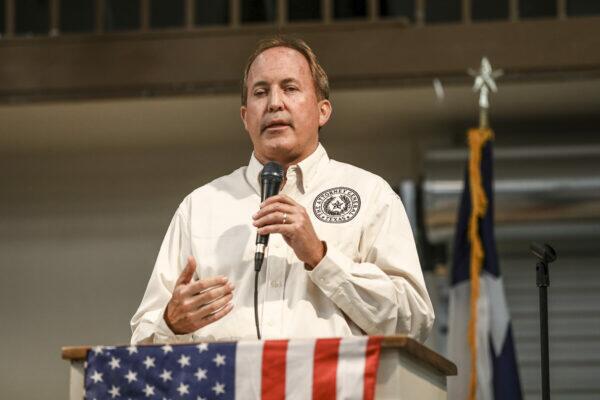
Texas Attorney General Ken Paxton speaks at a border town hall in Brackettville, Texas, on Oct. 11, 2021. (Charlotte Cuthbertson/The Epoch Times)

Public Charge

Paxton’s office said the new rule prohibits the consideration of statutorily required factors in determining whether an alien is likely to become a “public charge.” The term public charge first appeared in statute in the Immigration Act of 1882, where Congress barred the admission of “any person unable to take care of himself or herself without becoming a public charge.”

Self-sufficiency has been considered a basic principle of U.S. immigration law since the country’s earliest immigration statutes. It is U.S. immigration policy that aliens within the country’s borders shouldn’t depend on public resources to meet their needs but rather rely on their individual capabilities and the resources of their families, sponsors, and private organizations. Further, the availability of public benefits shouldn’t be an incentive for immigration to the United States.

As assurance that they won’t become a drain on taxpayers, aliens usually offer U.S. authorities documentation that their family will financially support them. However, Biden’s rule prevents a comprehensive probe of the truth of this material, according to Paxton’s office.

Paxton is also leading a 14-state coalition that filed a cert-stage brief in the U.S. Supreme Court in September 2022 after the Biden administration tried to covertly abolish the public charge rule. That petition was filed after the Chicago-based U.S. Court of Appeals for the Seventh Circuit ruled against a Texas-led coalition.

“With America in the midst of a recession and families across the country already facing record-high inflation, it’s completely reprehensible to expect taxpayers to foot the bill for hundreds of millions of dollars to sponsor more and more illegal aliens,” Paxton said at the time.

A U.S. Border Patrol agent directs an illegal immigrant after he crossed into the United States from Mexico through a gap in the border wall separating Algodones, Mexico, from Yuma, Arizona, on May 16, 2022. (Frederic J. Brown/AFP via Getty Images)

Rule Change

Paxton argues in his lawsuit that the Biden administration’s rule change is intended to ensure that “virtually no alien is ever found to be a public charge.”

While the 1996 reform was designed “to increase the bite of the public charge determination,” the 2022 rule change “illegally narrows the meaning of ‘public charge’ to oblivion, disregarding of the term’s historical meaning and violating the statute,” according to the lawsuit.

Paxton’s lawsuit argues that the 2022 rule change ignores congressional mandates by only considering cash, but not in-kind, government benefits when assessing whether an individual is likely to become a public charge.

https://www.zerohedge.com/political/texas-sues-biden-admin-over-public-charge-immigration-rule-change

Centene, under siege in America, moved into Britain's NHS

 In the final days of 2020, the U.S. health insurer Centene made a swift incursion into Britain’s prized National Health Service, one of the world’s largest employers.

A Centene subsidiary, Operose Health, took over nearly three dozen medical practices in London—gateways for NHS care—in a deal worth tens of millions of dollars. The subsidiary became the largest private supplier of general practice services in the United Kingdom, with 67 practices accounting for 570,000 patients.

A local health commission, records show, signed off after a nine-minute review in a virtual hearing held the week before Christmas. Centene was not mentioned. Not a question was asked. It was the time of year—amid pandemic restraints—when official business in London gave way to fizzy cocktails and quiet glad tidings.

Within weeks, the acquisition set off alarms for Louise Irvine, an NHS doctor, who called it “privatization of the NHS by stealth.” Irvine, other practitioners, and residents supported a crowdfunded legal challenge to the takeover of AT Medics Holdings, the U.K. primary care company under contract to the NHS.

Centene is the largest privately managed care provider in the U.S. that offers government-sponsored insurance, such as Medicaid and Affordable Care Act plans, as well as health care to seniors, prisoners, military members, and veterans. Britons who protested its expansion saw a for-profit outsider with ambitions that could weaken the NHS. They worried Centene would decide on staffing to suit its bottom line. NHS contracts with doctors at set rates, and assistants are paid less; critics questioned whether the Centene deal would reduce more highly trained staff.

Then there was this: The corporation faced legal problems and had paid fines, since 2013, over noncompliance with state or federal Medicaid contracts or rules. By mid-2021, as its legal battle intensified in London, Centene was grappling with allegations of overbilling Medicaid for pharmacy services. It has since paid about $657 million to settle the accusations of 15 states. It faces investor lawsuits as well as overbilling allegations from several more states. Centene, based in Missouri, has denied wrongdoing.

Centene’s “suitability” for doing business with the NHS was not discussed in the virtual hearing. And because of technical limitations, members of the public could review the decision only through an audio recording, released online a day later.

“It was COVID time,” Irvine, now retired, said with some frustration about the public meeting. “We believe NHS should be a public service, and it is being gradually eroded.”

Centene did not respond to requests to discuss its U.K. strategy. By July 2021, Centene’s interests also acquired Circle Health Group, a private healthcare group based in London with 50 hospitals.

Earlier this year, a judge ruled that the 2020 public meeting was conducted lawfully. The judge questioned the relevance of raising Centene’s liabilities; she noted the American company’s counsel had documented that its “financial position was strong” and that the insurer “continues to operate successfully in the U.S. healthcare market.”

Advocates for market-based efficiencies, including former NHS chiefs who were hired by Centene-related businesses, portray the managed-care titan as a change agent that can innovate and trim costs.

In October, an NHS care commission declined to renew a Centene contract for Hanley Primary Care Center in north London, which was part of the 2020 deal. The clinic was left with too few doctors, the Islington Tribune reported, and patient appointments had dropped by 270 a week, representing a “huge hole” in care since the acquisition. The NHS’ decision followed a BBC report in June about Operose staffing, in which clinic employees said the practice was short eight doctors and that less qualified workers, called physician associates, filled the gaps.

Operose spokesperson Stephen Webb, in an email, said the Hanley practice “is currently rated as ‘Good’ by the national regulator” and the contract would be reviewed next year. On its website, Operose calls the BBC report “sensational.” It adds that “we have a strong track record of performance, recruitment and investment in our staff and services.”

The Hanley decision is a small validation for Irvine and others who warned that efficiencies would degrade the quality of care.

“The whole ethos of the American system, well, it is fundamentally different than how we view care in the U.K.,” Irvine said. “Our values are free and accessible health care for all.”

Cultivating ties in government

Centene was eyeing the British health system in 2011 when it hosted health advisers from across Europe to tour its facilities in Spain’s seaside region of Valencia.

In March 2011, and again in 2015, representatives from Centene’s subsidiary Ribera Salud promoted its “pioneering approach” to caregiving at hospitals and treatment centers through a public-private partnership, according to an NHS advisory report.

Like Britain, Spain faces an aging population. The subsidiary promised a model for “efficient and effective healthcare” for patients who are government-supported or pay out-of-pocket. The government paid the provider a flat rate per patient each year, and Ribera Salud operated the sites and managed staff.

The approach intrigued British politicians and advisers, conservatives as well as liberals, eager to manage health care costs by encouraging competition.

Centene cultivated its image and relationships, launching the subsidiary Centene UK in 2016. Within months, it was hiring NHS administrators for its executive ranks. Among the highest-profile recruits: Samantha Jones, a nurse and the NHS England director of “new care models,” who had championed Centene’s work in Spain.

By 2019, Jones was named CEO of Centene UK. In 2021, she left to work for Prime Minister Boris Johnson as “an expert adviser for NHS transformation and social care.”

As Johnson’s premiership came under pressure, Jones was named chief of operations at No. 10 Downing St. She left when he resigned in July.

By then, Centene had a substantial U.K. foothold and other former NHS administrators had joined its top ranks. Contacted through LinkedIn, Jones said she was “not available to do any interviews.”

For consumers intent on preserving Britain’s national health care—or just understanding who owns what and where—Centene is difficult to track. It’s the same in the U.S., where the company has more than 300 subsidiaries. Names there typically lean into local iconography such as Peach State Health Plan of Georgia and Buckeye Community Health Plan of Ohio—with no mention of Centene.

In England, Jenny Shepherd, 72, has written about Centene and its subsidiaries for years. She set up a hyperlocal news site in 2012 to track public services amid government budget restraints. She soon focused on NHS. When Centene’s operations in Spain were being floated as a model for reform, Shepherd saw little coverage of it. “Journalism was lacking,” she said.

Shepherd scours regulatory filings for her posts, published under “NHS Matters.” Over years, she has documented a flowchart of sorts of Centene’s businesses. She said the company routinely recasts its corporate profile. From 2016 to 2018 alone, subsidiary names, addresses, and company directors changed often, she noted.

In 2018, Centene UK was listed as controlled by a Centene subsidiary, MH Services International Holdings. In November 2019, according to regulatory filings, Centene UK formally changed its name to Operose Health.

The practices acquired in 2020, however, were still identified in March 2021 as part of AT Medics Holdings. That filing, in U.K. government records, lists Operose Health as a board member.

Centene’s stake in Circle Health was laid out in December 2021 regulatory filings. Circle Health’s parent company in the U.K. is MH Services International (UK) Ltd., “with the ultimate parent being Centene Corporation,” records show.

Centene aims to wring profit from government-guaranteed payments, Shepherd said: “The English NHS is as big as the Chinese army, and it was clear that the Americans wanted to get their hands on it.”

Such guarantees have diminished, however, as healthcare costs have increased. The pandemic has propelled a two-year backlog for some treatments. For the first time in history, NHS nurses in England, Wales, and Northern Ireland went on strike in December, largely over pay. Ambulance drivers and paramedics in England and Wales followed suit. Military personnel were readied to take over some services.

‘Closer to the American model’

The rise of for-profit providers within the British NHS has sparked incendiary debates, with brute questions about costs and motives. How much is spent on patients? How much is spent on services? And could market forces plow the national health landscape into a tiered system of care?

“We are seeing a shift in care access and waiting times, and a big rise in the number of people moving toward a private system,” said Chris Thomas, principal health fellow at the Institute for Public Policy Research think tank in London. “Britain already has the largest number of private patients in the G-7, and that brings us closer to the American model.”

Centene has been welcomed by some as a way “to ease burdens within a chronically overworked NHS,” Thomas said. “But it doesn’t seem optimal to have a corporation—a for-profit organization—coming in.”

Centene has seen limits to government guarantees, particularly in Spain.

Even as British health advisers visited Ribera Salud in 2011, the Spanish press was documenting financial missteps in the venture. Fees per patient, meant to cover access to universal care, had to be renegotiated. Directors and administrators moved between public-sector jobs and Ribera through what appeared to be an unchecked revolving door.

Anne Stafford, a finance professor at University of Manchester, examined the numbers behind the Ribera model. The rhetoric of savings never matched reality, she said, with no clear comparison offered of labor costs, financing, wage demand, and patient ratios between Spain and Britain.

Debates over how best to deliver care often lack rigor and consistency, she added. “People say they love their NHS, but they have no concept of how it is funded or how it operates,” she said. “That allows people with an agenda to get into the market.”

British politicians have seen health care as ripe for privatization since the late 1990s, she said, but “there is very little proper accountability” for whether “the private sector, in fact, is delivering value for money.”

NHS advisers also have questioned whether the two systems could be effectively compared: Invented after World War II, the NHS was so celebrated that in 2012 doctors and nurses marched in the opening ceremony of the London Olympics. Spain’s national health care emerged in the 1980s, after the death of dictator Gen. Francisco Franco, and it struggled with costs within its first decade. The Centene model in Valencia, reliant on bank financing, was implemented in 1999.

The report found differences in size and staffing of facilities as well as how care systems were integrated. Measuring possible cost savings was difficult and, the report said, “there are risks that these benefits may be hard to replicate.”

By December 2021, it was clear that Centene no longer regarded its Ribera operations as a moneymaker. It announced it would divest “non-core assets” to improve its profit margin.

Centene executives pointed investors to two international assets: Circle Health and Ribera.

Within months, the Spanish subsidiary was sold for an undisclosed figure, bundled with other health and diagnostic groups, to Vivalto Santé, the third-largest private hospital company in France. The acquisition was completed in November.

Centene, in a statement, described its excising of Ribera, with 10 hospitals, 1,650 beds, and 71 primary care and outpatient clinics, as a “significant milestone in our value creation plan.”

For now, it’s steaming ahead with its Circle Health venture. Its 1,900 beds delivered two-thirds of more than $2 billion in annual revenue, according to investor guidance in December 2021. It’s now the largest private hospital care provider in England.

https://www.fiercehealthcare.com/payers/centene-under-siege-america-moved-britains-national-health-service


Paying more for a different bias

 The problem of minority populations not being adequately represented in clinical trials has long vexed healthcare researchers, but it can be fixed by increasing the payment for such participation, according to researchers with the University of Chicago.

Their working paper (PDF) argues that offering participants $500 would entirely close the gap in participation among different socioeconomic, racial and ethnic groups. Data on participants show who isn’t included in the tests but not why that’s the case. The researchers looked at the effect of three different incentives on participation: $0, $100 and $500.

They considered six characteristics: higher poverty neighborhood, minority neighborhood, uninsured rate, preventable hospitalization rate per 10,000 individuals, drug-related hospitalization rate per 10,000 individuals and the COVID-19 local risk index from 1 to 10.

Studies without any incentives would be highly nonrepresentative, as would studies with the $100 incentive, though not as much as studies with no incentives.

“However, a study with a $500 incentive is representative on all six characteristics, with average participant characteristics that are statistically indistinguishable from those in the target population,” the study said. “For example, with no incentive, only 13% of the participants are from higher poverty neighborhoods, compared to a target population average of 46%. This figure would increase to 22% with a $100 incentive, and to 51% with a $500 incentive.”

But would paying $500 a participant be economically feasible for those institutions conducting the studies?

“This is certainly doable,” David Cutler, Ph.D., an internationally known healthcare economist, told Fierce Healthcare. “There is no obvious reason why people cannot be compensated for participation in clinical trials, and the cost would not be large relative to the total cost of clinical trials.”

Richard Stefanacci, chief medical officer at the Jefferson College of Population Health at Thomas Jefferson University, told Fierce Healthcare that a congressional push might be needed to make studies more diversified and cites legislation introduced last month in the Senate by Bob Menendez, D-New Jersey, and Susan Collins, R-Maine. Their bill calls for more diversity of participants in studies funded by the National Institutes of Health.  

Stefanacci said “studies are already incredibly costly, pushing many to reconsider the value of even undertaking such studies, which could end up decreasing the number of drugs studied.”

But a press release by the University of Chicago released with the working paper said better diversification in studies equals better healthcare for society.

“In the case described in this new research, a lack of representation from Black, Hispanic, and low socioeconomic status households poses a risk to public health and a challenge for policymakers responding to COVID-19. If we don’t know why these households don’t participate, we cannot effectively encourage greater participation and, thus, improve health outcomes," according to the release.

Researchers used data from the Representative Community Survey Project’s COVID-19 serological study. Some households in Chicago were sent a blood sample collection kit and were instructed to mail the sample to a research laboratory. The households were randomly assigned to receive a $0, $100 or $500 participation payment.

A letter in the kit “informed the household that the returned blood sample would be tested for seropositivity, but that they would not be told the result of the test,” the study said. “Hence, desire to learn about seropositivity status could not contribute to the household’s motivation for participating in the study.”

The two main reasons for individuals not participating in clinical studies are that they cannot be contacted or hesitancy. The researchers argue that poor and minority households don’t participate because they think doing so might in some way cost them money, not because they are more difficult to contact.

“For example, 61% of contacted households in majority minority neighborhoods would not participate for $100, compared to only 14% in majority White neighborhoods,” according to the University of Chicago press release. “Hesitancy explains 89% of the participation gap at $0, and 93% at $100.”

The study concluded that “randomized financial incentives can be used to measure the causes of non-participation and how they contribute to underrepresentation. In the context of the RECOVER serological study, we found that non-contact is a cause for low participation, but not of underrepresentation. Hesitancy among contacted households is a cause of both low participation and underrepresentation. High incentives for participation appear to restore representativeness.”

Stefanacci said he remains unconvinced that more compensation for study participants will solve the diversity problem.

“High financial payments for study participation may bias the study results as those paid especially these high sums would underreport adverse events, their exclusion criteria and be more positive on the outcomes,” he said.

https://www.fiercehealthcare.com/payers/researchers-say-500-participant-would-add-diversity-clinical-studies

November's hospital margins up monthly thanks to cooling expenses

 Hospital margins shifted upward in November thanks to a dip in expenses yet still remained in the red across the first 11 months of 2022, according to the most recent monthly industry report from Kaufman Hall.

Median operating margins rose 12% over October, when labor woes and discharge difficulties pumped the brakes on months of steady recovery.

Year-to-date (YTD) median hospital margins now sit at -0.2%, slightly improved from October’s -0.3%, according to the report. Despite the minor gain, hospitals’ YTD margins are 44% worse than this time last year and 31% worse than in November 2019, according to the report.

The advisory firm pointed to a decrease in expenses, most notably labor, as the driving force behind the improving numbers.

“As we’ve seen in other industries, the significant increases in labor costs have made it harder for hospitals to realize positive margins,” Erik Swanson, senior vice president of data and analytics with Kaufman Hall, said in a release. “Hospitals were fortunately relieved of some financial pressure in November amid a continued competition in the healthcare labor market, potentially due to a shift away from expensive contract labor.”

Net operating revenue grew 1% month over month and is up 3% YTD compared to this time last year. Net patient service revenue per adjusted discharge increased 1% month over month but was down 1% YTD compared to 2021.

Adjusted discharges fell 1% month over month but were up 1% YTD over this time in 2021. Average length of stay also fell 1% month over month while rising 1% YTD, though operating room minutes fell 2% month over month and stayed flat YTD.

Kaufman Hall noted that the dipping volume numbers drove a 1% month-over-month decrease in hospitals' total expenses during November, though they still remain up 7% YTD over November 2021. While supply and drug spending generally remained flat or increased slightly from October, total labor expense fell 2% month over month and now sits at a 9% YTD increase over this time last year, when the omicron surge was just starting to gain steam.

“The average patient length of stay declined slightly—along with several other key volume metrics—leading to relatively flat revenue,” the firm wrote. “However, hospital expenses declined, resulting in improved margins.”

Kaufman Hall’s report also highlighted rising outpatient revenues, “a bright spot in hospitals’ revenue column in 2022.”

Compared to the flat year-over-year performance of YTD inpatient revenue, YTD outpatient revenue was up 8% over November YTD 2021 and 20% over November YTD 2019, potentially highlighting an opportunity for hospitals looking to recover lost ground.

“The November data, while mildly improved compared to October, solidifies what has been a difficult year for hospitals amidst labor shortages, supply chain issues and rising interest rates,” Swanson said. “Hospital leaders should continue to develop their outpatient care capabilities amid ongoing industry uncertainty and transformation.”

Kaufman Hall’s monthly reports are based on a sample of more than 900 nationally representative hospitals, the data from which are collected by Syntellis Performance Solutions.

The firm and other market watchers have painted 2022 to be a historically difficult year for hospital finances due to the combination of workforce shortages, hard-to-predict demand spikes, capacity constraints and an end to 2021’s relief funds. Multiple state hospital organizations have warned of looming closures among rural or less-resourced facilities should the trends continue into the new year.

https://www.fiercehealthcare.com/providers/novembers-hospital-margins-12-monthly-thanks-cooling-expenses

OIG: CMS needs to help drugmakers in calculating best Medicare Part B prices

 Drugmakers need more guidance from the Centers for Medicare & Medicaid Services (CMS) on how to calculate the best price for drugs sold on Medicare Part B, a key federal watchdog said. 

The review, released Tuesday by the Department of Health and Human Services (PDF) Office of Inspector General (OIG), comes amid concerns from physicians that reimbursements for Part B drugs are too low. A survey conducted by OIG of drugmakers listed concerns that they have less guidance from CMS on calculating best practices compared to other programs such as Medicaid. 

“CMS should review current guidance and determine whether additional clarification may prove beneficial, prioritizing issues that may have greater effects on pricing and payments (e.g., value-based arrangements),” the analysis said. 

CMS reimburses physicians for the average sales price (ASP) for Medicare Part B drugs and a 4% add-on to cover handling and storage costs. OIG attempted to explore the accuracy of ASPs by comparing the 30 highest-cost drugs in Part B to different benchmark prices in 2020.

OIG compared the ASPs to the wholesale acquisition cost for the same product, which is the estimated list price that wholesalers or other direct purchasers pay, not including any discounts or rebates. The watchdog didn’t find any inaccuracies when comparing the ASP price to the wholesale price, as the wholesale cost exceeded the ASP for all 30 high-spending drugs. 

OIG also compared prices between the ASP and the average manufacturer price that Medicaid pays. While the analysis found the ASP exceeded Medicaid’s prices by more than 5%, it may not be an apples-to-apples comparison as Medicaid allows discounts to be applied. 

The watchdog also interviewed 20 manufacturers of the 30 products to explore what factors they consider when calculating an ASP. Manufacturers cited the need for guidance on the treatment of value-based purchasing arrangements and how to calculate them into the sale price. 

“Without clear guidance, manufacturers argue that they will need to adopt varying reasonable assumptions that could create distortions among reported [average sales prices],” the analysis said. 

CMS also has not defined the term “bundled sale” for calculating ASP.

The agency has never sufficiently detailed how to treat sales to TRICARE retail pharmacies, which dispense drugs as part of the military healthcare programs. Without such guidance, drugmakers are required to make a reasonable assumption on which amounts should be included in the calculation of the ASP, which can cause inconsistencies, OIG said. 

CMS told OIG that it will look at the current guidance and investigate whether an update is needed. 

The analysis touches on a persistent issue of reimbursement for physicians, who have experienced a cut in the add-on payment from 6% down to 4%. For example, the Community Oncology Alliance has repeatedly said that the pay cuts have led to the closures of community cancer practices. 

https://www.fiercehealthcare.com/payers/oig-cms-needs-help-drugmakers-calculating-best-medicare-part-b-prices

Cost holding uninsured back from signing up for coverage: Fla. Blue survey

 People who lack health insurance are hesitant to sign up for coverage because they fear the costs are too high, a new survey shows.

The survey, commissioned by Blue Cross Blue Shield of Florida, polled hundreds of Floridians who are uninsured and found that nearly 70% feel they are unable to afford health insurance or that coverage is simply too expensive. All of the survey respondents were between the ages of 21 and 64, and more than half had either been uninsured for three years or longer or had never had insurance before.

Many of those surveyed (65%) said they believe that health plans available on the Affordable Care Act's exchanges would cost between $50 and $500 per month, and just 11% believe they could secure coverage at $10 or less per month. 

Florida Blue said it commissioned the study to coincide with open enrollment for exchange plans, which continues through Jan. 15.

The insurer noted that while patients may perceive these plans as pricey, 4 in 5 people who enroll on the exchanges are able to secure coverage that is $10 or less per month. The vast majority (90%) of people qualify for financial assistance when enrolling, Florida Blue said.

“We realize that people are busy, tired, and everything costs more, but we are here to help them during these challenging times and make it easier than ever to switch plans or sign up for plans, especially during the open enrollment period that closes on Jan. 15," said Florida Blue CEO Pat Geraghty in the release.

Many of those surveyed said they avoid medical care because of the cost, and 73% said they did not know that if they secured coverage they would likely be able to access key preventive services such as checkups, colonoscopies or mammograms, with $0 in out-of-pocket costs.

Thanks in large part to enhanced subsidies for plans and significant investment in outreach, enrollment in individual market plans has exploded, and sign-ups have been on pace to set a new record during the current open enrollment period.

https://www.fiercehealthcare.com/payers/cost-fears-holding-uninsured-people-back-signing-coverage-florida-blue-survey

How mental health made the 'remarkable transition' to virtual: RAND study

 What RAND researchers describe as “a remarkable transition in the U.S. health system from in-person to virtual care” occurred during the first year of the COVID-19 pandemic in 2020 for individuals seeking mental health services.

The study, published today in JAMA Health Forum, looks at data from about 5.1 million adults covered by commercial health insurance. The researchers examined data measuring county-level mental health utilization rates in all 50 states for adults 18 and older from Jan. 5, 2020, to Dec. 21, 2020, focusing on five diagnostic categories: major depressive disorder, anxiety disorders, bipolar disorder, adjustment disorder and post-traumatic stress disorder (PTSD).

The data were analyzed in April and May 2021.

The patients were grouped according to age, sex and mode of delivery for mental health services. The researchers found a more than 50% decline in in-person mental health care utilization among patients, which was entirely offset by rapid expansion in telehealth service utilization.

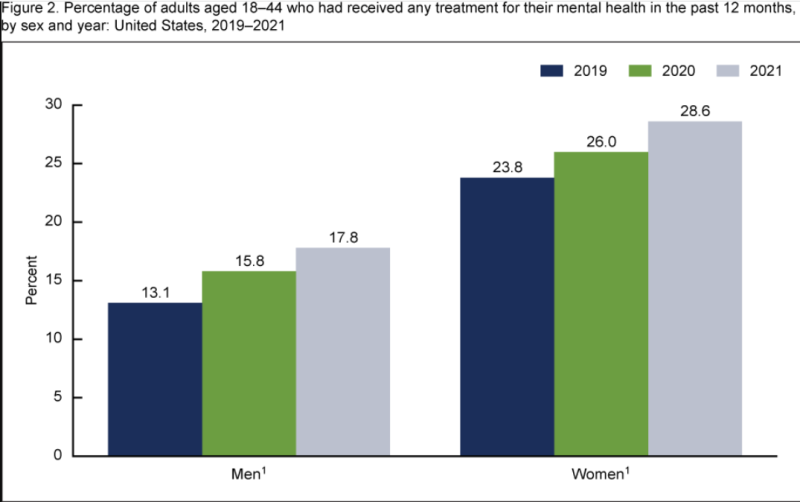
mental health CDC

RAND researchers noted that while previous studies documented an increase in telehealth services during the pandemic, “to our knowledge, this is the first study to show that the magnitude of this increase (roughly a 16­- to 20-­fold increase in utilization) fully compensated for the decline in in-person care. For the 3 highest-prevalence diagnostic categories, we also found that service utilization continued to increase throughout 2020, primarily in the telehealth context.”

The use of telehealth to treat mental health will continue, Christopher M. Whaley, Ph.D., the study’s corresponding author, told Fierce Healthcare.

“Telehealth for behavioral health care has not declined in use over the course of the pandemic,” said Whaley. “This is in contrast to many other services, which saw an increase in telehealth care in the first few months of the pandemic, but then a rebound of in-person care. For behavioral health, telehealth has been sticky and use has remained constant.”

When COVID-19 was declared a national public health emergency (PHE) on March 13, 2020, the Department of Health and Human Services relaxed Health Insurance Portability and Accountability Act compliance regulations to promote broader adoption of telehealth, including use for mental health treatment. The PHE is set to expire in April, but the $1.7 trillion omnibus bill signed by President Joe Biden on Dec. 23, 2022, guarantees these flexibilities will continue for another two years.

According to the RAND study, the mean standard deviation for beneficiaries receiving help for depression before the pandemic stood at 11.66 per 10,000 enrollees each week. When COVID-19 struck, that declined to 6.44 beneficiaries per 10,000 enrollees. For anxiety disorder, 12.24 beneficiaries per 10,000 people dropped to 5.28; for bipolar disorder, 3.32 dropped to 1.81; for adjustment disorders, 12.14 dropped to 6.78; and for PTSD, 4.93 dropped to 2.  

That’s when telehealth visits soared, with the lowest increase for bipolar disorder and the highest for anxiety disorder.

RAND researchers said they “were not able to assess quality of care and whether it differed between in-person and telehealth services. Although evidence from previous studies indicates that telemental health services are comparable with in-person services for conditions such as anxiety and depression, more evidence is required to establish quality of care in this and other samples."

One thing most can agree on: COVID-19 exacerbated the mental health problems of millions.

“The pandemic has been associated with decreased social interactions and physical exercise, threats to individuals’ employment and economic security, and an escalation in morbidity and mortality—all of which are likely to have contributed to widespread psychological distress,” the study said.

Women were more likely to seek help for anxiety disorders than men, which RAND researchers say may have to do with a greater comfort with telehealth among women. Also, women may have been under more stress, with many having to care for children not attending school.

Many had to put their careers on hold, becoming part of the "great resignation," the study noted.

female mental health

The study also cites lower rates of telehealth for mental health services in rural counties, possibly as a result of those areas being low-income.

In addition, utilization rates for adults aged 46 or older were lower than that for younger adults, the study found.

“While this may be partly attributable to a lower prevalence of certain conditions among older adults, the consistency of this trend across diagnostic categories suggests that other factors may play a role, including the digital literacy and comfortability of older adults to use videoconferencing for communicating with healthcare professionals,” the study said.

Whaley, who is a health economist at RAND and professor at the RAND Pardee Graduate School, said that “the policy takeaway is that telehealth is a widely used modality for behavioral healthcare. Restricting telehealth use of behavioral health services would likely lead to reductions in behavioral health care.”

https://www.fiercehealthcare.com/providers/telemental-health-services-rode-rescue-when-covid-struck-study