The nurses’ strike that left four NYC hospitals scrambling for coverage after 7,000 nurses walked off the job has ended, the nurses’ union announced early Thursday morning.
The walkout began on Monday – causing a massive staffing blow at Mount Sinai Hospital’s main campus in Manhattan and three locations of Montefiore Medical Center in the Bronx, officials said.
The New York State Nurses Association confirmed that the strike ended in “historic victory” with “tentative deals” reached at both hospitals.
“This is a historic victory for New York City nurses and for nurses across the country,” union president Nancy Hagans said in a statement. “NYSNA nurses have done the impossible, saving lives night and day, throughout the COVID-19 pandemic, and now we’ve again shown that nothing is impossible for nurse heroes.”
“Through our unity and by putting it all on the line, we won enforceable safe staffing ratios at both Montefiore and Mount Sinai where nurses went on strike for patient care,” Hagans said. “Today, we can return to work with our heads held high, knowing that our victory means safer care for our patients and more sustainable jobs for our profession.”
Nurses were set to walk back into Mount Sinai at 7 a.m. Thursday, after “winning wall-to-wall safe staffing ratios for all inpatient units,” the union said.
“The strike is over and we have an agreement,” the Mount Sinai Health System tweeted. “Thank you, Mount Sinai team, for your unwavering dedication to world-class patient care.”
At Montefiore, the nurses won “new safe staffing ratios in the Emergency Department,” the union said.
“Nurses also won community health improvements and nurse-student partnerships to recruit local Bronx nurses to stay as union nurses at Montefiore for the long run,” the union said.
Montefiore announced that its nurses will also return at 7 a.m. Thursday, and all surgeries, procedures and outpatient appointments set for Thursday and after will proceed as scheduled.
“We are pleased to announce that Montefiore Medical Center has reached a tentative agreement with the leadership of the New York State Nurses Association (NYSNA) on a new collective bargaining agreement,” the hospital said in a statement. “Our tireless focus remained on ensuring Montefiore nurses have the best possible working environment, with significant wage and benefit enhancements, and we worked hard to secure this outcome with NYSNA.”
Overnight, nurses at Wyckoff Heights Medical Center also reached a tentative deal and withdrew their 10-day strike notice, the union said.
Hundreds of health care professionals were seen picketing outside Mount Sinai at the height of the strike.
Placards called for “better patient care,” a “fair contract for patients and nurses” and demanded, “Don’t silence our voice on staffing!”
A travel nurse working at the hospital as a result of the strike told The Post exclusively that the strike had crippled the hospital as skeleton crews juggled an overwhelming workload.
“God, it’s not like they are saying it is — it’s worse,’’ she said.
“If I were a family member, I’d move my family to a hospital that’s not on strike because it’s difficult, and it’s not safe,’’ the nurse added.
“I am a confident nurse. I have a lot of experience in the ICU. But I’ve never felt like this before. We are literally doing all we can to keep them alive.”
Patient Leah Stern, 19, of New Rochelle, was at Montefiore’s campus at 111 E. 210th St. on Tuesday for her daily platelet transfusion to treat a bleeding disorder and told The Post she had to wait nearly six hours – or triple the usual time – to get the procedure.
“I had to wait for hours,” said Stern, who had an eye swollen shut and a bandage wrapped around her head from a recent fall because of her medical condition.
“And I didn’t even finish all my transfusions,” she lamented. “I have to do it at home now.”
Fox Sports reporter Allison Williams is one of two former ESPN employees suing the Worldwide Leader over their termination for refusing to comply with the company’s COVID-19 vaccination mandate.
Williams and former producer Beth Faber filed a joint lawsuit on Wednesday, claiming ESPN and Disney violated their religious beliefs.
In the 83-page complaint, filed in Connecticut, Williams claims she applied for an “exemption from vaccination on grounds of disability” as she was set to undergo in vitro fertilization. She later applied for a religious exemption, which was denied and led to her exit from the company in October 2021.
“[Williams] informed Defendants in writing that she was a Christian and that her sincerely held and heartfelt religious beliefs prohibited her from being vaccinated,” the suit reads.
The 38-year-old says she told an employee relations associate she had not had any vaccinations since “she got a bad reaction to one” at the age of 12, and her 2-year-old daughter was not vaccinated, either.
Allison Williams was part of a joint lawsuit filed against ESPN on Tuesday, claiming her religious rights were violated over the company’s vaccine mandate.Allison Williams/Twitter
Despite offering to test regularly and wear a mask, work remotely or in-studio, and claiming she had already had COVID-19 and “had natural immunity,” ESPN denied her exemption request and terminated her contract a week later, according to the suit.
Williams claimed she opted to leave ESPN rather than comply with the vaccine mandate.
“I have been denied my request for accommodation by ESPN and The Walt Disney Company, and effective next week, I will be separated from the company,” Williams said in a video posted to Instagram on Oct. 15, 2021. “I’m so morally and ethically not aligned with this. I’ve had to really dig deep and analyze my values and my morals. Ultimately, I need to put them first. The irony in all this are the same values and principles I hold so dear are what made me a really good employee and probably what helped with the success I’ve been able to have in my career.”
Faber, an ESPN employee of 31 years, claims her religious exemption was denied before she was fired in September 2021.
She alleges a HR representative told her, “maybe God has led you to a new career, when God closes a door, he opens another.”
Williams claims she was terminated in October 2021 for not complying with the vaccine mandate, per her suit against ESPN.Getty Images
The suit also claims Disney has “a symbiotic relationship with the Defense Department.”
“It is well-known that the Defense Department has exercised direct editorial control over Disney’s content,” the suit reads. “That control does not stop at content but extends to direct, indirect and covert encouragement as it pertains to policies and practices, such as vaccination requirements.”
Faber and Williams seek “compensatory damages, back and front pay, reputational damages, damages for emotional trauma and distress, punitive damages, reasonable attorneys’ fees and costs of the action, pre- and post-judgment interest.”
California’s aggressive climate plan to reduce greenhouse gas emissions “lacks a clear strategy,” the Legislative Analyst’s Office reported on Jan. 4.
“Despite the significant reductions needed to meet these goals, CARB’s plan does not identify which specific policies it will implement,” the report stated.
The California Air Resources Board (CARB) in December 2022 adopted an “equity-focused” 300-page climate action plan, or roadmap, to meet the state’s goal of drastically reducing emissions and reaching carbon neutrality by 2045.
The agency also adopted a more ambitious goal for 2030, seeking to reduce emissions by 48 percent—instead of the statutory mandate’s 40 percent—below the 1990 level.
The analyst’s office said that without a clear roadmap, state departments will be forced to identify and adopt necessary policy changes in a short time, which could make the process “costlier and/or disruptive for private businesses and households.”
According to the report, CARB’s plan is unclear about how much the state will rely on financial incentives, regulatory programs, or cap-and-trade—a government program that puts a cap on emissions and requires companies to pay for extra allowances—to achieve these goals.
The plan also didn’t provide the state Legislature with enough information on potential financial and environmental impacts, among other concerns, according to the report.
“Failing to develop a credible plan … could adversely affect California’s ability to serve as an effective model for other jurisdictions or demonstrate global leadership,” the report stated.
The office has recommended the Legislature direct CARB to submit a report by July 31 to clarify its plan.
California Gov. Gavin Newsom, a Democrat, speaks to reporters during a visit the Antioch Water Treatment Plant in Antioch, Calif., on Aug. 11, 2022. (Justin Sullivan/Getty Images)
In November 2022, Gov. Gavin Newsom applauded the plan, calling it “the most ambitious set of climate goals of any jurisdiction in the world” that will “spur an economic transformation akin to the industrial revolution.”
The plan reflected the governor’s call for more aggressive climate measures and a faster transition to clean energy. It aims to cut air pollution by 71 percent and reduce the consumption and demand of fossil fuel by 86 percent and 94 percent, respectively, by 2045.
The state has reduced emissions by about 1 percent annually over the past decade. To meet CARB’s goals, the state would need to speed up to about 4 percent, the analyst’s office said.
Most of the transformation would come from reducing the presence of fossil fuels as much as possible, including phasing out the use of natural gas for heating homes and buildings. It also means clamping down on chemicals and refrigerants and encouraging residents to walk, bike, and use public transit instead of driving.
The plan also introduced four potential scenarios of how the state might become carbon neutral between 2035 and 2045, each with different levels of restrictions on residents and businesses.
The first path, also the most restrictive, includes phasing out all fossil fuel refining in the state; reducing vehicle miles traveled by 30 percent; and allowing only electric vehicles on the road—all by 2035. It also calls for reducing heating, air conditioning, and water heaters in buildings and replacing them with electric appliances by the same year. Cutting dairy methane emissions—or cow manure emissions—by 50 to 75 percent by reducing the state’s dairy cow population is also mandated in this case.
Other assumed scenarios allow longer transition time, with fewer restrictions but accelerated removal of carbon dioxide from the atmosphere.
A top U.S. Capitol Police commander - recently retired Assistant Chief Yogananda Pittman - failed to respond to repeated urgent radio calls to evacuate the U.S. Congress on Jan. 6, 2021, causing the loss of precious time that might have prevented the shooting death of protester Ashli Babbitt, a former USCP commander said.
The delay caused by the radio silence from the Capitol Police Command Center was so urgent that the 22-year veteran lieutenant located near the U.S. Senate chamber forged ahead with the evacuation anyway. He said he feared lawmakers would be injured or killed if he didn’t lead them to safety before the chamber doors were breached by protesters.
In a series of exclusive interviews with The Epoch Times, former Lt. Tarik K. Johnson, 47, detailed allegations that Pittman failed to respond to multiple urgent calls for help.
“I begged for help all day on Jan. 6, 2021, and I feel I was largely ignored,” Johnson told The Epoch Times. “I beg again on Jan. 6, 2023—exactly two years later—for the proper investigative entities to uncover what really occurred on J6 and I pray that the country hears my cry.”
Johnson said the crucial delay in the evacuations should never have happened.
“There was no response from anybody at the Command Center,” Johnson said. “I say even before I initiated evacuation, I say specifically, ‘We’ve got to start thinking about getting the people out before we don’t have a chance to.’ I heard no response. Then I asked for permission to evacuate. I heard no response.”
Pittman, 49, who will begin a new job as chief of police at the University of California-Berkeley on Feb. 1, did not reply to messages seeking comment. She announced her retirement from USCP in November 2022.
The USCP Command Center, located on the seventh floor of the headquarters building on D Street in Washington, is a 40-by-30-foot room staffed by Capitol Police and officials from partner agencies, including the DC Metropolitan Police Department, the FBI, U.S. Park Police, and others.
In his new book, “Courage Under Fire,” published on Jan. 3, former USCP Chief Steven Sund, 57, said an area of the Command Center nicknamed “the pit” is used for monitoring “all the camera systems, radios, alarms, and a computer-aided dispatch terminal to monitor USCP and MPD calls for service.”
Founded by an act of Congress in 1828, the U.S. Capitol Police has more than 1,800 sworn officers, more than 500 civilian employees, and an annual budget of $602.5 million.
According to the book, Sund was in the Command Center the afternoon of Jan. 6, but was occupied making dozens of calls to the House and Senate sergeants at arms and the Pentagon, trying to get National Guard troops sent to the Capitol. He also made and took numerous calls to arrange for mutual aid from surrounding police agencies, the book said.
There is no indication in the book that Sund was aware of the unanswered calls for help. Johnson does not fault him for the troubles. Sund did describe watching some of the Capitol violence unfold from the Command Center.
“As I sit in my Command Center watching the video screens,” Sund wrote, “my frustration at the repeated delays from the sergeants at arms, along with my concern for my officers’ safety, is redlining. To be more precise, I am [expletive] livid.”
Johnson became known to much of America as the Capitol Police lieutenant who wore a bright red Make America Great Again ball cap when he worked with a pair of Oath Keepers to rescue 16 USCP officers trapped in the foyer inside the massive Columbus Doors.
Johnson was suspended by USCP and later accused of rules violations, including conduct unbecoming, for wearing the Trump hat and working with the Oath Keepers on the officer rescue. He said he believes those charges were actually brought because the evacuations and other split-second leadership decisions he made embarrassed Pittman.
U.S. Capitol Police Lt. Tarik Khalid Johnson asks Oath Keepers Steve (center) and Michael Nichols for help rescuing police officers trapped inside the Capitol on Jan. 6, 2021. (Rico La Starza/Special to The Epoch Times)
After about 17 months of suspension, Johnson got his job back, but chose to resign. Johnson said wearing the MAGA cap made the crowds more receptive to him, provided a level of safety that he likened to a tactical helmet, and served as a de-escalation tool.
Johnson had been with USCP for 22 years at the time of the Jan. 6 events, serving as a police officer, dignitary special agent, sergeant, and lieutenant. For two years prior to his USCP service, he worked for the Senate Sergeant at Arms.
One of the Oath Keepers, retired New York police Sgt. Michael Nichols, said Johnson’s actions during the officer rescue were heroic.
“He adapted to the environment, put the officers’ and people’s safety before his own, and succeeded in defusing a tense situation that could have resulted in a mass-casualty incident,” Nichols said.
Johnson’s actions throughout the day on Jan. 6 reminded Nichols of a character in the television miniseries “Band of Brothers.”
“It’s not like he just helped these officers out, this man was like the lieutenant in Band of Brothers who just keeps running back and forth across the battlefield to get everyone in position and on task, with no regard for self—only for what needs to be done,” Nichols told The Epoch Times. “He really saw the big picture that day.”
Rico La Starza, who documented the rescue operation on video, agreed. “He’s the leader people pray for,” La Starza said. “Quick on the feet and willing to go through flames for his team.”
Radio Dispatch Recordings Confirm Events
Johnson’s assertions about the Senate and House evacuations were corroborated by USCP radio dispatch recordings and transcripts obtained by The Epoch Times.
The unanswered plea for authorization to evacuate was among at least four instances when Johnson or the USCP dispatcher asked in vain for help or direction from the Command Center, where Pittman sat at the center console near Chief Sund.
Babbitt was shot and killed by USCP Lt. Michael Byrd at 2:44 p.m. as she attempted to climb through a broken window pane leading into the Speaker’s Lobby. Shortly before that, Babbitt shouted at rioters who were vandalizing the doors and windows and chastised three Capitol Police officers for doing nothing to stop the violence.
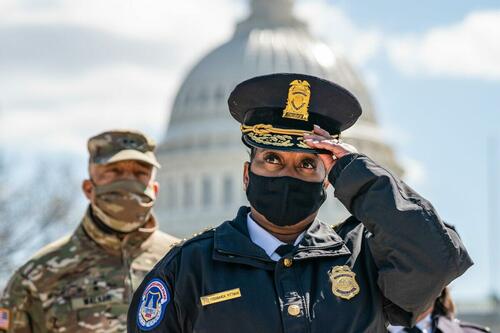
Acting Capitol Police Chief Yogananda Pittman attends a press briefing about a security incident at the U.S. Capitol on April 2, 2021. Pittman announced that one police officer was dead after a man rammed his vehicle into a Capitol barricade. (Drew Angerer/Getty Images)
Johnson said if the evacuation of Congress started when he first asked for help, Byrd would not have been near the Speaker’s Lobby entrance, and the House chamber would have been empty if the violent crowd had somehow breached the barricaded double doors.
“I made the evacuation order at approximately 2:28 for the Senate, and then I did it maybe six to eight minutes later for the House,” Johnson said.
“[Byrd] should not have been put in that situation. Had the evacuation occurred earlier, Lt. Michael Byrd would not have been there and Ashli Babbitt would have met a vacated lobby.”
Senate Evacuation
Audio from the main USCP radio channel provides dramatic testimony on the efforts to evacuate hundreds of lawmakers and staff.
At about 2:23 p.m., Johnson asked for authorization to have one of the Senate doors unlocked so he could get Senate Sergeant at Arms Michael Stenger into the chamber. Thomas Lloyd, USCP inspector, crackled across the radio, “Approved.”
Johnson shortly made his biggest and most urgent plea of the day.
“405J-John with a message. I want to advise that we evacuate the Senate floor before [we] won’t have a chance to,” Johnson said over the radio just after 2:25 p.m. “We have a clear directional sight to get out of the Senate door from the second floor. I need permission to go ahead and initiate that, copy.”
The dispatcher repeated Johnson’s plea. “…He has a clear sight to get everyone out,” the dispatcher said.
For a second time, the dispatcher relayed the request. “405J-John requesting to clear the Senate floor,” he said. “He has a clear path. Clear ahead a path to get everyone out.”
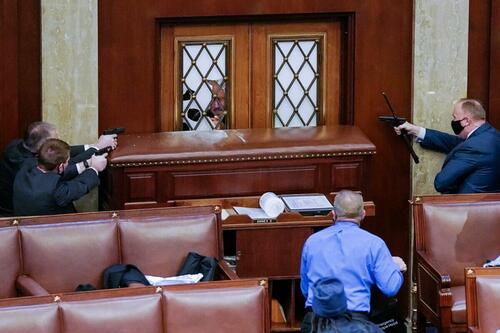
Police officers aim their weapons at the main door in the House chamber after protesters breached the U.S. Capitol on Jan. 6, 2021. (Drew Angerer/Getty Images)
There was no reply from the command staff on the ground or in the Command Center. Johnson said Pittman, then the No. 2 official at U.S. Capitol Police, was the person who should have made that call.
Johnson said his fear grew as the seconds and minutes ticked away.
“405J-John disregard,” Johnson broadcast. “I’m going to go ahead and do it anyway. I’ll take the 550 or 534. We’re evacuating now on the north side, send everybody out the Senate door, copy.”
The numbers 550 and 534 refer to officer disciplinary codes, Johnson said.
The dispatcher responded: “I copy that. Evacuations being executed at this time, 1429 hours [2:29 p.m.].”
The official USCP Jan. 6 timeline of events states that at 2:28 p.m., “remaining members evacuated from Senate floor.”
Dispatch acknowledged the evacuation order at 2:29 p.m. At 2:32 p.m., Deputy Chief Eric Waldow broadcast, “Senate floor is continued to be evacuated. I’m moving with the members now.”
The Senate was declared clear at 2:33 p.m.
House Evacuation
The House went into recess at 2:29 p.m. At about that time, a group of 75–100 protesters—including Babbitt—began filling up the hallway outside of the Speaker’s Lobby adjacent to the House chamber. Some members of the crowd turned violent and began rioting. Agitators smashed the glass in the doors with a helmet and flag poles.
After leading the senators through the subway tunnel to safety, Johnson turned his attention to the evacuation of the House, coordinating over the radio with Sgt. Nelson Vargas, 49.
For the third time in less than a year, a group of lawmakers is urging the Biden administration to use a controversial provision of federal law to widen access to a pricey cancer medicine, an issue that has festered ever since cancer patients petitioned the federal government.
The medicine in their crosshairs is the Xtandi prostate cancer drug, which last year had a $156,000 list price, according to Elsevier Health. The treatment was developed at the University of California, Los Angeles, with U.S. taxpayer dollars — specifically, grants from the National Institutes of Health and the Department of Defense. A key inventor was a professor at the school, which licensed the drug to a biotech that later struck a marketing deal with Astellas.
With backing from advocacy groups, two cancer patients in November 2021 asked the agency to effectively sidestep Xtandi patents by using march-in rights. Under a federal law known as the Bayh-Dole Act, a government agency that funds private research can require a company to license its patent to another party in order to “alleviate health and safety needs, which are not being reasonably satisfied.” An agency can also do so when the benefits of a product are not available on “reasonable terms.”
The patients argued that pricing is, essentially, a proxy for access. And they noted that Xtandi, which Astellas and Pfizer now market jointly in the U.S., costs much less in other countries. For instance, they contended the drug costs less than $31,000 in Australia and less than $25,000 last year in Japan, at current exchange rates. However, the U.S. list price does not reflect rebates or discounts paid by a drugmaker to win favorable placement on health plan formularies, or lists of covered drugs.
After more than a year without a substantive reply from the NIH, the agency last month responded to the patients with a vague update. NIH officials, they wrote, were “currently coordinating” with the Department of Health and Human Services “to review and assess” the information that was submitted in their petition in order to determine whether the use of march-in rights outlined in federal law “may be warranted.” There was no timeline provided for a decision.
The lag time has irked lawmakers, though.
Led by Sen. Elizabeth Warren (D-Mass.), who has previously urged the administration to use march-in rights to address the cost of Xtandi, two dozen Senate and House lawmakers wrote HHS Secretary Xavier Becerra to complain about the delay. They noted HHS previously committed to consider petitions for march-in rights but nothing happened. And in July 2021, Biden issued an executive order instructing the Commerce Department not to finalize provisions of a rule forbidding the use of march-in rights. Two months later, the White House listed march-in rights as one potential avenue for addressing drug prices.
“Over a year has passed since the petition to exercise march-in rights for Xtandi was first submitted to HHS and, despite numerous commitments from HHS that the department would give such petitions ‘due consideration,’ the petition has not been fully reviewed,” the lawmakers wrote, noting that Medicare spent nearly $2 billion on Xtandi in 2020. “… We urge you to move forward with the march-in petition for Xtandi without delay.”
Whether the Biden administration will embrace march-in rights is unclear. We asked HHS for comment and will update you accordingly.
It is worth noting that the Trump administration proposed a rule to prevent the use of march-in rights to address pricing of “commercial goods and services that stem from an invention.” President Biden, however, subsequently issued an executive order that instructed the Department of Commerce not to finalize provisions of that rule concerning march-in rights.
Since then, however, the recently enacted Inflation Reduction Act has given Biden a win insofar as the law is designed to lower the cost of prescription medicines, such allowing the federal government to negotiate some drug prices and requiring pharmaceutical companies to pay rebates if they increase prices more than inflation. But the lawmakers argued many of these provisions will not take effect immediately. And some provisions do not start until 2026.
The Biden administration “has the tools to bring relief to Americans now, including by using its existing authority to lower the cost of Xtandi,” they wrote.
For its part, the pharmaceutical industry and its supporters have regularly countered that this provision of the law is misunderstood and was never intended to address prescription drug costs. Drugmakers also argue that exercising march-in rights would chill the willingness among companies to work with federal agencies and, subsequently, harm innovation. This argument has successfully persuaded previous administrations from acting on earlier petitions that sought the use of march-in rights.
China’s factory-gate deflation narrowed last month even as rising virus infections snarled factory operations, while a small uptick in consumer inflation will likely still leave the central bank room to ease policy and bolster the economy.
The producer price index fell 0.7% in December from a year earlier after declining 1.3% in the previous month, the National Bureau of Statistics said Thursday. Economists surveyed by Bloomberg had expected a 0.1% drop.
Consumer inflation gained 1.8% compared with a 1.6% increase in November, in line with economist expectations. Core inflation, which excludes volatile food and energy prices, picked up slightly to 0.7% after staying unchanged at 0.6% for three straight months.
Consumer prices “were generally stable” in December thanks to multiple measures to ensure market supply and price stability, said Dong Lijuan, chief statistician at the NBS.
The bigger-than-expected decline in PPI, meanwhile, reflects “the virus damage on industrial demand during the month,” said Zhou Hao, chief economist at Guotai Junan International Holdings.
There was little reaction in Chinese stocks to the data, with the CSI 300 Index trading up 0.2% at 10:38 a.m. in Shanghai. The yuan was 0.1% stronger against the greenback.
Surging infections following the abrupt reversal of Covid Zero pushed activity off a cliff as people became ill or stayed home for fear of catching the virus — contributing to what other economic indicators have suggested was the weakest month for China’s activity since early 2020. Factory production and new orders in December both contracted the most since April 2022, during Shanghai’s lockdown.
Major cities experiencing outbreaks did not begin to rebound until near the end of the month, high frequency data measuring subway usage and other mobility data showed.
As the reopening gains momentum both consumer and producer prices are likely to “warm up,” Zhou said — though he added that the “overall inflation pressure remains mild.”
Authorities on Thursday cited “volatile” international commodity prices this year as a concern. “Imported inflation pressure remains,” said Wan Jingsong, head of the National Development and Reform Commission’s price department, at a press briefing. He added though that China is “confident and capable” of maintaining stable prices.
Inflation in 2023 should “remain moderate and controllable, and the probability of a sustained and rapid rise in inflation is not high,” said Bruce Pang, chief economist and head of research for Greater China at Jones Lang LaSalle Inc. He added that monetary policy should be focused on stabilizing upward momentum for the economy’s recovery.
Officials have recently said monetary stimulus in 2023 will be at least as strong as last year, and policy will be focused on supporting domestic demand. In addition to interest-rate cuts, that could include another reduction in the reserve requirement ratio for banks — the amount of cash lenders have to keep in reserve.
While major cities are showing signs of recovery, economic pain may continue as Covid infections spread elsewhere in the country during a busier-than-usual Lunar New Year holiday travel rush.
Economists, though, expect a faster rebound once infections peak. The median estimate among economists surveyed by Bloomberg is for gross domestic product to expand 4.8% this year, accelerating from an estimated 3% in 2022.
New research in the January 2023 issue of Journal of the National Comprehensive Cancer Network finds that immunotherapy from immune checkpoint (PD-1) inhibitors prior to surgery was strikingly effective for patients with localized mismatch repair-deficient or microsatellite instability-high (dMMR/MSI-H) colorectal cancer (CRC).
Nearly all of the patients studied benefitted from neoadjuvant PD-1 inhibitors, with 1-of-4 experiencing complete response on clinical assessment. In addition to the short-term effectiveness, the findings showed substantial longer survival benefits from neodjuvant PD-1 inhibitors, including a low recurrence rate when compared with historic rates.
The researchers—who are based in Southern China—anticipated PD-1 inhibitors could be at least as effective for locally-advanced but operable cancer as they have historically been in the treatment of metastatic dMMR/MSI-H CRC, but were surprised to find it so much more effective for this patient population.
The study included a retrospective review of 73 patients between ages 18 and 75 with confirmed dMMR/MSI-H CRC who received any type of PD-1 inhibitor prior to surgery between October 1, 2017 and December 31, 2021. Of those 73, 48 were diagnosed with colon cancer, 18 with rectal cancer, and 7 with multiple types of CRC. 84.9% overall experienced an objective response, with 23.3% showing complete response and 61.6% partial response.
The 2-year rates for tumor-specific overall survival and disease-free survival were 100% for patients who underwent surgery after PD-1 blockade.
"We need to keep in mind that our final goal is to cure patients long term, not just remove the tumor at the moment," said senior author Pei-Rong Ding, MD, Sun Yat-sen University Cancer Center, State Key Laboratory of Oncology in South China, Collaborative Innovation Center of Cancer Medicine.
"I think care providers, especially surgeons, should refrain from scheduling immediate surgery for patients with locally advanced, or even early-stage dMMR/MSI-H colorectal cancer. With such a powerful option at hand, we have the duty to offer a safer surgery with better outcomes or a non-surgical-yet-equally-effective approach for this group of patients, especially for those who might suffer from function damage or organ sacrifice after surgery."
The study had an average follow-up time of 17.2 months, with 16 patients tracked for more than two years. The researchers call for more studies with an even longer follow-up to confirm these results, especially after treatment ends. There is also more to learn about the long-term safety of this approach and possible implications for limiting or avoiding surgery entirely.
"The treatment of mismatch repair deficient locally-advanced colorectal cancer is a highly active area of research," commented Dustin A. Deming, MD, University of Wisconsin Carbone Cancer Center, Member of the NCCN Guidelines Panel for Colon/Rectal/Anal Cancers, who was not involved in this study.
"This retrospective analysis highlights the potential for significant treatment responses with limited toxicities for these patients treated with immune checkpoint inhibitors. It will be exciting to see how these results, and other completed and on-going studies, will be utilized to incorporate anti-PD1 treatments into the standard-of-care for locally-advanced colorectal cancers."
More information: Bin-Yi Xiao et al, Neoadjuvant immunotherapy leads to major response and low recurrence in localized mismatch repair–deficient colorectal cancer, Journal of the National Comprehensive Cancer Network (2023). DOI: 10.6004/jnccn.2022.7060