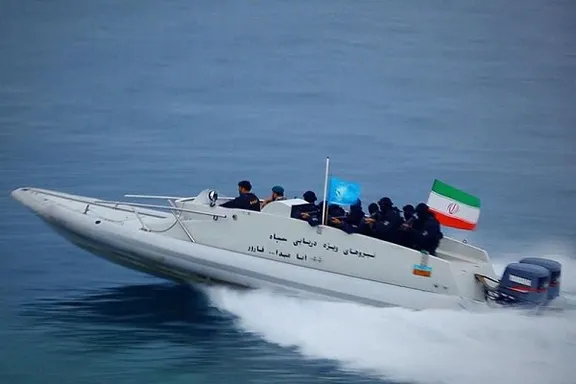
The Islamic Revolutionary Guard Corps (IRGC) has deployed special forces along Iran’s Persian Gulf coast to identify in advance vessels using the Oman-side route through the Strait of Hormuz, sources familiar with the matter told Iran International.
The IRGC operatives are also seeking access, through Omani sources, to the schedules and coordination details of ships passing through the southern route of the Strait of Hormuz, the sources said.
The special forces deployed by the IRGC are equipped with various intelligence-gathering systems, including land-based observation posts, naval equipment and aerial systems, and have recently been tasked with identifying in advance any vessel intending to pass through the southern route and issuing warnings about it, the sources said.
The sources also say that IRGC operatives are extensively gathering information from Omani sources and agents to learn ahead of time about the coordination and schedules of ship movements through the southern route and receive related alerts.
The IRGC has said the only authorized routes through the Strait of Hormuz are those designated by the Islamic Republic. It has warned international vessels not to use the southern corridor, which passes through waters near Oman’s coast and has been recommended by Oman and the International Maritime Organization.
The deployment of the IRGC monitoring and identification network, and its attempt to access shipping information through Omani sources, comes as Washington and Tehran agreed on Sunday after several rounds of exchanges of fire, to a temporary one-week de-escalation in the Strait of Hormuz.
Talks between the two sides are expected to continue in Doha based on a new proposal put forward by Oman.
Sources say the Islamic Republic, while sitting at the negotiating table, is strengthening its identification and warning chain for vessels that do not use Tehran-approved routes — a route at the center of the current dispute between Tehran and Washington.
The attack on a Singapore-flagged vessel
The pattern of last week’s IRGC attack on a commercial vessel in the southern route is consistent with the new mission assigned to these forces.
IRGC forces on Thursday, June 25, targeted a Singapore-flagged cargo ship in the Strait of Hormuz near Oman’s coast. According to the United Kingdom Maritime Trade Operations, the attack damaged the vessel’s bridge but caused no casualties. It came only hours after the IRGC Navy warned against using unauthorized routes.
US warplanes on Friday, June 26, struck Iranian missile and drone depots as well as coastal radar sites. The IRGC Navy responded by attacking US positions in the region and, citing Clause 5 of the Islamabad memorandum of understanding, said arrangements for controlling traffic through the Strait of Hormuz were under the authority of the Islamic Republic.
Three rival routes in one waterway
According to reports, three different routes have now emerged for passage through the Strait of Hormuz: the southern route near Omani waters, the middle route used before the war, and the northern route under Iranian control.
Ships that choose non-Iranian routes risk being targeted, while those that pass through the Iranian route fear exposure to Western sanctions if the agreement collapses.
An analyst at the shipping intelligence firm Kpler told CNN that if the disputes are not resolved by mid-August, use of all three routes will become more chaotic and insecure.
Because of naval mines in the traditional traffic separation scheme designated by the International Maritime Organization in 1968, the middle route remains effectively closed, although Tehran has committed under the war-ending memorandum to clear the mines within 30 days.
Ship traffic is now moving through two routes: one near Oman’s coast and one near Iran’s coast. The Iranian Navy has also warned vessels to pass only south of Larak Island.
The dispute over Hormuz management
The IRGC’s attempt to access shipping information through Omani sources is especially significant because Muscat is both the coastal state for the southern route and the mediator and architect of the framework for the ongoing talks.
Mohammad Bagher Ghalibaf, the head of the Islamic Republic’s negotiating team, said in Oman on June 23 that management of the Strait of Hormuz would not return to the pre-war situation. He said Tehran, in talks with China and Egypt, had raised the idea of charging vessels a “service fee” modeled on the Dardanelles waterway.
But Omani Foreign Minister Badr al-Busaidi told Marco Rubio on June 25 that any possible mechanism for managing the Strait of Hormuz would not include tolls.
Officials of the Islamic Republic say Iran and Oman have joint sovereignty over the Strait and that after the 60-day deadline set in the memorandum expires, they will begin joint management and toll collection. The United States, however, regards the Strait of Hormuz as an international waterway and says any new mechanism there would require the approval of Persian Gulf countries.
Kazem Gharibabadi, Iran’s deputy foreign minister, has also previously said the safe passage of ships through the Strait of Hormuz cannot be guaranteed without coordination with Iran, warning that if such coordination does not take place, designated routes could be suspended.
A waterway far from normal
Two weeks after the signing of the 14-article Islamabad memorandum, which called for an end to the war on all fronts, the reopening of the Strait of Hormuz and the end of the US naval blockade, traffic through the Strait remains only a fraction of pre-war levels.
The number of vessel transits reached about 70 on June 24, the highest level since the start of the war. Before the war, an average of about 130 vessels passed through the waterway each day.
The secretary-general of the International Maritime Organization has said 14 seafarers have been killed since the start of the Strait of Hormuz crisis. The organization also temporarily suspended the evacuation of about 600 ships and 11,000 sailors stranded in the area after the attack on the Singapore-flagged vessel.
Tracking data nevertheless shows that ships are continuing to use the southern route despite Tehran’s warnings. The Joint Maritime Information Center, which operates under US Navy oversight, has also said the route near Oman’s coast is being expanded to allow two-way traffic.
Under these conditions, the IRGC’s deployment of special forces to identify vessels on the southern route in advance, and its efforts to obtain shipping information through Omani sources, show Tehran is preparing to exert control over the same corridor Washington and Muscat are working to expand.

No comments:
Post a Comment
Note: Only a member of this blog may post a comment.