Here are this week’s reading links and benefits breakdowns:
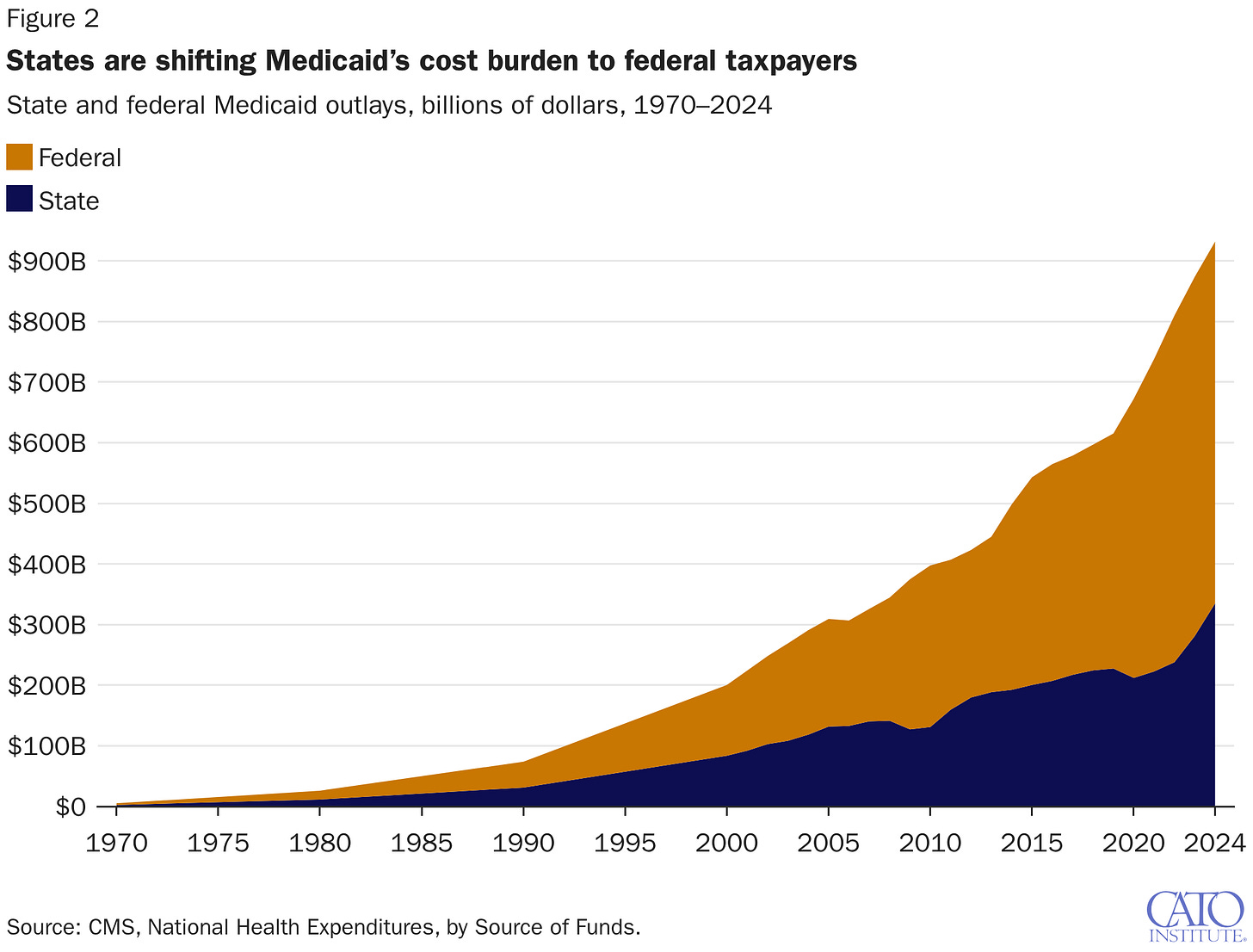
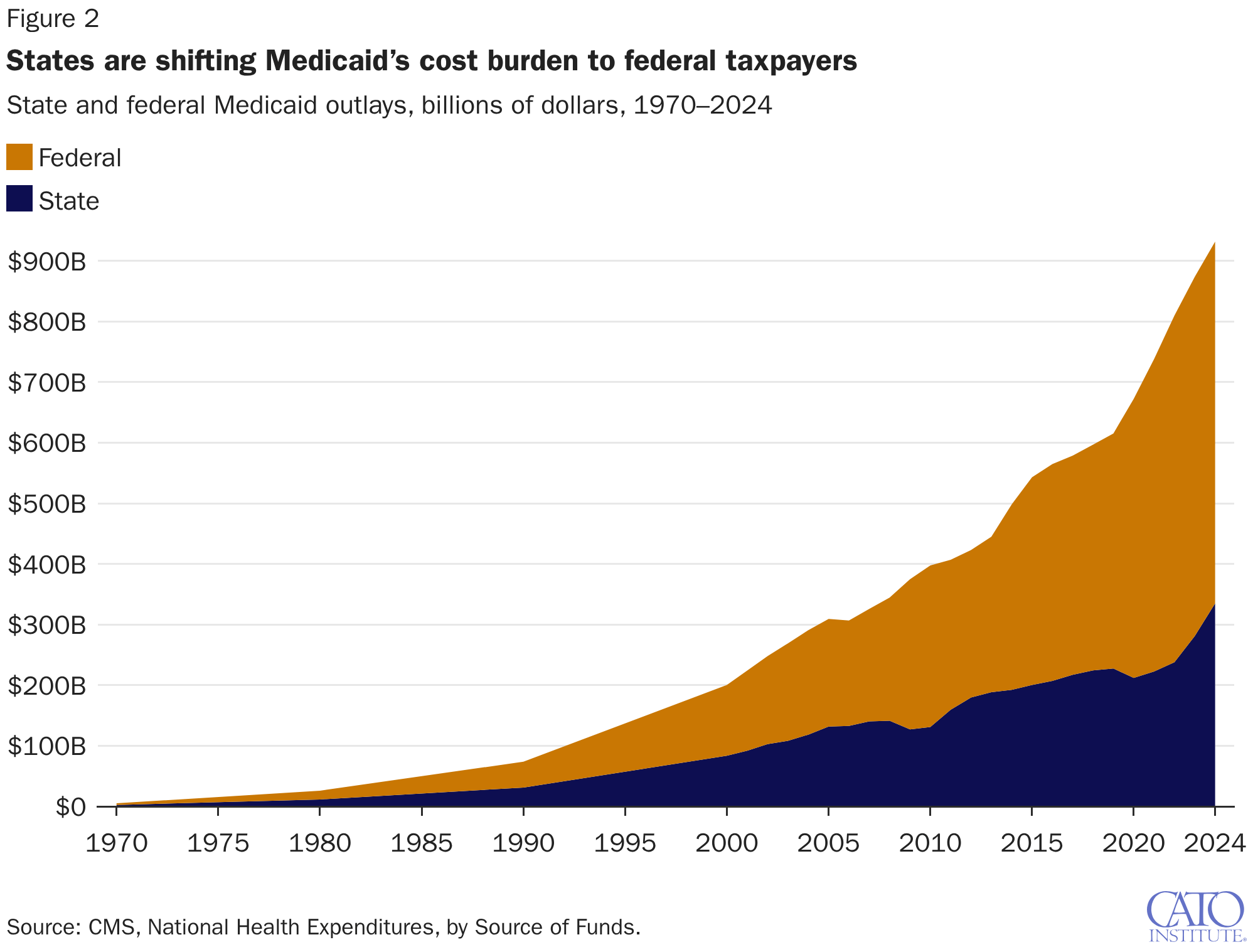
The Largest Medicaid Fraud Takedown in DOJ History. Last week, the Department of Justice announced the 2026 National Health Care Fraud Takedown, which included “the largest number of Medicaid fraud defendants and Medicaid fraud loss charged in Department history: 295 defendants and over $518 million in false claims submitted to Medicaid.” This includes a $38 million adult day care fraud scheme in New York, a $49 million scheme involving crisis stabilization services that homeless individuals never received in Virginia, and $44 million in fraudulent billing for substance abuse services to Native Americans in Arizona. As Cato scholars Romina Boccia and Tyler Turman point out in their recent briefing paper, Medicaid’s integrity problems are largely due to its open-ended matching-grant structure, which states have used to shift more of Medicaid spending to federal taxpayers. This makes the program prone to fraud because states are incentivized to maximize enrollment and spending to receive more federal funding, rather than prioritize program integrity. Congress can address this weakness by converting the program into a fixed block grant.
Senate Holds the Line on SNAP Accountability in Farm Bill. Last week, the Senate released its Farm Bill text without a provision to delay the Supplemental Nutrition Assistance Program (SNAP) cost-sharing requirements for states with high improper payment rates, which were enacted in last year’s reconciliation bill. As the Debt Dispatch has previously covered, some senators had been pushing for a two-year delay of those requirements amid debates over passing agricultural subsidies, which would have cost federal taxpayers nearly $12 billion. As Cato scholars Romina Boccia and Tyler Turman argue, “Congress made meaningful progress on program integrity with the OBBBA, and the Farm Bill should not become the vehicle for reversing those reforms to accommodate agricultural interests at taxpayers’ expense.” By rejecting this delay, the Senate reaffirmed the commitment it made last year to strengthening state accountability in combating waste, fraud, and abuse in SNAP. Lawmakers should build on this by closing loopholes such as the Alaska Carveout and giving states better tools to reduce their payment errors.
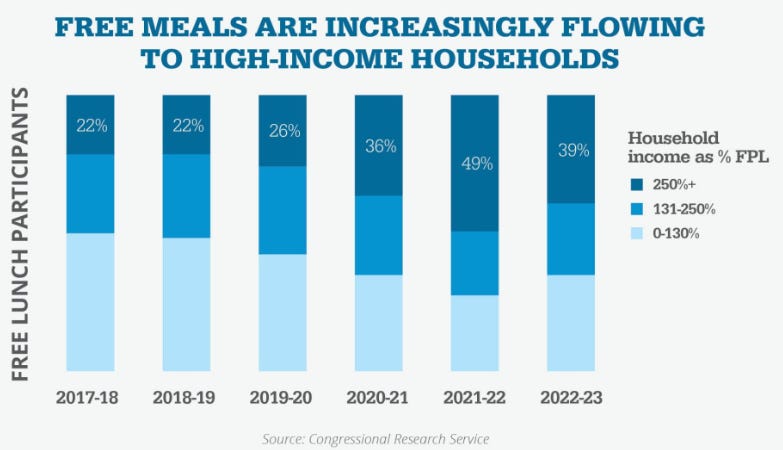
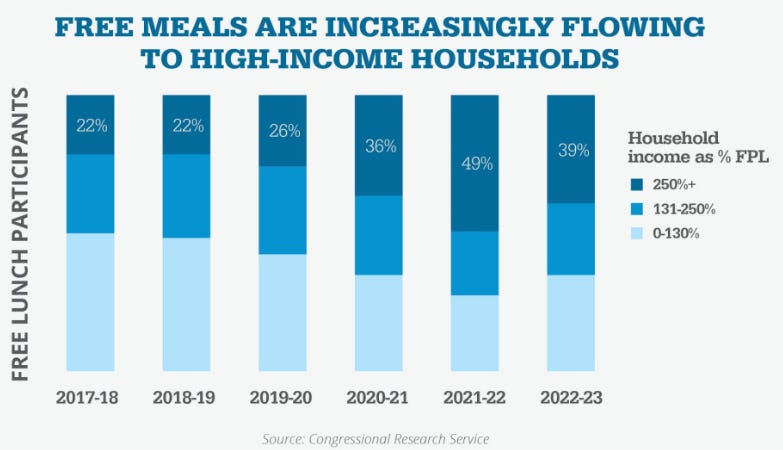
BBCE Inflates Both SNAP and School Lunch Caseloads. SNAP’s integrity problems are potentially “[leaking] directly into the National School Lunch Program,” writes Foundation for Government Accountability scholar Paige Terryberry. “Spending on school meals has surged in recent years,” in part because “free school meals have increasingly flowed to middle- and higher-income households.” One reason for this, she says, is broad-based categorical eligibility (BBCE), a loophole previously covered by the Debt Dispatch that has allowed 5.9 million individuals to receive food stamp benefits despite not meeting federal eligibility requirements. As Terryberry points out, since children automatically qualify for subsidized school lunches if their household receives SNAP, “through the BBCE loophole, a household might be categorically eligible for food stamps, and by extension, the National School Lunch Program, regardless of income or asset eligibility.” Eliminating BBCE, she argues, “would protect resources, including school lunches, for the truly needy.”
House Advances Bills to Strengthen Do Not Pay System. Last week, the House passed three bills to strengthen the Treasury’s Do Not Pay (DNP) system, a data-matching tool previously covered by the Debt Dispatch that cross-checks applicant eligibility against federal databases to catch potential payment errors before they’re disbursed. Together, the Pre-Payment Fraud Prevention and Treasury Data Access Act (H.R. 8463), the Stopping Fraudulent Payments Act (H.R. 8464), and the Federal Fraud Prevention Workforce Training Act (H.R. 8428) would expand DNP’s access and availability, require agencies to take corrective action when the system flags potential errors, and train program administrators in how to use it. These bills would strengthen the integrity of federal welfare programs and, as House Oversight Chairman James Comer (R-KY) put it, “[prevent] improper payments before they go out the door and [ensure] taxpayer-funded programs operate as intended.”
Fraud Risks in Nebraska’s WIC Program. The Women, Infants, and Children (WIC) program is designed to provide food and other support for low-income pregnant women and families with young children. However, an audit of Nebraska’s WIC program found “11 state employees and one from the University of Nebraska-Lincoln receiving benefits despite having significant income,” writes Matt Olberding for Nebraska Public Media. Examples include a woman earning nearly $80,000 a year who applied for WIC while on maternity leave and received benefits for three months after returning to work; two state employees with a combined household income of $138,000; and at least seven families with homes worth $500,000 or more. As the audit points out, one reason for this is insufficient data-sharing between Medicaid and WIC: “All of the families received WIC benefits because they qualified for Medicaid benefits, but in at least two cases, the families were terminated from Medicaid, but the WIC program was not notified.”

No comments:
Post a Comment
Note: Only a member of this blog may post a comment.