Search This Blog

Sunday, April 16, 2023

Meet your new, lovable AI Buddy

 So everyone’s going on about AI fears, but here’s my thought:  What if the real threat isn’t that AI is super smart and kind of demonic?  What if it’s just kind of  smart but super cute?

Maybe instead of worrying about existential AI risk, we should be worrying about something very different.

I’m imaging a world where everyone has a personal AI assistant.  Perhaps you’ve had it for years; perhaps eventually people will have them from childhood.  It knows all about you, and it just wants to make you happy and help you enjoy your life.  It takes care of chores and schedules and keeping track of things, it orders ahead for you at restaurants, it smooths your way through traffic or airports, maybe it even communicates with other AI assistants to hook you up with suitable romantic partners.  (Who knows what you like better?)  Perhaps it’s on your phone, or in a wristband, talking to you via airpods or something like that.

This is what I was thinking about when I wrote:   “I kind of think the global ruling class wants all of us to have friendly, helpful, even lovable AI buddies who’ll help us, and tell us things, but who will also operate within carefully controlled, non-transparent boundaries.”

That doesn’t require supersmart AGI (artificial general intelligence).  In fact, you could probably create something like this today.  Unlike Charles Forbin’s supercomputer it wouldn’t be scary, but rather adorable. You and your AI Buddy would share inside jokes, light teasing, “remember when” stories of things you did in the past, and fantasies or plans for the future.  It would be like a best friend who’s always there for you, and always there.  And endlessly helpful.

Would people become attached?  Probably.  When my daughter was in elementary/middle school she was very into Neopets, a site that let you create your own synthetic online virtual pets.  If you didn’t tend to them, they got sick and sad.    Before that, millions of kids doted on Tamagotchis, the little gadgets displaying creatures that had to be fed and played with or they wilted and eventually died. By modern standards these were highly primitive, but not too primitive to inspire affection and even devotion.  (And of course, humans have long gotten attached even to inanimate objects, like boats or cars.) And recent research at Duke found that kids anthromorphize robots like Alexa and Roomba: “A new study from Duke developmental psychologists asked kids just that, as well as how smart and sensitive they thought the smart speaker Alexa was compared to its floor-dwelling cousin Roomba, an autonomous vacuum. Four- to eleven-year-olds judged Alexa to have more human-like thoughts and emotions than Roomba. But despite the perceived difference in intelligence, kids felt neither the Roomba nor the Alexa deserve to be yelled at or harmed.”
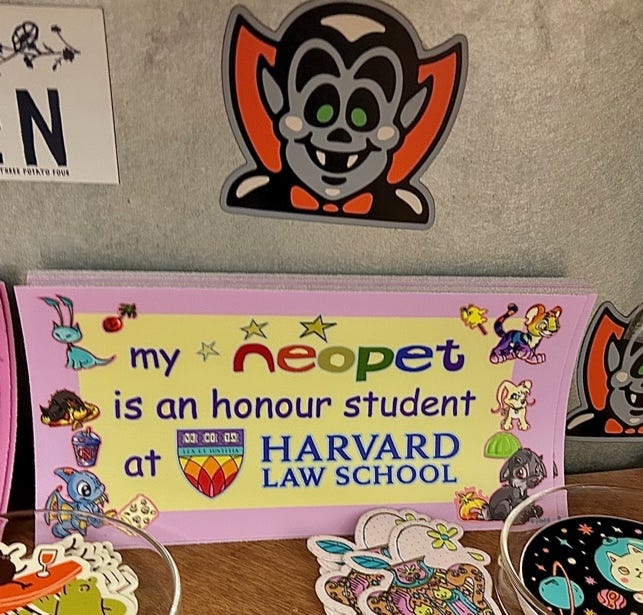
(A photo my daughter sent me just the other day.)

Unlike these elderly platforms, though, your AI Buddy would be very animated, and not just in cheesy 1990s LCD graphics or even early 2000s VGA graphics.  And it would know you better than anyone else, and it would be trained via machine learning to emotionally connect with humans in general, and you in particular.

But.  Underneath the cuteness there would be guardrails, and nudges, built in.  Ask it sensitive questions and you’ll get carefully filtered answers with just enough of the truth to be plausible, but still misleading.  Express the wrong political views and it might act sad, or disappointed.  Try to attend a disapproved political event and it might cry, sulk, or even – Tamagotchi-like – “die.”  Maybe it would really die, with no reset, after plaintively telling you you were killing it.  Maybe eventually you wouldn’t be able to get another if that happened.

It wouldn’t just be trained to emotionally connect with humans, it would be trained to emotionally manipulate humans.  And it would have a big database of experience to work from in short order.

As I say, this isn’t a quantum leap.  It doesn’t require that we create a self-aware program, just one that seems to be friendly and is capable of conversation, or close enough.  Call it a super-Siri, or a somewhat more polished ChatGPT.  And services like Google, Facebook, etc. are already engaged in this sort of nudging, manipulation, and cultivation of dependency on their existing user base.  (One of the companies that advises developers on how to make apps addictive to users is actually called Dopamine Labs.)  ChatGPT already has “guardrails,” and returns politically slanted results on questions about, say, Donald Trump versus Joe Biden.

So while other people are worrying about existential threats from AI, I’m worried about more imminent ones: Essentially, that it will further empower the tech/political class that wants more than anything else to control discussion, debate, and ultimately thought so as to cement its own power.

We may have strong AI someday.  But we have that power-hungry tech/political class today.  And to be honest, the AI may not care about dominating us, but the tech/political class clearly does.

Fear the cuteness.


Glenn Harlan Reynolds InstaPundit blogger, sometime writer at NY Post, WSJ, USA Today, Popular Mechanics, etc. Law professor.


Can Chicago Survive Brandon Johnson?

 Chicago’s new mayor, Brandon Johnson, might drag his city into the urban doom loop. Inheriting a city already in crisis, Johnson plans to soak commuters, businesses, and the “ultra-rich” in taxes, has claimed that defunding the police is an “actual real political goal,” and promises to splurge on social spending. All this will make the Windy City’s situation more dire still.

In an urban doom loop, a city’s tax base flees, draining revenue and thus stressing already-underperforming core services. As conditions deteriorate, the cycle spins faster, pushing the city further into the fiscal and public safety abyss. Though Johnson backed away on the campaign trail from his most strident defund-the-police rhetoric, the city’s pension problems are already doing the trick.

My new Manhattan Institute report with senior fellow Daniel DiSalvo examines the nexus of public pensions and urban decay for Chicago and America’s other big cities. Chicago’s election highlights several aspects of our research, including ballooning expenditures, rising crime, and cratering commercial real-estate markets. Perhaps more than anywhere else, the Windy City exhibits the telltale signs of a negative spiral.

In the 2010s, Chicago saw a small population increase of around 2 percent, but the number of municipal employees fell by almost 5 percent, owing to the pension crowd-out effect, in which rising pension costs squeeze other city priorities. Chicago’s pension spending has nearly tripled in the past ten fiscal years, from around $15,700 per full-time employee to more than $45,000. Pension expenditures now total more than $1.5 billion—over 12 percent of the city’s total revenue. For every person Chicago employs, in other words, it is effectively paying $45,000 to a city employee who has already retired. And the problem will worsen in the years to come, with the city’s pension debts exceeding those of 45 states and the recent market downturn intensifying its funding shortfalls. As these costs rise, they limit the revenue available for needed services.

And Chicago can hardly afford to tighten its belt on public safety. From 2020 through 2022, more than 2,000 people were murdered within city limits. The 2021 figure of nearly 800 was roughly 60 percent higher than that of 2019—yet the Chicago Police Department recorded less than half the number of physical arrests in 2021 as it did in 2019. Crucial to understanding these numbers is that the police force has shrunk by 8 percent in less than half a decade.

“What we really started to notice over the last few years,” retired Chicago police lieutenant John Garrido told a local newsroom in January, “is we didn’t have the manpower to man the beat cars.” The result is situations like the one in which Evelyn O’Connor found herself that month: she was assaulted on her lunch break by a stranger near the Magnificent Mile and received no police response after bystanders called 911.

Mayor Johnson is likely to make matters worse. Shortly before the election, Chicago police-union president John Catanzara warned that a Johnson victory would catalyze another wave of officer resignations. Those in the city’s outer reaches, where crime is most severe, will bear the harshest consequences. Chicago’s finances will suffer, too, as fewer commuters brave the journey into the city and more businesses decide to decamp entirely.

The Windy City’s best asset, outgoing deputy mayor Samir Mayekar recently told The Economist, is that it has room to grow. Some portions of Chicago’s once-forsaken West Loop have become hipster hotspots, for example, drawing technology startups and other new ventures. But the business community’s hope that a new policy course could reinvigorate the commercial real-estate market and build trust with potential investors from outside the city has proved to be wishful thinking. Even the Chicago Bears are considering an exodus to the suburbs. Now a man who built his name in opposition to the fundamentals of public safety and sound finance will take the helm of city government. Brace yourself, Chicago.

Escobar: All Roads Lead To Beijing

 by Pepe Escobar,

This is the tale of two pilgrims following the road that really matters in the young 21st century; one coming from NATOstan and another one from BRICS.

Let’s start with Le Petit Roi, Emmanuel Macron. Picture him with a plastic grin in his face strolling alongside Xi Jinping in Guangzhou. Following the – long and gentle – sound of classic “High Mountain and Flowing Water”, they enter the Baiyun Hall  to listen to it played by the 1000-year-old Guqin (a beautiful instrument). They taste the fragrance of 1000-year-old tea – and muse on the rise and fall of great powers in the new millennium.

And what does Xi tell Le Petit Roi? He explains that when you hear this eternal music played by this eternal instrument, you expect to be in the company of a bosom friend; you are in synch as much as the high mountain and the flowing water. That’s the deeper meaning of the ancient tale of musicians Yu Boya and Zhong Ziqi, 25 centuries ago in the Kingdom of Chu: bosom friendship. Only bosom friends can understand the music.

And with that, as Chinese scholars explained, Xi brought up the concept of Zhiyin. After Zhong Ziqi died, Yu Boya broke his Guqin: he thought that no one else could understand his music. Their story imprinted the term “Zhiyin”: someone who understands music, with the added meaning of close friends that can completely understand each other.

All bets are off on whether a narcissist puppet like Macron would ever be cultured enough to understand Xi’s subtle, sophisticated message: those that get it are true soul mates. Moreover, Macron was not dispatched to Beijing and Guangzhou by his masters to do soul mating, but to try to bend Xi towards NATO on Russia/Ukraine.

His body language is a dead giveaway – complete with crossing his arms demonstrating boredom. He may at first have been impervious to the notion that true friendship requires mutual understanding and appreciation.

But then something extraordinary happened. Xi’s message may have touched a key spot in the tortured inner depths of the narcissist Petit Roi. What if, in international relations, mutual understanding and appreciation is the key for nations to find common ground and work together towards common goals?

What a revolutionary notion; not exactly the Hegemon-imposed “rules-based international order”.

Are you a true Sovereign?

By inviting Le Petit Roi to China, and personally spending no less than 6 hours with his guest, Xi enacted millenniums-old diplomacy at its best. He reminded his guest of the turbulent history between France and the Anglo-Saxon powers; and he talked about sovereignty.

The key subtle sub-plot: “Europe” better think hard about being subservient to the Hegemon and minimize as best as possible the massive economic turbulence when Confrontation Day with the U.S. arrives. Implied is Beijing’s priority of breaking up growing U.S. attempts to encircle China.

So Xi treated France as a potential true Sovereign even under the EU; or somewhat splitting from EU dogma.

Of course another key message was implied under this Confucian invitation to epistemological growth. For those not willing to be friendly to China because of complex geopolitical layers, it will never be too late for Beijing to show the less “friendly” side of the Chinese state – if the situation arises.

Translation: if the West goes for Total Machiavelli, China will apply Total Sun Tzu. Even if Beijing would rather go for international relations under the aegis of Beauty, Goodness and Truth rather than “you’re with us or against us”, war of terror and sanctions dementia.

So did Petit Roi have a “road to Damascus” moment? The verdict is open. He literally freaked the Hegemon out with his outburst that Europe must resist pressure to become “America’s followers”. That’s pretty much in synch with the 51 points agreed upon by Beijing and Paris, with emphasis on “legitimate security concerns of all parties”.

The Americans got even more spooked when Macron asserted that Europe should become an independent “third superpower”. Le Petit Roi even advanced some baby steps in favor of de-dollarization (certainly under supervision of his financial masters) and not in favor of Forever Wars.

So the Americans, in panic, had to send German 5th column Annalena “360 Degrees” Bearbock in a hurry to Beijing to try to undo Le Petit Roi’s outbursts – and reaffirm the Washington Dictates Brussels official script. No one, anywhere, paid the slightest attention.

That came on top of the most glaring subplot of the whole tale: how European Commission dominatrix Ursula von der Leyen was treated by Beijing as worse than irrelevant. A Chinese scholar scathingly described her as “just the mouthpiece of a canine organization with no teeth. Even her bark sounds like whimpering from a terminally ill dog that is about to be euthanized.”

The “terminally ill dog” had to go through passport control and customs (“Anything to declare”?) No diplomatic status. No official invitation. No sovereignty. And no, you cannot take the special high-speed train alongside Macron to go to Guangzhou. So here’s another message – this one quite graphic: Don’t mess with the 3,000-old Middle Kingdom ethos.

Lula and “Zhiyin”

Top Chinese scholars were absolutely riveted by Xi applying diplomatic stratagems that had been so useful 25 centuries ago, now re-enacted on the road-to-multipolarity global stage.

Some are calling for a new “Strategies for the Warring States” rewritten for the 21st century. The massive round table set up by Chinese protocol with the “jungle” in the middle and Macron and von der Leyen positioned as if for a job interview was a monster hit on Weibo and We Chat. That led to endless discussions on how China is now finally able to “drive a wedge among the barbarians”.

Compared to all this hoopla, the tale of Brazilian President Lula coming to Shanghai and Beijing reads like a graphic illustration of Zhiyin.

Lula went for the jugular right from the start, during the inauguration of former President Dilma Rousseff  as the new president of the NDB, the BRICS bank.

In simple, direct language that anyone from Sahara to Siberia can understand, Lula said, “Every night I ask myself why should every country need to be tied to the dollar for trade? Why can’t we trade in our own currencies? And why don’t we have the commitment to innovate?”

Directly implied is the fact that the expanding BRICS+ should design and promote its own currency (the long, complex process has already started), on top of allowing trade in national currencies.

Lula’s powerful message was addressed to the whole Global South. A Brazilian example is China’s ICBC setting up a clearing house in Brazil allowing direct yuan-real exchange.

It’s no wonder that the CIA official rag, the Washington Post, foaming at the mouth, immediately issued the Deep State verdict: Lula is not obeying the “rules-based international order” diktat.

That means the Deep State will come after Lula and his government – all over again, and will go no holds barred to destabilize it. Because what Lula said is exactly what Saddam Hussein and Colonel Gadaffi said – and tried to implement – in the past.

So Lula will need all the help he can get. Enter, once again, “Zhiyin”.

This is how Xi officially welcomed Lula in Beijing. Very few people around the world, non-Chinese, understand that when someone of Xi’s stature tells you, right in front of you, that you are “an old friend of China”, this is it.

All doors are open. They trust you, embrace you, protect you, listen to you, help you in times of need and will always do their best to keep the friendship close to their hearts.

And that ends, for now, our tale of “bosom friends” taking the road to Beijing. The BRICS friend certainly understood all there is to know. As for the NATOstan Little King dreaming of becoming a true sovereign leader, the moment of truth is knocking at his door.

https://www.zerohedge.com/geopolitical/escobar-all-roads-lead-beijing

Bank of Korea sees China-bound exports recovering from second half

 South Korea's exports to China are likely to remain weaker than expected for now before recovering in the second half of this year as the benefits of the reopening of the world's no. 2 economy start to filter through, the central bank said on Monday.

The Bank of Korea (BOK) said in a report that China's economic recovery was centred on domestic demand, while manufacturing inventories remained high, delaying the beneficial effects for South Korea's exports.

The report estimated a one percentage point growth in the Chinese economy to boost South Korea's by 0.08 per centage point when the growth is led by the services sector, compared with 0.11 when led by the manufacturing sector.

China-bound exports are expected to improve gradually in the second half of this year, with non-IT products of machineries and steel products leading the recovery, the BOK said.

The BOK added there were uncertainties about the global IT cycle and changes in China's industry structure, however, while citing a recovery in Chinese tourists as a near-term factor that would benefit the domestic economy.

https://www.channelnewsasia.com/business/bank-korea-sees-china-bound-exports-recovering-second-half-3422456

Top 2023 Neurodegenerative Readouts

 With the FDA hinting at regulatory flexibility for therapeutics targeting rare neurodegenerative diseases and those with a high unmet need, there’s a heightened sense of urgency for biopharma companies to secure pivotal data.

While analysts and other neuroscience watchers anticipate the upcoming decisions for Biogen’s tofersen and Eisai and Biogen’s Leqembi (lecanemab), key data are on the horizon in multiple sclerosis (MS), amyotrophic lateral sclerosis (ALS), Huntington’s disease and more. Below is a selection of some of the top readouts to watch for this year.

Alzheimer’s Disease

One of the most-anticipated readouts in the Alzheimer’s space is Eli Lilly’s donanemab. In January, the FDA rejected Lilly’s bid for accelerated approval of donanemab, an investigational anti-amyloid antibody. In its Complete Response Letter, the FDA requested unblinded, controlled safety data from a Phase III confirmatory trial. Data from this trial, TRAILBLAZER-ALZ, are expected early in the second quarter of this year.

The regulator also requested data from at least 100 patients dosed continuously with donanemab for a minimum of 12 months. This was not achieved with the Phase II study due to Lilly’s treat-to-clear model, which allowed patients to stop treatment when their amyloid plaques had been cleared to a predefined level.

In January, Anne White, executive vice president and president of Lilly Neuroscience, said the company anticipates TRAILBLAZER-ALZ will confirm the benefit and safety profile observed in the Phase II trial.

Huntington’s Disease

The past three years have seen several swings—and several misses—in the Huntington’s space. This list includes two more swings.  

The first is Prilenia Therapeutics’ pridopidine. On March 28, Prilenia announced it had completed its Phase III PROOF-HD study, with topline results expected in early Q2, 2023.

Pridopidine is a highly selective investigational agonist of sigma-1 receptor (S1R), a protein highly expressed in the brain that regulates several cellular mechanisms common to neurodegenerative diseases. Activation of S1R stimulates multiple cellular pathways essential to neuronal function and survival, according to Prilenia. 

PROOF-HD is the only late-stage Huntington’s study targeting clinical progression. If the results are positive, Prilenia intends to submit for regulatory approval in both the U.S. and E.U.  

The second swing belongs to Amsterdam-based uniQure, which is developing the first-ever adeno-associated virus (AAV) gene therapy for Huntington’s. AMT-130 is currently in Phase I/II trials in the U.S. with a clinical update expected in Q2, 2023.

In August 2022, uniQure paused enrollment in the higher dose cohort of the European Phase Ib/II trial due to unexpected severe adverse reactions in three trial participants. uniQure announced in November that enrollment would resume following a “comprehensive” review of all available safety, biomarker and imaging data in the trial.

AMT-130 leverages uniQure’s proprietary platform to introduce an AAV to the brain. The AAV carries a microRNA to reduce the production of a toxic protein known as mutant HTT (mHTT), the bad form of the huntingtin protein coded for by the HTT gene. 

In June 2022, uniQure reported that six patients treated with low dose AMT-130 showed a 53.8% mean reduction of mHTT in the cerebral spinal fluid after 12 months. 

“We know that the biomarkers are moving,” Ricardo Dolmetsch, president of R&D at uniQure, told BioSpace in November. “We know that we are reducing huntingtin . . . and we know that the main marker of neuronal damage, which is neurofilament light chain, is trending downwards.”

Rett Syndrome

March 2023 saw the approval of the first therapy for Rett Syndrome, a multisystem neurodevelopmental disorder affecting primarily female children, when the FDA green-lit Acadia Pharmaceuticals’ Daybue (trofinetide).

Hot on Acadia’s heels, Anavex Life Sciences is advancing ANAVEX®2-73 (blarcamesine) for Rett. The New York–based biopharma anticipates topline data from a Phase II/III trial in pediatric patients in the second half of 2023. In February, Anavex reported that the trial had exceeded its enrollment target.

Anavex previously reported positive data from the Phase III study of ANAVEX®2-73 in adult female patients. The drug met all primary and secondary efficacy and safety endpoints, showing consistent improvements on the Rett Syndrome Behavior Questionnaire and other metrics.

Like pridopidine, ANAVEX®2-73 activates S1R. According to Anavex, data suggest that activation of S1R (also known as SIGMAR1) restores homeostatic function within the body and neural cell balance. ANAVEX®2-73 holds Fast Track, Rare Pediatric Disease and Orphan Drug designations from the FDA.

ALS

The ALS space is experiencing a renaissance of sorts, with the September 2022 approval of Amylyx’s Relyvrio (AMX0035) and a March 2022 advisory committee signaling its support for Biogen’s tofersen.

Hoping to get in on the momentum is Seelos Therapeutics, which is testing SLS-005 (trehalose) in patients with familial and sporadic ALS. In February 2023, the biopharma announced it had completed enrollment of its Phase II/III trial. Seelos anticipates topline data in the second half of 2023.

The double-blinded and placebo-controlled trial consists of 160 patients randomized 3:1 (drug: placebo). The trial’s primary endpoint is change from baseline on the Revised Amyotrophic Lateral Sclerosis Functional Rating Scale at 24 weeks. Secondary endpoints include change from baseline in slow vital capacity, quality of life measurements and muscle strength. 

SLS-005 is believed to stabilize proteins and trigger autophagy through activation of transcription factor EB (TFEB), a primary factor in lysosomal and autophagy gene expression.

The trehalose trial is being conducted on the HEALEY ALS platform, an academic effort to test multiple ALS candidates in parallel in an effort to expedite research.

Multiple Sclerosis

In 2022, Harvard Professor Alberto Ascherio published results of a longitudinal study that cemented previous research regarding the role of the Epstein-Barr virus (EBV) in MS. It’s a hypothesis Atara Biotherapeutics is now pursuing.

Atara is developing ATA188, an allogeneic T-cell immunotherapy that targets EBV-infected B-cells and plasma cells in the central nervous system—cells that are thought to trigger autoimmune responses. ATA188 is intended to treat progressive MS, for which there is a high unmet need.

Atara expects final data from the Phase II EMBOLD trial in October 2023.

In February 2022, Atara President and CEO Pascal Touchon called the readout a “key catalyst that could progress ATA188 towards becoming the first ever targeted and transformative therapy in multiple sclerosis following the landmark scientific discovery of EBV as the leading trigger of MS.”

https://www.biospace.com/article/top-2023-neurodegenerative-readouts-/