Search This Blog

Friday, August 4, 2023

Assertio Shares Plunge After 2023 Outlook Withdrawal


  • Assertio (ASRT) stock is dropping alongside its earnings report for the second quarter of 2023.
  • The company missed revenue estimates for the quarter.
  • It also withdrew its outlook for the full year of 2023

Assertio (NASDAQ:ASRT) stock is falling hard on Friday after the pharmaceutical company released its second-quarter earnings report.

Assertio disappointed investors with its adjusted earnings per share of 19 cents. That’s worse than the 22 cents per share Wall Street was predicting. It’s also a drop from the 28 cents per share reported in the same period of the year prior.

That disappointment comes despite the company reporting positive revenue of $40.99 million. This beats out analysts’ revenue estimate of $39.83 million for the quarter and represents a 13% increase year-over-year (YOY).

One negative that investors aren’t happy about is Asserito’s guidance for 2023, or lack thereof. The company withdrew its guidance for the year to evaluate the effect of the U.S. Food and Drug Administration (FDA) approving a generic indomethacin suppository.


Spectrum Pharmaceuticals Acquisition

Assertio also notes that it completed its acquisition of Spectrum Pharmaceuticals in the recent earnings report. President and CEO Dan Peisert had this to say about the news:

“The acquisition of Spectrum Pharmaceuticals and its innovative ROLVEDONTM asset is transformative to our Company. ROLVEDON continues its exceptional launch trajectory as second quarter sales increased to $21.0 million1, from $15.6 million in the first quarter. We intend to maintain their highly effective commercial team to continue expanding on the success of this exciting new asset.”

https://investorplace.com/2023/08/why-is-assertio-asrt-stock-down-46-today/

Alector Reports Second Quarter 2023 Financial Results and Provides Business Update

Closed screening in the INVOKE-2 Phase 2 trial of AL002 in participants with early Alzheimer’s disease; completing enrollment in Q3 2023, with data readout expected in Q4 2024

Presented update on INVOKE-2 at the Alzheimer’s Association International Conference (AAIC)

Anticipate completing enrollment in pivotal INFRONT-3 trial of latozinemab with symptomatic FTD-GRN participants in Q4 2023 based on recent interactions with the FDA and EMA

$630.0 million in cash, cash equivalents and investments provide runway through 2025;
 revenue and expense guidance updated for 2023

Management to host conference call and webcast today at 4:30 p.m. ET / 1:30 p.m. PT

Alector’s management team will host a conference call discussing Alector’s results for the second quarter of 2023 and provide a business update. The conference call will be webcast and accessible via the investor relations section of Alector’s website at www.alector.com.

To access the call, please use the following information:

Date: Thursday, August 3, 2023
Time: 4:30 p.m. ET, 1:30 p.m. PT

The event will be webcast live under the investor relations section of Alector’s website at https://investors.alector.com/events-and-presentations/events and following the event a replay will be archived there for 30 days. Interested parties participating by phone will need to register using this online form. After registering for dial-in details, all phone participants will receive an auto-generated e-mail containing a link to the dial-in number along with a personal PIN number to use to access the event by phone.

https://finance.yahoo.com/news/alector-reports-second-quarter-2023-200500907.html

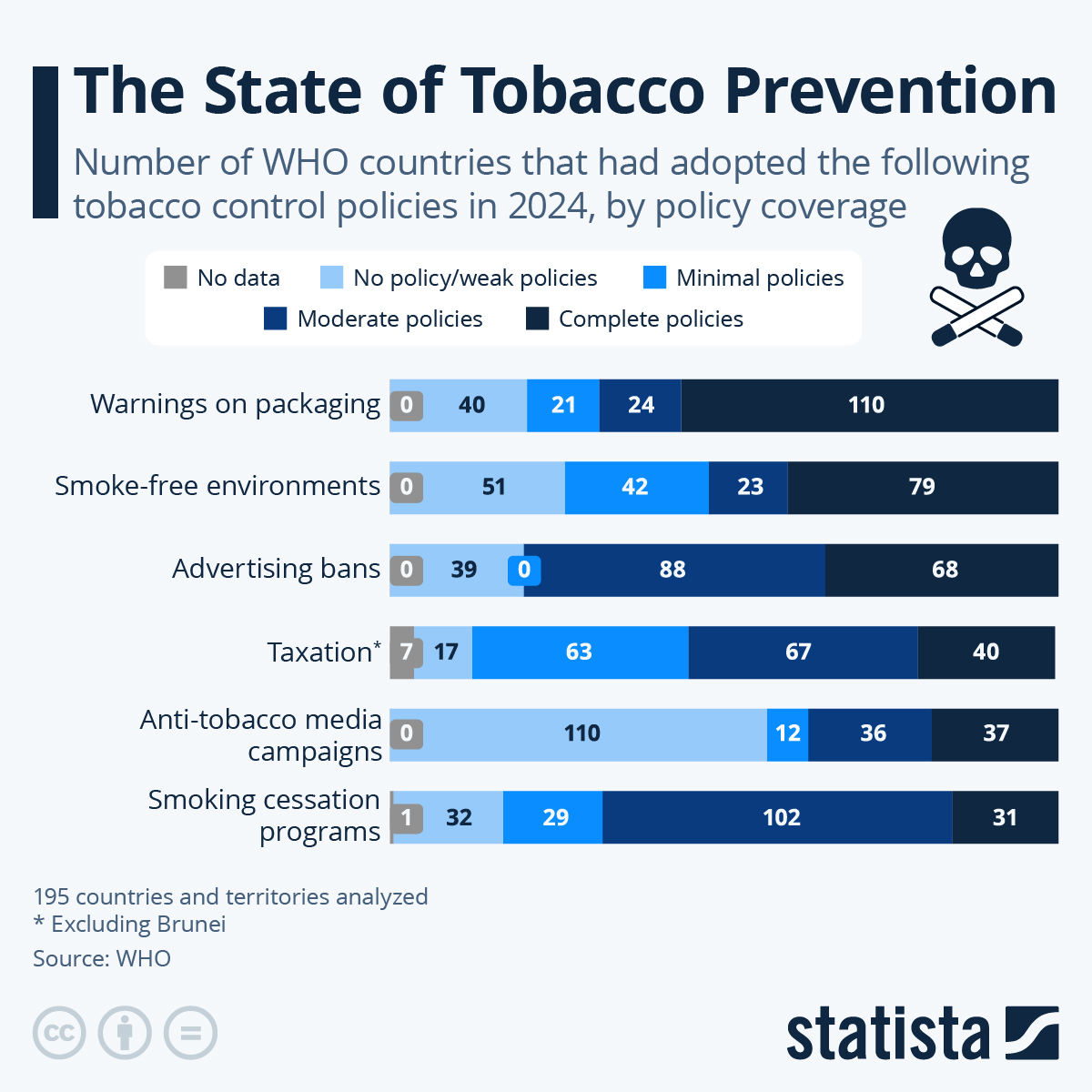
The State Of Tobacco Prevention

 An estimated 8.7 million people are killed from tobacco each year, according to the World Health Organization (WHO).

Of these, 1.3 million people do not use tobacco directly themselves, but are exposed to it second-hand.

While these figures are still highStatista's Anna Fleck notes that progress has been made in terms of countries adopting health-promoting policies to try to curb their populations’ tobacco usage.

In the WHO’s 2023 report on the global tobacco epidemic, released this week, the organization notes that now some 5.6 billion people live in countries where at least one of the six best practice measures promoted by the WHO (MPOWER) for tobacco control has been introduced - that's 71 percent of the world's population.

As the following chart shows, around 79 percent of WHO member countries have introduced warning labels on packaging, albeit not all to the same extent.

Infographic: The State of Tobacco Prevention | Statista


At the same time, almost 38 percent of the surveyed countries have implemented strict regulations on no-smoking areas, while around 34 percent have strict bans on tobacco advertising.

44 countries still have no tobacco control measures in place.

https://www.zerohedge.com/medical/state-tobacco-prevention

TikTok travel hack for meds 'a big mistake'

 A packaging expert has called out a viral TikTok video that describes using a Tic Tac box to carry medicines whilst travelling, warning that it could lead to people being banned from flights.

The video recommends swapping medicines from their original packaging to save space while travelling, but the small saving in space isn't worth the risk, according to Steve Brownett-Gale of pharma packaging specialist Origin.

"While the smaller container might marginally take up less space in your luggage, most countries require you to keep your medication from its original packaging when travelling overseas," according to Brownett-Gale.

"Airport security may not be able to identify the medication if it is not in its original packaging or if the label is not clear or legible," he added. "This lack of identification could raise concerns, and they may ask for additional information or documentation, delaying or even preventing you from boarding the flight."

There are plenty of other concerns about removing medicines from their original packaging, particularly when the advice is to use a container that ordinarily contains sweets.

"Pharmaceutical packaging is specially designed to keep children safe and prevent them from accidentally ingesting dangerous substances. It can be all too easy for children to mistake tablets for sweets, which could be fatal for the wrong medication and dosage," said Brownett-Gale.

In addition, medication taken from its original packaging could lose its effectiveness, he cautioned, as drugmakers carefully select materials in their packaging to protect drugs from light, moisture and air that can degrade its stability and potency.

Brownett-Gale also advises that travellers carefully check the rules and regulations of the country they are visiting ahead of time.

"Some popular summer destinations, such as Dubai, have different classifications for controlled medications," he said. "If you have a prescription for antidepressants or sleeping tablets, for example, you may be required to bring a letter of proof that the medication has been prescribed to you before you travel."

Furthermore, people are not permitted to bring more than three months' supply of medication on a flight when departing from the UK.

"If you plan to be abroad for longer than this period and need to bring a larger volume of medication, you'll have to apply for a personal license from the Home Office," he noted.

The video is another example of the double-edged sword posed by social media when it comes to health. On the one hand, platforms like TikTok can be put to good use by healthcare professionals to deliver advice to a large audience, particularly teenagers and young adults.

On the other, they can be a terrible source for health advice, as revealed by a study presented at the Digestive Disease Week conference in the US in May, which revealed that 40% of all TikTok videos containing the words "cirrhosis" or "liver disease" were found to contain misleading information and inaccurate claims.

https://pharmaphorum.com/news/tiktok-travel-hack-meds-big-mistake

Novo Nordisk, Lilly Sued Over Stomach Paralysis Allegations Regarding GLP-1 Drugs

 A Louisiana woman is suing Novo Nordisk and Eli Lilly, respective manufacturers of Ozempic and Mounjaro, alleging the drugmakers failed to warn users of the medications about the risk of severe gastrointestinal issues.

The suit claims the companies “downplayed the severity of the gastrointestinal events caused by Ozempic and Mounjaro” and never warned patients about the possibility of gastroparesis—a slowdown or stopping of the digestive system—or gastroenteritis, an infection and inflammation of the digestive system.

The plaintiff, 44-year-old Jaclyn Bjorklund, took Ozempic for over a year before switching to Mounjaro, according to the lawsuit. It alleges that she suffered from “severe gastrointestinal events” including being hospitalized for stomach issues and going to the emergency room, as well as “teeth falling out due to excessive vomiting, requiring additional medications to alleviate her excessive vomiting, and throwing up whole food hours after eating.”

The two drugs are a part of a class of drugs known as GLP-1 receptor agonists, which stimulate insulin production and reduce glucose production, that are used to treat Type 2 diabetes. While different drugs in the class are approved for treatment of both obesity and diabetes, many only approved for diabetes are also prescribed off-label for weight loss.

The lawsuit alleges that while the companies “acknowledge that gastrointestinal events are well known side effects of the GLP-1 class,” they nevertheless never warned patients of the risk of more severe gastrointestinal events, such as gastroparesis or gastroenteritis.

The labels of both medications do note the risk of delayed gastric emptying, among other stomach problems such as nausea, vomiting, and diarrhea, but do not include an explicit warning of gastroparesis.

The allegations come on the heels of an investigation into possible suicidal ideation and self-harm risk associated with the class of drugs. The UK’s Medicines and Healthcare products Regulatory Agency announced an investigation on July 26, shortly after The European Medicines Agency expanded its own investigation into GLP-1 receptor agonists.

A Novo Nordisk spokesperson reportedly said in a statement that gastrointestinal events are “well-known side effects” of GLP-1 receptor agonists, and that Ozempic’s side effects are usually “mild to moderate in severity and of short duration.” The spokesperson added: “We are continuously monitoring the safety profile of our products and collaborate closely with authorities to ensure patient safety, including adequate information on gastrointestinal side effects in the label.”

A Lilly spokesperson reportedly said in a statement that patient safety is the company’s “top priority” and that it “actively [engages] in monitoring, evaluating, and reporting safety information” for its medications.

The law firm that filed the lawsuit against Novo Nordisk and Lilly on behalf of Bjorklund told CBS News it is investigating 400 other inquiries from clients across 45 states.

https://www.biospace.com/article/novo-nordisk-eli-lilly-sued-over-stomach-paralysis-allegations-regarding-glp-1-drugs/

Amneal ups guidance after Q2


  • Q2 2023 Net Revenue of $599 million; GAAP Net Income of $12 million; Diluted EPS of $0.08
  • Q2 2023 Adjusted Net Income(1) of $57 million; Adjusted EBITDA (1) of $146 million; Adjusted Diluted EPS (1) of $0.19
  • Raising 2023 Full Year Guidance

Thursday, August 3, 2023

Mesoblast shares tank after US FDA rejects cell therapy for children

 The U.S. health regulator rejected Mesoblast's cell therapy for children under 12 years of age for treating a type of complication that occurs after a stem cell or bone marrow transplant, sending its Australia-listed shares crashing about 58% on Friday.

The U.S. Food and Drug Administration (FDA) required more data to support marketing approval for the company's lead product remestemcel-L, Mesoblast said in a statement on Thursday.

Mesoblast shares slumped as much as 58.3% when they opened in Sydney, before marginally paring some losses to trade down 54.8% at A$0.49 by 0416 GMT.

The rejection is a blow to Mesoblast's hopes for a potential launch of the therapy, especially after its fundraising efforts over the last two years.

The drug developer was seeking the FDA's approval for a cell therapy to treat children with a type of graft versus host disease (GvHD), whose symptoms did not respond to standard steroid therapy or developed recurrence while continuing treatment.

There are no approved therapies in children for the condition in which the donor's bone marrow or stem cells attack the recipient.

https://finance.yahoo.com/news/1-mesoblast-shares-tank-us-043605029.html