Search This Blog

Friday, September 8, 2023

Why CymaBay Therapeutics Stock Is Jumping

 Shares of CymaBay Therapeutics (CBAY 14.25%) were jumping 14.2% higher as of 10:54 a.m. ET on Friday. This move came on the heels of an 8.5% gain on Thursday.

The continued momentum is a result of CymaBay's announcement yesterday of positive top-line results from a late-stage clinical study evaluating experimental drug seladelpar in treating primary biliary cholangitis (PBC), a rare chronic inflammatory liver disease.

CymaBay reported that seladelpar achieved the study's primary endpoint as well as all key secondary end points.

CymaBay's late-stage results for seladelpar move the company closer to potentially launching its first product. But there are already two approved drugs for treating PBC: ursodeoxycholic acid (UDCA) and Intercept Pharmaceuticals' Ocaliva. 

The great news for CymaBay, though, is that seladelpar appears to have a key advantage over those other PBC treatments. The results from the company's phase 3 study found that it significantly reduced itching, which is a major issue for many PBC patients.

CymaBay now plans to talk with the Food and Drug Administration, the U.K.'s Medicines and Healthcare products Regulatory Agency, and the European Medicines Agency about regulatory approval filings for seladelpar. Assuming all goes well, it's possible that the company could bring the product to market sometime next year.

Will the biotech stock continue its momentum? That remains to be seen. CymaBay's market cap already stands at nearly $1.7 billion. It could take a while for seladelpar's sales to grow even if it's approved. As a comparison, Intercept projects 2023 sales of Ocaliva between $320 million and $340 million, a level that's taken seven years to reach.

https://www.fool.com/investing/2023/09/08/why-cymabay-therapeutics-stock-is-jumping-today/

Theratechnologies Preliminary Q3 2023 Financial Highlights

 - 2023 Q3 positive adjusted EBITDA to be achieved

- Cash, bonds and money market funds of US$22.9 million as at August 31, 2023

https://finance.yahoo.com/news/theratechnologies-announces-certain-preliminary-q3-110000197.html

Otsuka, Shape Potential $1.5B Deal to Develop Eye AAV Gene Therapies

 Japan’s Otsuka Pharmaceuticals on Thursday announced a multi-target collaboration with RNA editing biotech Shape Therapeutics to develop intravitreal adeno-associated virus gene therapies for ocular diseases.

While the companies did not provide full details of the financial terms, they revealed that the contract has a potential aggregate value exceeding $1.5 billion, which includes an upfront payment from Otsuka. This sum also takes into account potential development, regulatory and sales milestone payments.

Seattle-based Shape will also remain eligible for tiered royalties on future sales of any product that results from this agreement.

In return, Otsuka will gain access to Shape’s AI-driven AAVid capsid discovery platform and transgene engineering technology. The Japanese pharma will also have the option to expand the agreement to additional targets and tissue types.

By combining high-throughput screening and machine learning, AAVid produces capsids with high target precision and minimal off-target biodistribution, according to the companies. This, in turn, they contend allows for lower gene therapy doses resulting in an overall safer clinical profile.

AAVid’s use of AI technology, in particular, allows the platform to design AAV vectors that overcome typical industry challenges regarding gene therapy delivery, enabling its therapies to “transcend the boundaries of what is possible experimentally,” Shape CEO Francois Vigneault said in a statement.

The partnership will also leverage Shape’s transgene engineering technology in order to optimize expression levels of the therapeutic payloads.

The deal presents a good opportunity to meld Shape’s vector expertise with Otsuka’s experience in ophthalmology and genetic payload design to “target specific disease cell types in the eye and provide a once-in-a-lifetime and curative administration with stable lifetime expression,” Toshiki Sudo, head of the Osaka Research Center for Drug Discovery at Otsuka, said in a statement.

With Thursday’s AAV agreement, Otsuka appears to be starting to build up its ophthalmology portfolio, particularly as its bedrock neurology business suffered back-to-back Phase III failures in July 2023. Data from the DIAMOND 1 and DIAMOND 2 studies showed that the company’s investigational TAAR1 agonist ulotaront, being developed in collaboration with Sumitomo Pharma, could not significantly outperform placebo in schizophrenia.

Otsuka reported another Phase III fail Thursday when a fixed-dose trial of its brexpiprazole—in combination with sertraline—failed to significantly improve symptom severity, as compared with placebo, in patients with post-traumatic stress disorder. Meanwhile, a similar study using flexible dosing met this primary endpoint.

https://www.biospace.com/article/otsuka-shape-ink-potential-1-5b-deal-to-develop-eye-aav-gene-therapies/

Turbulence For Biden's Offshore Wind Farms As Orsted CEO Warns: Abandoning US Projects 'Real Option'

 The world's largest offshore wind farm developer is preparing to walk away from US projects unless the Biden administration guarantees more support, Bloomberg reported. 

"We are still upholding a real option to walk away," Orsted CEO Mads Nipper told Bloomberg in an interview in London on Tuesday. 

Nipper continued, "But right now, we are still working towards a final investment decision on projects in America."

The Biden administration has touted offshore wind farms as an essential component of decarbonizing America's grid, but soaring inflation costs have undermined the sector's growth and left many projects dead in the water. 

Under the Inflation Reduction Act, Orsted receives upwards of 30% tax credits, but more appears to be needed as a financial crisis is unfolding in the offshore wind power industry. 

Nipper has asked the Biden administration to guarantee subsidies without the domestic content requirement and requested more time to overcome supply chain snarls in sourcing US-made materials. 

"What we proposed was a grace period, say, so give us three to five years," the CEO said, adding, "Right now, it can't deliver."

More from Bloomberg on Nipper, who warned offshore wind farm plays are 'uninvestable': 

Orsted's delays were triggered by bureaucratic uncertainties during the previous US administration and were intensified by supply-chain disruptions during the COVID-19 pandemic. Biden's push on clean energy helped accelerate some plans, but high-interest rates and delays in procuring foundations, known as monopiles, for its wind turbines slowed developments even more.

Because final investment decisions weren't made and the projects were being funded by the company's balance sheet, the fact that long-term interest rates in the US soared above 3% means Orsted's cost of capital is higher.

"For a company like ours, where the targeted range of returns is 150 to 300 basis points above our cost of capital, it has essentially made this extremely tough," Nipper said.

Nipper said Orsted couldn't have predicted the industry turmoil, yet an investor selloff saw the company lose $8 billion in value last week after impairments were booked on several US projects. Longer-term plans also are at risk, with developments near New Jersey and Delaware not investible right now, he said.

Last month, Nipper warned investors on a conference call: "The situation in US offshore wind is severe." As we noted, "snarled supply chains, soaring interest rates, and easy money tax credits drying up" is a "warning sign the green energy revolution bubble is in trouble." 

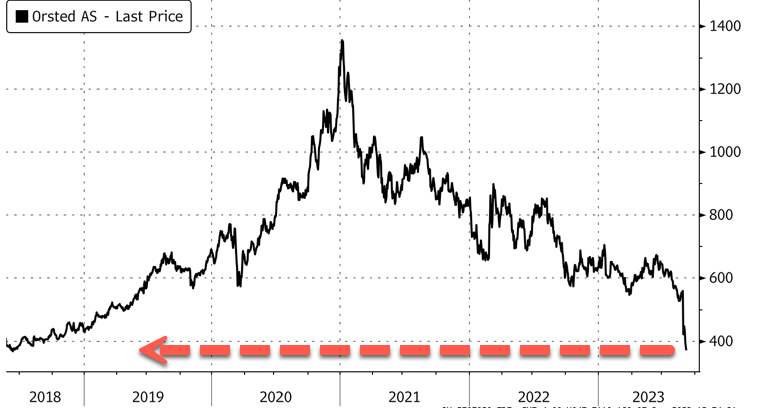
Shares in Denmark-listed green energy giant have crashed in recent weeks on the mounting headwinds -- now back to levels last seen in 2018. 

The Biden administration's ambitious goal of achieving 30 gigawatts of offshore wind energy capacity by 2030 appears to be in jeopardy. Even though the Inflation Reduction Act was supposed to ease inflation, a green energy crisis has emerged, as Orsted describes, that stems from inflation. 

We have asked the question: Is The ESG Investing Boom Already Over?

It seems so, given that Shell, Europe's leading oil company, has discreetly set aside the world's most expansive corporate initiative to create carbon offsets. Meanwhile, Europe's 'green tech' future has been threatened due to waning investment flows. 

https://www.zerohedge.com/markets/turbulent-times-bidens-offshore-wind-farms-orsted-ceo-warns-abandoning-us-projects-real

Gilead upped to Buy from Neutral by B of A

 Target to $95 from $88

https://finviz.com/quote.ashx?t=GILD&ty=c&ta=1&p=d

COVID mRNA Vaccines Cut Immune Response To Other Infections, Potential Concern Of Immune Deficiency

 by Marina Zhang via The Epoch Times (emphasis ours),

recent study on the immune effects of Pfizer’s COVID-19 mRNA vaccine has scientists raising concerns over vaccine-acquired immune deficiencies.

Vaccine-acquired immune deficiency syndrome (VAIDS) is a new colloquial term coined by researchers and health practitioners since the COVID-19 vaccine rollout. Though not recognized as a medical condition, some experts believe the COVID-19 vaccines may impair or suppress immune responses.

While the new study does not use the term VAIDS, the researchers recognized “a general decrease in cytokine and chemokine responses” to bacteria, fungi, and non-COVID viruses in children after COVID-19 vaccination.

Our findings suggest SARS-CoV-2 mRNA vaccination could alter the immune response to other pathogens, which cause both vaccine-preventable and non-vaccine-preventable diseases,” the authors of the paper published in Frontiers in Immunology wrote.

“This is particularly relevant in children as they: have extensive exposure to microbes at daycare, school, and social occasions; are often encountering these microbes for the first time; and receive multiple vaccines as part of routine childhood vaccination schedules.”

The researchers from the Murdoch Children’s Research Institute and Royal Children’s Hospital in Melbourne, Australia, took blood samples of 29 children, both prevaccination and after two Pfizer mRNA doses.

They found that blood samples postvaccination had a lower cytokine response to non-COVID pathogens compared to prevaccination. This reduced immune response was particularly persistent for non-COVID viruses. Blood samples taken at six months showed some children still had low responses for hepatitis B virus proteins and proteins that mimic a viral infection; however, cytokine responses had increased for bacterial exposures.

Immune responses to COVID-19 proteins—including spike proteins and their S1 and S2 subunits—and nucleocapsid proteins remained high after vaccination.

Professor Retsef Levi, specializing in risk management and health systems at the Massachusetts Institute of Technology (MIT), posted on X (formerly known as Twitter) that the study “adds to cumulative evidence suggesting adverse immune alteration” by COVID-19 vaccination. Family physician Dr. Syed Haider and immunologist and computational biologist Jessica Rose both connected the study’s findings to VAIDS.

Rebuttal

Marc Veldhoen, an immunologist specializing in T-cell responses and the head of a laboratory at Instituto de Medicina Molecular in Portugal, challenged the study’s findings.

In an X thread, Mr. Veldhoen highlighted flaws in the study, including the lack of controls, meaning children who were not vaccinated, to compare against the subject group on their innate immune responses to other pathogens.

“Without a non-vaccinated control group, at least another vaccine control group (to claim specificity), much larger numbers of subjects, and cellular composition data, [the study authors’] conclusion is speculation, and unlikely to hold,” Mr. Veldhoen wrote.

Accumulation of Studies Suggesting Decreased Immunity After Vaccination

The study is one of many suggesting declined immune response after COVID-19 vaccination.

preprint study in 16 adults inoculated with the Pfizer mRNA vaccines had similar findings of a reduced innate immune response in participants exposed to pathogenic fungi. The same paper also found long-term changes in innate immune cells.

The Epoch Times reported on a January study out of Germany that showed multiple mRNA vaccinations induce a “class switch” in the type of antibodies formed against the spike protein and other COVID-19 proteins.

https://www.zerohedge.com/medical/covid-19-mrna-vaccines-reduce-immune-response-other-infections-potential-concern-immune

Vodafone and Teladoc Health launch Health-e

 Starting today, Health-e is available, an online health service from Vodafone that includes 24/7 access to a doctor. Children or partners can also use the service all on one subscription.

One of the main features of Health-e is 24/7 access to online GPs. Users and their family members can seek advice from family doctors and health professionals registered in the Netherlands. The app also allows for easy and accessible online consultations during the day. For example, with professional coaches for mental support and dieticians to help promote lifestyle and well-being.

To this end, Vodafone has partnered with Teladoc Health, an expert in virtual care with 20 years of experience in online health services and digital innovation.

Health-e will initially be available to private Vodafone customers and the longer-term ambition is to make the health service available nationwide.

https://www.marketscreener.com/quote/stock/TELADOC-HEALTH-INC-22762533/news/Vodafone-and-Teladoc-Health-launch-Health-e-44799748/