Search This Blog

Friday, September 8, 2023

FTX Probing If Millions in Payments to Shaq, Naomi Osaka Can Be Reversed

 FTX Group advisers have scrutinized whether they can claw back millions of dollars paid to Shaquille O’Neal, tennis star Naomi Osaka and other professional athletes and teams that promoted Sam Bankman-Fried’s crypto platform before its collapse.

Financial advisers hired by FTX disclosed in court papers that they’ve analyzed if certain payments dished out to athletes before the company unraveled last November can be recovered in Chapter 11. Advisers have reviewed payments to O’Neal, Osaka and others to determine if the transfers are subject to rules that permit companies to reverse transactions that occurred just before a Chapter 11 filing, according to court documents.

While not a complete accounting of FTX’s spending on endorsements, the new disclosures likely offer the fullest glimpse to date into how Bankman-Fried’s empire elevated its profile using the notoriety of celebrity athletes, Major League Baseball, National Basketball Association teams and Formula 1.

Whether FTX advisers believe all of the payments can be recovered, or if any athletes or teams have already offered to return payments, couldn’t be learned. FTX’s disclosures describe many of the transfers to athletes, teams and leagues as prepayments related to advertising or sponsorship deals.

FTX cautioned the financial disclosures may not be complete because the company lacked “detailed historical amortization information” and could be further amended in the future. New FTX Chief Executive Officer John J. Ray III said when the company filed Chapter 11, the company lacked trustworthy financial information and didn’t keep complete books and records.

It’s also possible that athletes, teams or other parties either withdrew or offset deposits before FTX filed bankruptcy, the company said. FTX in December said a number of parties that had been paid by the firm had attempted to return funds for the benefit of customers and other creditors. FTX said prepayments and deposits it ultimately recovers may differ from amounts the company reported.

The crypto platform disclosed roughly $4.9 million disbursed to MLB, which for a time required umpires to wear patches bearing FTX’s logo, and at least $12.2 million related to partnership agreements with Formula 1 racing team Mercedes-AMG Petronas. The platform disclosed $3.4 million in payments to the NBA’s Golden State Warriors and nearly $242,000 in payments to star player Stephen Curry’s business, SC30 Inc.

An FTX spokesman and a lawyer for Mercedes-Benz Grand Prix Ltd. declined to comment. Lawyers representing O’Neal, Osaka, Curry, the Golden State Warriors, and MLB didn’t respond to requests for comment.

FTX said at least a portion of the Formula 1-related payments could potentially be reversed in Chapter 11 and FTX’s financial adviser, Alvarez & Marsal, has analyzed whether payments to the Golden State Warriors could also be undone, according to the firm’s billing records. Payments to the Warriors include $2 million transferred to the team about a month before FTX filed bankruptcy, according to court documents. Mercedes announced it would suspend its relationship with FTX shortly before the firm filed bankruptcy.

The disclosures come after FTX’s new management sued a venture capital firm that allegedly connected Bankman-Fried to NBA stars and other celebrities. Athletes and teams that promoted FTX including O’Neal, Osaka and the Warriors have denied wrongdoing in lawsuits blaming them for investor losses.

FTX affiliate West Realm Shires Services Inc. said it paid $2.5 million in August 2022 to a subsidiary of Authentic Brands Group affiliated with O’Neal. The same FTX affiliate said it paid Osaka $2 million on Nov. 9, 2022, two days before Bankman-Fried resigned as CEO and his company filed bankruptcy. The payments are among some $4.3 million in payments FTX attributes to O’Neal and his ABG business and roughly $3.2 million the company said it paid to Osaka related to FTX partnership and endorsement deals, according to court documents.

Other athletes named in FTX’s disclosures include Jacksonville Jaguars quarterback Trevor Lawrence, who FTX said received a $500,000 payment in September 2022. FTX also disclosed roughly $600,000 in payments to retired Boston Red Sox slugger David Ortiz and his charity that funds heart surgeries for children in the Dominican Republic and New England.

Also disclosed were roughly $1.2 million in payments to the NBA’s Washington Wizards and team owner Monumental Sports and Entertainment as well as about $484,000 paid to the Miami Heat. Those amounts include payments from an FTX affiliate to Monumental and the Heat for $969,000 and $400,333, respectively, about a month before the crypto firm filed Chapter 11.

Lawyers for Lawrence and Ortiz didn’t return messages seeking comment. Alvarez & Marsal, the Miami Heat, Monumental and Authentic Brands Group also didn’t respond to messages seeking comment.

https://finance.yahoo.com/news/ftx-probing-millions-payments-shaq-205504538.html

BofA Warns Clients Detroit Auto "Strike Almost Guaranteed"

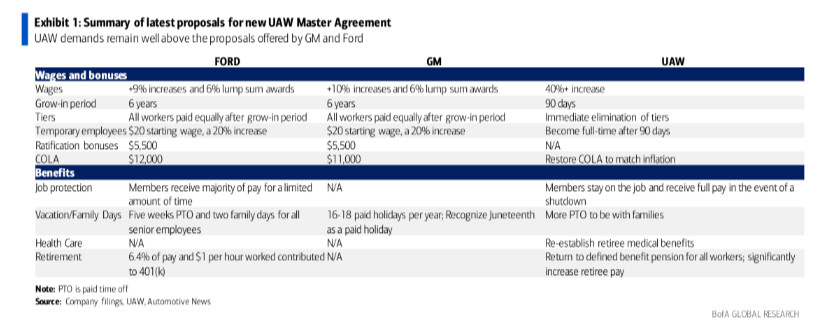
 The United Auto Workers are nearing the end of their negotiations with Detroit's "Big Three" automakers - General Motors, Ford, and Stellantis, the producer of Chrysler - concerning a new four-year labor agreement for approximately 146,000 workers. The current labor contract expires next Thursday as the union has made demands that even the UAW's own president calls "audacious." 

General Motors and Ford have already sent their proposal contracts to UAW earlier this week and last -- only to get quickly rejected. On Friday, Stellantis made its first proposal on wages of around 14.5% -- still well under UAW President Shawn Fain's demand of 46% over four years

The automakers' underwhelming offers put President Biden in a tough spot ahead of next week. "Union Joe," while relaxing at his beach house in liberal white-elitest Rehoboth Beach last week, said he 'wasn't too worried about potential strikes.' 

Fain has described the labor talk discussions with Detroit's Big Three as a battle between billionaires and the working class. As the deadline looms, none of the proposals have met the union's demands, which has led John Murphy, a senior auto analyst at Bank of America Securities, to warn clients on Friday: "Strike almost guaranteed" next week. 

Murphy expects negotiations will result in a 25-30% increase in labor costs over the next four years with "sizable cash signing bonuses and adjustments to other benefits" once contracts are finalized. 

He said the word on the street is "UAW may offer a counter-proposal to the OEM offers shortly" but warned, "We continue to believe a strike is very likely after the Master Agreement expires next Thursday, September 14." 

Murphy explained if a strike was to occur next Thur., then negative headlines could weigh down automaker stocks: 

Should this occur, it could drive some headline-related downwards movement to the stocks, but our discussions with investors and the valuations for GM and Ford (with the stocks down - 15% and - 9%, respectively since 7/31 vs. - 3% for S&P 500) suggest the stocks largely reflect the risks of a material strike. The UAW's strike with GM in 2019 lasted 6 weeks and a one - to two-month strike appears to be the likely outcome here, in our view.

When BofA's note was published, Stellantis had not disclosed their proposal to the union. Below is a comprehensive overview of the offers from Ford and GM and how they match up with UAW's demands.

Everyone is eagerly awaiting UAW's counter-offer before the deadline next Thursday. Union Joe may care a little more this weekend. 


How Deep Runs The Corruption?

 by Jeffrey Tucker via The Epoch Times,

For the past several years, my friends in public health and science have expressed astonishment and professional disorientation at the behavior and messaging of the Centers for Disease Control and Prevention (CDC) and the National Institutes of Health (NIH). The scientific journals are part of this.

They simply couldn't believe the brazen manipulation of science for political purposes. They couldn't believe that so many people within these agencies and journals went along with it for reasons of career protection. They've been appalled that science and public health have been deployed in this way.

They worry about the future with this level of corruption. And they've been quite passionate in decrying it, while paying a professional price for not going along.

Implicit in this reaction is a history in which they implicitly trusted these institutions, their data, their reporting, and their sincerity with regard to public health. They presumed that these agencies weren't capable of manipulating science for political reasons. They certainly would never have believed that they would preside over the worst public health calamity of our lifetime.

When they set out to decry this, correct the error, and alert the public to the truth, it wasn't because they hated the NIH and the CDC. Indeed, it was the opposite. They wanted them to be good. They wanted their integrity restored. They wanted to trust again.

In other words, what motivated them is piety in their professions and the agencies that preside over them. In this, the real haters get it all wrong. My friends aren't disinformation spreaders, they're spreaders of facts in the interest of public well-being. They believed strongly that the system isn't broken fundamentally and could be improved.

They decided that they didn't want to practice their craft in an environment of lies. They wanted restoration of truth.

I’ve listened and understood, but because this hasn't been my realm or my main intellectual interest for the dominant part of my career, I’ve not entirely understood the intensity of their critique or the motivations of my friends. Maybe I’ve always assumed that such enormous bureaucracies were up to no good. I’ve never believed that the CDC, for example, was a net positive in terms of public health, not that I thought about it much before the pandemic.

I’m seeing this fully now because of something that happened this past week. It affects a realm about which I care deeply, namely economics. The Bureau of Labor Statistics (BLS) reported the jobs data again, with a headline number of 187,000 new jobs. That isn't great, but it isn't bad news.

But over the past year and a half, I’ve grown incredulous toward these data releases and the little essay that sits on top of them that's routinely copied by all media outlets as the truth. So I’ve started to look more carefully at the underlying data. The release text said that the number of part-time jobs for reasons of economics—meaning the people who have part-time jobs when they would actually prefer full-time jobs—was “little changed.”

That’s what the BLS said, but the data showed otherwise. It showed an increase of 221,000 part-time jobs. That’s 5.4 percent growth. That’s not “little changed.” That’s a huge and alarming change.

It’s also more than the total number of jobs created. This means that many people have lost full-time work and have been forced to take part-time jobs. This is truly awful news, the very opposite of where we would like to be. One might suppose that the BLS would just admit this outright. It didn’t admit it. It covered it up. The person who wrote those words “little changed” either knew and lied under pressure or didn't look at the data himself and simply trusted his superiors.

In any case, it's flat-out wrong. And demonstrably so!

This makes one wonder about all the data releases coming from the Biden administration. Every month, an output release from the previous month is reduced. This has been systematic and large, and it just keeps happening.

It raises the question: If we were in a technical recession now—or if we never left the one from 2020—would we actually know it? We have no choice but to trust the government’s numbers. Maybe we shouldn’t. Maybe everything is much worse than we know from the agencies’ reporting. It certainly feels that way.

We look at independent data that we know we can trust and find out terrible things. A survey by the Lending Club recently reported that nearly two-thirds of Americans are living paycheck to paycheck. This isn't only a huge increase, it's completely unsustainable.

Why is this happening? Many consumers are spending without thinking. They're persisting in their old habits even though the value of money has fallen by nearly 20 percent in three years. Everyone is poorer than before but continuing to live as if all is normal. To blame—at least in part—is the relentless propaganda from the Biden administration that says the economy is in great shape and there's nothing to worry about.

These are very costly lies.

Do you see the relationship here between economics and public health? During COVID-19, we were told that distancing would protect people. Then we were told that masks would do the trick. Then we were told that the vaccine would work. Do all those things, and you won't be bothered by COVID-19.

That was a lie. Everyone got it anyway. And once people got sick, they had no real protocol for how to get better. That’s because the agencies had disparaged repurposed drugs such as Ivermectin. They did this in order to pretend as if the vaccine was the only real solution, thereby making the “emergency use authorization” compatible with prevailing conditions.

Thus, when people got sick, they had no idea what to do. The agencies that people trusted are fully culpable for this.

It’s true in the economic realm. The government hasn't been straight with people about the economic crisis of our time. All official channels say everything is hunky-dory, just keep adding to that credit card debt, spending as always, draining your savings such as it is, and don’t worry about your job. Everything is fine. Look at our press release! Listen to the weird White House spokeswoman!

This is malpractice. It also undermines trust even further.

No society can run without trust. Builders have to trust measurements, economists trust the data, scientists trust the journal, doctors have generally trusted pharmaceutical companies, and philosophers trust logic. There's just no alternative. If we take that away and replace truth with lies, where does that leave us? As one of my friends says: in a new dark age.

Last night, I was watching the U.S. Open. Several times, an ad came on saying that COVID-19 is still with us, killing more people than the flu, so we need to be alert. The ad is just text with ominous music. It ends by urging that everyone get the COVID-19 vaccine immediately. The closing slogan is "No one has time for the 19."

That’s weird, I thought. We know for sure that the vaccine doesn't protect well, or perhaps at all, against infection. Who's putting out this propaganda? The CDC? The third time that the ad ran, I noticed a tiny word at the end: Moderna. It’s a pharmaceutical ad. For some reason, the ad escaped all the usual legal injunctions about side effects and downsides. There wasn't a word about those.

There's no way that viewers knew that this was a pharma ad. It looked for all the world like a public service announcement from the CDC or NIH. It turns out to be a Moderna ad. But, really, is there much of a difference? We know now that these agencies themselves are wholly captured and doing pharma ads themselves.

I never wanted to live in a world without trust. I perhaps hoped that people would trust government less, but there's much more going on now. Government is involved in everything, and therefore a loss of integrity in government means a loss of integrity in a huge range of areas, leaving us confused about what the truth is.

There’s never been a better time to trust your instincts. If you smell a rat in these official pronunciations, there probably is a rat. The corruption goes very deep. We don’t yet know the bottom of it.

https://www.zerohedge.com/political/how-deep-runs-corruption

NeuBase Statement Regarding Filing By Shareholder

  NeuBase Therapeutics, Inc. (Nasdaq: NBSE) (“NeuBase” or the “Company”) today issued the following statement regarding the Schedule 13D filed with the U.S. Securities and Exchange Commission on August 31, 2023, by Symetryx Corporation (“Symetryx”) and their subsequent press release issued on September 6, 2023.

“The NeuBase Board of Directors (“Board”) appreciates input from its shareholders. The Board remains committed to completing its comprehensive exploration of strategic alternatives focused on maximizing shareholder value. The Board does not believe that shareholder value will be enhanced by issuing the special $1 per share dividend Symetryx requested in their press release. The Board and management will continue to seek an open and active dialogue with its shareholders, including Symetryx.”

https://finance.yahoo.com/news/neubase-therapeutics-issues-statement-regarding-110000583.html

Walmart lowers starting pay for some new hires

 Walmart is changing its starting pay structure for certain new hires amid a slowing job market. 

All new hires are now being paid the same hourly starting wage barring a few exceptions, according to Walmart. 

TickerSecurityLastChangeChange %
WMTWALMART INC.163.47+2.00+1.24%

Previously, newly hired personal shoppers and stockers had been given a higher starting wage, but now wages are consistent across the store except for those who work in the deli, bakery and auto care centers, Walmart said. 

Those roles will still receive higher starting pay given that it takes a higher skill level, according to Walmart.

Walmart in Atlanta, Georgia

A Walmart in Atlanta, Georgia, on Feb. 19, 2023.  (Photographer: Dustin Chambers/Bloomberg via Getty Images / Getty Images)

Walmart said this change does not result in any pay cuts to current employees. Its minimum starting wage will also remain at $14. However, starting wages differ depending on where the store is and can be as high as $19, the company added. 

Walmart spokesperson Anne Hatfield said in a statement that making starting pay consistent "results in consistent staffing and better customer service." 

placeholder
walmart

A Walmart location on 2844 North Broadway Street ahead of permanently closing in Chicago, Illinois, US, on Wednesday, April 12, 2023.  (Christopher Dilts/Bloomberg via Getty Images / Getty Images)

Still, the move comes as companies try and lower their overhead amid the cooling job market. 

U.S. job growth continued at a moderate pace in August while the unemployment rate unexpectedly jumped, a sign that the labor market is finally cooling in the face of rising interest rates and chronic inflation.

https://www.foxbusiness.com/lifestyle/walmart-lowers-starting-pay-some-new-hires

'CDC says existing antibodies can work against new COVID variant'

 Early research data has shown that antibodies produced by prior infection or existing vaccines against the coronavirus were sufficient to protect against the new BA.2.86 variant, the U.S. Centers for Disease Control and Prevention (CDC) said on Friday.

The Food and Drug Administration in the coming days is expected to authorize the updated vaccines that target the XBB.1.5 subvariant of Omicron, and early data provide encouraging signs for the new shots, CDC said.

The public health agency added that the new BA.2.86 lineage of coronavirus was not driving the current increases in COVID cases and hospitalizations in the United States, but rather attributed it to other predominantly circulating viruses.

Since CDC's initial risk assessment last month, BA.2.86 has been identified in nine U.S. states as of Friday. The Omicron offshoot has also been identified from both human and wastewater specimens in countries including Japan, UK and Canada.

This is in contrast to CDC's comments in August that the new variant may be more capable than older variants in causing infection in people who have previously had COVID-19 or who have received vaccines.

https://www.marketscreener.com/news/latest/US-CDC-says-existing-antibodies-can-work-against-new-COVID-variant--44805813/

Marijuana rescheduling falls short of expectations on Biden

 The Biden administration’s recommendation last week for the Drug Enforcement Administration (DEA) to reschedule marijuana marked one of its most significant steps related to the president’s ambitious campaign promise to decriminalize cannabis use. 

But advocates and policy experts say rescheduling marijuana under the Controlled Substances Act (CSA) does not address the plethora of racial justice issues caused by current cannabis laws. 

“Rescheduling doesn’t address … the harm to marginalized communities,” said Natacha Andrews, executive director for the National Association of Black Cannabis Lawyers. 

“It doesn’t address the over policing, it doesn’t address the immigration issues, it doesn’t address the access to federal services, and it’s not in alignment with what 38 states have done to regulate and legalize.”

Under its current scheduling, marijuana is rated at the most stringent level — as a Schedule I controlled substance — on par with methamphetamines and more severe than fentanyl. 

This designation means authorities consider the drug to have no accepted medical use and a high potential for abuse. The Department of Health and Human Services (HHS) has reportedly advised a shift down to Schedule III.

The DEA has final say in changing marijuana’s scheduling and is not bound to abide by HHS’s recommendation.

“My initial reaction is that this is less than what the Biden administration promised specifically,” said Cat Packer, director of drug markets and legal regulation at the Drug Policy Alliance (DPA). 

“This decision kind of leaves me and other communities that are concerned about the harmful impacts of cannabis criminalization wondering how President Biden is going to keep his promises around specifically decriminalizing personal use.”

Changing marijuana’s schedule under the CSA is not the same as decriminalizing marijuana use. 

The Biden administration’s goal for decriminalizing marijuana has been presented as a social justice action from the beginning. During a town hall event in October 2020, then-candidate Biden voiced his opinion that marijuana should be decriminalized and said, “ I don’t believe anybody should be going to jail for drug use.”

Two years later, he followed through on part of his promise when he announced pardons for everyone convicted of marijuana possession under federal law. Along with the pardons, Biden directed the HHS secretary and the attorney general to review how marijuana is scheduled.

When reached for comment for this story, a White House spokesperson reiterated that the review of marijuana’s scheduling is an independent process run by HHS and the DEA. 

Moving marijuana’s designation down to Schedule III would essentially mean the federal government acknowledges marijuana has some medical uses, but it doesn’t change its status as a prohibited substance.

“What Biden promised and what people are crying out for is a combination of decriminalization and equity and neither of those things are even remotely addressed by going from Schedule I to Schedule III,” Andrews said. “It takes people who already have access, who already have resources, who already have connections, who already have politicians in their pocket and it gives them a leg up.”

That’s not to say there won’t be some gains, but they will be minimal, Andrews said. 

“When you look at the realities, there will still be people arrested, there will still be people detained, there will still be people deported. There will still be moms going in for custody battles because they have a legal cannabis card but someone that day felt that they didn’t,” she said. 

Karen O’Keefe, director of state policies at the Marijuana Policy Project, said the larger issue is that the history of cannabis prohibition is still not addressed with rescheduling. 

“White folks and African Americans tend to use cannabis at roughly the same rates,” O’Keefe told The Hill. “Despite that, we see more than three times as many arrests for cannabis possession by Black individuals as we do for white individuals. We see these disparities at every level — at searches, stops, arrests, sentencing and incarceration, and we also have some cases where law enforcement were very explicitly motivated by racism.”

Biden’s pardons last year excluded several groups, like those who were convicted of possessing another substance or had another drug offense as well as people who were not lawful permanent residents at the time of their conviction. And unlike expungements — which Biden alluded to on the campaign trail — the pardons don’t erase convictions from permanent records.

These limitations led some to characterize the White House’s actions as mostly symbolic, which advocates say could be said about rescheduling too.

“Symbolically, the fact that we are changing the policy in the direction away from strict prohibition, that’s a good thing. But the simple schedule change itself doesn’t necessarily alter the facts on the ground,” David Nathan, founder and president of Doctors for Cannabis Regulation, told The Hill.

A change in scheduling won’t allow doctors to prescribe it to patients. The Food and Drug Administration (FDA) would need to approve it as a drug and, according to Nathan, a Schedule III designation is unlikely to encourage the agency to do so. He notes when it comes to botanicals in general, the FDA usually approves extracts of a plant as opposed to a plant itself.

Nathan said physicians like him who are focused on marijuana regulation worry that rescheduling would amount to the Biden administration saying, “OK, we did something and now we’re done.”

It’s also unclear how rescheduling could affect states that have decriminalized or legalized the plant, said Andrews, of the National Association of Black Cannabis Lawyers. 

“It has the potential to derail a lot of state programs,” Andrews said. “The legalization within states violates the order of operations. Not knowing what that next step is going to be that the DEA takes leaves a lot of things in question.” 

By legalization happening from the bottom up, Andrews added, some states could have no issues with the new scheduling, while others could see medical programs disrupted, recreational use affected or other issues. 

“I don’t think any of us know what the final outcome will be,” she said. Andrews predicted pharmaceutical companies will see the most profit from the change — rather than Black and Brown communities.

Other groups have noted that a scheduling change could benefit marijuana businesses — white-owned by a vast majority — which are currently prohibited from deducting expenses from their taxes like other businesses due to selling a Schedule I substance.

O’Keefe, of the Marijuana Policy Project, said the only way for true racial justice is if marijuana is completely legalized. Decriminalization could still lead to police interactions, which can be violent and deadly, and which disproportionately target Black individuals, she said. 

Legalization also needs to include “reparative justice,” she added. 

“Reparative justice measures things like removing the stigma, removing old criminal convictions, freeing prisoners, having set up so you have employment training and assistance for disproportionately impacted and Black and Brown communities to own cannabis businesses,” O’Keefe said. “So, at the bare minimum, I think legalization is what’s needed federally.”

https://thehill.com/policy/healthcare/4192705-marijuana-rescheduling-falls-short-of-expectations-on-biden/