Johnson & Johnson (NYSE: JNJ) announced today it has entered into a definitive agreement to acquire Ambrx Biopharma, Inc., or Ambrx (NASDAQ: AMAM), a clinical-stage biopharmaceutical company with a proprietary synthetic biology technology platform to design and develop next-generation antibody drug conjugates (ADCs), in an all-cash merger transaction for a total equity value of approximately $2.0 billion, or $1.9 billion net of estimated cash acquired.
Monday, January 8, 2024

Merck Is in Advanced Talks to Buy Cancer Drugmaker Harpoon Therapeutics
Merck & Co. has agreed to acquire cancer drugmaker Harpoon Therapeutics Inc. for $680 million as it seeks to solidify its leadership position in the profitable oncology space.
The drugmaker will pay $23 a share for South San Francisco-based Harpoon, it said in a statement on Monday that confirmed an earlier report by Bloomberg News. Merck is offering more than double Harpoon’s last closing share price on Friday.
Harpoon, whose stock gained 41% in the past year, rose as much as 113% as of 2:09 p.m. in New York, the most since December 2022. Merck shares fell 0.6%.
Merck is looking for new sources of growth as its top-selling medicine, the cancer immunotherapy Keytruda, is likely to face pricing pressure at the end of this decade. Keytruda generated $20.9 billion in 2022, making it one of the best-selling drugs in the world.
Early Opportunities
Deal activity in the pharma world has gotten more competitive and prices are starting to rise, Merck Chief Executive Officer Rob Davis said in an interview, but the company’s scientists can spot good opportunities early, as in the case of Harpoon.
Deals worth up to $15 billion tend “to be a sweet spot, a focal point for us,” Davis said. While the company is open to larger purchases, he isn’t interested in a massive, transformative merger.
Harpoon is developing drugs that harness the body’s immune system to fight cancer, including a type of lung tumor and multiple myeloma. Its technology involves T-cell engagers, drugs that aim to use a patient’s own immune system to kill tumor cells. The company’s lead candidate targets a molecule called delta-like ligand 3 that’s found at high levels in small cell lung cancer and neuroendocrine tumors.
The drug is currently in an early-stage trial as a single agent for patients with certain advanced cancers and is being studied in combination with an existing immunotherapy for small cell lung cancer.
Did The Vaccine Eradicate Smallpox?
by Yuhong Dong via The Epoch Times (emphasis ours),
The widespread faith in vaccines is often traced back to the assumption that the first vaccine in human history effectively eradicated one of the deadliest pandemics. However, does this belief hold true?
\Despite the unclear nature of the original smallpox vaccine invented by Dr. Jenner and its increasing failures and medical challenges, there remains an underlying societal belief that smallpox vaccines effectively prevent smallpox. By the year 1801, an estimated 100,000 people were vaccinated for smallpox in England.
In the 1970s, a smallpox global eradication effort led by a World Health Organization (WHO) officer and American medical doctor, Dr. Donald Ainslie Henderson (1928 to 2016), initially used a strategy of mass vaccination campaigns to achieve 80 percent vaccine coverage in each country.
The campaign integrated mass vaccination programs, surveillance of outbreaks, and rapid response to any reported cases. By 1977, the last natural case of smallpox was recorded in Somalia, leading to the WHO’s declaration of smallpox eradication in 1980.
Yet this begs the question: Is there any direct evidence that the infection or mortality rate has declined due to vaccination?
In search of evidence that smallpox vaccination plays a direct role in eradicating the smallpox waves, we found quite a few examples showing that the waves of smallpox seen throughout history were even more severe after a massive vaccination program.
US: No Decline After Vaccination
Dr. Suzanne Humphries, an internist and board-certified nephrologist has practiced medicine in conventional hospital settings for over 20 years. The graphs below represent some key facts from her book about smallpox, “Dissolving Illusions.”
She spent countless hours at Yale’s medical library and other libraries scouring medical journals, books, and newspapers to locate mortality data and create computerized graphs.
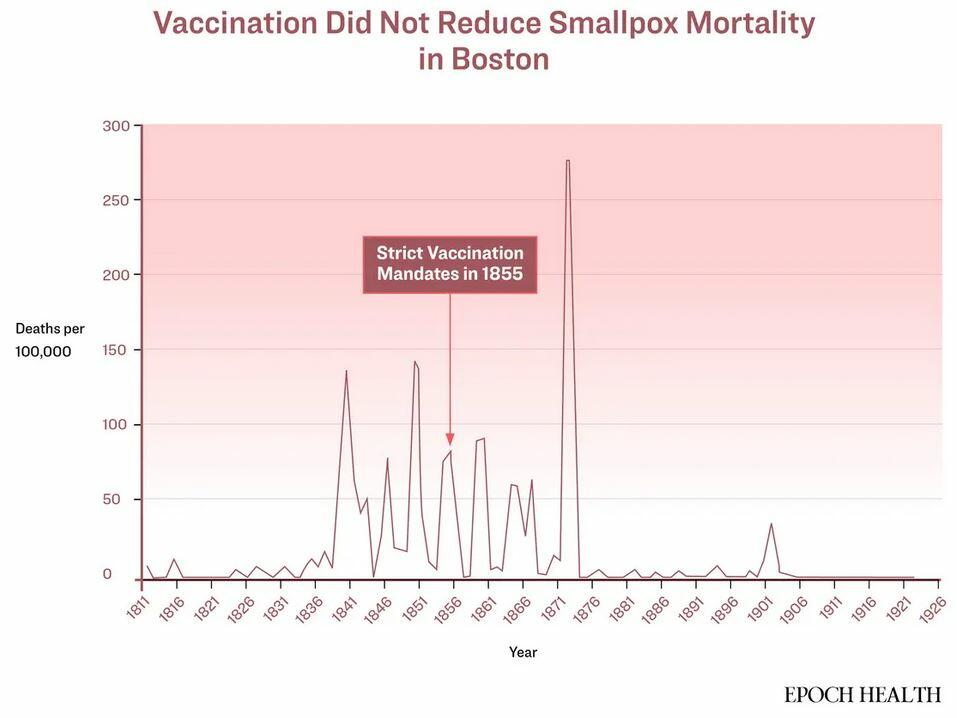
Records from Boston, starting in 1811, reveal recurring smallpox epidemics beginning around 1837. Despite the introduction of vaccination mandates in 1855, epidemics continued to occur in 1859 to 1860, 1864 to 1865, and 1867, with a particularly severe outbreak from 1872 to 1873. The continual reoccurrence of these epidemics in Massachusetts indicates that stringent vaccination regulations had no positive impact on curbing smallpox.
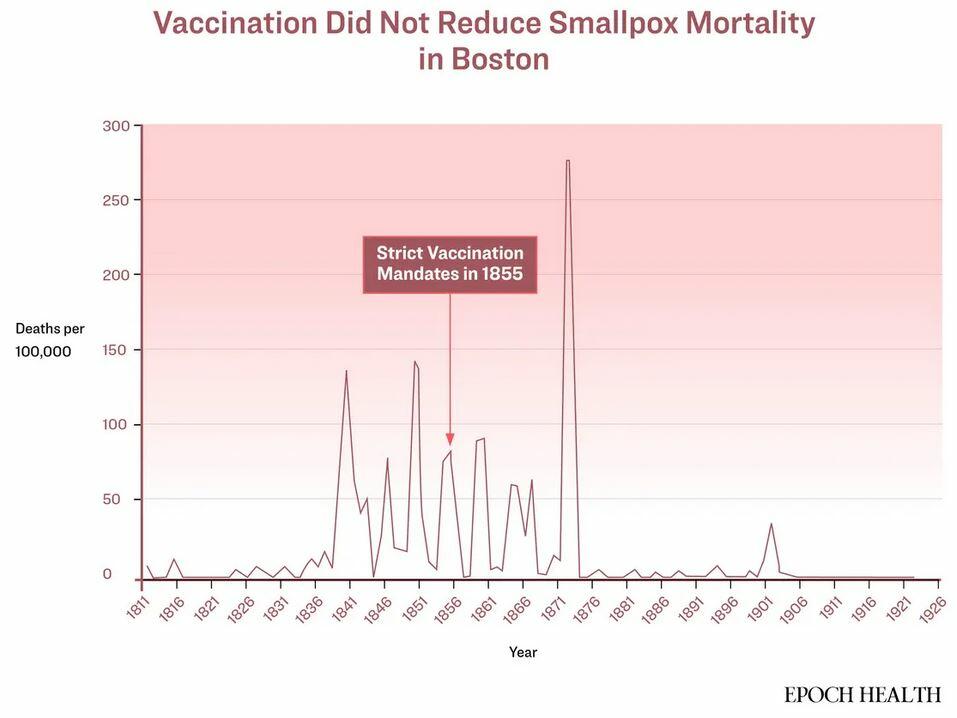
According to the research article, “SmallPox and Revaccination,” published in the 1881 Boston Medical and Surgical Journal, “The latest epidemic that of 1872–1873, having proved fatal to 1,040 persons, was the most severe that has been experienced in Boston since the introduction of vaccination.”
In Chicago, despite 95 percent vaccination coverage by 1868 and mandatory vaccination after the Great Chicago Fire of 1871, a severe smallpox epidemic occurred in 1872. Over 2,000 people contracted smallpox, and more than a quarter of these died, with the highest fatality rate among children under age 5.
Europe: No Decline After Vaccination
Throughout the Western world, epidemics were more severe in highly-vaccinated populations.
Dr. G. W. Harman published an article in the 1900 medical journal Medical Brief entitled “A Physician’s Argument Against the Efficacy of Virus Inoculation,” highlighting widespread smallpox cases among vaccinated individuals in England, France, and Germany.
England
In England, the smallpox vaccination became compulsory in 1853.
Yet since then, there have been three smallpox epidemics. The first occurred from 1857 to 1859, with 14,244 death cases; the second happened from 1863 to 1865, with 20,059 deaths; the third wave, from 1870 to 1872, had 40,840 deaths. The population increased from the first to the second epidemic by 7 percent, yet the increase in smallpox cases was nearly 50 percent. The population increased by 10 percent from the second to the third epidemic, yet smallpox cases increased by 120 percent.
Dr. Harman cited data published on July 15, 1871, from The London Lancet reporting that of the 9,392 smallpox patients in London hospitals, 6,854 had been vaccinated (73 percent) and 17.5 percent of vaccinated patients died.
The death rate for smallpox declined after 1872, but there is no evidence that vaccination had anything to do with it. In the early 1900s, death from smallpox all but vanished from England.
France
During the Franco-Prussian War from July 1870 to January 1871, the French army had 23,469 smallpox cases and every army recruit was required to be vaccinated.
Dr. Charles Creighton’s 1888 critical review in the Encyclopedia Britannica highlighted a mortality rate from smallpox in Prussia of 60,000 deaths between 1870 and 1873, despite widespread vaccination. “Not withstanding the fact that Prussia was the best revaccinated country in Europe, its mortality from smallpox in the epidemic of 1871 was higher (59,839) than in any other northern state,” he wrote.
Germany
In Bavaria, Germany in 1871, nearly 96 percent of all smallpox cases occurred in vaccinated individuals (29,429 of 30,742).
Between 1870 and 1885, official records indicated that 1 million vaccinated individuals died from smallpox.
Italy
In 1888, despite a population in Italy that was extensively vaccinated and revaccinated, smallpox wreaked havoc in numerous towns. Many of these towns had adhered to a biannual vaccination regimen for several years.

In 1899, Dr. Ruata documented the failure of vaccination in Italy. Numerous smallpox outbreaks resulted in 18,110 deaths, including the following notable instances:
- Badolato recorded 1,200 smallpox cases (population 3,800).
- Guardavalle had 2,300 cases (population 3,500).
- St. Caterina del Jonio had 1,200 cases (population 2,700).
- Sortino documented 570 deaths (population 9,000).
- San Cono had 135 deaths (population 1,600).
- Vittoria reported a staggering 2,100 deaths (population 2,600).
Dr. Ruata wrote: “Can you cite anything worse before the invention of vaccination? And, the population of these villages is perfectly vaccinated, as I have proved already, not only, but I obtained from the local authorities a declaration that vaccination has been performed twice a year in the most satisfactory manner for many years past.”
Japan: No Decline After Vaccination
Dr. Simon Katzoff reported that compulsory vaccination laws began in Japan in 1872, and stricter revaccination mandates were passed in 1885. Laws required infants to be vaccinated and revaccinated up to three times within their first year if the first attempt was unsuccessful, then every year after that for seven years.
However, these measures didn’t prevent outbreaks. Smallpox remained rampant.
Between 1885 and 1892, with over 25 million vaccinations and revaccinations, there were still 156,175 smallpox cases and 39,979 deaths. From 1892 to 1897, Japan recorded 142,032 smallpox cases and 39,536 deaths.
Even after an 1896 law mandating vaccination every five years for everyone, the country saw 41,946 cases and 12,276 deaths in 1897 alone—a 32 percent mortality rate—almost double the rate before the vaccination era.
Smallpox Waves Fluctuate, Independent of Vaccinations
Based on the smallpox waves noted above, the virus appears to independently fluctuate, regardless of vaccination.
For instance, in the 1700s, London witnessed a substantial decline in smallpox deaths, even before the widespread use of vaccination. In the 18th century, several outbreaks occurred, despite vaccination mandates.
https://www.zerohedge.com/political/did-vaccine-eradicate-smallpox
Orion and Glykos in research collaboration and licensing agreement on next-generation ADCs
Under the agreement, Orion gains access to Glykos’ proprietary ADC technologies, initiating an ADC program with the potential for expansion into two additional programs in the future. Orion will be responsible for the target selection, research, development, and commercialization of up to three next-generation ADCs, with a focus on solid tumors.
Glykos is eligible for milestone payments related to signing of the agreement, target selection and sales milestones. Glykos is also entitled to receive royalties on commercial sales generated from the three ADC programs.
MorphoSys to Present at the 42nd Annual J.P. Morgan
MorphoSys AG (FSE:MOR)(NASDAQ:MOR) today announced that Jean-Paul Kress, M.D., Chief Executive Officer, will present at the 42nd Annual J.P. Morgan Healthcare Conference on Wednesday, January 10, 2024, at 3:00 p.m. PST in San Francisco, California. The company's Chief Financial Officer, Lucinda Crabtree, Ph.D., and Chief Research and Development Officer, Tim Demuth, M.D., Ph.D., will also be in attendance and available to address questions.
A live webcast of the presentation can be accessed on the Investors section of MorphoSys' website at https://www.morphosys.com/en/investors. An archived version of the webcast will be available on the company's website following the presentation.
Calliditas Therapeutics provides business update ahead of JP Morgan
- Strong Q4 preliminary product revenue growth with net TARPEYO revenues of $31 – 33m for the quarter, representing significant growth over Q3.
- Preliminary Net TARPEYO revenues of $100 – 102m for 2023, representing over 170% year over year growth compared to 2022.
- Preliminary Total revenues reaching $110 – 113m for 2023, as a result of milestone payments and royalty income from the Nefecon franchise outside the US.
- Record quarter in terms of enrollments with 555 new TARPEYO prescriptions in the 4th quarter.
Lab Leaks Have Increased By 50% Since COVID Pandemic: Report
by Steve Watson via Modernity.news,
The Telegraph reports that it has found a FIFTY PERCENT increase in leaks and accidents at laboratories in the UK since the outbreak of COVID in 2020, warning of “potentially catastrophic consequences” in the future.
The report notes that a Freedom of Information Act request sent to all British universities, government research bodies and the Health and Safety Executive (HSE) yielded results showing that “dozens of dangerous viruses and bacteria including anthrax, rabies and Mers (Middle East respiratory syndrome) are being stored close to large populations, potentially placing citizens at risk.”
The investigation also found that since January 2020, there have been 156 reports of lab leaks or accidents, around 42 per year. That is a rise of 50 per cent on the years between January 2010 and December 2019, when 286 incidents were recorded in total, approximately 28 per year.
🔴 Lab leaks and accidents up 50pc as fears grow dangerous viruses and bacteria could escape https://t.co/ZJtdocHiIM
— The Telegraph (@Telegraph) January 7, 2024
Some of the incidents recorded since 2020 include a worker dropping plates of Mycobacterium tuberculosis, the bug responsible for TB at a former Public Health England lab at Heartlands Hospital in Birmingham. At the same lab a worker was pricked with a needle containing HIV, human T-cell lymphotropic virus type 2, and Candida albicans.
At other facilities, avian flu leaked from a cracked sample tube, an accident involving the bacteria responsible for life-threatening sepsis was recorded, and a worker was stabbed by a needle containing the Vaccinia virus, similar to smallpox.
At another lab, workers “lost” a mouse that they had genetically modified.
The Telegraph notes that not all incidents were disclosed because “some of the biological agents involved are listed in the Terrorism Act.”
American molecular biologist Richard H. Ebright, who has been vocal regarding his opinion that the COVID pandemic was a gain of function lab leak, further highlighted several terrifying quotes from the Telegraph report:
"The HSE, which had to be threatened with contempt of court by the Information Commissioner’s Office before it would release the data, said it could not disclose full details of the incidents because some of the biological agents involved are listed in the Terrorism Act."
— Richard H. Ebright (@R_H_Ebright) January 6, 2024
David Harper, former director general in UK Department of Health: "Accidental breaches in laboratory biocontainment can have potentially catastrophic consequences. The accidents that are reported today without doubt provide an underestimate of the true scale of the problem.'"
— Richard H. Ebright (@R_H_Ebright) January 6, 2024
"Col Hamish de Bretton Gordon, former commander of Nato’s Chemical, Biological and Nuclear Defence Forces, said: 'The apparent lab leaks in this country alone show we are all sitting on a ticking time bomb. "
— Richard H. Ebright (@R_H_Ebright) January 6, 2024
https://www.zerohedge.com/political/report-lab-leaks-accidents-have-increased-50-covid-pandemic
Subscribe to:
Posts (Atom)