Search This Blog

Thursday, January 11, 2024

US Budget Deficit Soars By 50% In December As Fiscal Collapse Under Biden Accelerates

 Remember when we showed that the "stealth" secret sauce behind Bidenomics was nothing more than a massive, multi-trillion debt-fueled spending spree, which led to the biggest peactime, non-crisis budget deficit in US history, with the total deficit for fiscal 2023 ending just over $2 trillion, or double the prior year, something which BofA's Michael Hartnett called the "era of fiscal excess"?
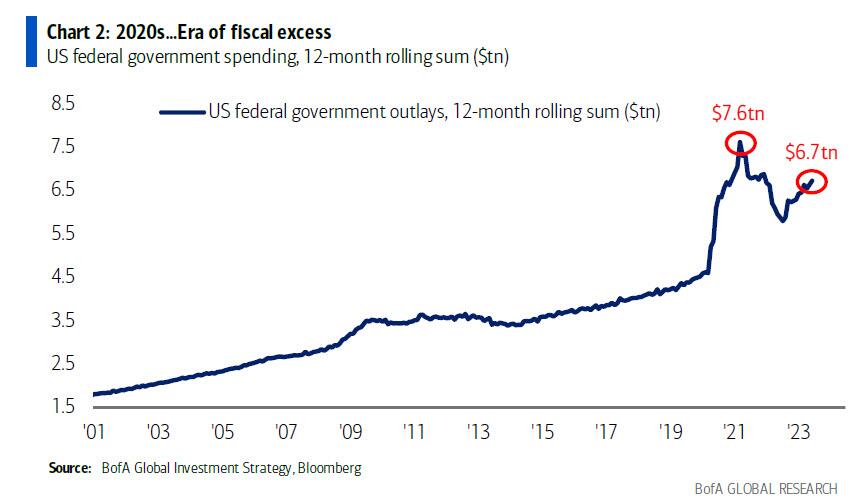
Well, we have news for you: if 2023 was bad, 2024 an election year of course is shaping up to be far worse.

Moments ago the US Treasury reported the budget deficit picture for December and it will come as no surprise to anyone that the US has continued to spend like a drunken sailor, or rather, even more. As shown in the chart below, in the month of December, the US collected $429 billion through various taxes, while total outlays hit $559 billion...
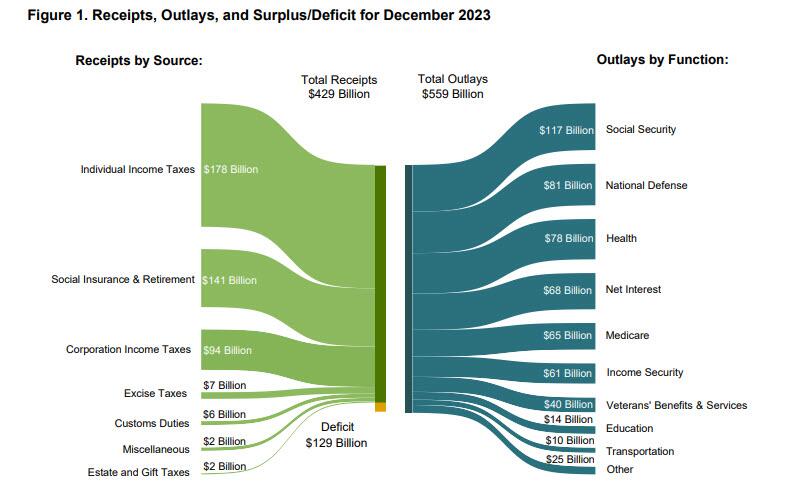
... resulting in a December deficit of $129.4 billion.

This may not sound like a lot, but December is actually one of those months when the US deficit is relatively tame, or used to be.

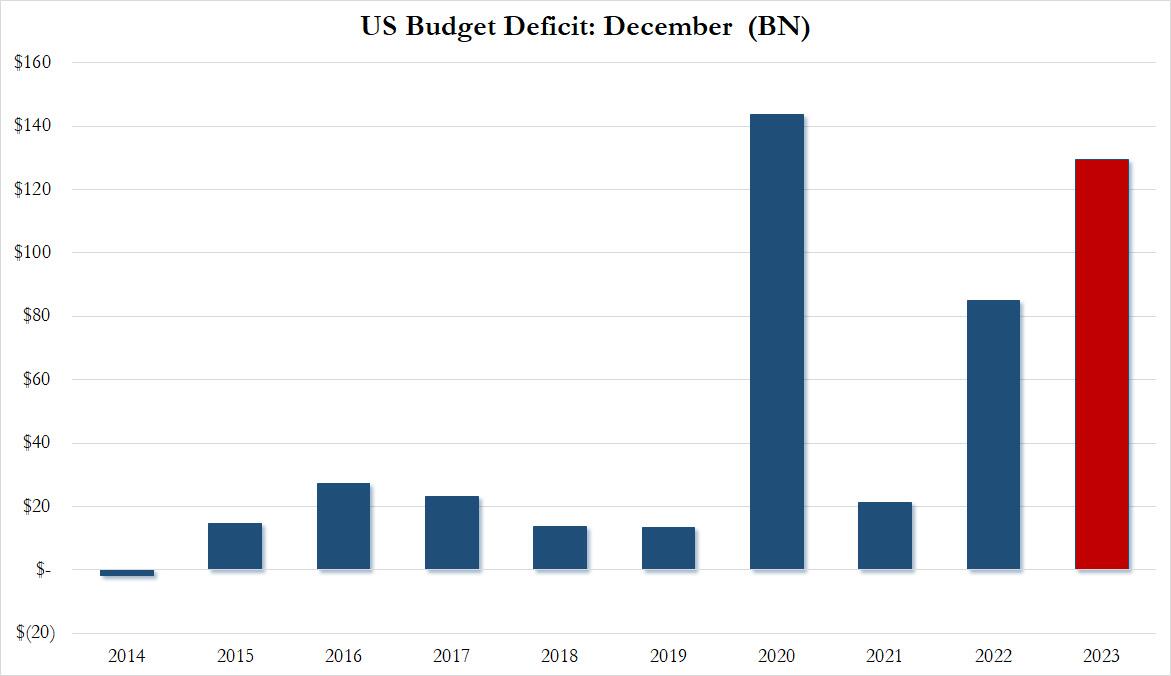
As shown in the next chart, traditionally the December deficit was barely in the $10-20BN range... until 2020 when it exploded to an all time high of $140BN. And while it dropped sharply in 2021, it rebounded dramatically in 2022, and rose to just shy of the December crisis high last month!

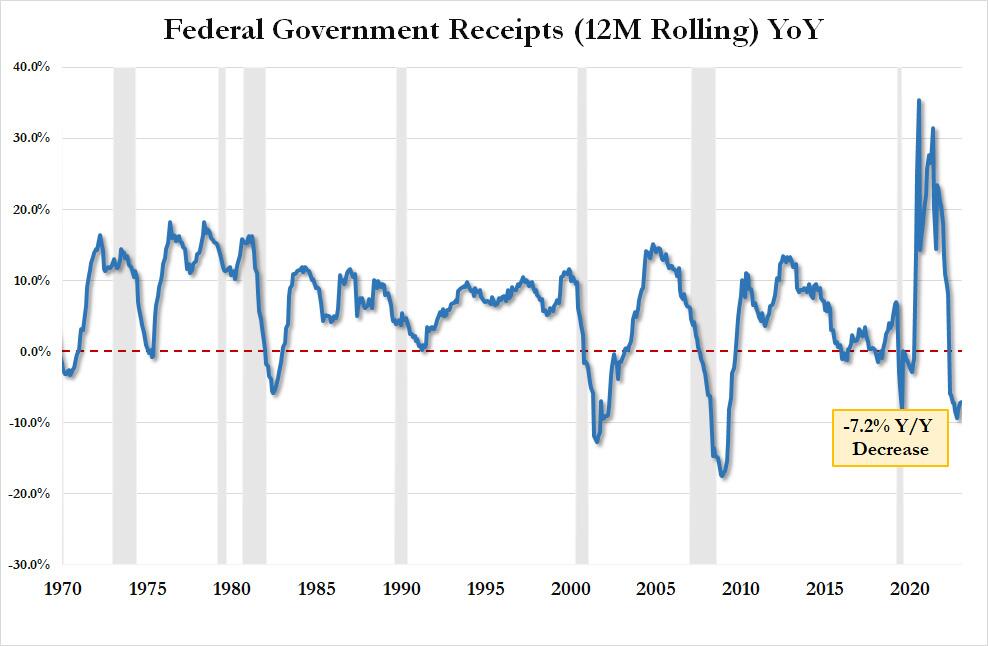
Here is some more context: tax receipts of $429.3BN in December were down 5.6% from the $454.9BN in December 2022 and down a whopping 11.8% from December 2021. On an LTM basis, US total tax receipts were $4.521TN, or down 7.2% YoY. This is now the 9th consecutive YoY decline in LTM tax receipts, something that historically has only taken place when the US was in a recession. As an aside, the "smart economists" were certain that the collapse in tax receipts would reverse after November when the postponed California taxes would be collected. Well, November has come and gone and the big picture is just as ugly.
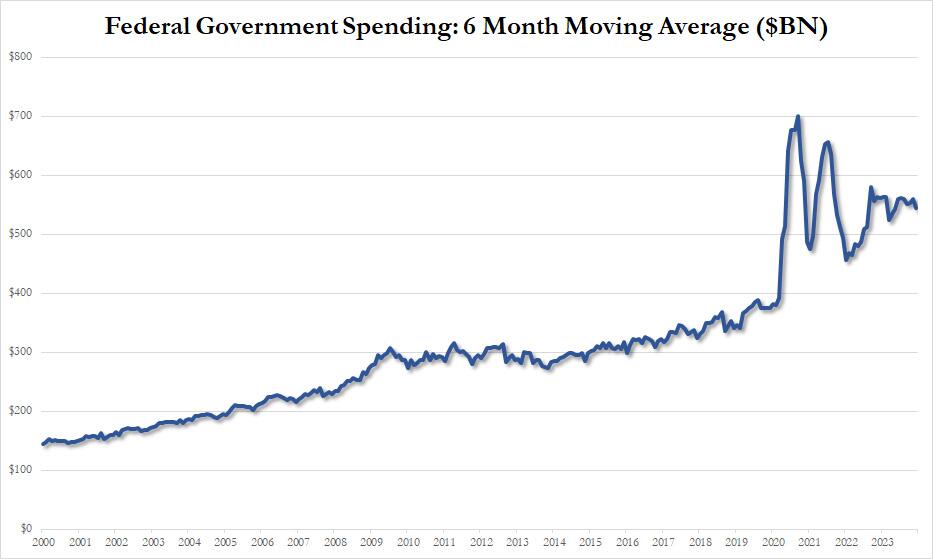
Looking at outlays, unlike tax receipts, there is danger of a decline... ever; and indeed in December the US spent a total of $559 billion, up 3.5% from the $540BN spent a year ago, and up even more from the $508BN in 2021. On a 6 month moving average basis, we are rapidly approaching the exponential phase even when accounting for the spending burst in 2020 and 2021.
Putting it all together, we get the scariest chart of all: the YTD budget deficit three months into fiscal 2024 is already $509 billion, which would be the biggest deficit in US history after one quarter with the exception of the covid outlier year of 2021 when the US injected multiple trillions in stimmies.
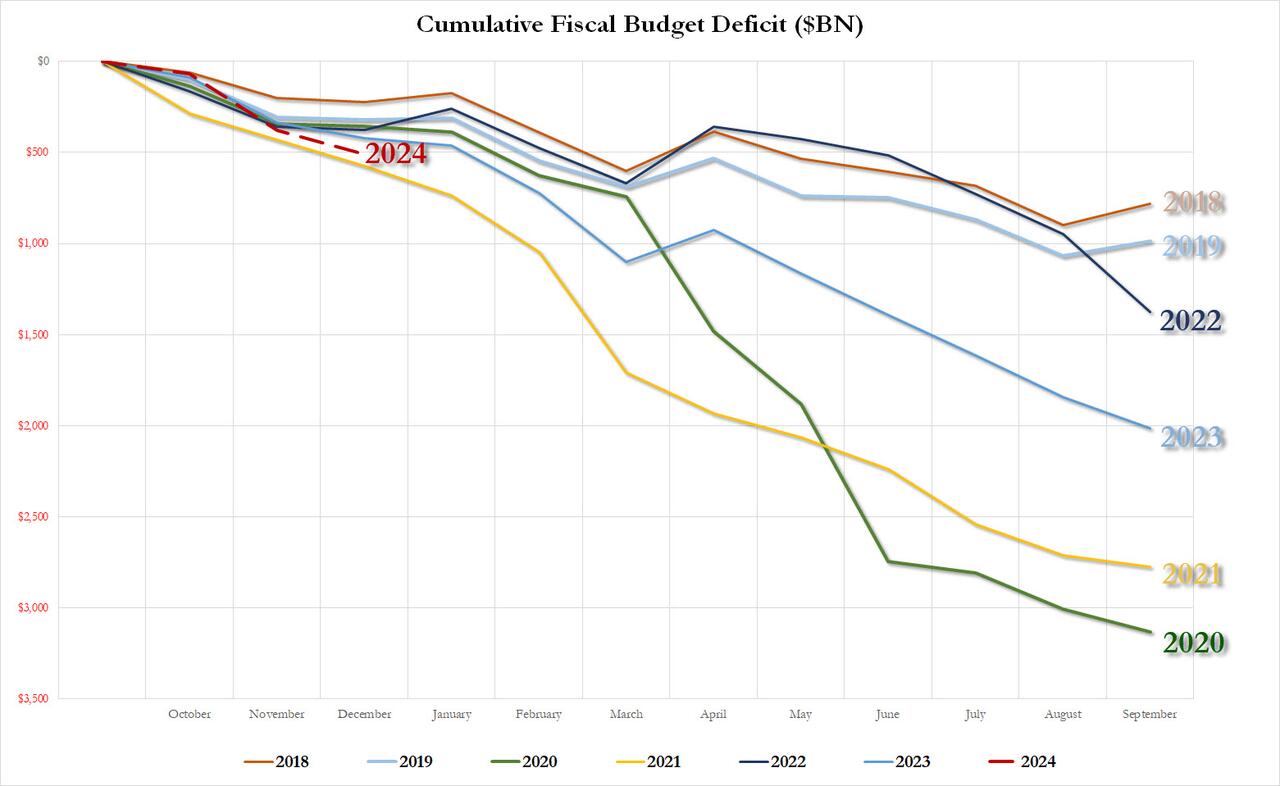
As for the final, and most shocking, data point, the December budget deficit of $129.4 billion was more than $40BN higher than the $87.5BN median estimate, and was more than 50% higher compared to the $85BN December deficit in fiscal 2022.
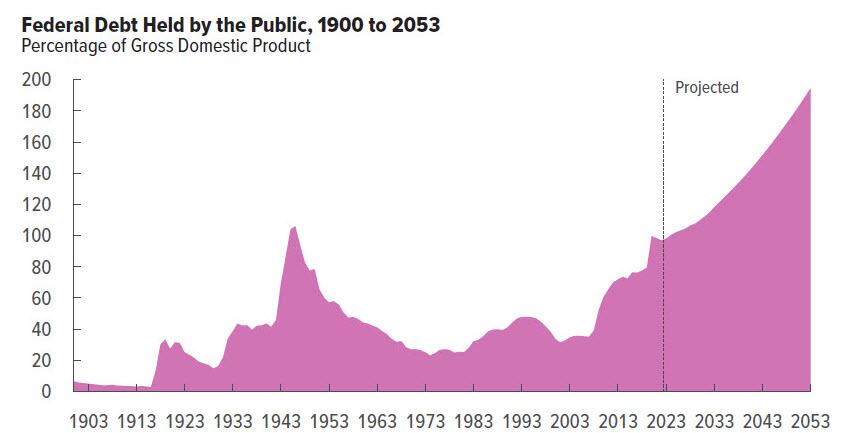
Needless to say, this is completely unsustainable and assures fiscal collapse for the US, not if, but when. Then again, we already knew this thanks to the CBO which was kind enough to chart the endgame:
What is funniest about all this is that the US is on an accelerating path to ruin less than one year after the imposter in the White House published this laughable propaganda.
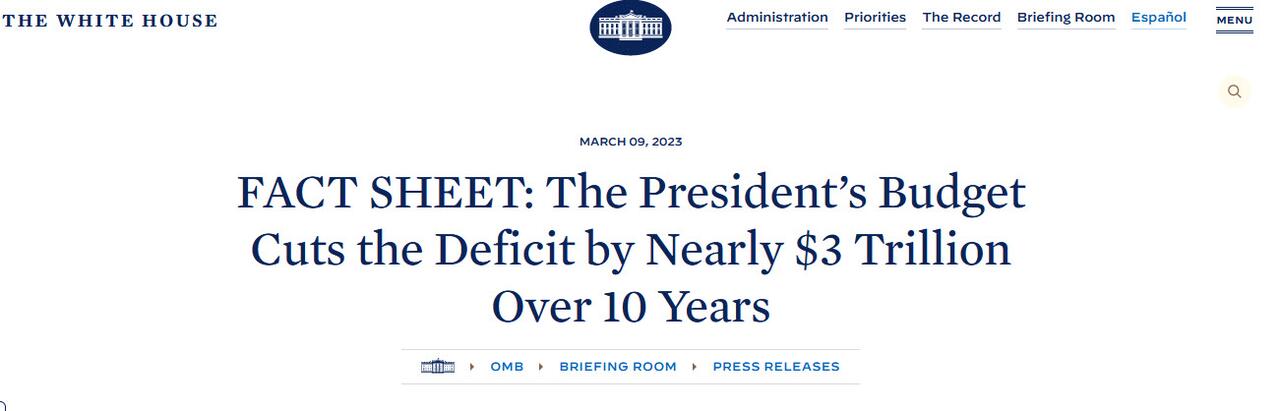
We can't wait to see what really happens to the budget deficit over the next 10 years. Spoiler alert: there won't be a happy ending


https://www.zerohedge.com/markets/us-budget-deficit-soars-50-crushing-estimates-fiscal-collapse-under-biden-accelerates

CVS to close ‘select' pharmacies in Target

 CVS Health plans to close select pharmacies inside Target stores early this year, a company spokesperson said Thursday, as retail pharmacy chains in the U.S. struggle to boost profits. 

The closures will begin in February and finish by the end of April, the spokesperson said in a statement. She added that employees affected by the closures will be offered comparable roles within CVS. 

The spokesperson did not disclose how many stores would be shuttered, but a report from the Wall Street Journal on Thursday said CVS would close "dozens" of locations.

CVS operates 9,000 pharmacy locations nationwide. The company has a pharmacy in about 1,800 of Target's 1,956 stores in the U.S., according to a Target spokesperson. 

The Target spokesperson declined to comment on the closures or share plans for the closed CVS locations. 

The decision to shutter the stores is part of CVS's effort to reduce its retail footprint "based on our evaluation of changes in population, consumer buying patterns and future health needs," the CVS spokesperson said.

https://www.nbcconnecticut.com/news/national-international/cvs-to-close-select-pharmacies-in-target-stores-in-the-coming-months/3191175/

UK, US Preparing To Carry Out Offensive Strikes On Yemen's Houthis: Reports

 Chatter and rumors are growing on reports that the Western coalition is cobbling together a plan to go on the offensive against continuing Houthi attacks in the Red Sea... "If approved in the emergency UK cabinet meeting tonight, the military action will be in partnership with the US against Houthi forces in Yemen," journalist Halah Jaber, formerly of the Sunday Times, has reported on X.

Additionally, al-Arabiya has reported Thursday afternoon that the US military is "stepping up its contingency plans for a response to Yemen's Houthis in the near future" while also noting that Washington's "multiple warnings" have failed to stop the attacks.

Amazon’s cashierless checkout is coming to hospitals

 Amazon

 is pitching its cashierless checkout technology to hospitals and other health-care facilities.

The company on Thursday said the latest version of its Just Walk Out system lets health-care employees pay for items at on-site cafes using their work badge. Hospital visitors will also be able to shop at JWO-enabled stores using credit cards and debit cards, as well as mobile wallets. It’s rolling out the tech at St. Joseph’s/Candler Hospital in Savannah, Georgia, Amazon said in a blog post.

Amazon’s JWO technology allows shoppers to enter a store by scanning an app and exit without needing to stand in a checkout line. Cameras and sensors track what items shoppers select and charge them when they leave. Some newer iterations of the technology remove the need for ceiling-mounted cameras, and instead use radio-frequency identification, or RFID, tags to keep track of which items are taken off the shelf.

The company debuted its first cashierless store in 2018, and since then, it has deployed the technology in its convenience stores, Fresh supermarkets and Whole Foods locations. It also sells the technology to third-party retailers in airports, college campuses, stadiums and theme parks, among other venues.

https://www.cnbc.com/2024/01/11/amazons-cashierless-checkout-is-coming-to-hospitals.html

Gotham Allegations ‘False,’ Grifols CEO Tells Investors

 Grifols SA Chief Executive Officer Thomas Glanzmann failed to assuage investor concerns about a critical short-seller report during an investor call on Thursday, with the shares resuming a sharp selloff.

The Spanish blood plasma firm held the call to answer questions about the accounting and corporate government allegations made by Gotham City Research LLC. On the call, executives pledged to simplify the company’s business structure and repay debt.

Glanzmann accused Gotham City of “re-purposing financial information” and acting out of “pure self-interest and financial gain.” He reiterated that the board will take legal action against the fund.

Still, investors responded by selling the stock, sending it down 15% by the close. “Little new info was given at the call, where management mostly reiterated the messages of the past few days,” Alvaro Lenze, an analyst at Alantra Equities, wrote in a note. “We see a missed opportunity to communicate a stronger message” on improving transparency and governance, Lenze added.

Grifols has been in turmoil after Gotham City released its report on Tuesday, which caused a 26% plunge in the stock. The next day, filings showed that Gotham City had slashed its short bet against the company. The stock is down by about 30% since the report’s publication.

Among its accusations, Gotham City said Grifols’s financial statements included earnings from BPC Plasma and Haema, two companies for which Grifols has a call option and that are owned by Scranton Enterprises NV, an investment vehicle for some members of the Grifols’s founding family and a group of former executives. Glanzmann denied this was a family office on Thursday’s call.

JPM2024: IRA Favors Biologics Over Small Molecule Drugs and Hurts Innovation: Analysts

 The potential impact of the Inflation Reduction Act’s drug pricing provisions on small molecule drugs was on the minds of industry stakeholders in San Francisco this week for the J.P. Morgan Healthcare Conference.

At the crux of the matter is a disparity in which biologics are spared from price negotiations under the Inflation Reduction Act (IRA) for 13 years following approval, while the grace period for small molecules is only nine years.

Incubate, a lobbying group for venture capital firms in the life sciences, contends there is an urgent need for 13-year parity when it comes to small molecule drugs and biologics.

“Nine years of exclusion from price negotiations for small molecule products and 13 years for biologics—that’s a big difference when you consider that 50% of all drug revenues come in years 10 to 13 and you’re taking that off the table,” John Stanford, Incubate’s executive director, said at the group’s policy panel in San Francisco on Sunday.

It’s a concern shared by Gaurav Gupta, managing partner of J.P. Morgan Life Sciences Private Capital, who said the loss of four years of exclusivity for small molecules has “very real” consequences from an investment standpoint.

“The impetus for what has led to the development of many of these exciting medicines that we’ve seen is that someone has taken that risk to have it pay out down the line,” Gupta said at the panel. The IRA provisions, he added, are “taking, for certain types of medicines, a significant amount of revenue potentially off the table.”

An analysis from the Partnership for Health Analytic Research (PHAR), in collaboration with the Pharmaceutical Research and Manufacturers of America (PhRMA), highlighted the fact that the majority of cancer medicines approved by the FDA are small molecules and projected that the IRA’s price setting provisions will have “an acute impact” on the research and development (R&D) of cancer drugs.

J.P. Morgan’s Gupta said it is “head-scratching” that lawmakers who drafted and passed the IRA into law would “bias the modality by which we target certain disease,” adding that the provisions are particularly detrimental because they affect patients.

“There will be people and companies who just choose to back away from small molecule programs” including radiopharmaceuticals, Gupta said. “Cancer patients may end up being disproportionately affected.”

In September 2023, credit rating agency Fitch Ratings released an analysis showing that the Medicare Drug Price Negotiation Program will likely deter investments in small molecule drugs.

“Companies may focus more on complex biologic products that benefit from longer periods before price negotiation is required, with less attention and investment for small molecule drugs, as they tend to lose the vast majority of their sales in the 12 months following patent expiration,” according to Fitch Ratings, which warned that “this may affect pharmaceutical companies’ product diversification and growth prospects.”

PhRMA has similarly made the case that biopharma companies are rethinking their R&D investments, “with the government essentially picking winners and losers” by stifling the development of certain types of drugs for specific patient populations. 

Kirsten Axelsen, a senior policy advisor at DLA Piper, also expressed concerns about the IRA’s targeting of small molecules, which she said will have potentially dire consequences.

“Are we going to see switch strategies towards the end of lifecycles? Are we going to see indications split into different products? There’s going to be a lot of inefficient R&D as a result of this law,” Axelsen told the panel.

https://www.biospace.com/article/jpm2024-ira-favors-biologics-over-small-molecule-drugs-and-hurts-innovation-say-industry-analysts/

Lloyd Austin's Deputy Ran The Pentagon From The Beach, Didn't Cancel Vacation

 Amid growing pressure on the Biden administration in the wake of Defense Secretary Lloyd Austin going MIA for nearly four days as he was in the ICU of Walter Reed hospital but without telling anyone at the White House (as basic long-standing national security protocol would require), new details have been unearthed which reveal the situation to have been far worse (and comical) than previously known.

Not only was there no one officially at the helm of the Department of Defense at a moment Iran-backed militias targeted US bases in the Iraq-Syria region, but Austin's #2 was "running the Pentagon" from the beach, apparently.

Austin and his staffers have tried to paint a picture that Deputy Defense Secretary Kathleen Hicks was basically running things. But while Hicks is said to have been tasked with "some duties" during Austin's absence - it remains that she was on vacation and didn't so much as know that her boss was out of commission.

According to fresh details in The Wall Street Journal, Hicks was literally on a beach in Puerto Ricoand what's worse is that she stayed on vacation even as Austin was laid up:

On the evening of Monday, Jan. 1, Austin experienced severe abdominal pain and was rushed via ambulance to Walter Reed, where he was put in the intensive care unit, the Pentagon said. Once there, doctors identified a urinary tract infection and abdominal fluid collections in Austin, and he remained in the ICU for several days. 

On the day Austin returned to the hospital, Kelly Magsamen, his chief of staff, was sick with the flu, and her deputy was out, U.S. officials said, a factor that contributed to the delayed communications.

The following day, Jan. 2, Hicks, who was on a beach in Puerto Rico with her family, was informed by the Pentagon that she needed to assume some of Austin’s duties. The request was a surprise since Hicks had planned her vacation well in advance and normally, if she was to assume the defense chief’s duties, she should be in Washington to perform them.

The comedy of errors was compounded from there. It would be hard to make this up...

The communications team which routinely travels with her, even while on leave, prepared for an elevated role while at the hotel, which required her to stick close to her communications suite, forgoing walks on the beach. She began to make some routine operational and management decisions in Austin’s stead, and was “fully authorized and ready to support the president on other military matters, should the need have arisen,” a Pentagon official said. 

So Hicks, who found herself in charge (somewhat unknowingly perhaps) of the world's most powerful military, and at a moment the US is engaged in several hotspots from Ukraine to Syria to the Red Sea, decided that she must sacrifice walks on the sandy beaches.

During that very time, the Pentagon was engaged in some high-risk aerial operations against Iran-linked groups in Iraq. The WSJ underscores there was nothing about that week that was mere "business as usual": 

For two more days, information about Austin’s condition was kept to the small group of aides. 

In the meantime, the U.S. conducted a strike in Baghdad targeting a leader of an Iranian-backed Iraqi militia, which Austin had approved earlier. Air Force Maj. Gen. Pat Ryder briefed reporters on Thursday, Jan. 4, and made no mention of the secretary’s whereabouts. 

Hicks continued carrying out some duties while she stayed in Puerto Rico, and the White House remained in the dark for most of the day.

That very strike has triggered Iraq government efforts to boot American troops from the country to gain steam and popularity in the region.

But important to emphasize is that the person who was effectively acting secretary of defense stayed on her vacation, in a posh hotel room, only "foregoing walks" - as we are assured. More broadly, there was a window of days where it seems that simply no one was actually in charge of the US armed forces.

https://www.zerohedge.com/political/lloyd-austins-deputy-ran-pentagon-beach-didnt-cancel-vacation