Search This Blog

Friday, January 12, 2024

Jim Jordan in new standoff with feds over Biden ‘$10M bribe’ file that may contain ‘crucial’ info

 House Judiciary Committee Chairman Jim Jordan is asking FBI Director Christopher Wray to hand over another confidential informant file related to an alleged $10 million bribe that the owner of Ukrainian natural gas company Burisma Holdings paid to Hunter and Joe Biden.

The March 1, 2017, file from a confidential human source of the bureau may contain “crucial” information to the committee’s investigation of Hunter’s overseas business dealings and impeachment proceedings against President Biden, Jordan (R-Ohio) wrote in a Thursday letter to Wray.

Jordan said the file “resulted in the creation of now publicly available [report], dated June 30, 2020, containing information implicating then-Vice President Biden in a multimillion-dollar bribery scheme,” was “necessary” for his committee’s work and must be submitted by Jan. 19.

The 2020 FBI informant file, released last year by Sen. Chuck Grassley (R-Iowa), contained bombshell allegations that the president and his son “coerced” Burisma owner Mykola Zlochevsky into paying them each $5 million to get Ukrainian prosecutor Viktor Shokin fired in early 2016.

House Judiciary Committee Chairman Jim Jordan is asking FBI Director Christopher Wray to hand over another confidential informant file related to an alleged $10 million bribe paid to Hunter and Joe Biden.AP
The March 2017 file from an FBI confidential human source may contain “crucial” information to the committee’s investigation of Hunter’s overseas business dealings and impeachment proceedings against President Biden.REUTERS

Jordan added that Judiciary panel members “first learned” of the 2017 file after conducting a transcribed interview with former Pittsburgh US Attorney Scott Brady, who was tapped by then-Attorney General Bill Barr to probe matters related to Ukrainian corruption in 2020.

A source told The Post that Jordan intends to subpoena the informant file if the FBI balks at the Jan. 19 deadline. The bureau’s national press office confirmed receipt of the letter but did not provide further comment.

The 2017 informant file “discussed Hunter Biden” and plans for Burisma executive Vadym Pozharskyi “to travel to Washington, D.C., in March 2017” but “was not relevant to Burisma’s interest in acquiring a US-based petroleum business for $50-$100 million,” according to the FBI’s source.

AP

The details are mentioned in a footnote of the 2020 file, which Brady had “developed” from the “highly credible” source, who had worked for the bureau for more than a decade.

“Once we were made aware of it,” the former federal prosecutor told the Judiciary Committee in his Oct. 23, 2023, interview, his assistant prosecutors “identified that line relating to Mr. Biden and his role at Burisma.”

“They brought that to my attention, and we then engaged the FBI and said we need to understand what this is or what this is not; can you please go out and re-interview the [confidential human source] and develop this,” Brady said. “That then led to this June of 2020 1023.”

A source told The Post that Jordan intends to subpoena the informant file if the FBI balks at the seven-day deadline.Getty Images

The informant described four conversations he had with Zlochevsky between late 2015 and early 2016 — around the time that then-Vice President Biden traveled to Kyiv to pressure then-Ukrainian President Petro Poroshenko to remove Shokin.

The prosecutor was ousted in March 2016 by a vote of Ukraine’s parliament.

During a 2018 panel discussion at the Council on Foreign Relations, the elder Biden bragged about threatening to withhold $1 billion in US loan guarantees in December 2015 from Poroshenko to force Shokin’s ouster.

“Well, son of a bitch. He got fired,” the future president recalled, to laughter from his audience.

Burisma owner Mykola Zlochevsky told the FBI source that he had 17 recordings of conversations with the Bidens — two involving Joe — and “many text messages,” documents and financial information about the payments.NurPhoto via Getty Images

Congressional Democrats have insisted Shokin’s removal had been sought by both the US and European nations due to his own corruption.

Hunter Biden sat on the board of Burisma from 2014 to 2019, earning up to $1 million per year despite having no relevant energy experience, but his monthly salary was cut in half in March 2017 — just two months after his dad left the White House.

Zlochevsky told the FBI source that he had 17 recordings of conversations with the Bidens — two involving Joe — and “many text messages,” documents and financial information about the “payment(s) to the Bidens.”

Hunter Biden sat on the board of Burisma from 2014 to 2019, earning up to $1 million per year despite having no relevant energy experience.REUTERS

“Zlochevsky responded he did not send any funds directly to the ‘Big Guy’ (which [the FBI source] understood was a reference to Joe Biden),” the file states.

“[The source] asked Zlochevsky how many companies/bank accounts Zlochevsky controls; Zlochevsky responded it would take them (Investigators) 10 years to find the records (i.e. illicit payments to Joe Biden).”

Several former associates of Hunter referred to Joe Biden as “the big guy” in emails discussing the first son’s business ventures abroad, including a 2017 deal involving a Chinese government-linked energy conglomerate that was set to provide Joe Biden a 10% stake.

The deal was one of two bombshell reports by The Post in October 2020 about Hunter’s influence-peddling schemes with foreign nationals, which were retrieved from his abandoned laptop’s hard drive.

The other reported on the then-second son introducing his father to Pozharskyi in April 2015, a meeting that was later confirmed to have taken place at Cafe Milano in Georgetown.

White House Counsel spokesman Ian Sams panned the request as “More Failure Theater,” saying House Oversight Committee Chairman James Comer (R-Ky.) had already gotten access to the file back in June 2023.

Both Comer and Oversight Ranking Member Jamie Raskin (D-Md.) were able to review the documents at a security facility.

“According to the Committee minority: ‘Nothing to do with any corruption allegations involving the Bidens,'” Sams posted on X, citing a statement from Raskin.

But Comer released a statement last June saying “the FBI brought two unclassified FD-1023 forms that were heavily redacted.”

Raskin made other comments last year about the 2020 FD-1023 form and the origin of the information provided to Brady for his probe that were disputed as inaccurate by Barr in a statement to The Post.

Hunter Biden, 53, is currently battling both federal and congressional investigations into his foreign business affairs and has been indicted on tax fraud charges in Los Angeles and weapons charges in Delaware.

https://nypost.com/2024/01/12/news/jim-jordan-in-new-standoff-with-fbi-over-biden-bribe-informant-file/

Is New York In Play For 2024?

 In an exclusive interview with Breitbart News released on January 2, former President Donald Trump stated his intention to make a “heavy play” to win liberal strongholds – including deep blue New York.

While Trump’s bold plan predictably drew jeers and mockery from media pundits and elected Democrats, some polling suggests that the Empire State might not be out of reach. Moreover, even if Trump doesn’t win the state, a competitive battle there could divert Democrat resources from other battleground states and force the Biden campaign on the defensive in states they thought they’d never have to worry about.

“I’m going to do rallies, I’m going to do speeches, I’m going to work them,” Trump told Breitbart. “I may rent Madison Square Garden and that’s the belly of the beast, right?”

Trump specifically outlined a slate of failures by Democrat leaders in New York that could make the state fertile ground for what would be one of the most shocking political upsets in American history.

“You have migrants living on Madison Avenue,” Trump said. “You can’t get into a hospital. You can’t get into a school… I think it’s really bad and I think the people in New York and New Jersey and a lot of these states are—it would have been semi-unthinkable, but I think these are states that can be won.”

Given recent presidential election results in New York, a GOP victory there in 2024 may seem impossible. The last Republican presidential candidate to carry the state was Ronald Reagan, who won there in both the 1980 and 1984 elections. Since then, the best performances by a Republican presidential nominee were George W. Bush’s 40 percent in 2004 and Trump’s 37.8 percent in 2020.

New York also hasn’t elected a Republican governor since 2002 and hasn’t sent a Republican to the U.S. Senate since 1992.

But there are nonetheless some emerging signs that 2024 could see a political earthquake in New York.

Perhaps most alarmingly for the Biden campaign, the president’s lead in a potential rematch with Trump this year has shrunk to just 10 points in the latest Siena poll fielded last November. After Biden won the state by more than 23 points in 2020, his advantage has now been more than cut in half – and that’s without any concerted effort by Trump to flip the state.

In that same poll, just 45 percent of New Yorkers said they approve of the job Biden is doing as president, compared to 53 percent who disapprove. 55 percent of Democrats polled said they wanted someone other than Joe Biden to be the Democrat nominee for president.

Other Democrat leaders are also deeply unpopular in New York, creating a potential opportunity for a Republican to capitalize on that discontentment. A Marist poll released last November found Governor Hochul’s approval to be just 41 percent, compared to 42 percent who disapprove of her performance. 59 percent of respondents said quality of life had deteriorated in the state over the past year.

52 percent of respondents in that poll also said they disapproved of the job Hochul was doing to address crime, including a full 35 percent of Democrats. Democrat Mayor Eric Adams is in even worse shape with only a 28 percent job approval.

Issue polling further supports the idea that Trump could compete in New York in 2024. In another Siena poll released last August, 82 percent of New Yorkers said the influx of migrants into the state was a “serious problem.” 58 percent of respondents – including 48 percent of Democrats – said, “New Yorkers have already done enough for new migrants and should now work to slow the flow of migrants to New York.” Since then, the migrant crisis has only gotten worse, and now at least one school has been closed to students in order to house migrants.

The brewing intraparty war among Democrats over the response to the Israel-Gaza war could be another big problem for Biden and other down-ballot Democrats this November. While New York’s 1.6 million Jewish residents typically skew heavily liberal, Democrats’ lackluster response to the outpouring of antisemitism and anti-Israel sentiment from the left might cost them big at the ballot box.

Recent electoral results in New York also suggest that Republicans still have a fighting chance in the state.

GOP Congressman Lee Zeldin ran within five points of incumbent Democrat Governor Kathy Hochul in 2022’s gubernatorial contest. Along with Zeldin’s strong showing, Republicans flipped six competitive House seats, including the ouster of Democratic Congressional Campaign Committee Chair Sean Patrick Maloney – perhaps the crowning achievement for House Republicans in the midterm elections.

In 2024, Democrats will face their toughest political landscape in decades in New York. Whether or not it will be enough for Trump or another potential Republican nominee to have a shot at victory there remains to be seen, but at the very least it is an opportunity that should not be ignored.

https://amac.us/newsline/society/is-new-york-in-play-for-2024/

Medical Cannabis for Chronic Pain Tied to Arrhythmia Risk


TOPLINE:

Adults using medical cannabis for chronic pain, especially those with cancer or cardiometabolic disease, have a slightly elevated risk of developing arrhythmia, mainly atrial fibrillation/flutter, a Danish registry study suggested. Cannabis use has been associated with increased cardiovascular (CV) risk, but data on CV side effects with use of medical cannabis for chronic pain are limited.

METHODOLOGY:

  • To investigate, researchers identified 5391 patients with chronic pain (median age 59; 63% women) initiating first-time treatment with medical cannabis during 2018-2021 and matched them (1:5) to 26,941 control patients on age, sex, chronic pain diagnosis, and concomitant use of other noncannabis pain medication.
  • They calculated and compared absolute risks for first-time arrhythmia (atrial fibrillation/flutter, conduction disorders, paroxysmal tachycardias, and ventricular arrhythmias) and acute coronary syndrome (ACS) between groups.

TAKEAWAY:

  • Within 180 days, 42 medical cannabis users and 107 control participants developed arrhythmia, most commonly atrial fibrillation/flutter.
  • Medical cannabis users had a slightly elevated risk for new-onset arrhythmia compared with nonusers (180-day absolute risk, 0.8% vs 0.4%).
  • The 180-day risk ratio with cannabis use was 2.07 (95% CI, 1.34-2.80), and the 1-year risk ratio was 1.36 (95% CI, 1.00-1.73).
  • Adults with cancer or cardiometabolic disease had the highest risk for arrhythmia with cannabis use (180-day absolute risk difference, 1.1% and 0.8%). There was no significant association between medical cannabis use and ACS risk.

IN PRACTICE:

"With the investigated cohort's low age and low prevalence of comorbidity in mind, the notable relative risk increase of new-onset arrhythmia, mainly driven by atrial fibrillation/flutter, could be a reason for concern, albeit the absolute risks in this study population were modest," the authors wrote.

"Medical cannabis may not be a 'one-size-fits-all' therapeutic option for certain medical conditions and should be contextualized based on patient comorbidities and potential vulnerability to side effects," added the author of an editorial.

SOURCE:

The study, led by Anders Holt, MD, Copenhagen University and Herlev-Gentofte Hospital, Hellerup, Denmark, was published online on January 11, 2024, in the European Heart Journal, with an editorial by Robert Page II, PharmD, MSPH, University of Colorado, Aurora.

LIMITATIONS:

Residual confounding is possible. The registers lack information on disease severity, clinical measures, blood tests, and lifestyle factors. The route of cannabis administration was not known.

DISCLOSURES:

The study was funded by external and independent medical research grants. Holt had no relevant disclosures. Some coauthors reported research grants and speakers' fees from various drug companies.

https://www.medscape.com/viewarticle/medical-cannabis-chronic-pain-tied-arrhythmia-risk-2024a10000sc

Why Do GLP-1 Drugs Stop Working, and What to Do About It?

 There's no question that glucagon-like peptide 1 (GLP-1) agonists represent a major advance in the treatment of obesity for patients with or without diabetes. In clinical trials, participants lost 15%-20% of their body weight, depending on the drug.

But studies also have shown that once people stop taking these drugs — either by choice, because of shortage, or lack of access — they regain most, if not all, the weight they lost.

Arguably more frustrating is the fact that those who continue on the drug eventually reach a plateau, at which point, the body seemingly stubbornly refuses to lose more weight. Essentially, it stabilizes at its set point, said Fatima Cody Stanford, MD, MPH, MPA, MBA, an obesity medicine physician at Massachusetts General Hospital and associate professor at Harvard Medical School in Boston.

'Tug of War'

Every study of weight loss drugs done over the past 40 years or so shows a plateau, Stanford told Medscape Medical News. "If you look at the phentermine/topiramate studies, there's a plateau. If you look at the bupropion/naltrexone studies, there's a plateau. Or if we look at bariatric surgery, there's a plateau. And it's the same for the newer GLP-1 drugs."

The reason? "It really depends on where the body gets to," Stanford said. "The body knows what it needs to do to maintain itself, and the brain knows where it's supposed to be. And when you lose weight and reach what you feel is a lower set point, the body resists."

When the body goes below its set point, the hunger hormone ghrelin, which is housed in the brain, gets reactivated and gradually starts to reemerge, she explained. GLP-1, which is housed in the distal portion of the small intestine and in the colon, also starts to reemerge over time.

"It becomes kind of a tug of war" between the body and whatever weight loss strategy is being implemented, from drugs to surgery to lifestyle changes, Stanford said. "The patient will start to notice changes in how their body is responding. Usually, they'll say they don't feel like the treatment is working the same. But the treatment is working the same as it's always been working — except their body is now acclimated to it."

Anne L. Peters, MD, CDE, professor and clinical scholar, Keck School of Medicine of the University of Southern California, and director, agreed that in the simplest terms, a plateau occurs because "the body becomes more and more used to" the weight loss intervention.

However, when you lose weight, you lose both fat mass and lean body mass, and lean body mass is the metabolically active part of your body, explained Peters. "That's what burns and basically makes up your basal metabolic rate."

With weight loss, the metabolism slows down, she said. If patients need 2000 calories a day to survive at a certain weight and then lose 50 pounds, they may then need only a 1000 calories a day. "With any obesity treatment, you reach a point at which your metabolic rate and your daily caloric requirements become equal, and you stop losing weight, even though your daily caloric requirement is less than it was when your weight was higher."

Managing the Plateau

Several strategies can be used to help patients break through a plateau. One is to try multiple weight loss agents with different targets — something often done in the real world, Stanford said. "You don't see this in the studies, which are focused on just one drug, but many of our patients are on combination therapy. They're on a GLP-1 drug plus phentermine/topiramate plus metformin, and more. They're usually on three, four, five drugs, similar to what we would see with resistant hypertension."

If a patient plateaus on a GLP-1 drug, Stanford might add phentermine. When the patient reaches a plateau on phentermine, she would switch again to another agent. "The goal is to use agents that treat different receptors in the brain," she said. "You would never use two GLP-1 agonists; you would use the GLP-1, and then something that treats norepinephrine, for example."

At the same time, Peters noted, "try to get them off the drugs that cause weight gain, like insulin and sulfonylurea agents."

Tapering the GLP-1 dose can also help, Peters said. However, she added, "If I'm using a GLP-1 drug for type 2 diabetes, it's different than if I'm using it just for weight loss. With type 2 diabetes, if you taper too much, the blood sugar and weight will go back up, so you need to reach a balance."

Peters has successfully tapered patients from a 2-mg dose down to 1 mg. She has also changed the strategy for some — ie, the patient takes the drug every other week instead of every week. "I even have a patient or two who just take it once a month and that seems to be enough," she said. "You want to help them be at the dose that maintains their weight and keeps them healthy with the least possible medication."

Emphasizing lifestyle changes is also important, she said. Although resistance training won't necessarily help with weight loss, "it's critical to maintaining lean body mass. If people keep losing and regaining weight, they're going to lose more and more lean body mass and gain the weight back primarily as fat mass. So, their exercise should include about half aerobic activity and half resistance training."

Long-term Journey

Setting appropriate expectations is a key part of helping patients accept and deal with a plateau. "This is long-term, lifelong journey," Stanford said. "We need to think about obesity as a complex, multifactorial chronic disease, like we think about hypertension or type 2 diabetes or hyperlipidemia."

Furthermore, and in keeping with that perspective, emerging evidence is demonstrating that GLP-1 drugs also have important nonglycemic benefits that can be achieved and maintained, Peters said. "Obviously weight loss matters, and weight loss is good for you if you're overweight or obese. But now we know that GLP-1 drugs have wonderful benefits for the heart as well as renal function." These are reasons to continue the drugs even in the face of a plateau.

One of Peters' patients, a physician with type 2 diabetes, had "fought with her weight her whole life. She's been on one or another GLP-1 drug for more than 15 years, and while none seem to impact her weight, she's gone from having relatively poorly controlled to now beautifully controlled diabetes," Peters said. "Even if she hasn't lost, she's maintained her weight, a benefit since people tend to gain weight as they get older, and she hasn't gained."

Another patient was disabled, on oxygen, and had recurrent pulmonary embolisms. "She weighed 420 pounds, and I put her on semaglutide because she was too sick to be considered for bariatric surgery." When that didn't work, Peters switched her to tirzepatide, gradually increasing the dose; the patient lost 80 pounds, her emboli are gone, she can walk down the street, and went back to work.

"Part of why she could do that is that she started exercising," Peters noted. "She felt so much better from the drug-related weight loss that she began to do things that help enhance weight loss. She became happier because she was no longer homebound."

This points to another element that can help patients break through a plateau over time, Peters said — namely, behavioral health. "The more people lose weight, the more they feel better about themselves, and that may mean that they take better care of themselves. The psychological part of this journey is as important as anything else. Not everyone has the same response to these agents, and there are all sorts of issues behind why people are overweight that physicians can't ignore."

"So, in addition to managing the drugs and lifestyle, it's important to make sure that people access the behavioral health help they need, and that once they break through a plateau, they don't develop an eating disorder or go to the opposite extreme and become too thin, which has happened with some of my patients," she said. "We need to remember that we're not just giving patients a miraculous weight loss. We're helping them to be healthier, mentally as well as physically."

Stanford disclosed that she had been a consultant for Calibrate, GoodRx, Pfizer, Eli Lilly, Boehringer Ingelheim, Gelesis, Vida Health, Life Force, Ilant Health, Melli Cell, and Novo Nordisk. Peters disclosed that she had been a consultant for Vertex, Medscape Medical News, and Lilly; received funding from Abbott and Insulet; and had stock options in Omada Health.

https://www.medscape.com/viewarticle/why-do-glp-1-drugs-stop-working-and-what-do-about-it-2024a10000ti

Wisconsin Judge Rules Use Of Mobile Vans In Absentee Voting Violates State Election Law

 by Katabella Roberts via The Epoch Times (emphasis ours),

A Wisconsin judge ruled this week that the use of a mobile van to facilitate absentee voting violates state election laws, marking a win for Republicans who had challenged the city of Racine after the vehicle drove to various locations throughout the city and collected absentee ballots in 2022.

Racine County Circuit Court Judge Eugene Gasiorkiewicz said in his ruling that the city’s use of a mobile van for absentee voting not only violated state law but also unfairly benefited Democrats in a primary election in August 2022.

In his 17-page ruling, the judge noted that while no statute of state law expressly prohibits the use of mobile voting vans, it also does not explicitly authorize their use.

“The absence of an express prohibition, however, does not mean mobile absentee ballot sites comport to procedures specified in the election laws,” the judge wrote.

“Nothing in the statutory language detailing the procedures by which absentee ballots may be cast mentions mobile van absentee ballot sites or anything like them. Such an interpretation was and is contrary to law.”

The judge further noted that state law “clearly and unequivocally indicates that chosen alternate absentee balloting sites ‘cannot afford an advantage to any political party’” but that the filings in the case “clearly indicated that the alternate sites chosen clearly favored members of the Democratic Party or those with known Democratic Party leanings.”

Van Granted ‘Advantage’ to Democrats

Judge Gasiorkiewicz’s ruling centered on a lawsuit bought by the Wisconsin Institute for Law & Liberty (WILL), a nonprofit conservative law firm based in Milwaukee, on behalf of Racine County Republican Party Chairman Ken Brown, following the 2022 primary.

The lawsuit listed Racine City Clerk Tara McMenamin and the Wisconsin Elections Commission as defendants.

In their lawsuit, plaintiffs argued that using the “election van” as an alternate absentee ballot site violated state law and that the locations the van visited afforded an advantage to citizens who are members of the Democratic Party or have a history of voting Democratic.

The van was purchased with grant money the city of Racine received from the Center for Tech and Civic Life, the nonprofit funded by Facebook founder Mark Zuckerberg and his wife, according to The Associated Press.

It was sent to nearly two dozen sites in the two weeks before the primary, where it would stop by for several hours of in-person absentee voting before moving to another site over the course of two weeks.

However, plaintiffs argued the van was only sent to Democratic areas in the city and claimed it increased the chances of voter fraud.

They further claimed that the locations the van visited were not as close as possible to the City Clerk’s office and violated the “shall be located as near as practicable to the office of the municipal clerk or board of election,” clause of state law.

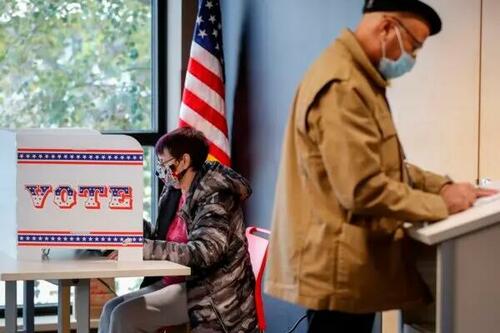
People cast their ballots on the first day of in-person early voting for the Nov. 3, 2020, elections in Milwaukee, Wis., on Oct. 20, 2020. (Kamil Krzaczynski/AFP via Getty Images)

Ruling Bolsters Election Security

Additionally, the plaintiffs claimed city officials had further violated state law by allowing absentee voting in the same physical building (City Hall) where the Office of the City Clerk is located and failed to have alternate site designations in effect for the requisite mandatory statutory time period.

The judge, however, rejected claims that in-person absentee ballot sites should be located as near as possible to the office of the municipal clerk or board of election commissioners, noting that the term “as near as practicable” encompasses “consideration beyond a pure geographic standard.”

“In fact, treating this legal term of art as purely distance-based would be an ‘erroneous concept of law,’” the judge wrote.

The Democratic National Committee, Wisconsin Alliance for Retired Americans, and Black Leaders Organizing for Communities had all joined in seeking to rebuke the claims in the lawsuit and defend the legality of the van, arguing there was no cause shown to believe the law had been broken and no specific prohibition against using it.

In a statement following the ruling, WILL deputy counsel, Lucas Vebber, said the ruling ensures government actors are held accountable to the rule of law at all levels.

“Wisconsin voters should know that their elections are secure, and that election administration does not favor one political party over another. This decision does just that,” he said.

WILL research director, Will Flanders, added, “Every citizen should have an equal opportunity to participate in the electoral process. We are grateful the Court recognized that the City of Racine broke the law. WILL is proud to provide sound research and to help ensure fair elections for all.

https://www.zerohedge.com/political/wisconsin-judge-rules-use-mobile-vans-absentee-voting-violates-state-election-law