Search This Blog

Wednesday, January 17, 2024

Biden Weighs Banning Natural Gas Exports to Save the Climate

 The climate fear mongers are pressuring Biden to ban natural gas exports. Let’s discuss the ramifications.

Climate Test for Natural Gas Exports

Politco notes Biden’s Aides Weigh Climate Test for Natural Gas Exports.

The Biden administration is launching a review that could tap the brakes on the booming U.S. natural gas export industry — a move that threatens to pit the president’s climate ambitions against his foreign policy agenda.

The review being led by the Department of Energy will examine whether regulators should take climate change into account when deciding whether a proposed gas export project meets the national interest, according to two people familiar with the action who were granted anonymity to discuss deliberations that have not yet been publicly acknowledged.

U.S. gas exports have jumped four-fold during the past decade as production has surged, turning the United States into the world’s largest natural gas exporter and helping Europe replace Russian shipments after Moscow’s invasion of Ukraine. But Biden also faces growing pressure from environmental groups to live up to his pledge to transition away from fossil fuels — something the U.S. also promised to do at last month’s climate summit in Dubai.

Roishetta Ozane, the founder of environmental group Vessel Project of Louisiana, welcomed the news that the Biden administration may be rethinking how it determines whether a proposed project is in the public interest. Ozane is among a group of green activists planning to protest next month at the Energy Department headquarters to pressure the administration to change how it evaluates export proposals.

We’re really hoping that DOE will pause any new permits for industry, because we know that the Biden administration really needs a climate win and in order for them to win” the 2024 election, said Ozane, whose hometown of Sulphur, La., is within an hour’s drive of three LNG plants. “If these politicians want to be elected or re-elected in this upcoming presidential election, they’re going to have to make some bold choices and some bold moves.”

Democrats have been asking the Biden administration for months to consider how shipping massive amounts of natural gas overseas affects greenhouse gas emissions. Sen. Jeff Merkley (D-Ore.) asked Granholm in a letter last year to review how DOE weighs whether a project is in the public interest.

Democratic Minnesota Sen. Tina Smith said it was a mistake to ignore the pollution produced by the LNG sector.

Climate Win For Biden?

“We know that the Biden administration really needs a climate win and in order for them to win.”

The public is more than a bit sick of the policies of this administration. Banning natural gas exports would hurt Biden’s elections chances.

Biden Threat

Natural Gas Math

91.2 million tons * 0.005367 MMBtu/ton * $10/MMBtu = $48.8 billion. If we look at oil exports (back of the napkin math) 3.99 million b/d (avg) * $80/barrel (avg 2023)* 365 days = $110.5 billion. That seems like a lot of revenue for a country $34T in debt to stifle…just saying.

But what is this really about?

Banning LNG exports would tend to lower prices.

My Guess

Biden will not want to give Trump another energy card.

Nor will he want to risk Pennsylvania.

Addendum

One of my readers noted a point I failed to mention: Russia will sell more natural gas as a result.

Bingo: Reducing exports does not change global demand. It will only shift the source of the supply.

https://mishtalk.com/economics/biden-weighs-banning-natural-gas-exports-to-save-the-climate/

Despite Tough Market, Some Life Science IPOs Find Success

 Just this week, Alto Neuroscience filed to go public—at least the fourth company this year—in yet another sign that the biotech IPO market is rebounding from 2023’s weak market. Among the positive signs are the success of those few companies that did make the leap to the public market in 2023.

“This year there’s a different energy, where people are really excited to meet each other and have conversations,” medical oncologist Jakob Dupont, an executive partner in private equity at Soffinova Investments, said of the sentiment at last week’s JP Morgan Healthcare Conference in San Francisco. “We’re also bolstered by all the mergers and acquisitions activity that we’re seeing with Big Pharma investing in the sector . . . and some of the recent IPOs that have been successful.”

He added that the Nasdaq Biotechnology Index was up from the previous 10 years going into the annual conference.

Norwest Venture Partners’ Brian Matesic, who focuses on venture capital in the healthcare sector, said those with highly differentiated products already in clinical trials performed particularly well. Other factors that helped companies go public last year, Dupont added, include exciting technology, de-risked clinical trial data and a clear path to FDA approval. 

And for the companies that did successfully go public during the recent tough market, Matesic said they might be better off for it.

“With the outlook for biotech IPOs looking more favorable in 2024, those companies that braved the challenging market last year will find themselves ahead of the potential influx,” he said.

Investor Support Critical for Going Public

One such company was CARGO Therapeutics, which announced its IPO bid in November. When CARGO CEO Gina Chapman joined the team in May 2022, the company employed 11 people. CARGO was in stealth mode, so she had to work quickly to create a compelling story for investors.

“I’ve done a lot of builds in my career—I built franchises—and we did not have a long time to launch and commercialize [CARGO], so getting the right team in place to do that was forefront on my mind,” Chapman, formerly of Genentech, told BioSpace. She noted that the market looked bleak—“it was looking like it was gonna get tougher before it got better”—but she heeded the advice of investors that “going public would enable me to have access to capital that I wouldn’t have in the private market.”

Critically, Chapman added, she was able to bank on the product the company was developing: CARGO plans to use around $220 million of the proceeds from the IPO to fund Phase II trials of its lead candidate CRG-022, an autologous CD22 CAR T cell therapy designed for patients whose large B-cell lymphoma (LBCL) is relapsed or refractory to CD19 CAR T cell therapies. “How could somebody not see this as a worthwhile thing to invest in? A potentially curative therapy, a proven regulatory path forward . . . and the data de-risked tremendously.”

Sure enough, she said, she was able to attract “very strong, high-quality, committed investors in the [Series] A.” It made it easier to go public, Chapman said, because she actually had investors that were not able to invest in CARGO's Series A round, so the company had continued demand.

CARGO sought more than $315 million and ultimately raised $281 million, with 18.8 million shares at $15 each.

“In a tough market, if you have that investors’ support and you have others who want to come in, you can do it," Chapman said.

From Going Public to Getting Purchased

Another standout from the small 2023 herd of biotech IPOs is RayzeBio, which in September announced its offering of 17.2 million shares for a total of $311 million. Four months later, the company was acquired by Bristol Myers Squibb for $4.1 billion.

“Filing an IPO is not the finish line. In some ways, it’s actually the starting line,” said Dupont, whose company Soffinova Investments was a major investor in RayzeBio and held a board seat. “The whole point of an IPO is to raise money so that [companies] can actualize their plans, maybe enroll that clinical trial, file for approval with the FDA . . . what we call use of proceeds.”

Getting acquired after the initial successful IPO was a “Cinderella story,” Dupont said. “It’s important for companies not only to think about what do they need to go public, but what do they need to be successful going forward after they’ve gone public, as well.”

One of the reasons for RayzeBio's success was its unique radiopharmaceutical technology, which hits a certain protein produced by a cancer cell with a radioisotope. There’s been a lot of interest in this and other types of next-generation protein therapeutics that deliver a toxic payload, such as antibody-drug conjugates, Dupont said.

https://www.biospace.com/article/despite-tough-market-some-life-science-ipos-find-success/

Roche Reports Phase III TIGIT Win at ASCO Gastro Cancer Meeting

 After a lackluster data leak in 2023, Roche’s Genentech is turning the tables with positive Phase III data for its anti-TIGIT immunotherapy. The subsidiary revealed study results Tuesday in an abstract at this week’s American Society of Clinical Oncology Gastrointestinal Cancers Symposium. 

In patients with esophageal squamous cell carcinoma (ESCC), tiragolumab improved progression free survival (PFS) and overall survival when combined with Tecentriq and chemotherapy versus chemo alone. SKYSCRAPER-08 enrolled 461 ESCC patients in Asian countries. Median survival in the treatment arm was 15.7 months, compared to 11.1 months in the control arm. PFS was 6.2 months versus 5.4 months in the anti-TIGIT arm compared to chemo and placebo. 

Another trial of the treatment did not show any benefit to PFS in patients with non-small cell lung cancer (NSCLC). Last year, after an accidental data drop, the company announced tiragolumab also failed to improve overall survival for locally advanced or metastatic NSCLC. SKYSCRAPER-08 is one of seven Phase III trials for tiragolumab. 

Roche’s first quarter 2023 earnings announcement caused some speculation on the checkpoint inhibitor for ESCC, with investors foreseeing another failure. The final data released Tuesday shows positive results but it’s not necessarily a slam dunk.  

While the endpoints of the trial were met, the trial’s comparator of chemo only is no longer considered the standard of care for ESCC. First-line treatments now include a PD-1 inhibitor like Merck’s Keytruda or BMS’ Opdivo. A checkpoint inhibitor was not included in Genentech’s control arm. 

The anti-TIGIT market has proved a tough egg to crack and Roche isn’t alone in facing challenges. 

In July 2023, Novartis axed its partnership with BeiGene, taking a loss on the $300 million dropped upfront for an anti-TIGIT in NSCLC. Merck’s Keytruda plus anti-TIGIT combo also failed in NSCLC last year. The company announced in December 2023 the treatment did not improve PFS or meet secondary endpoints for overall survival or overall response. 

Partners Gilead and Arcus are among the few touting positive results in the competitive space. In November 2023, the two shared Gilead’s Fc-silent anti-TIGIT antibody domvanalimab plus Arcus’s anti-PD-1 asset zimberelimab and chemotherapy had an “encouraging” overall response rate and a six-month PFS rate in a Phase II trial. The data supports an ongoing Phase III study of the combination, which is also being investigated in lung cancer.  

Despite setbacks, the anti-TIGIT market is expected to expand with Roche considered one of its leading players. As of September 2023, more than 40 anti-TIGIT antibodies are in clinical trials. 

https://www.biospace.com/article/roche-reports-phase-iii-tigit-win-at-asco-gastro-cancer-meeting-/

GSK Raises $1.24B by Selling Stake in Consumer Health Spin-Off Haleon

 GSK has sold around 300 million shares in its spin-off consumer healthcare business Haleon, raising $1.24 billion, Reuters reported Wednesday.

The sale marks the third time in less than a year that the British pharma let go of some of its stake in Haleon, according to Reuters. In October 2023, Bloomberg reported that GSK sold $1.1 billion worth of its stake in Haleon, which followed an earlier sale, made in May 2023, earning the British pharma $1 billion.

After its most recent sale, GSK will now only hold a 4.2% stake in Haleon, down from its initial 12.9% stake, according to Reuters.

In December 2018, GSK and Pfizer joined hands and decided to create a joint global consumer healthcare company. The agreement would eventually result in the creation of Haleon. At the time, the companies agreed that Pfizer would own less than half of the joint venture—it settled on a 32% equity stake—but that it would be able to appoint three of the nine members of the new company’s board of directors.

GSK, meanwhile, would own more than two-thirds of the venture.

The partners closed the deal in July 2019, creating the “world’s largest over-the-counter business,” according to an announcement at the time. The combined venture would market some of the world’s top-selling drugs in pain relief and respiratory health, along with vitamins, minerals and supplements.

In June 2021, GSK CEO announced  that the company was looking at a demerger in which it would spin out the consumer healthcare business as its own entity, after which the British drugmaker would be focused on vaccines and specialty medicines in the fields of HIV, oncology, infectious diseases and immunology.

In February 2022, GSK formally named the new consumer health venture as Haleon, which launched as its own company and was listed on the London Stock Exchange in July 2022. In June 2022, amid GSK’s demerger, Pfizer announced that it would also sell off all of its stake in Haleon once the spin-out was completed.

As GSK pulls away from Haleon, it continues to expand its specialty medicines portfolio through a string of high-value deals. Last week, it announced a $1.4 billion deal to buy Aiolos Bio and its pipeline of respiratory and inflammatory assets. In December 2023, GSK put $1.7 billion on the line in an exclusive licensing agreement for Hansoh Pharma’s B7-H3-targeted antibody-drug conjugate, being developed for small and non-small cell lung cancer and sarcoma.

https://www.biospace.com/article/gsk-raises-1-24b-by-selling-3-2-percent-stake-in-consumer-healthcare-spin-off-haleon/

CDC Drafted Alert For Myocarditis And COVID-19 Vaccines, But Never Sent It

 by Zachary Stieber via The Epoch Times,

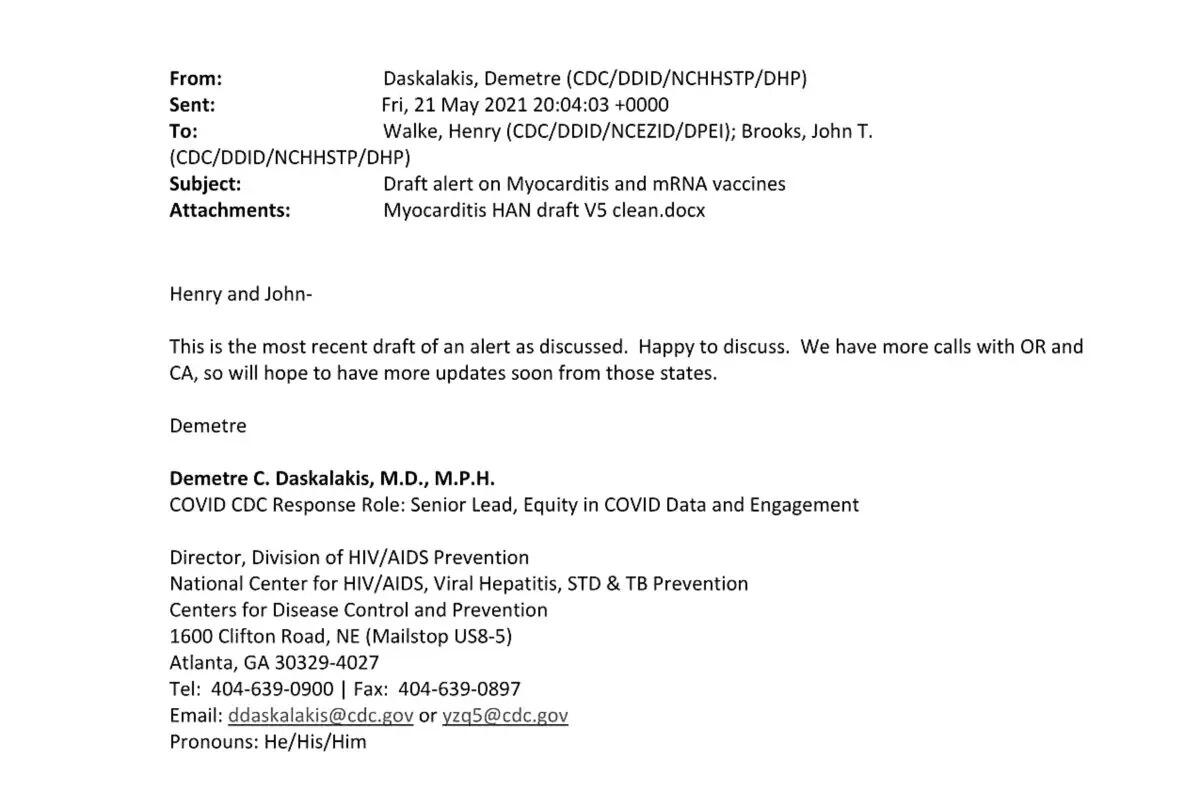
The U.S. Centers for Disease Control and Prevention (CDC) prepared to alert state and local officials to an emerging connection between heart inflammation and COVID-19 vaccines, but ultimately did not send the alert, according to a new document obtained by The Epoch Times.

Dr. Demetre Daskalakis of the U.S. Centers for Disease Control and Prevention (CDC) in Washington in a file photograph. (Kevin Dietsch/Getty Images)

All four COVID-19 vaccines that are or have been available in the United States can cause the heart inflammation, or myocarditis, according to studies, experts, and agencies like the CDC. The first cases were reported shortly after the vaccines became available in late 2020.

The CDC sends alerts to federal, state, and local public health officials and doctors across the nation through a system called the Health Alert Network (HAN). Messaging through the system conveys “vital health information,” according to the CDC.

In May 2021, CDC officials drafted an alert on myocarditis and the two most widely used COVID-19 shots, according to the newly obtained document, which is being made public for the first time by The Epoch Times.

“This is the most recent draft of an alert as discussed. Happy to discuss,” Dr. Demetre Daskalakis, the CDC’s top official for equity in COVID-19 data and engagement, told two other high-ranking CDC colleagues in the email.

The CDC drafted an alert on COVID-19 vaccines but never sent it, this email shows. (CDC via The Epoch Times)

It was titled “draft alert on myocarditis and mRNA vaccines.”

The Pfizer-BioNTech and Moderna vaccines are made with modified messenger RNA (mRNA) technology.

The draft alert was attached to the email. The Epoch Times is working to acquire the draft alert.

“This censorship of a proposed alert in May of 2021 is just one more example of our regulatory agencies’ repeated pattern of behavior to censor any information that serves to counter the narrative that the COVID-19 vaccinations are ’safe and effective,'” Dr. Joel Wallskog, co-chair of the vaccine-injured advocacy group React19, told The Epoch Times via email.

The CDC started receiving reports of post-vaccination myocarditis in January 2021 and either failed to detect or ignored a safety signal for myocarditis and the mRNA shots the following month, previous reporting from the Epoch Times showed. The agency also hid a warning from Israel, the country that first vaccinated young people, who face the highest risk of myocarditis from

The CDC and other agencies have also repeatedly not disclosed other information that undermines their promotion of the vaccines, including how many COVID-19 cases there were among the vaccinated.

The newly disclosed email is dated May 21, 2021. That’s three days before a CDC workgroup acknowledged for the first time that the number of reported myocarditis cases after COVID-19 vaccination was higher than expected, and a week before the CDC said it was still recommending that virtually all Americans 12 years and up receive a vaccine.

Dr. Daskalakis and his two colleagues, Drs. Henry Walke and John Brooks, responded to requests for comment through a spokesperson.

“CDC uses a variety of ways to inform the public of potential vaccine safety concerns. A HAN is one method,” the spokesperson said.

The agency ultimately chose to issue in May 2021 a document called “clinical considerations,” which stated that there was an increased number of reported myocarditis cases after mRNA vaccination but emphasized the CDC was still recommending vaccination for virtually all people above age 11.

The CDC’s media office declined to outline how the CDC made sure the same people who would have received a HAN saw the document.

“The clinical consideration reached the provider audience as the HAN would have,” a spokesperson alleged.

“A clinical consideration is useful when information needs to be updated as circumstances evolve, and more data is collected and evaluated.”

Double Standard?

The Health Alert Network has been sending messages since at least 2001, according to an archive of the alerts. The CDC says the network is the agency’s “primary method of sharing cleared information about urgent public health incidents with public information officers; federal, state, territorial, and local public health practitioners; clinicians; and public health laboratories.”

The CDC issued an alert on Jan. 8, 2020, for what became known as COVID-19, providing several updates in the subsequent months on the illness. The agency also shared alerts on testing for COVID-19, travel on cruise ships, and a rare disease called MIS-C linked to COVID-19.

The first alert related to COVID-19 vaccines was issued on April 13, 2021. It was for a combination of blood clotting and low platelet levels after Johnson & Johnson vaccination.

The message noted six cases of the combination of conditions, cerebral venous sinus thrombosis with thrombocytopenia (TTS), had occurred in women after receipt of the shot and that one had died. Authorities advised doctors and officials to stop administering the vaccine while a safety review was conducted.

One month later, the CDC officials considered the alert for COVID-19 vaccines and myocarditis. By that time, hundreds of cases had been reported in Israel, the United States, and other countries, including two deaths in Israel and other deaths in the United States.

“That’s a double standard,” Dr. Tracy Hoeg, an epidemiologist based in California who was one of the first U.S. experts to challenge the CDC narrative on post-vaccination myocarditis, told The Epoch Times.

“Why would they issue one for the J&J vaccine for the blood clots but not for myocarditis post-mRNA vaccination? We had data from our own Department of Defense at this time indicating it was a real safety signal and two fatal post-Pfizer vaccination myocarditis cases had already been reported in Israel.”

Dr. Hoeg said CDC officials involved in the draft should testify.

“I think it’s going to be crucial to figure out who decided that the alert shouldn’t be sent after all, after they had already apparently written it,” Dr. Hoeg said.

“It would be nice to have one of the people included on the email testify before Congress about how it was determined the alert about post-RNA vaccination myocarditis should not be released.”

The U.S. House of Representatives Select Subcommittee on the Coronavirus Pandemic, which is investigating the U.S. response to the pandemic, declined to comment.

The CDC later sent alert multiple alerts encouraging COVID-19 vaccination. None mentioned myocarditis.

https://www.zerohedge.com/covid-19/cdc-drafted-alert-myocarditis-and-covid-19-vaccines-never-sent-it

Watch: EU President Demands Globalist Control Over All Information

 by Steve Watson via Modernity.news,

President of the European Commission, Ursula von der Leyen addressed elites at the World Economic Forum in Davos Tuesday, calling for overarching globalist control over the flow of all information in the digital age.

The top concern for the next two years is not conflict, or climate, it is disinformation and misinformation,” von der Leyen proclaimed, adding “The boundary between online and offline is getting thinner and thinner, and this is even more important in the era of generative AI.”

Addressing the elite as “Excellencies,” and personally naming “dear” Klaus Schwabb in her introduction, von der Leyen further called for the development of “a new global framework for AI risks,” and a vow to “drive global collaboration” to prevent the spread of ‘misinformation’ (information they don’t want you to know about).

She continued, “Many of the solutions lie not only in countries working together but, crucially, on businesses and governments, businesses and democracies working together,” adding that “While governments hold many of the levers to deal with the great challenges of our time, business have [sic] the innovation, the technology, the talents to deliver the solutions we need to fight threats like climate change or industrial-scale disinformation.”

Furthermore, von der Leyen said 2024 is “the biggest electoral year in history”, and expressed concern that “freedom comes with risks.”

“There will always be those who try to exploit our openness, both from inside and out. There will always be attempts to put us off track. For example, with disinformation and misinformation,” she added.

She also touted the EU Digital Services Act, which under the guise of preventing ‘hate speech’, establishes controls over all information on social media platforms.

“With our Digital Services Act, we defined the responsibility of large internet platforms on the content they promote and propagate,” von der Leyen bragged.

She concluded “there is no doubt that we face the greatest risk to the global order in the post-war era. But in my mind, there is also no doubt that we can move forward with optimism and resolve.”

There can be no doubt that the number one target of these unelected technocrats is Elon Musk and X, given that they already have every other major platform in their pockets.

At last year’s WEF confab, VÄ›ra Jourová, who holds the incredibly Orwellian title of The European Commission’s Vice-President for Values and Transparency, commented that  Musk’s “freedom of speech absolutism,” doesn’t jive with new EU online regulations.

“Our message was clear: we have rules which have to be complied with, otherwise there will be sanctions,” Jourová declared, adding “The time of the Wild West is over,” and further having the gall to declare “we are the protectors of freedom of speech as well.”

This year at Davos, Jourová has been meeting with the heads of Meta and YouTube among others to make sure they “play by the rules”:

https://www.zerohedge.com/geopolitical/watch-eu-president-demands-globalist-control-over-all-information