Search This Blog

Sunday, February 4, 2024

'Moody's: Why Medicare Advantage's profitability may be on the decline'

 Medicare Advantage (MA) continues to grow, but there are signs that its profitability is on the decline, according to a new report from Moody's Investors Service.

The analysis found that margins declined from 4.9% in 2019 to 3.4% in 2022. Margins also fell in the commercial risk-based sector, but by a smaller amount, and they grew in Medicaid during that window, according to the report.

These data are based on reports from 10 payers rated by Moody's, which encompass two-thirds of all MA enrollees.

Dean Ungar, vice president at Moody's and one of the report's authors, told Fierce Healthcare that MA has continued to balloon given the sheer volume of people reaching Medicare eligibility, but translating higher membership to profitability has proven a challenge, especially given the difficulty of breaking into the market in the first place.

"You've got this great opportunity where you have this great cohort of people, where you can earn a lot of money on the theoretical use, but you need to be able to make it profitable," he said. "And I think that's what we've seen is not really the case. Almost all the profits are in the big companies."

UnitedHealthcare, Humana and Aetna are the largest players in the MA space, and, while the market has attracted interest from disrupters, competing with those large players at scale has been a major hurdle, according to the report.

"Although not immune to the weakening performance, the three market leaders have been able to grow earnings and generally maintain their margins," the analysts wrote. "We attribute this to the importance of scale to cover things such as customer acquisition costs, achieve appropriate pricing and maintain a stable benefits package."

In addition, smaller players or newer entrants may not be as nimble in adapting to value-based care models, according to the report. The analysts estimate that the biggest three companies "accounted for virtually all the earnings reported above in 2022."

Ungar said that beyond value-based care and their larger size, the major insurers have greater know-how around crafting provider networks and are far more familiar with common utilization management models than the upstarts.

These new entrants are coming to the table with good ideas—focusing on greater digital engagement, for example—but are struggling with the fundamentals, he said.

"It needs to be accompanied by the same level of knowledge about how to run the business. The nuts and bolts have to be there," Ungar said. "So if you get in and you're not really good on the other parts, you're gonna get hurt."

Even for the biggest players, though, there are pressures set to squeeze the MA space in the near term, according to the report. Both UnitedHealth and Humana were hit with a spike in utilization in the latter half of the year that is set to be a likely headwind through 2024.

CVS Health, the parent company of Aetna, has not yet reported its fourth-quarter results and will do so next week, so it remains to be seen how an increase in utilization has impacted them.

The Moody's analysts attribute the spike in part to a combination of pent-up demand due to COVID-19, and then a "log jam" in scheduling thanks to provider staffing issues. However, while several key factors are involved, there isn't a consensus on the ultimate cause, according to the report.

Beyond concerns around utilization, the program also faces funding issues as the Medicare Trust Fund remains at risk of running out, and changes to risk adjustment audits will likely lead to lower payments.

Those risk adjustment changes will be phased in over the next three years, and UnitedHealthcare, for example, made adjustments to benefits and pricing to account for that decline in payouts. That can, instead, lead to lower-than-expected membership growth as products are less attractive, Ungar said.

"You might have put yourself at somewhat of a disadvantage upfront," he said.

https://www.fiercehealthcare.com/payers/moodys-why-medicare-advantages-profitability-may-be-decline

Payers up against slight decline in 2025 Medicare Advantage payments

 Medicare Advantage (MA) payments are set to decrease yet again in 2025 as the feds phase in significant changes to risk adjustment.

As those overhauls begin to take effect, benchmark payments are set to decline by about 0.2% on average, according to the latest advance notice released by the Centers for Medicare & Medicaid Services (CMS).

Despite this, the feds said Wednesday that payments to MA plans are expected to increase by 3.7% in 2025, a $16 billion increase over 2024. The payment rate announced today could change by the time the final rate announcement is published, no later than April 1.

When asked if health plans will upcode members so much that such an increase is needed, Meena Seshamani, M.D., Ph.D., deputy CMS administrator and director of the Center for Medicare, said during a news briefing the agency is following guidance and analysis conducted by its actuaries based on past risk score trends.

CMS said it expects premiums and benefits to remain stable should the payment rate be established. It also wants to continue the phased-in approach of the Part C risk adjustment model by blending 67% of the risk score using the new model and 33% calculated with the old model.

The coding intensity adjustment will stay at the statutory minimum of 5.9%, with CMS opting against raising the rate.

Addressing concerns that the risk adjustment model changes could hurt dually eligible enrollees, special needs plans (SNPs) enrollees and vulnerable populations, CMS decided the new model is "necessary and appropriate and increases predictive accuracy … for these individuals." The agency found that these individuals' risk scores are 4.33 percentage points higher than for non-dually eligible individuals.

"On average, this growth in MA risk scores will more than offset the impact of the new risk adjustment model and normalization for dually eligible individuals," CMS said.

Seshamani said the agency is confident in its recent regulatory policies, based on data from the first year implementing the updated model.

"These data from 2024 clearly showed, despite strong industry pushback to the contrary, as expected, the MA market remained stable for beneficiaries in 2024, including stable premiums, increased choice and increased rebate dollars, which are used for supplemental benefits," said Seshamani. She explained the updated risk adjustment model benefited, not hurt, individuals on SNPs, noting there was an increase in supplemental benefits and SNP plans project enrollment to grow 13% this year, outpacing MA and traditional Medicare growth levels.

"This indicates MA remains a strong and stable market for eligible beneficiaries," she added.

While the MA programs continues to grow as more individuals become eligible for the program, insurers are finding the segment to be less profitable than before. Additionally, both UnitedHealthcare and Humana reported increased utilization levels in recent earnings calls, while Cigna sold its MA and Part D business to Health Care Service Corporation in a $3.7 billion deal, finally separating itself from a business it wanted to sell for several months.

Part D benefits could also change for 2025 because of amendments from the Inflation Reduction Act that increases plan liability. Updates, which fall under the CY 2025 Part D Redesign Program released by CMS today, include lowering the out-of-pocket cap to $2,000 and removing cost sharing for certain adult vaccines and enrollees that fall within a catastrophic range as well as limiting cost sharing for insulin products. The new regulations also implement the Manufacturer Discount Program and sunsets the Coverage Gap Discount Program, as the agency explained last fall.

"The purpose of the document is to provide interested parties with draft guidance for 2025 on changes that affect the structure of the defined standard Part D drug benefit," Seshamani said. "The changes outlined in this guidance will provide needed financial relief to millions of Medicare beneficiaries."

The public comment period will be open for the Part D Redesign Program and Advance Notice through March 1.

Last year, CMS initially proposed to increase MA and Part D plan payments by 1.03% for 2024, when factoring in its MA risk score trend statistic. The agency estimated a 3.12% decline in payments after accounting for changes to the risk adjustment model, such as transitioning to the ICD-10 diagnosis classification system. That coincided with a 1.24% decline in payments based on 2023 star ratings.

But CMS ultimately decided to raise MA payments by 3.32% after insurers heaped pressure on policymakers warning the 1.03% payments would cause them to cut plans. Insurers said CMS wasn't accounting for changes to the risk adjustment model or star ratings effectively. CMS also decided to phase risk adjustment model changes in over three years instead of transitioning entirely in 2024.

During last year's fight over plan payments, insurers said the policy would hurt their bottom line and the beneficiaries they serve, but advocacy groups and the Biden administration framed the issue as reining in overpayments to MA plans by preventing unnecessary overcoding that burdens the system.

At a recent MedPAC meeting, staff revealed data showing overpayments by the federal government are projected to cost it $88 billion more than it would be if those individuals were in fee-for-service Medicare, the largest disparity to date.

Debate has amplified in recent months as policymakers and expert determine what reform is needed to improve upon the weaknesses of MA.

Proponents of MA plans draw from bipartisan support. They say the plans are popular and can offer robust benefits, a cap on out-of-pocket expenses and savings on premiums and cost-sharing for a diverse population of beneficiaries, though they often concede the plan is flawed and could use serious reform.

Last week, 61 senators signed a letter to CMS (PDF) asking the agency to "ensure payment and policy stability for the MA program."

Critics say MA plans can effectively trap individuals in plans that have limited provider networks as well as put them at mercy of a convoluted prior authorization process. CMS finalized a rule earlier this month hoping to crack down on patient wait times, though some advocacy groups say even those new limitations won't go far enough.

CMS urges policy watchers to look at regulatory announcements in the context of other recent actions, including its work to stop predatory MA marketing practices, promote behavioral care, foster health equity initiatives and improve transparency.

https://www.fiercehealthcare.com/payers/cms-proposes-37-pay-rate-increase-ma-plans-redesigning-part-d-program

Hospital-backed proposal would make insurers reveal prior auth denial rates

 A recommendation on the 2024 Measures Under Consideration list, brought forward by the Federation of American Hospitals (FAH), would add a quality measure in the Medicare Advantage (MA) star ratings system that mandates health plans to report certain prior authorization denial rates.

The Measures Under Consideration list gives feedback to the Centers for Medicare & Medicaid Services (CMS) on quality and efficiency measures the agency should consider and implement for government health programs. Released today, the list comment period is open through Feb. 16.

FAH is asking CMS to include a performance measure within the star ratings program of the percentage of initial MA plan denials that are upheld, overturned and partially overturned.

Their policy, titled Level 1 Upheld Denial Rate, is intended to add a layer of transparency that is required by insurers. FAH's intention is to financially discourage health plans from abusing the prior authorization system and promote getting the coverage decision correct the first time.

The vote was approved 13-1, with another vote to recommend with conditions. The committee determined the policy could reduce burden and improve transparency, reduce patient stress and complement similar Level 2 measures that are in the MA star ratings program.

“Medicare Advantage plan members need to know the extent to which plans are denying or delaying care due to prior authorization abuse," said FAH President and CEO Chip Kahn in a statement shared with Fierce Healthcare. "FAH developed this important performance measure to shed light on Medicare Advantage plans’ practices that are baselessly denying or delaying care seniors need. We hope CMS will hold managed care companies accountable and increase transparency by including this measure in the next round of rulemaking.”

A MedPAC analysis found that MA plans overturned initial denials 80% of the time in 2021, reported KFF. A 2022 Office of Inspector General report showed 13% of denials would have been covered by traditional Medicare.

Yet FAH argues arbitrary denials face no consequence, and there is no reporting or measurement of initial delay or denial of care, naturally leading insurers to slow-walk decisions.

The MA star ratings program judges health plans on a scale of one star to five based on a series of criteria evaluating performance and care outcomes. This annual score is important, because plans that do poorly receive smaller monetary payouts from CMS and operate within a restricted marketing timeline.

Prior authorization has drawn the ire of policymakers, advocacy groups, providers and patients in recent months. They say prior authorization practices are restrictive and operate against the best interest of patients, going beyond standard cost-cutting measures. Patients can often wait a long time to be approved or denied coverage, and the appeals process is confusing for many individuals.

In January, a rule was finalized that requires health plans to send prior authorization decisions within three days for urgent requests and seven days for standard requests starting in 2026. Although an improvement over current policy, some groups feel that doesn't go far enough. In the case of the American Medical Group Association (AMGA), it says standard requests should take 48 hours and urgent requests just 24 hours.

“These timelines need to be much shorter,” said Jerry Penso, M.D., AMGA president and CEO, in a news release. “There is nothing expedited about three days. Slow-moving prior authorization decisions leave patients in limbo and create a cascading effect of backlogs in the system.”

Meanwhile, MA plans are heavily marketed to seniors on the promise they will receive robust benefits and comprehensive coverage, but MA networks are often more limited for beneficiaries than in traditional Medicare.

The FAH proposal is one of 42 recommendations presented to and voted on by the Partnership for Quality Measurement in pre-rulemaking measure review.

https://www.fiercehealthcare.com/payers/hospital-backed-proposal-would-make-insurers-reveal-denial-rates

Senate 'Deal' Allows 1.5 M Illegals/Year, Slides Up To $2.3B To NGOs Trafficking Them, Gives $60B To Ukraine

 While the House has gone full 'Israel or Bust', the Senate has come up with a $118 billion bipartisan agreement which would allow 1.5 million illegals to enter the US every year, allocates $2.3 billion towards NGOs and other organizations which traffic them, gives $14.1 billion in security assistance to Israel, and a whopping $60 billion in support to Ukraine.

The bill also locks in green card giveaways until 2030.


The agreement was reached by Sens. James Lankford (R-OK), whose own state legislature censured him last week for striking such a crappy border deal, along with Chris Murphy (D-CT) and Kyrsten Sinema (I-AZ).

Let's pause to revisit the fact that President Biden could close the border with the stroke of a pen, right now, but refuses to do so until Ukraine and Israel money materializes. He really likes quid-pro-quo arrangements, you see.

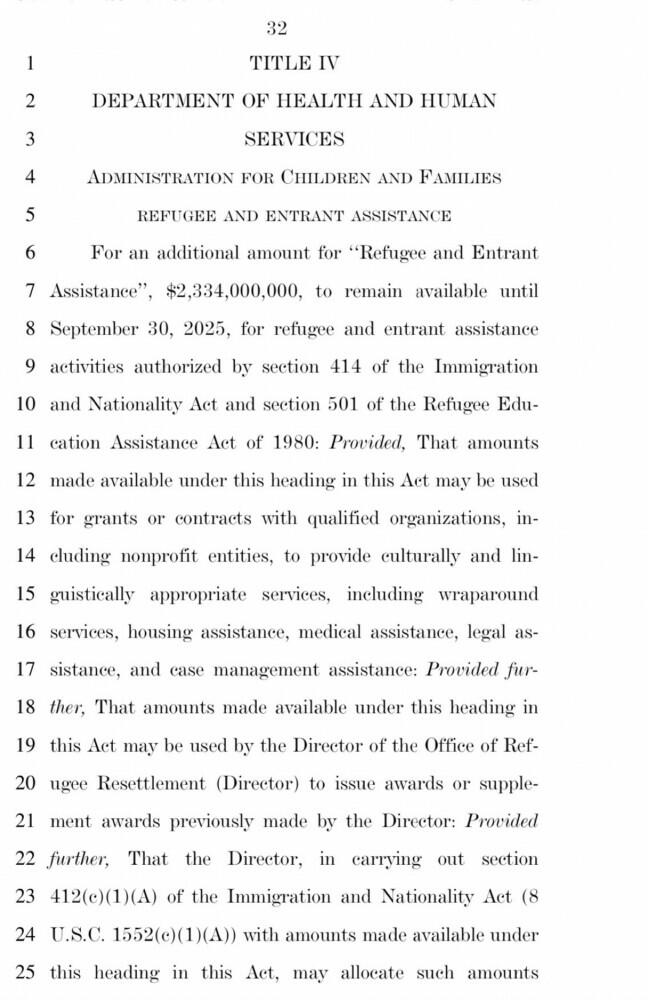
As noted above, the bill also carves out $2.33 billion for "Refugee and Entrant Assistance," which provides that "Amounts made available under this heading in this Act may be used for grants or contracts with qualified organizations, including nonprofit entities, to provide culturally and linguistically appropriate services."

Breaking it down further, the $118.28 billion national security supplemental package includes:

  • $60.06 billion to support Ukraine as it fights back against Putin's bloody invasion and protects its people and sovereignty.
  • $14.1 billion in security assistance for Israel.
  • $2.44 billion to support operations in the U.S. Central Command and address combat expenditures related to conflict in the Red Sea.
  • $10 billion in humanitarian assistance to provide food, water, shelter, medical care, and other essential services to civilians in Gaza and the West Bank, Ukraine, and other populations caught in conflict zones across the globe.
  • $4.83 billion to support key regional partners in the Indo-Pacific and deter aggression by the Chinese government.
  • $2.33 billion to continue support for Ukrainians displaced by Putin's war of aggression and other refugees fleeing persecution.
  • The bipartisan border policy changes negotiated by Senators Chris Murphy (D-CT), Kyrsten Sinema (I-AZ), and James Lankford (R-OK).
  • $20.23 billion to address existing operational needs and expand capabilities at our nation's borders, resource the new border policies included in the package, and help stop the flow of fentanyl and other narcotics.
  • The Fentanyl Eradication and Narcotics Deterrence (FEND) Off Fentanyl Act.
  • $400 million for the Nonprofit Security Grant Program to help nonprofits and places of worship make security enhancements.

"The Senate’s bipartisan agreement is a monumental step towards strengthening America’s national security abroad and along our borders," said Sen. Majority Leader Chuck Schumer (D-NY) of the deal. "This is one of the most necessary and important pieces of legislation Congress has put forward in years to ensure America’s future prosperity and security."

Over in the Senate, Rep. Dan Bishop (R-NC) said he's a "hard NO on any bill legitimizing illegal immigration."

How nice for all involved, except US taxpayers.


Powell Tells 60 Minutes Fed "Not Likely" To Cut In March

 In his highly anticipated 60-Minutes interview, Jerome Powell did not deliver any new shocks, and unlike the Fed's dovish December pivot, there were no major surprises: instead, the Fed Chair echoed what he said last week, predicting that the Fed policymakers will likely wait after March to cut interest rates as he sought to explain the central bank’s rationale for eventual reductions to a broad public audience (amid mounting pressure by Democrats to cut aggressively ahead of December even as the Biden Dept of Labor fabricated jobs data to make it seem like the US is enjoying a golden ago for workers).

In an interview conducted on Thursday with CBS’s 60 Minutes and airing Sunday evening, Powell reiterated that Fed officials want to see more economic data to assure that inflation is on a sustainable path to their 2% goal.

"The danger of moving too soon is that the job’s not quite done, and that the really good readings we’ve had for the last six months somehow turn out not to be a true indicator of where inflation’s heading,” Powell said in the interview adding that while “we don’t think that’s the case... the prudent thing to do is to, is to just give it some time and see that the data continue to confirm that inflation is moving down to 2% in a sustainable way.”

Powell then said it isn’t likely that the Fed “will reach that level of confidence” about inflation’s path by its March 19-20 gathering, echoing remarks he made at a press conference Wednesday, and certainly not after the latest laughably ridiculous and political manipulated jobs number. He clarified that while most FOMC members are now dovish and expect rate cuts, that's certainly not the case for all, to wit: “all but a couple of our participants do believe it will be appropriate to, for us to begin to dial back the restrictive stance by cutting rates this year,” Powell said. “And so, it is certainly the base case that, that we will do that. We’re just trying to pick the right time, given the overall context.” Here is the full exchange:

PELLEY: The next meeting around this table that will decide the direction of interest rates is in this coming March. Knowing what you know now, is a rate cut more likely or less likely at that time?

POWELL: So, the broader situation is that the economy is strong, the labor market is strong, and inflation is coming down. And my colleagues and I are trying to pick the right point at which to begin to dial back our restrictive policy stance. That time is coming. We've said that we want to be more confident that inflation is moving down to 2%. And I would say, and I did say yesterday, that I think it's not likely that this committee will reach that level of confidence in time for the March meeting, which is in seven weeks.

So, I would say that's not the most likely or base case. However, all but a couple of our participants do believe it will be appropriate to, for us to begin to dial back the restrictive stance by cutting rates this year. And so, it is certainly the base case that, that we will do that. We're just trying to pick the right time, given the overall context.

While inflation has subsided substantially in recent months, Powell has repeatedly emphasized the central bank’s need to see more data before lowering borrowing costs. He indicated last week a rate cut is unlikely in the first quarter.

The central banker also said he didn’t expect policymakers to “dramatically” change their forecasts for rates next year, which in December showed they expect their benchmark lending rate to reach 4.6% by the end of 2024, suggesting three rate cuts remains the baseline.

PELLEY: This past December in your quarterly report, the Fed predicted rate cuts this year down to about 4.6%. Still likely?

POWELL: Those forecasts were made in December. And those are individual forecasts made by participants. It's not a committee plan. We don't update those at every meeting. We'll update them at the March meeting. I will say, though, nothing has happened in the meantime that would lead me to think that people would dramatically change their forecasts.

PELLEY: So something around a 4.6% interest rate is likely?

POWELL: I would say it this way. It's really going to depend on the data. The data will drive these decisions. And we can't do any better than to look at the data and ask ourselves, "How is this affecting the outlook and the balance of risks?" That's what we'll be doing. So, what we actually do will depend on how the economy evolves.

Curiously, while there was a Bloomberg headline that...

  • CBS REPORTER SAYS POWELL SUGGESTED THE FIRST CUT AROUND MIDYEAR

The actual transcript did not show Powell commenting on a midyear cut.

  • *CBS TRANSCRIPT DOESN’T SHOW POWELL COMMENT ON MIDYEAR CUT

While Powell is unlikely to confirm something he may have said in conversation off camera, the notion of delayed rate cuts certainly affirms the narrative after Friday's "very strong" (ridiculously so) US jobs report.

The timing of this year’s policy pivot poses unique challenges for the Fed as rapid price increases have angered Americans, weighed on President Joe Biden’s approval ratings and thrust Powell and the Fed into election-year politics. Cutting rates this year will subject the Fed to Republican accusations that the central bank is trying give Democrats a boost by aiding the economy ahead of the election. And, sure enough, Democrats such as Senators Sherrod Brown and Elizabeth Warrren sent letters last week urging Powell to lower interest rates.

And former President Donald Trump told Fox Business Network on Friday that he wouldn’t reappoint Powell, even though he chose him to lead the central bank in 2017.

And so, touching on a topic we discussed extensively after the Fed's shocking dovish pivot in December, namely how much water the Fed is now carrying for the Biden admin, Powell naturally denied the Nov election had anything to do with the Fed's dramatic U-turn on rate cuts.

PELLEY: Your decisions inevitably are going to have a bearing on this year's election. And I wonder, to what degree does politics determine your timing?

POWELL: We do not consider politics in our decisions. We never do. And we never will. And I think the record -- fortunately, the historical record really backs that up. People have gone back and looked. This is my fourth presidential election in the Fed, and it just doesn't come into our thinking, and I'll tell you why.

Two reasons. One, we are a non-political organization that serves all Americans. It would be wrong for us to start taking politics into account. Secondly, though, it's not easy to get the economics of this right in the first place. These are complicated, you know, risk-balancing decisions. If we tried to incorporate a whole 'nother set of factors in politics into those decisions, it could only lead to worse economic outcomes. So, we simply don't do that, and we're not going to do it. We haven't done it in the past, and we're not going to do it now.

And then there was this epic lie:

PELLEY: There are people watching this interview who are skeptical about that.

POWELL: You know, I would just say this. Integrity is priceless. And at the end, that's all you have. And we in, we plan on keeping ours.

You know what else is priceless, Jerome? Former Fed President Bill Dudley writing an op-ed in August 2019 urging the Fed to crush the economy and destroy Trump's re-election chances. You'll never guess what happened to the economy just a few months later...  But yeah, you go ahead and enjoy your "priceless integrity."

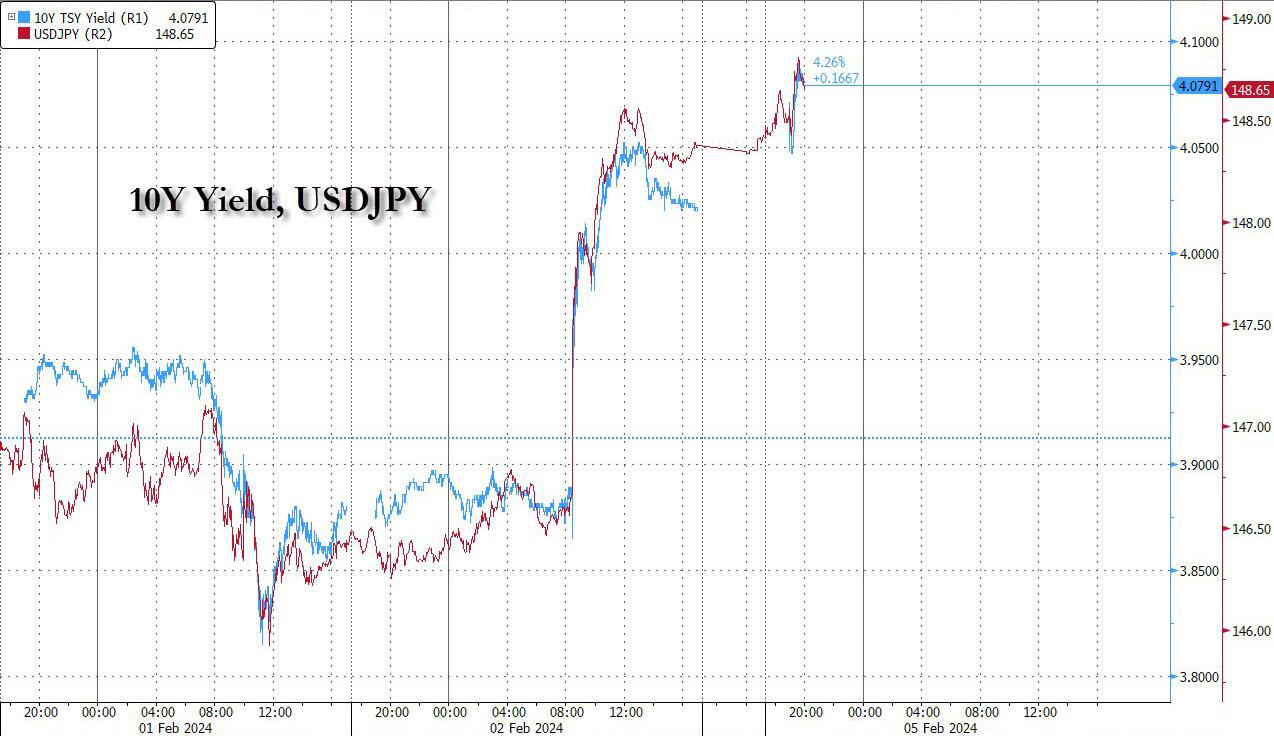
As for the market reaction, while Powell did not say anything he didn't already bring up in last week's FOMC meeting, the fact that the Fed chair pushed back on March sent Treasury futures lower as investors interpret the Fed chair's words as ruling out a Fed interest rate cut before June. And after jumping on Friday after the "blowout" jobs report, the USDJPY - which has been tied to the 10Y yield's hip - also pushed higher leading a broad dollar bid in early Asian trading Monday.

Here is the full transcript from Powell's 60 Minutes interview.

Haley further alienates Republicans with a cringy SNL performance

 By Andrea Widburg

One of Nikki Haley’s biggest funders is Reid Hoffman, an ardent Democrat. In New Hampshire, only 30% of her votes came from Republicans. The Republican base dislikes her, so she’s trying to win the Republican nomination by appealing to Democrats. Nothing could more clearly show that than her cringy appearance on yesterday’s Saturday Night Live.

The premise is that Nikki Haley, a “concerned” South Carolina voter, appears at a CNN Trump town hall, asking why Trump won’t debate Nikki Haley:

Regarding the video itself, there are a few comments:

One: It’s viciously anti-Trump

Two: The leftist audience is thrilled by Nikki Haley

Three: The shtick in which Haley participated plays the woman card, which is one of the most noxious things about Nikki.

Four: Nikki subtly endorses the E. Jean Carroll verdict.

Five: It’s not funny. There’s no wit or cleverness, and there are no surprises. All that the woke sketch writers could crank out was Trump bashing and Nikki worship. This isn’t humor; this is state-sponsored comedy attempting to move an election to the state’s preferred candidate.

It’s clear to see where Nikki is going with her Democrat-funded, Democrat-supported campaign: Thanks to the pernicious open primaries in effect in almost half of America, her plan is to win the Republican nomination not by appealing to conservatives but by getting Democrats to vote for her. She then assumes that those same people will vote for her in the general election, elevating her to the presidency.

What Nikki doesn’t know—but the Democrats supporting her do know—is that in the general election, if the choice is between a Democrat and a squish Republican, the Democrat will win. The Democrats who supported her in the primaries were just gaming the system, so they’ll vote for Biden (or Harris or Michelle or Gavin Newsom).

Just as importantly, conservatives will stay home. Sure, they’ll mean to vote or mail in their ballots because “anything is better than Biden.” But then they’ll look at a woman who is a warmonger and a cultural panderer, and, consciously or subconsciously, they’ll think, “Why bother?” The effect will be that their votes go uncast. In a divided nation, you don’t win by standing for nothing.

Nikki Haley’s tweet about her SNL appearance implies that Trump and Biden are cut from the same cloth: They’re both retreads of the past who bring nothing to the presidential race. In fact, though, it would be a Nikki versus Biden race that would truly make it a choice between two people cut from the same cloth: Both Biden and Nikki want the presidency and will do anything, including abandoning any principles they may once have espoused or still purport to support, in their pursuit of that Gold Ring.

https://www.americanthinker.com/blog/2024/02/nikki_haley_further_alienates_republicans_with_a_cringy_snl_performance.html

The Curious Case Of ‘Free’ Covid-19 Tests

 Starting from November 20th, 2023, every household in the U.S. can order eight “free” at-home Covid-19 tests (four for those that already ordered this fall). How much taxpayers paid for these tests remains undisclosed.

Our government has provided “free” Covid-19 at-home tests to households across the country in four previous rounds. We were told that more than 755 million tests have been provided for the previous rounds. However, no information on pricing or total spending is available for any of them.

Retail price in Germany for Covid-19 at-home tests has been less than $1 each. In the U.S., it’s about $7 and used to be more than $10 before the Food and Drug Administration (FDA) expanded approved vendors. Businessman Bill Gurley described how FDA, influenced by certain test manufacturers, restricted test approval to them, resulting in an uncompetitive market and high test prices in the U.S.

Taxpayers, who ultimately foot the bills, are entitled to ask questions: How much exactly did our government pay for the “free” tests? Among the hundreds of millions of tests bought on our behalf, about how many were used, how many ended up in landfills, and how many are in warehouses waiting to expire?

The “free” test program disadvantages low-income households that order fewer tests. It uses taxpayers’ money to subsidize households that order a lot of tests—regardless of how rich they are; it penalizes households that use fewer or no test—they still must pay through their tax dollars.

This inequity issue is especially problematic for low-income households that would be better off from receiving cash subsidies to buy things that they deem most necessary, rather than receiving “free” tests. They are worse off as they cannot decline “free” tests and get cash instead.

We could have expanded early on the pool of approved test vendors beyond the few politically well-connected ones, allowing competition to drive down prices to the European level. Individuals in need would have been able to buy as many tests as they wish, and private organizations would have afforded to purchase them for financially disadvantaged stakeholders to use.

For low-income households, a cash subsidy that allows a wide range of purchases such as Covid-19 tests could have been substantially more helpful than packages of “free” tests. Taxpayers would have gotten a much bigger bang for their buck.

Despite these shortcomings of the “free” Covid-19 test program, it benefited certain individuals, enriched politically connected interest groups and reaped political gain through virtue signaling.

The “free” Covid-19 test program is merely the tip of the iceberg of inefficient government purchasing and subsidization. Other examples include overpaying Covid-19 PCR tests and the allocation of the relief dollars. They should serve as cautionary tales.

Governments are composed of groups of individuals spending taxpayers’ money. Like everyone else, individuals working in governments have their own self-interest and incentives. It is up to the public to understand the drawbacks of relying on governments to provide “free” commodities or services. Surrender the control of money, get ready to be exploited.

Ge Bai is a professor of accounting at the Johns Hopkins Carey Business School and a professor of health policy & management at the Johns Hopkins Bloomberg School of Public Health. An expert on healthcare accounting, finance, and policy, she has testified in Congress, written for popular press, and published my research in leading academic journals. Her work has been widely featured in the media and cited in regulations and congressional testimonies.

https://www.forbes.com/sites/gebai/2024/02/04/the-curious-case-of-free-covid-19-tests/?sh=7594dbbf6d6e