Search This Blog

Sunday, February 4, 2024

5 Alzheimer’s Data Readouts to Watch in 2024

 After decades of frustration and flops, the Alzheimer’s disease market is on the cusp of offering two disease-modifying treatments. Biogen and Eisai’s Leqembi earned full approval last July and an FDA stamp on Eli Lilly’s donanemab could come any day now—after the company advised to expect a decision before the end of 2023. 

The anti-amyloid space endured a rocky start after Aduhelm’s history-making but controversial approval in 2021. Biogen has since made the decision to discontinue sales of the embattled therapy and terminate the post-approval study. Now, several other companies are looking to push their investigational drugs to market.

“We’re still in very early days of Alzheimer’s disease treatment,” said Graig Suvannavejh, senior biopharmaceuticals and biotechnology equity research analyst at Mizuho Americas. Many of the candidates currently in development target a specific piece of the Alzheimer’s puzzle, such as triggering receptor expressed on myeloid cells 2 (TREM2) and the hepatocyte growth factor (HGF) system. Suvannavejh told BioSpace that he believes a combination approach—like the ones seen in cancer treatment—is where the space is ultimately headed.

Here are five Alzheimer’s assets with data readouts Suvannavejh is excited about in 2024:

1. Alector/AbbVie’s AL002

Alector Therapeutics’ monoclonal antibody, AL002, has a novel target—TREM2. Impairments to this receptor’s functionality is believed to lead to Alzheimer’s disease and other forms of dementia, according to the company’s website. AL002 activates TREM2 signaling to improve cell survival and activity.

The infused antibody is currently in Phase II testing, with a data readout slated for the fourth quarter of 2024 that will determine the future of the program, Suvannavejh said. AbbVie has full opt-in rights to Phase III development if the results are sufficiently compelling.


2. Athira Pharma’s fosgonimeton

According to Athira, this potential first-in-class therapy is designed to modulate the HGF system to activate neuroprotective and anti-inflammatory pathways in the central nervous system. Fosgonimeton flopped in a Phase II trial in December for Parkinson’s disease dementia or dementia with Lewy bodies. However, once Athira shrunk the scope to five patients in the modified intent-to-treat population, it saw a statistically significant improvement in cognitive score.

Athira has now completed enrollment in a Phase II/III trial for mild-to-moderate Alzheimer’s, with a topline data readout expected in the second half of this year. Suvannavejh said he finds fosgonimeton “intriguing,” despite the controversial data so far collected, adding that HGF is a unique drug target that could potentially improve neuron function and be used in combination with an anti-amyloid or anti-tau therapy.


3. Alzheon’s ALZ-801

The first oral disease-modifying treatment for Alzheimer’s could come from the labs of Framingham, Mass.–based Alzheon. ALZ-801 is designed to prevent the formation of amyloid oligomers, the toxic amyloid species that eventually form plaques. It is being tested in patients with at least one copy of the APOE4 gene variant as these individuals tend to have a higher buildup of amyloid-beta in the brain. Topline results from an ongoing Phase II trial showed that after two years, ALZ-801 preserved the hippocampus without increasing the risk of ARIA, a side effect sometimes seen with anti-amyloid therapies like Leqembi and donanemab.

ALZ-801 is now in Phase III testing, with a readout expected around the middle of the year, Suvannavejh noted. While Alzheon is a private company at this point, Suvannavejh believes a positive data readout will lead to either a deal with a larger company or possibly an IPO.


4. Prothena’s PRX012

Holding the FDA’s Fast Track designation, Prothena’s next-generation anti-amyloid antibody carries best-in-class potential, Suvannavejh said. PRX012’s key differentiator: it’s delivered subcutaneously, as opposed to intravenously like Leqembi and donanemab.

Although the candidate is only in Phase I trials, Suvannavejh said investor interest was clear last year and resulted in a stock bump driven by the convenient formulation, efficacy and possibility of avoiding ARIA. But clinical readouts have been delayed, somewhat dampening excitement, Suvannavejh noted. In a January press release, Prothena reported that the ongoing Phase I trial “continues as planned,” with an update expected this year.


5. Axsome Therapeutics AXS-05

Unlike the other drugs on this list, this candidate is not a disease-modifying treatment but a symptom-treating one. Axsome has repurposed a drug currently on the market as an antidepressant and is testing it against Alzheimer’s disease-related agitation. According to Axsome’s website, agitation is reported in about 70% of people living with Alzheimer’s and is associated with decreased functioning, earlier nursing home placement and increased mortality.

Already riding high on positive Phase II and Phase III data, Axsome’s second pivotal Phase III study is expected to read out in the second quarter of 2024, Suvannavejh noted. While Otsuka and Lundbeck gained approval for Rexulti last year for Alzheimer’s agitation, the drug comes with a black box warning for elderly patients with dementia-related psychosis. Suvannavejh said that if Axsome is successful, it would be the only drug on the market indicated for AD agitation without such a warning.


As of January 2023, there were 187 trials assessing 141 drugs for Alzheimer’s disease. With these readouts and more anticipated in 2024, the stage is set for additional, compelling options for Alzheimer’s patients.

“This is, in my opinion, a really exciting place for innovation and Alzheimer’s disease,” Suvannavejh said.

https://www.biospace.com/article/five-alzheimer-s-data-readouts-to-watch-for-in-2024/

Does New York Community Bancorp have another surprise in store for investors?

 The bank's shares fell 11% on Thursday, following Wednesday's 38% drubbing

New York Community Bancorp surprised investors with what could be called a reset on Wednesday. The bank cut its quarterly dividend to 5 cents a share from 17 cents, set aside much more money to cover loan losses than usual and said it was working to raise its capital ratios to comply with regulations after growing in size to over $100 billion in assets, through acquisitions. The bank's stock dropped 38% on Wednesday.

So why did it drop another 11% on Thursday?

One reason might be that its level of loan-loss reserve coverage remains light, according to Wedbush analyst David Chiaverini.

Before looking at some bank data, let's get a few definitions out of the way.

A bank's provision for credit losses is the amount of money it adds to its loan-loss reserves. This affects pretax earnings directly.A bank's loan-loss reserves can also be called its allowance for credit losses, or ACL. This is a balance-sheet item - a contra asset that declines as problem loans are charged off.

New York Community Bancorp's (NYCB) fourth-quarter provision for credit losses came in at $552 million, compared with $62 million in the previous quarter and $124 million in the fourth quarter of 2022. The increased provision was tied to losses on two loans. One was a multifamily-mortgage loan that was written down as the bank transferred it to held-for-sale when it determined that "unique" credit aspects of the current loan were unfavorable. The other was an office-building loan that was charged off "based on an updated valuation."

The bank determined that because of "recent credit deterioration" within its portfolio of office-building loans, it would increase its ACL coverage ratio.

These actions by New York Community Bancorp underscore that it can be difficult for investors or analysts to predict an increase in nonperforming commercial real estate loans or loans secured by large residential buildings. For some loan types, such as credit-card loans or mortgage loans for one- to four-family residences, banks will report delinquent credits as past due 30 to 89 days, or past due 90+ days or nonaccrual - which means the lender expects to charge off the loan and book a loss.

But for problem loans such as the two at NYCB, there is a tendency to go straight to nonaccrual or even a charge off.

Growing pains for a larger bank

One reason NYCB is taking pains to increase its level of capital is that it is subject to a higher level of regulatory requirements following its acquisition of Flagstar Bank of Troy, Mich., in December 2022 and of deposits and loans from the failed Signature Bank of New York in March 2023. NYCB had $116 billion in total assets as of Dec. 31, placing it in the category of a Category IV bank. It will have to submit its first capital plan to the Federal Reserve in April.

During NYCB's earnings call on Wednesday, CEO Thomas Cangemi said the bank had "pivoted quickly" to build capital, enhance its risk-management processes and build its reserves, "which brings our ACL coverage more in line with peer banks, including Category IV banks," he said.

The dividend cut was an important part of the move to build capital. NYCB paid out $125 million in dividends on common shares during the third quarter.

A quick look at reserve coverage

In a note to clients on Wednesday, Wedbush analyst David Chiaverini reiterated his "underperform" rating for NYCB shares and wrote: "The company took a large loan-loss provision which increased its reserve/loan ratio to 1.17% (from 0.74%), but this reserve coverage remains below peers of 1.4%, despite NYCB having a higher-risk credit portfolio, in our view."

Let's look at the data to see where NYCB's level of reserve coverage fits in. We began a screen with the 24 stocks in the KBW Nasdaq Bank Index BKX, which is tracked by the Invesco KBW Bank exchange-traded fund KBWB and includes the largest U.S. banks. We added the 50 stocks in the KBW Nasdaq Regional Banking Index XX:KRX, which is tracked by the Invesco KBW Regional Banking ETF KBWR.

Publicly traded banks report their quarterly financial results to investors through filings with the Securities and Exchange Commission. Later they file uniform financial statements with regulators, which can be more detailed in certain areas than the SEC reports.

Some data on the makeup of banks' loan portfolios as of Dec. 31 isn't yet available in some of the SEC reports. So we began by looking at levels of concentrations for commercial and multifamily real-estate loans to the banks' total assets as of Sept. 31, using regulatory data provided by FactSet.

Among the 74 banks, it turns out that the big four -JPMorgan Chase & Co. (JPM), Bank of America Corp. (BAC), Citigroup Inc. (C) and Wells Fargo & Co. (WFC) - had combined ratios of commercial real estate plus multifamily residential loans of 6% or less of total assets. So we excluded those from our data set, along with Goldman Sachs Group Inc. (GS) and Morgan Stanley (MS), which each have exposure of only 1%. Then we excluded three large banks primarily focused on providing trust, asset-management and securities-custody services: Bank of New York Mellon Corp. (BK), State Street Corp. (STT) of Boston and Northern Trust Corp. (NTRS) of Chicago.

Among the largest 20 remaining banks, ratios of loan-loss reserves to total loans were available as of Dec. 31, based on the preliminary SEC data, except for East West Bancorp Inc. of Pasadena, Calif., for which we included the Sept. 30 ratio, based on regulatory data. The table is sorted by Dec. 31 total assets and includes the Sept. 30 concentrations of commercial real estate plus multifamily loans to total assets:

   Bank                                Ticker City                     Dec. 31 total assets ($bil)  Loan-loss reserves/ total loans  Sept. 30 CRE + multifamily/ total assets 
   U.S. Bancorp                         USB   Minneapolis                                     $663                            1.97%                                        6% 
   PNC Financial Services Group Inc.    PNC   Pittsburgh                                      $562                            1.49%                                        7% 
   Truist Financial Corp.               TFC   Charlotte, N.C.                                 $535                            1.54%                                        8% 
   Capital One Financial Corp.          COF   McLean, Va.                                     $478                            4.77%                                        6% 
   Citizens Financial Group Inc.        CFG   Providence, R.I.                                $222                            1.44%                                       11% 
   Fifth Third Bancorp                  FITB  Cincinnati                                      $215                            1.98%                                        5% 
   M&T Bank Corp.                       MTB   Buffalo, N.Y.                                   $208                            1.59%                                       17% 
   KeyCorp                              KEY   Cleveland                                       $188                            1.34%                                        9% 
   Huntington Bancshares Inc.           HBAN  Columbus, Ohio                                  $189                            1.85%                                        9% 
   Regions Financial Corp.               RF   Birmingham, Ala.                                $152                            1.60%                                        8% 
   New York Community Bancorp Inc.      NYCB  Hicksville, N.Y.                                $116                            1.17%                                       43% 
   Zions Bancorp N.A.                   ZION  Salt Lake City                                   $87                            1.18%                                       22% 
   Comerica Inc.                        CMA   Dallas                                           $86                            1.32%                                       15% 
   First Horizon Corp.                  FHN   Memphis, Tenn.                                   $82                            1.26%                                       23% 
   Webster Financial Corp.              WBS   Stamford, Conn.                                  $75                            1.25%                                       26% 
   Western Alliance Bancorp.            WAL   Phoenix                                          $71                            0.67%                                       16% 
   Popular Inc.                         BPOP  San Juan, Puerto Rico                            $71                            2.06%                                       15% 
   East West Bancorp Inc.               EWBC  Pasadena, Calif.                                 $70                            1.29%                                       29% 
   Valley National Bancorp              VLY   Morristown, N.J.                                 $61                            0.89%                                       46% 
   Synovus Financial Corp.              SNV   Columbus, Ga.                                    $60                            1.10%                                       30% 
                                                                                                                                                              Source: FactSet 


https://www.morningstar.com/news/marketwatch/20240203155/does-new-york-community-bancorp-have-another-surprise-in-store-for-investors

"Inevitable Fire Sale" Of 23andMe To "Overseas PE Firm" Could Be National Security Risk

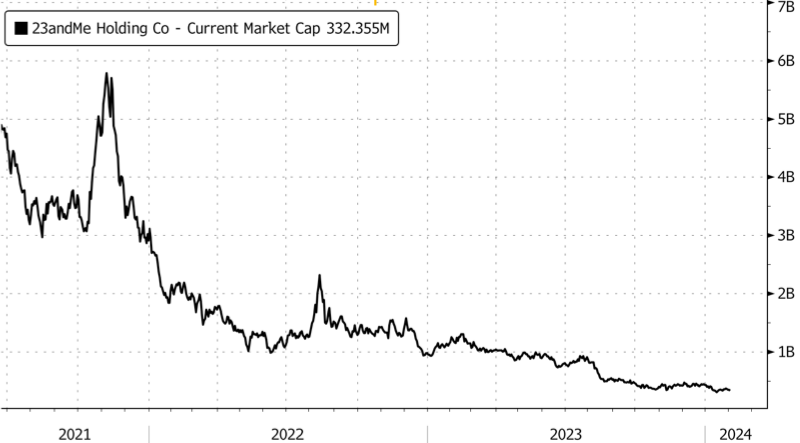
 Several years ago, DNA-testing company 23andMe began publicly trading on Nasdaq following a deal to merge with VG Acquisition Corp., a special-purpose acquisition company founded by billionaire Richard Branson. The company was pimped by Hollywood elites, such as Oprah and Lizzo, as market capitalization topped $6 billion in late 2021. 

Fast forward this past week, 23andMe has lost 94% of its market cap following the November 2021 peak, and Nasdaq threatened to delist the penny stock as it closed around 69 cents per share on Friday. 

Pharma hunt antibody-drug conjugates in China

China has become a popular destination for drugmakers looking for a new class of targeted cancer drugs called antibody-drug conjugates.

Hochul pushed to ease rules on out-of-state adoption

 Adoption advocates are turning up the heat on Gov. Kathy Hochul to change a restrictive policy they say makes it difficult for New Yorkers to adopt from out-of-state birth mothers.

“The policy puts New York families at a great disadvantage,” said Ronnie Oliva, who with her husband Michael, recently adopted a baby girl from another state.

Ronnie Oliva said New York’s adoption policy is anti-child and anti-woman.

“They’re putting children last. You have to put children in loving homes,” said Ronnie Oliva, calling the process to adopt “emotionally draining.”

The Olivas formed the New York Adoption Coalition along with former US Rep. Max Rose, also an adoptive parent. 

Hochul’s Office of Children and Family Services imposed a new edict Jan. 5 that limits the financial support adoptive families can give to out-of-state birth mothers.

Previously, New York adoptive parents were allowed to give more financial support to birth mothers from other states — based on the less restrictive rules on compensation in those states.

Ronnie Oliva and her husband Michael recently adopted a baby girl from another state.

But the new restriction — which also affects New York birth mothers — says financial help can only be made 60 days before the baby is born and 30 days after birth, severely hindering help for the biological moms at crucial times of need, advocates said.

“The whole adoption process in New York is extremely hard and this policy makes it harder,’ Michael Oliva said.

Ronnie Oliva noted that many birth mothers give up their child for adoption because they’re financially struggling or in dire circumstances.

“These birth mothers need help,” Ronnie Oliva said.

Adoption advocates are turning up the heat on Gov. Kathy Hochul to change a restrictive policy they say makes it difficult for New Yorkers to adopt from out-of-state birth mothers.Matthew McDermott

Veteran adoption advocate Lisa Goldberg personally appealed to Hochul in a Jan. 29 letter to repeal the rule put in place by OCFS Agency Director Shelly Fiebich last month that has had a “devastating impact on New York prospective adoptive parents.”

“The current change in policy has thrown a horrific chill over the adoption plans of multitudes of New Yorkers working with expectant mothers from outside our state. There is not even a grandfather clause allowing for current existing adoption plans to continue to move forward as previously agreed upon,” Goldberg, who also is the Olivas’ attorney, told the governor.

“This leaves many NY adoptive parents unable to complete a placement and bring home a baby despite having worked for months with the birth mother and having paid her living expenses.”

Each state has an Interstate Compact on the Placement of Children, created to protect all parties in adoption contracts: the birth mother, adoptive parents and child.

The compact aims to prevent child trafficking and the office vets and approves every private and agency adoption when a child is born in one state and brought to another by adoptive parents.

Hochul’s Office of Children and Family Services imposed a new edict Jan. 5 that limits the financial support adoptive families can give to out-of-state birth mothers.Getty Images

“We have no quarrel with the important job that ICPC carries out in each and every state,” Goldberg said. “However, it is absolutely unreasonable and unacceptable for NY ICPC to tie NY adoptive parents’ hands behind their backs in this way, causing them to be at such a disadvantage and to lose out on out-of state adoption plans.

She called the state’s new policy of “disregarding” court orders from other states regarding fees paid to birth expectant mothers “unconscionable.”

“We need more compassion and flexibility extended by those who work with adoptive families on all sides of this equation,” Goldberg said in her appeal to Hochul.

The Post reached out to Hochul’s office for comment.

https://nypost.com/2024/02/04/metro/hochul-pushed-to-ease-rules-making-adoption-difficult-for-ny-couples-theyre-putting-children-last/