Ardelyx (ARDX) stock jumps as kidney disease bill progresses in Congress, easing concerns about the future of its oral dialysis therapy.
https://seekingalpha.com/news/4076241-ardelyx-stock-spikes-kidney-patient-bill-advances
Ardelyx (ARDX) stock jumps as kidney disease bill progresses in Congress, easing concerns about the future of its oral dialysis therapy.
https://seekingalpha.com/news/4076241-ardelyx-stock-spikes-kidney-patient-bill-advances
Welcome to Impact Factor, your weekly dose of commentary on a new medical study. I'm Dr F. Perry Wilson of the Yale School of Medicine.
In the early days of the pandemic, before we really understood what COVID was, two specialties in the hospital had a foreboding sense that something was very strange about this virus. The first was the pulmonologists, who noticed the striking levels of hypoxemia — low oxygen in the blood — and the rapidity with which patients who had previously been stable would crash in the intensive care unit.
The second, and I mark myself among this group, were the nephrologists. The dialysis machines stopped working right. I remember rounding on patients in the hospital who were on dialysis for kidney failure in the setting of severe COVID infection and seeing clots forming on the dialysis filters. Some patients could barely get in a full treatment because the filters would clog so quickly.
We knew it was worse than flu because of the mortality rates, but these oddities made us realize that it was different too — not just a particularly nasty respiratory virus but one that had effects on the body that we hadn't really seen before.
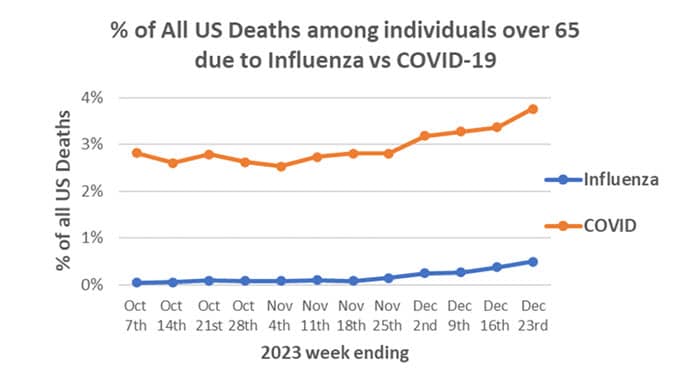
That's why I've always been interested in studies that compare what happens to patients after COVID infection vs what happens to patients after other respiratory infections. This week, we'll look at an intriguing study that suggests that COVID may lead to autoimmune diseases like rheumatoid arthritis, lupus, and vasculitis.
The study appears in the Annals of Internal Medicine and is made possible by the universal electronic health record systems of South Korea and Japan, who collaborated to create a truly staggering cohort of more than 20 million individuals living in those countries from 2020 to 2021.
The exposure of interest? COVID infection, experienced by just under 5% of that cohort over the study period. (Remember, there was a time when COVID infections were relatively controlled, particularly in some countries.)
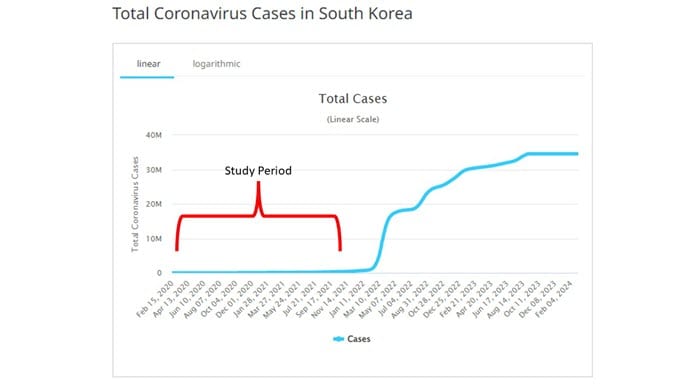
The researchers wanted to compare the risk for autoimmune disease among COVID-infected individuals against two control groups. The first control group was the general population. This is interesting but a difficult analysis, because people who become infected with COVID might be very different from the general population. The second control group was people infected with influenza. I like this a lot better; the risk factors for COVID and influenza are quite similar, and the fact that this group was diagnosed with flu means at least that they are getting medical care and are sort of "in the system," so to speak.
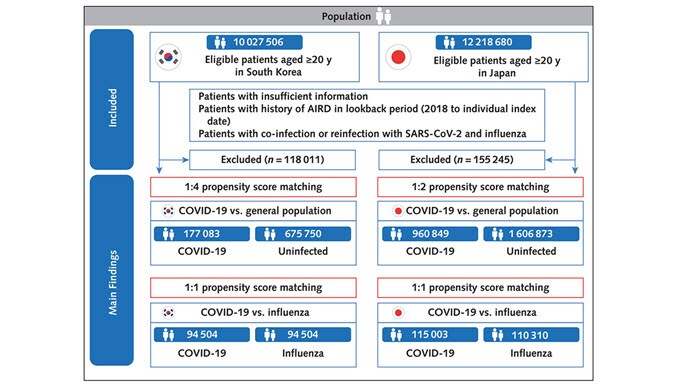
But it's not enough to simply identify these folks and see who ends up with more autoimmune disease. The authors used propensity score matching to pair individuals infected with COVID with individuals from the control groups who were very similar to them. I've talked about this strategy before, but the basic idea is that you build a model predicting the likelihood of infection with COVID, based on a slew of factors — and the slew these authors used is pretty big, as shown below — and then stick people with similar risk for COVID together, with one member of the pair having had COVID and the other having eluded it (at least for the study period).
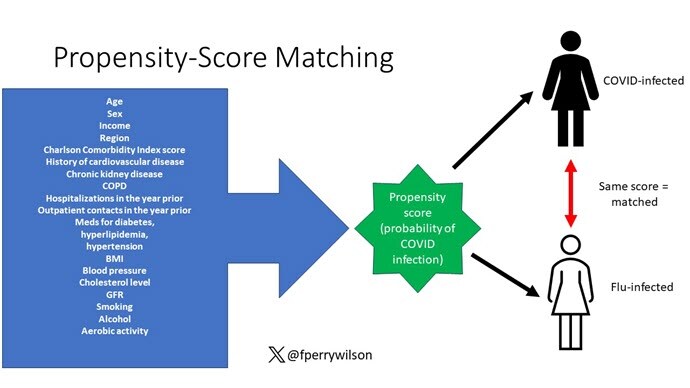
After this statistical balancing, the authors looked at the risk for a variety of autoimmune diseases.
Compared with those infected with flu, those infected with COVID were more likely to be diagnosed with any autoimmune condition, connective tissue disease, and, in Japan at least, inflammatory arthritis.
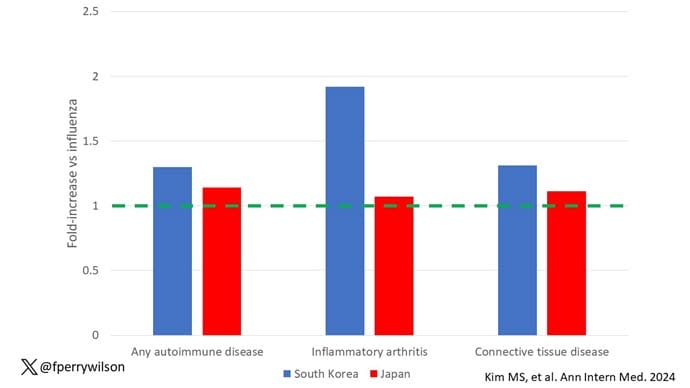
The authors acknowledge that being diagnosed with a disease might not be the same as actually having the disease, so in another analysis they looked only at people who received treatment for the autoimmune conditions, and the signals were even stronger in that group.

This risk seemed to be highest in the 6 months following the COVID infection, which makes sense biologically if we think that the infection is somehow screwing up the immune system.
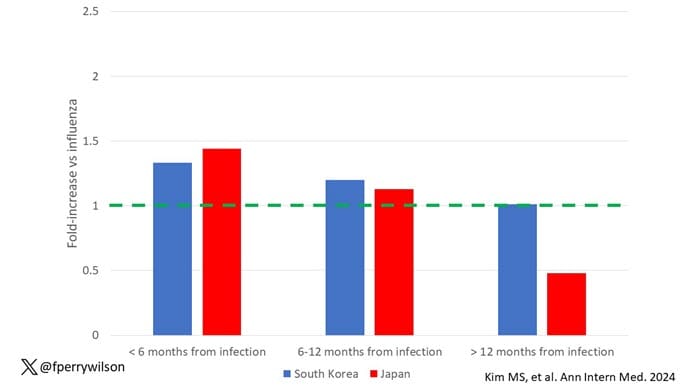
And the risk was similar with both COVID variants circulating at the time of the study.
The only factor that reduced the risk? You guessed it: vaccination. This is a particularly interesting finding because the exposure cohort was defined by having been infected with COVID. Therefore, the mechanism of protection is not prevention of infection; it's something else. Perhaps vaccination helps to get the immune system in a state to respond to COVID infection more… appropriately?
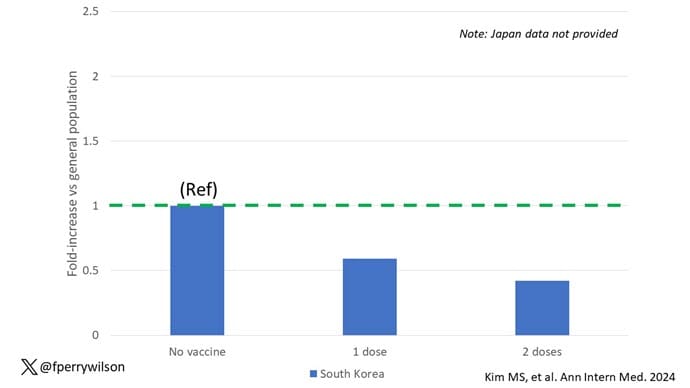
Yes, this study is observational. We can't draw causal conclusions here. But it does reinforce my long-held belief that COVID is a weird virus, one with effects that are different from the respiratory viruses we are used to. I can't say for certain whether COVID causes immune system dysfunction that puts someone at risk for autoimmunity — not from this study. But I can say it wouldn't surprise me.
F. Perry Wilson, MD, MSCE, is an associate professor of medicine and public health and director of Yale's Clinical and Translational Research Accelerator. His science communication work can be found in the Huffington Post, on NPR, and here on Medscape. He tweets @fperrywilson and his book, How Medicine Works and When It Doesn't, is available now.
Tesla shares plunged more than 7% on Wall Street yesterday, following poor sales figures in China. The group had its worst month since the end of 2022. Fierce competition in the field of electric vehicles and the reluctance of drivers to embrace the technology are overshadowing the good story.
The automaker sold just over 60,000 vehicles in China in February, down 19% on February 2023 and the lowest figure since December 2022. This data, published by the passenger car industry's umbrella organization, reinforces fears about the EV market. Tesla, whose vehicles are beginning to look a little dated in the face of the Chinese onslaught, has had to come to terms with adopting new pricing incentives, particularly with regard to insurance.
BYD, its main local competitor, was quick to respond by reducing the price of its most popular model. The price war continues in the EV sector.

Tesla shares significantly underperform the Nasdaq over one year
Tesla shares have already lost 24% of their value this year. It lags far behind the other "magnificores", the technology stocks that have driven up the indexes of late. The automaker's story of infinite growth has broken with the launch of a price offensive and the multiplication of EV manufacturers.
https://www.marketscreener.com/quote/stock/TESLA-INC-6344549/news/Tesla-goes-off-script-46092954/
As the 2024 election approaches, the Biden administration has gone into overdrive to try and convince the general public that inflation isn't his fault - and instead, a scourge of corporate greed washed over the country like a plague.
It certainly wasn't Biden's extended-innings of pandemic stimmies, sanctions on Russia, and rates being too low for too long.
Nope, corporate greed.
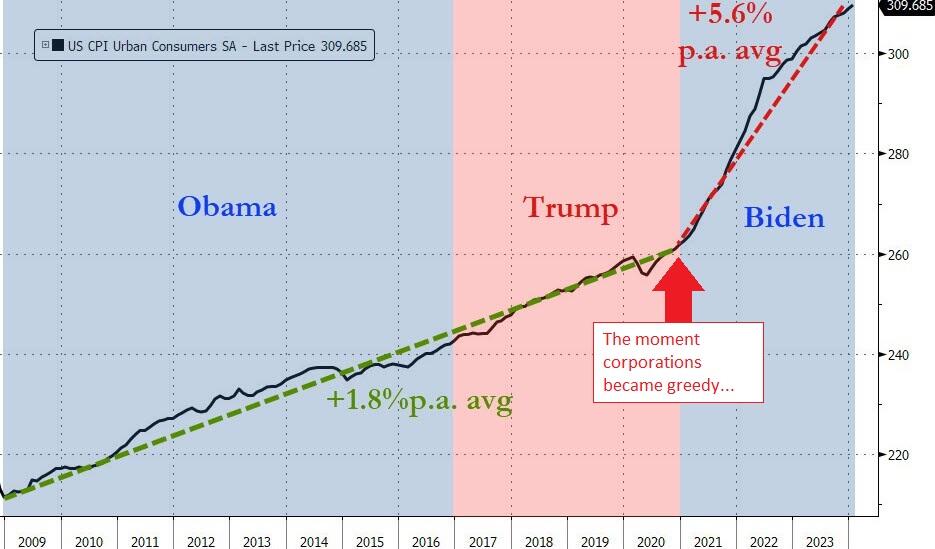
Except, these companies apparently really suck at being greedy, as margins have been dropping at the same time!
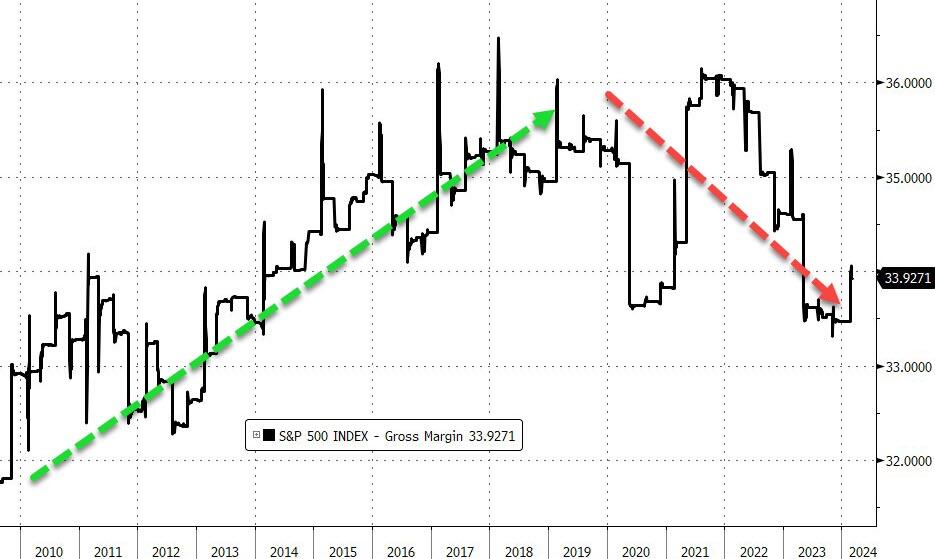
Of course their central premise fails to account for why corporations simply weren't 'greedy' in the Trump-era.
During the superbowl, Biden hammered the concept of "shrinkflation" - essentially, less food in the same package from snack food corporations. There are "fewer chips" in your bag, while companies are "still charging you just as much," Biden said.
According to Politico, recent polling circulated in the White House shows this 'corporate greed' narrative is working.

"It’s about framing this for the American people," said an anonymous official, adding that Biden's open frustration with shrinkflation "speaks to what they feel in a way that’s useful for us both in terms of messaging and making sure they understand that the president sees what’s going on."
The White House in recent weeks has sought new ways to neutralize concerns over grocery costs, a major factor dragging down voters’ otherwise improving views of the economy. Officials are keen to push back on the GOP emphasis on high food prices, and Biden has personally taken issue with the practice of shrinkflation — though some officials still question how much attention the president should devote to food inflation, specifically. -Politico
And so, to further legitimize the corporate greed narrative, the Biden administration has thrown the full weight of the US government behind a new "FTC-DOJ task force" which has been 'tasked' with cracking down on "unfair and illegal pricing" by said greedy corporations.
The task force will be jointly led by the Federal Trade Commission and the Department of Justice, two agencies at the forefront of the Biden administration’s aggressive regulatory agenda over the past three years. -CNBC
"We’re excited to be co-chairing the president’s new Strike Force on Unfair and Illegal Pricing, which builds on the FTC’s far-reaching work to promote competition and tackle unlawful business practices that are inflating costs for Americans," said FTC Chair Lina Khan in a Monday call with reporters.
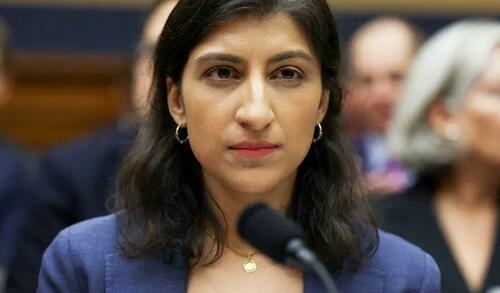
The 'strike force' (lol) will be co-chaired by Jonathan Kanter, assistant AG for the DOJ's antitrust division.
"Here at the Justice Department, we are confronting some of the world’s most powerful corporations so that we can improve the lives of American families," Kanter said on the call.
On Tuesday afternoon, Biden will convene the sixth formal meeting of the White House Competition Council - a group of top officials throughout the administration who will 'root out anti-competitive practices across a wide range of industries.'
In short, definitely don't blame the Biden administration for all the inflation.
The company, which was acquired by insurer UnitedHealth’s Optum segment in 2022, processes billions of healthcare transactions each year, according to a letter from the American Hospital Association.
Change first reported the outage on Feb. 21. Last week, the company said AlphV, also known as Blackcat — a ransomware group that has targeted the healthcare industry — had taken responsibility for the attack.
The outage has already had significant impacts on the industry, providers told Healthcare Dive last week. Some medical groups have been unable to receive and finalize payments from insurers and patients, which could become a major cash flow challenge particularly for smaller providers.
The financial assistance is only for providers where payment distribution has been affected, not for claims submission disruptions, according to UnitedHealth.
Though the intent behind the program is appreciated, it’s not enough to solve the significant cash flow problems, provider groups said. Workarounds for affected tasks like filing claims and prior authorization requests are time-consuming, removing staffers from other work, Anders Gilberg, senior vice president of Government Affairs at the Medical Group Management Association, said in a statement.
“We hope UnitedHealth Group will soon provide relief in those other areas, as continuing to operate in this fashion is simply unsustainable,” he said.
The funding is only available to an “exceedingly small” number of hospitals and health systems, American Hospital Association CEO Richard Pollack wrote in a letter to UnitedHealth.
The terms of the financial support are also onerous, requiring repayment within five days of receiving notice and allowing Optum Financial Services to take back funds without advance communication, according to the letter.
“UnitedHealth Group, which is a Fortune 5 company that brought in more than $370 billion in revenue and $22 billion in profit in 2023, can — and should — be doing more to address the far-reaching consequences that result from Change Healthcare’s inability to provide these essential hospital revenue cycle functions nearly two weeks after the attack,” Pollack wrote.
Sandoz, the global leader in generic and biosimilar medicines, today announced that the US Food and Drug Administration (FDA) approved Wyost® (denosumab-bbdz) and Jubbonti® (denosumab-bbdz), the first and only FDA-approved denosumab biosimilars, to treat all indications of the reference medicines.
Keren Haruvi, President Sandoz North America, said: "Sandoz has achieved the first FDA approval for biosimilars to denosumab, a medicine that can address primary and secondary bone loss, such as osteoporosis, as well as cancer-related skeletal events, which are disease states that can profoundly reduce quality of life for patients. I am proud that Sandoz continues to pioneer access to these life-changing medicines for the patients who need them most."
Wyost® is approved to prevent skeletal-related events (SREs) in patients with multiple myeloma and in patients with bone metastases from solid tumors, to treat adults and skeletally mature adolescents with giant cell tumor of bone that is unresectable or where surgical resection is likely to result in severe morbidity, and to treat hypercalcemia of malignancy refractory to bisphosphonate therapy.1
Bone is the third most frequent site for metastatic tumors.2 Nearly all types of cancer can spread to the bone and cause pain and fractures, though cancers that often metastasize in bones include breast and prostate.3
Jubbonti® is approved to treat postmenopausal women with osteoporosis at high risk for fracture, to increase bone mass in men with osteoporosis at high risk for fracture, to treat glucocorticoid-induced osteoporosis in men and women at high risk for fracture, to increase bone mass in men at high risk for fracture receiving androgen deprivation therapy for nonmetastatic prostate cancer, and to increase bone mass in women at high risk for fracture receiving adjuvant aromatase inhibitor therapy for breast cancer.4
Osteoporosis is a bone disease that develops when bone mineral density and bone mass decrease or when bone strength and structure change. People living with osteoporosis typically do not have symptoms and might not know they have the disease until they experience a fracture. More than 10 million US adults aged 50 and over live with osteoporosis, a major cause of fractures in postmenopausal women and in older men.5,6 Half of all women over the age of 50 will experience an osteoporotic fracture during their lifetime.