Search This Blog

Monday, March 18, 2024

'Weight loss caused by common diabetes drug tied to 'anti-hunger' molecule'

 An "anti-hunger" molecule produced after vigorous exercise is responsible for the moderate weight loss caused by the diabetes medication metformin, according to a new study in mice and humans. The molecule, lac-phe, was discovered by Stanford Medicine researchers in 2022.

The finding, made jointly by researchers at Stanford Medicine and at Harvard Medical School, further cements the critical role the molecule, called lac-phe, plays in metabolism, exercise and appetite. It may pave the way to a new class of weight loss drugs.

"Until now, the way , which is prescribed to control blood sugar levels, also brings about weight loss has been unclear," said Jonathan Long, Ph.D., an assistant professor of pathology. "Now we know that it is acting through the same pathway as vigorous exercise to reduce hunger. Understanding how these pathways are controlled may lead to viable strategies to lower  and improve health in millions of people."

Long and Mark Benson, MD, Ph.D., an assistant professor of medicine at Harvard Medical School, are co-senior authors of the study, which was published in Nature Metabolism. Postdoctoral scholar Shuke Xiao, Ph.D., is the lead author of the study.

Many people with diabetes who are prescribed metformin lose around 2% to 3% of their body weight within the first year of starting the drug. Although this amount of weight loss is modest when compared with the 15% or more often seen by people taking semaglutide drugs such as Ozempic and Wegovy, the discoveries that led to those drugs also grew from observations of relatively minor, but reproducible, weight loss in people taking first-generation versions of the medications.

Post-workout appetite loss

When Long and colleagues at Baylor University discovered lac-phe in 2022, they were on the hunt for small molecules responsible for curtailing hunger after vigorous exercise. What they found was a Frankenbaby of lactate—a byproduct of muscle fatigue—and an amino acid called phenylalanine. They dubbed the hybrid molecule lac-phe and went on to show that it's not only more abundant after exercise but it also causes people (as well as mice and even racehorses) to feel less hungry immediately after a hard workout.

"There is an intimate connection between lac-phe production and lactate generation," Long said. "Once we understood this relationship, we started to think about other aspects of lactate metabolism."

Metformin was an obvious candidate because as it stimulates the breakdown of glucose (thus reducing ) it can trigger the generation of lactate.

The researchers found that obese laboratory mice given metformin had increased levels of lac-phe in their blood. They ate less than their peers and lost about 2 grams of body weight during the nine-day experiment.

Long and his colleagues also analyzed stored blood plasma samples from people with type 2 diabetes before and 12 weeks after they had begun taking metformin to control their blood sugar. They saw significant increases in the levels of lac-phe in people after metformin compared with their levels before treatment.

Finally, 79 participants in a large, multi-ethnic study of atherosclerosis who were also taking metformin had significantly higher levels of lac-phe circulating in their blood than those who were not taking the drug.

"It was nice to confirm our hunch experimentally," Long said. "The magnitude of effect of metformin on lac-phe production in mice was as great as or greater than what we previously observed with exercise. If you give a mouse metformin at levels comparable to what we prescribe for humans, their lac-phe levels go through the roof and stay high for many hours."

Further research revealed that lac-phe is made by intestinal epithelial cells in the animals; blocking the ability of mice to make lac-phe erased the appetite suppression and weight loss previously observed.

Finally, a statistical analysis of the people in the atherosclerosis study who lost weight during the several-year study and follow-up period found a meaningful association between metformin use, lac-phe production and weight loss.

"The fact that metformin and sprint exercise affect your body weight through the same pathway is both weird and interesting," Long said. "And the involvement of the  suggests a layer of gut-to-brain communication that deserves further exploration. Are there other signals involved?"

Long noted that, while semaglutide drugs are injected into the bloodstream, metformin is an oral drug that is already prescribed to millions of people. "These findings suggest there may be a way to optimize oral medications to affect these hunger and energy balance pathways to control body weight, cholesterol and blood pressure. I think what we're seeing now is just the beginning of new types of  drugs."

Researchers from Beth Israel Deaconess Medical Center, Harbor-UCLA Medical Center, Cedars-Sinai Medical Center, Baylor College of Medicine, the University of Colorado, the University of Virginia and the Broad Institute contributed to the work.

https://medicalxpress.com/news/2024-03-weight-loss-common-diabetes-drug.html

Breathe, don't vent: Turning down the heat is key to managing anger

 Venting about a source of anger might feel good in the moment, but it's not effective at reducing the rage, new research suggests.

Instead, techniques often used to address stress—, mindfulness, meditation, yoga or even counting to 10—have been shown to be more effective at decreasing anger and aggression.

Researchers analyzed over 150 studies involving more than 10,000 participants and found that what really works to reduce anger is lowering physiological arousal—in other words, turning down the heat. Activities that increased arousal overall had no effect on anger, and some activities made it worse—particularly jogging.

"I think it's really important to bust the myth that if you're angry you should blow off steam—get it off your chest," said senior author Brad Bushman, professor of communication at The Ohio State University. "Venting anger might sound like a good idea, but there's not a shred of scientific evidence to support catharsis theory.

"To reduce anger, it is better to engage in activities that decrease arousal levels," Bushman said. "Despite what popular wisdom may suggest, even going for a run is not an effective strategy because it increases arousal levels and ends up being counterproductive."

The study was led by first author Sophie Kjærvik, who completed the review for her Ohio State dissertation. It was published online March 11 in the journal Clinical Psychology Review.

Kjærvik, now a postdoctoral fellow at Virginia Commonwealth University, said the work was inspired in part by the rising popularity of rage rooms that promote smashing things (such as glass, plates and electronics) to work through angry feelings.

"I wanted to debunk the whole theory of expressing anger as a way of coping with it," she said. "We wanted to show that reducing arousal, and actually the physiological aspect of it, is really important."

The meta-analytic review was based on 154 studies involving 10,189 participants of different genders, races, ages and cultures. The study selection and analysis were guided by the Schachter-Singer two-factor theory, which assumes that all emotions, including anger, consist of physiological arousal and mental meanings. To get rid of anger, you can work on either of those.

Several previous meta-analytic reviews have focused on changing mental meanings using , which works. However, Kjærvik and Bushman said a meta-analytic review on the role of arousal would fill an important gap in understanding how to resolve anger. Their analysis focused on examining both arousal-increasing activities (e.g., hitting a bag, jogging, cycling, swimming) and arousal-decreasing activities (e.g., deep breathing, mindfulness, meditation, yoga).

Results showed that arousal-decreasing activities were effective at fending off the fury in labs and field settings, using  or in-person instruction, and in group and individual sessions across multiple populations:  and non-students, people with and without a criminal history, and individuals with and without intellectual disabilities.

Arousal-decreasing activities that were effective at lowering anger across the board included deep breathing, relaxation, mindfulness, meditation, slow flow yoga, progressive muscle relaxation, diaphragmic breathing and taking a timeout.

"It was really interesting to see that progressive muscle relaxation and just relaxation in general might be as effective as approaches such as mindfulness and meditation," Kjærvik said. "And yoga, which can be more arousing than meditation and mindfulness, is still a way of calming and focusing on your breath that has the similar effect in reducing anger.

"Obviously in today's society, we're all dealing with a lot of stress, and we need ways of coping with that, too. Showing that the same strategies that work for stress actually also work for anger is beneficial."

In contrast, activities that increased arousal were generally ineffective, but also produced a complex range of outcomes. Jogging was the most likely to increase anger, while  and playing ball sports had an arousal-decreasing effect—suggesting to the researchers that introducing an element of play into physical activity may at least increase positive emotions or counteract negative feelings.

Finding that increasing arousal was not the answer to anger corresponded with previous work led by Bushman that linked venting anger with continued aggression.

"Certain physical activities that increase arousal may be good for your heart, but they're definitely not the best way to reduce anger," Bushman said. "It's really a battle because angry people want to vent, but our research shows that any good feeling we get from venting actually reinforces aggression."

That being the case, the authors noted that many arousal-decreasing interventions shown to lower the heat of anger are free or inexpensive and easy to access.

"You don't need to necessarily book an appointment with a cognitive behavioral therapist to deal with . You can download an app for free on your phone, or you can find a YouTube video if you need guidance," Kjærvik said. "It can't be really hard because you're in a state of fighting arousal, and you're ready to fight if you're really angry."

More information: Sophie Lyngesen Kjærvik et al, A meta-analytic review of anger management activities that increase or decrease arousal: What fuels or douses rage?, Clinical Psychology Review (2024). DOI: 10.1016/j.cpr.2024.102414


https://medicalxpress.com/news/2024-03-dont-vent-key-anger.html

New strategy to facilitate muscle regeneration after injury

 Muscle injuries are common in the active population, and they cause the majority of player retirements in the world of sports. Depending on the severity, recovery of muscle function is quite slow and may require surgery, medication and rehabilitation. Now, a study led by the University of Barcelona reveals a strategy to improve and accelerate recovery from muscle injuries that has potential application in the sports and health sectors.

This is the first study to provide scientific evidence for faster and more effective  from  through intermittent exposure to low oxygen availability () in a low-barometric pressure (hypobaric) chamber that simulates high-altitude geographic conditions.

The new approach is important for the recovery of athletes—especially in the competitive elite—but also to mitigate the socio-economic impact of the loss of work productivity caused by these injuries on the active population.

The study, carried out with animal models, has been published in the Journal of Physiology. The authors of the study are the experts Garoa Santoildes, Teresa Pagès, Joan Ramon Torrella and Ginés Viscor, from the Department of Cell Biology, Physiology and Immunology of the UB's Faculty of Biology.

Why does hypoxia help to regenerate injured muscle?

Hypobaric chambers have long been used to improve physical fitness in high-performance sports (mountaineers, climbers, etc.) and in professional sectors (high-altitude mining, astronomical observation, border control). In hypobaric hypoxia conditions, the body is exposed to a low atmospheric pressure environment in which cells take up less oxygen and generate a physiological response. The beneficial effects of intermittent hypoxia exposure on the body are well described, but its potential applications in biomedicine are still being explored.

"The study indicates that any type of muscle injury could recover more quickly with intermittent exposure to hypobaric hypoxia (simulated altitude), but probably also myotendinous injuries could accelerate their recovery," says Professor Viscor, head of the Adaptive Physiology Group: Hypoxia, Exercise and Health at the UB.

In tissues, hypoxia causes local activation of the HIF (hypoxia-induced factor) pathway, which is a sensor of oxygenation levels. "When the amount of oxygen reaching the cells is not sufficient, the HIF protein acts as a switch that activates a series of changes in  to compensate for this deficit," explains Professor Santocildes.

Among other pathways, the HIF protein activates the proliferation of more capillary vessels through endothelial growth factor (VEGF), a process that would bring more growth factors, metabolic substrates and oxygen to the muscle level to support the muscle regeneration process after injury.

As Professor Teresa Pagès explains, "In parallel, the HIF protein would also enhance the synthesis of specific proteins, the activity of some enzymes and the efficiency of the mitochondria, which are the cell organelles that supply energy for cellular functions."

Muscle injuries and therapies: A paradigm shift

In approaching muscle injuries, the classical view of RICE therapy (Rest, Ice, Compression and Elevation) has evolved towards a more holistic and active view, known as PEACE (Protection, Elevation, Avoid NSADs, Compression, Education) and LOVE (Load Management, Optimism, Vascularization, Exercise).

"All this has meant a major paradigm shift in the field of muscle injury recovery," says Professor Torrella. "Exposure to hypobaric hypoxia—the expert continues—is fully compatible with this new paradigm, and could even contribute to improving the effects of emerging therapies to accelerate the recovery of injured muscle."

Therapy based on exposure to low concentrations of oxygen could also help to explore new treatments for pathophysiological injuries. Thus, it would be important to test whether hypoxia can counteract the muscle atrophy typical of sarcopenia—a disease characterized by loss of muscle mass and strength—through the processes involved in muscle recovery (capillary proliferation, more effective oxidative metabolism, etc.).

"In these cases, hypobaric hypoxia intervention would most likely be improved if combined with individualized strength and endurance exercise activities. Even its application in the recovery of patients with persistent COVID-19 syndrome could be improved," the team concludes.

More information: Garoa Santocildes et al, Simulated altitude is medicine: intermittent exposure to hypobaric hypoxia and cold accelerates injured skeletal muscle recovery, The Journal of Physiology (2023). DOI: 10.1113/JP285398


https://medicalxpress.com/news/2024-03-strategy-muscle-regeneration-injury.html

Bacteria commonly found in the body contribute to stomach cancer

 A new study has discovered that a type of bacteria commonly found in the body, which usually does not pose problems for healthy people, plays a significant role in causing stomach cancer, the fifth most common cancer in the world. The findings are published in the journal Cell.

Streptococcus anginosus bacteria exist alongside other germs in the mouth, throat, intestines and vagina. Occasionally, they may cause mild infections like sore throats and skin infections. For patients with underlying health conditions or compromised immune systems, the bacteria can lead to more serious infections, such as those that damage the heart and brain.

However, research co-led by Nanyang Technological University, Singapore (NTU Singapore) and the Chinese University of Hong Kong (CUHK) showed that S. anginosus is involved in stomach infections in mice that cause  and changes known to encourage . This includes gastric inflammation, in which the stomach lining is irritated. The condition damages gastric lining cells and causes some of them to gradually transform into .

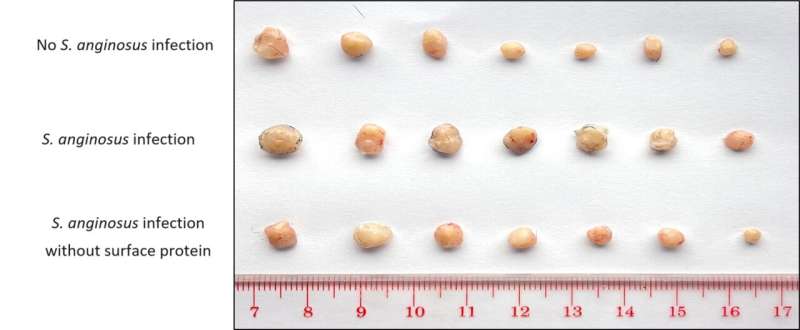
Mice experiments also revealed that the bacteria spurred the growth of stomach cancer cells, doubling the size and weight of tumors in some cases.

But the researchers also found that disrupting a protein on the bacteria's surface, which they need to interact with stomach lining cells, reduced S. anginosus' ability to contribute to stomach cancer.

The findings add to the number of bacteria species known to cause gastric cancer. Another bacteria species, Helicobacter pylori, is known to cause gastric ulcers in people. These painful sores increase patients' risk of developing gastric cancer. Whether other bacteria are involved has remained unclear until now.

"Our latest findings in mice shed light on another pathogen that contributes to stomach cancer, and how it does so," said the study's co-lead, Professor Joseph Sung, NTU's Senior Vice President (Health and Life Sciences).

"This lays important groundwork for further studies in humans that will help clinicians better treat and prevent gastric cancer driven by bacteria," added Prof Sung, who is also the Dean of NTU's Lee Kong Chian School of Medicine.

Bacteria commonly found in the body contribute to stomach cancer, finds study co-led by NTU Singapore
Professor Joseph Sung, NTU Singapore's Senior Vice President (Health and Life Sciences) and Dean of the Lee Kong Chian School of Medicine, is the co-lead of the study which found that Streptococcus anginosus bacteria play a significant role in causing stomach cancer. Credit: NTU Singapore

Professor Yu Jun, the study's other co-lead who is Director of CUHK's State Key Laboratory of Digestive Disease, said that the researchers will next "explore the therapeutic potential of targeting S. anginosus to reduce gastric inflammation and cancer risk."

The S. anginosus study contributes to one of the goals of the NTU 2025 strategic plan to address the needs and challenges of healthy living.

Bacteria-induced abnormalities

H. pylori bacteria are classified as carcinogenic (cancer-causing) to humans. But among people infected with the bacteria, only 1 to 3% develop stomach cancer, which suggests that other factors are involved in its development.

Past research has shown that 20% of patients with chronic gastritis—a known contributor to gastric cancer—are not infected by H. pylori. Chronic gastritis refers to long-term inflammation of the stomach.

Studies have also posited that other bacteria, including S. anginosus, could play a part in stomach tumor development too.

To confirm S. anginosus' role, Prof Sung and collaborating scientists from CUHK ran a series of experiments.

The researchers infected the stomachs of mice with S. anginosus over two weeks and found mild to moderate gastric inflammation. This was similar to what was observed in mice infected with H. pylori over the same time frame.

Bacteria commonly found in the body contribute to stomach cancer, finds study co-led by NTU Singapore
When Streptococcus anginosus infection occurred at stomach tumors implanted under mice skin, the bacteria spurred the growth of the gastric cancer cells, doubling the size and weight of tumors in some cases (middle row), compared to tumors without Streptococcus anginosus infection (top row). When a specific surface protein of the bacteria was genetically removed, the bacteria's ability to encourage tumor growth was impaired (bottom row). Credit: CUHK

When S. anginosus  of the mice was extended—by up to a year—persistent and prolonged inflammation of the stomach, or chronic inflammation, was observed three months after the initial infection. The level of inflammation was also similar to that of rodents infected by H. pylori only.

But when mice were co-infected by both S. anginosus and H. pylori, the level of chronic gastric inflammation recorded after three months was two times greater than infection by either bacteria alone.

As the S. anginosus infection progressed, anomalies that signal cancer development were also observed in the stomach. There was a surge in gastric cell numbers six months after the original infection, stomach acidity rose after nine months, and many cells of the stomach lining transformed into abnormal pre-cancerous cells after 12 months.

The scientists observed another way that S. anginosus infection created an environment conducive to gastric cancer—by disrupting the population of other microorganisms in the stomach. The bacteria increased the number of stomach microbes that typically reside in the mouth while reducing the number of probiotic bacteria important for good gut health, like Lactobacillus.

They demonstrated that S. anginosus was able to drive the growth of gastric tumors. When stomach cancer cells were implanted under the skin of mice or into the rodents' stomach lining, infection by S. anginosus at those sites encouraged the tumors to grow, doubling their size and weight in some cases.

The researchers also discovered that the bacteria needed a specific protein on their surface to physically bind to and invade stomach lining cells to promote gastric cancer development. When this protein was deficient in the bacteria, the germs' ability to bind to stomach lining cells and encourage the growth of gastric cancer implants was impaired.

Prof Sung said, "Our results suggest that long-term S. anginosus infection causes intensive chronic gastritis that is comparable to H. pylori infection. In fact, these two pathogens might act collaboratively to promote gastric inflammation and, eventually, gastric cancer. This could change how we approach prevention and treatment of the disease."

He added that detecting S. anginosus in feces could be useful for assessing whether a patient is at risk of gastric cancer in the future.

Since S. anginosus is commonly found in the mouth, the bacterium could be swallowed through saliva and find its way into the stomach. So, one potential way to guard against  from developing could be to practice good oral hygiene, said Prof Sung.

More information: Kaili Fu et al, Streptococcus anginosus promotes gastric inflammation, atrophy, and tumorigenesis in mice, Cell (2024). DOI: 10.1016/j.cell.2024.01.004


https://medicalxpress.com/news/2024-03-bacteria-commonly-body-contribute-stomach.html

Metformin during pregnancy impacts offspring brain development

 With the rise in gestational diabetes and metabolic disorders during pregnancy, metformin is also being prescribed more frequently. Although it is known that the oral antidiabetic agent can cross the placental barrier, the impacts on the brain development of the child are largely unknown.

An interdisciplinary research team from the German Institute of Human Nutrition Potsdam-Rehbrücke (DIfE) has now been able to demonstrate in a  that although metformin has positive effects in pregnant animals, it does not in the offspring. The results were published in the journal Molecular Metabolism.

Current figures show that around one in six  worldwide are affected by a special form of diabetes known as . According to the Robert Koch Institute, 63,000 women in Germany were affected by the disease in 2021, and the trend is increasing.

These numbers are alarming because excessively high blood sugar levels during pregnancy are associated with negative consequences for mother and child. This increases the risk of affected women developing type 2 diabetes later on, and their children have a higher risk of developing metabolic disorders and being overweight.

Long-term effect of metformin on offspring is unclear

For several years, the placenta-crossing oral antidiabetic agent metformin has been increasingly gaining importance as an alternative to insulin administration when lifestyle changes show no success during the treatment of gestational diabetes. However, there are currently only a few studies on the long-term effects of metformin on the health of offspring. It is known that metformin has an impact on the AMPK signaling pathway, which regulates the networking of nerve cells during brain development.

The interdisciplinary team of DIfE researchers led by Junior Research Group Leader Dr. Rachel Lippert therefore grappled with two central questions: Is metformin treatment only beneficial for the mother or also the child? And does metformin treatment lead to long-term negative physiological changes in the offspring, especially in connection with the development of neuronal circuits in the hypothalamus, a critical region in the regulation of energy homeostasis?

Mouse models shed some light

To answer the key questions, the researchers used two mouse models to represent the main causes of gestational diabetes: severe obesity of the mother before pregnancy and  during pregnancy. These metabolic states were achieved by means of different feeding patterns, with the mice receiving either a high-fat or control diet. The antidiabetic treatment of female mice and their offspring took place during the lactation period as this corresponds to the third trimester of a human pregnancy in terms of brain development.

Treatment involved insulin, metformin, or a placebo, whereby the dosage was based on standard human treatments. The research team collected data on the body weight of the mice, analyzed various metabolic parameters and hormones, and examined molecular signaling pathways in the hypothalamus.

Maternal metabolic state is crucial

"As a result of antidiabetic treatment in the early postnatal period, we were able to identify alterations in the weight gain and hormonal status of the offspring, which were critically dependent on the metabolic state of the mother," explains Lippert.

Furthermore, sex-specific changes in hypothalamic AMPK signaling in response to metformin exposure were also observed. Together with the -induced shift in the examined hormone levels, the results indicate that the maternal metabolic state must be taken into account before starting the treatment of gestational diabetes.

Focusing on prevention

According to Rachel Lippert, treatment of gestational diabetes in future could entail developing a medication that is available for all and does not cross the placenta.

"Given the increasing prevalence, education about gestational diabetes and preventive measures are of vital importance. If we can find a way to manage lifestyle and diet more proactively, we are in a better position to exploit the potential of gestational diabetes treatment," says Lippert.

More information: Lídia Cantacorps et al, Developmental metformin exposure does not rescue physiological impairments derived from early exposure to altered maternal metabolic state in offspring mice, Molecular Metabolism (2023). DOI: 10.1016/j.molmet.2023.101860


https://medicalxpress.com/news/2024-03-metformin-pregnancy-impacts-offspring-brain.html

'No evidence of Havana syndrome brain injury, US studies find'

 A U.S. government research team found no significant physical evidence of brain injury in a group of federal employees suffering symptoms of the "Havana syndrome" ailment that emerged in 2016, according to studies published in a medical journal on Monday.

The National Institutes of Health (NIH) researchers also found no differences in most clinical measures between a group of 86 employees and their adult family members reporting unusual health incidents and a group of healthy volunteers with similar work assignments.

Symptoms of the mysterious ailment, first reported by U.S. embassy officials in the Cuban capital Havana and later afflicting diplomats, spies and other personnel worldwide, have included hearing noise and experiencing head pressure followed by headache, migraines, dizziness, and memory lapses.

"These individuals have symptoms that are real, distressing and very difficult to treat," Dr. Leighton Chan, NIH Clinical Center acting chief scientific officer and lead study author, said on a call to discuss the findings published in JAMA.

Study participants, including personnel who had been stationed in Cuba, China, Vienna and the United States, underwent a battery of clinical, auditory, balance, visual, neuropsychological and blood testing. They also received different types of MRI scans aimed at investigating volume, structure and function of the brain.

Mark Zaid, a Washington-based lawyer who has represented Havana sufferers, said the findings of no significant medical differences between the two populations after time had passed "do nothing to undermine the theory that a foreign adversary is harming U.S. personnel and their families with a form of directed energy."

An NIH spokesperson said the studies sought to identify structural brain or biological differences and did not seek to determine whether some external phenomenon was the cause of symptoms, nor could they rule that out.

"We understand that some patients may be disappointed that researchers were unable to identify clear markers of injury," the spokesperson said.

EARLIER STUDY HAD DIFFERENT FINDING

The NIH studies, conducted from 2018-2022, do not match results from a study done at the University of Pennsylvania in 2019, which showed subtle brain changes in those affected.

Chan said the NIH used more rigorous MRI imaging protocols and a control group more closely matched in terms of work activities and location.

The researchers in a statement later said if the symptoms were caused by some external phenomenon, there is no persistent physical evidence, but acknowledged the possibility that such evidence is no longer detectible by methods they used.

An accompanying JAMA editorial from Dr. David Relman, professor at Stanford University School of Medicine, noted that earlier studies concluded that some of the cases could be plausibly explained by exposure to radiofrequency energy.

NIH researchers did find that more than a quarter of patients reporting symptoms developed a chronic condition called persistent postural-perceptual dizziness. They also reported significantly increased symptoms of fatigue, post-traumatic stress and depression, compared to the control group.

The MRI brain imaging results "should be some reassurance for patients," since researchers did not find a link between unusual symptoms and neurodegenerative changes, said Louis French, study investigator from Walter Reed National Military Medical Center.

“The post-traumatic stress and mood symptoms reported are not surprising given the ongoing concerns of many of the participants,” he said.

The U.S. State Department on Monday said it was reviewing the NIH report on what the department calls anomalous health incidents (AHI).

A spokesman said Secretary of State Antony Blinken was determined the department would do "everything possible to ensure employees and family members who report an AHI are treated with respect and compassion and receive timely access to medical care and all benefits to which they are entitled."

U.S. intelligence agencies last year concluded that it was "very unlikely" a foreign adversary was responsible for the Havana syndrome cases.

Dr. Mitchell Valdes, who spearheaded a Cuban task force that investigated the incidents from Havana, said the U.S. intelligence conclusion and NIH studies, were "devastating blows to the entire story that was put together that there was an attack with a mysterious energy weapon that had caused damage to (the diplomats') brain."

https://www.yahoo.com/news/us-study-finds-no-evidence-140623110.html

US Confirms Israel Killed Hamas No. 3, But Biden Calls Rafah Ground Op 'A Mistake'

 On Monday the White House confirmed that Israel killed Hamas number three Marwan Issa in an operation on March 11. Israeli military spokesman Rear Admiral Daniel Hagari had initially announced the likelihood of his death, but said the military is still awaiting confirmation. Some international reports have described Issa as the number two most important leader.

But what is clear is that Issa’s death marks the highest-ranking official of Hamas to be taken out during Israel’s war with Hamas began on Oct. 7. White House National Security Advisor Jake Sullivan confirmed the news in a Monday afternoon press briefing.

Marwan Issa, the deputy head of Hamas’s military wing, Last known photograph.