Search This Blog

Thursday, August 15, 2024

How to fix, not cut, the Social Security benefits tax

 Donald Trump is on to something questioning why the federal government taxes Social Security benefits.

Technically, this isn’t even a tax on benefits. We already impose a tax on additional income that Social Security beneficiaries earn while they collect Social Security checks. If Social Security is the only source of income, then individuals don’t pay any tax on it.

As a result of this tax and other penalties, seniors who continue to work often pay the country’s highest tax rates — much higher than the rates young people with the same income pay. That’s unfair and a punishment for those who work while they collect Social Security benefits. 

On the other hand, as others have pointed out, completely eliminating the tax would cost the Treasury large revenue losses at a time when deficits are already exorbitant.

However, there is a way to reform some of the worst features of the tax at low cost.   

Under current law, if one-half of Social Security payments plus other income exceeds $25,000, the individuals must pay income taxes on 50 cents of Social Security benefits for each additional dollar they earn. Since they also must pay regular income taxes on that dollar, they have to effectively pay $1.50 in taxes on $1 of earnings. 

That means that the tax rate on an additional dollar of earnings is 50 percent higher than it would be for a young person with the very same income.

It gets worse.

Once the combined income threshold reaches $34,000, the tax on Social Security benefits rises to 85 percent for each additional dollar they earn. Each dollar creates a $1.85 tax liability — 85 percent higher than it would be for a young person with the very same earnings.

For someone in the 15 percent bracket for ordinary income:

  •  The Social Security benefits tax potentially increases the tax rate on pension income and 401(k) and IRA withdrawals from 15 percent to 27.75 percent.
  •  It can raise the tax on capital gains and dividend income from zero to 12.75 percent.
  • Even tax-exempt income can be taxed at a rate of 12.75 percent.

That’s right: Seniors are required to pay a tax on bonds that are supposed to be tax-free. 

For most of the system’s history, there was no tax on Social Security benefits. But in 1983, Congress passed legislation to “save” Social Security, mainly with two large benefit cuts: raising the full retirement age and taxing benefits. The original Social Security benefits tax was structured so that it initially hit only very high-income seniors.

But here’s the catch: The benefits tax was intentionally not inflation-indexed. So, while the tax initially was paid by less than 10 percent of retirees, today it is paid by more than half. Unlike other parts of the tax code, inflation imposes an extra tax on most Social Security beneficiaries.

What makes things worse is that working seniors below the full retirement age can face astronomical marginal tax rates when the benefits tax is combined with another unjust “tax”: the Social Security earnings penalty.

This year, early retirees lose 50 cents of Social Security benefits for each dollar they earn beyond $22,320. That’s a 50 percent tax rate.

When income and payroll taxes are added in, senior workers can face a marginal tax rate that exceeds 80 percent — i.e., for every additional dollar they earn, they take home 20 cents.

Note that these high marginal tax rates only apply to middle-income seniors. Low-income seniors don’t earn enough. For high-income seniors, the marginal tax rates go away when benefits have been completely liquidated by the earnings penalty or when they have been “fully taxed” by the benefits tax.

Given our fiscal situation today, it’s likely to cost too much to fix all of these problems in the near future. However, abolishing the earnings penalty would probably be a revenue gainer for the government as seniors work more hours and they and their employers pay additional income and payroll taxes.

We could also eliminate those very high marginal tax rates by including a portion of the benefits in ordinary (taxable) income instead of the Rube Goldberg arrangement we have today. No longer would seniors be paying rates that are effectively 50 percent or 85 percent higher than what other workers pay.

This would also eliminate the stealth inflation tax imposed on seniors because tax rates on ordinary income (unlike the current Social Security benefit tax) are already inflation-indexed.

Seniors who want to continue to work, invest and contribute to the economy shouldn’t be so heavily penalized for doing so. And the government should never benefit from the inflation it causes at the expense of the elderly and the disabled.

John C. Goodman is president of the Goodman Institute for Public Policy Research. Stephen Moore is chief economist at FreedomWorks and co-founder of the Committee to Unleash Prosperity. 

https://thehill.com/opinion/finance/4827384-social-security-benefits-tax/

Tyra started at Overweight by Piper

 Target $33

https://finviz.com/quote.ashx?t=TYRA&p=d

Incyte Wins Second Graft-Versus-Host Disease FDA Approval


Nearly two weeks ahead of its target action date, the regulator on Wednesday has signed off on Incyte and Syndax’s Niktimvo for the third-line treatment of graft-versus-host disease.

Incyte and partner Syndax Pharmaceuticals announced on Wednesday that the FDA has given the green light to axatilimab-csfr—now to be branded Niktimvo—for the treatment of chronic graft-versus-host disease in patients who had failed at least two prior lines of systemic therapy.

Niktimvo, an intravenous infusion therapy, can be administered to both adult and pediatric patients, given they weigh at least 40 kg. It is the first FDA-approved anti-CSF-1R antibody directed against inflammatory and fibrotic drivers in chronic graft-versus-host disease (GVHD), according to Incyte.

CEO HervĂ© Hoppenot in a statement said that Niktimvo’s approval will offer chronic GVHD patients “a new treatment option with a novel mechanism of action to help address the serious and devastating complications associated with this disease.”

BMO Capital Markets analyst Evan Seigerman in an investor note called Niktimvo’s approval “a modest positive” for Incyte, similarly referring to the drug’s third-line opportunity as “modest.” The approximately $200 million peak sales in this setting is “a comparatively small win” compared with the impending loss of exclusivity for the kinase inhibitor Jakafi (ruxolitinib) in 2028, according to Seigerman.

“We want to see meaningful pipeline progress for larger indication assets,” Seigerman wrote. Toward that end, Incyte is continuing to study Niktimvo as a frontline treatment for chronic GVHD in combination with Jakafi and steroids.

Typically arising in patients who have undergone allogeneic stem cell transplantation, chronic GHVD is a serious condition characterized by the host’s immune system mounting a response against the implanted cells, eventually also attacking the host’s own organs. According to Incyte, around 42% of transplant recipients develop chronic GVHD—representing around 17,000 patients in the U.S.—of whom almost half require at least three lines of treatment.

Niktimvo is a monoclonal antibody that targets the CSF-1R cell surface protein, which plays a central role in the survival of immune cells. By blocking CSF-1R signaling, Niktimvo can lower the number of disease-causing macrophages and their precursor monocytes.

To validate Niktimvo’s mechanism of action and support its regulatory application, Incyte and Syndax ran the Phase II open-label AGAVE-201 trial which established the safety and efficacy of the therapy. At six months, the 0.3-mg/kg dose of Niktimvo elicited an overall response rate of 75%, with a median time to response of 1.5 months. By 12 months, 60% were able to maintain treatment response.

In terms of safety, AGAVE-201 documented serious adverse events in 44% of Niktimvo-treated patients. Ten percent of patients discontinued Niktimvo treatment due to toxicities, while 8% had to have their doses reduced.

Though without a boxed warning, the drug’s label carries precautions for infusion-related side effects and embryo-fetal toxicities. Women of reproductive potential who need to take Niktimvo are advised to use effective contraception.

https://www.biospace.com/fda/incyte-wins-second-graft-versus-host-disease-fda-approval

Not Just Buffett: Druck, Tepper, Soros All Dumped Tech Before The Rout: 13F Summary

It wasn't just Warren Buffett slashing his Apple stake by more than half: in the second quarter a veritable who is who of the hedge fund community were dumping tech exposure (just as we said at the time, but without knowing names, see "Hedge Funds Dumping Record Amounts Of Tech Stocks To Retail Investors" from June 26).

According to the latest 13F filed by the smart money, besides Buffett, some of the luminaries who trimmed their holdings in “Magnificent Seven” stocks ahead of the late July rout were George Soros and Stanley Druckenmiller.

Soros Fund Management sold some of its stake in Alphabet totaling $58 million, and about $15 million of Amazon.com, according to regulatory filings for the three months ended in June.


Jeremy Clarkson’s A-level results day tweet is here
317
Brand logo

Perhaps not too surprisingly, former Soros disciple, Stanley Druckenmiller, was also among investors paring stakes in AI leader Nvidia. His Duquesne Family Office sold more than 1.5 million shares, filings show.

Elsewhere, billionaire David Tepper’s Appaloosa Management cut its holdings of Amazon, Microsoft and Meta, three of its largest positions, continuing similar cuts reported at the end of March. 

Paul Singer, a prominent AI skeptic who recently slammed the AI space, echoing the deeply pessimistic take of Goldman's head of research, sold off his holdings in Nvidia. He also liquidated its holdings in Constellation Brands, Peabody Energy and the Bitcoin ETF IBIT.

David Bonderman’s Wildcat Capital Management also sold out of his Meta position, dumping shares worth $24 million in the quarter.

As Bloomberg notes, and as our readers were mostly aware, the latest 13F show how investors captured the benefits of the run-up before the benign economic outlook took a gloomier turn, with the Nasdaq 100 slumping 14% in the four-week period beginning July 10. The “Magnificent Seven” had been emblematic of the rally, reflected in the Bloomberg Magnificent 7 Price Return Index, which rose 17% in both the first and second quarters.

Speaking in a CNBC interview in May, Druckenmiller suggested the artificial intelligence boom may be “over-hyped” in the short term.

Yet it wasn't all selling: while Buffett was dumping Apple, others such as Janus and Third Point were buying; in total the stock attracted an aggregated net buy of more than 8.5 million shares from hedge funds, which of course is a far cry from the 400 million shares dumped by Buffett.

Several hedge funds also added to their holdings in other AI-related companies like Taiwan Semi and Amazon, where holdings were increased or initiated by 166 investors, the biggest tally... and likely to result in even more disappointment because after last week's rout, Amazn, which recently hit an all time high, is back to where it was in the summer of 2021.

At the same time, hedge funds sold shares Nvidia as they took their profit from the frenetic rally. Microsoft was cut or reduced by 140 investors, the biggest such reduction.

Here are some other notable moves:

  • Soros sold out of its $108 million position in American National Insurance, and $67 million in Aramark.
  • Elliott Management added new stakes in Southwest Airlines, with 6.00M shares, and Arm Holdings, worth 150K shares. He also beefed up position in Match Group to 11.7M shares  from 4.13M shares, Etsy to 4.50M from 2.25M, and Transocean to 11.9M from 9.75M.
  • Druckenmiller’s Duquesne reported a new position in Mid-America Apartment Communities, a real estate investment trust that acquires multi-family apartments, worth $92 million and in cigarette maker Philip Morris International Inc. of $90 million.
  • Druckenmiller’s Duquesne reported a new position in Mid-America Apartment Communities, a real estate investment trust that acquires multi-family apartments, worth $92 million and in cigarette maker Philip Morris International Inc. of $90 million.
  • Iconiq Capital, the investment firm which manages money for Meta CEO Mark Zuckerberg, sold $2.5 million in Apple.
  • Kemnay Advisory Services, a family office that helps manage the fortune of duty-free-shopping billionaire Alan Parker, cut its holdings of Nvidia, Apple, Microsoft, Meta, Alphabet and Amazon.
  • As reported last night, Warren Buffett added stakes in cosmetics chain Ulta Beauty Inc. and aerospace company Heico Corp, while liquidating Snowflake and Paramount.
  • Michael Burry’s Scion Asset Management continued to boost its stake in China’s tech giant Alibaba Group Holding Ltd., while slashing his overall equity portfolio in half, according to data compiled by Bloomberg.
  • Trian sold 29.69 million shares in Walt Disney, the biggest reduction by the investor group; Twin Tree Management LP sold 512,934 shares
  • Tairen Capital added 2.8 million shares in Apple, the largest increase; Renaissance Technologies LLC added 1.31 million shares
  • Reverence Capital Partners LP added 23.2 million shares in New York Community Bancorp, the largest increase; Renaissance Technologies LLC added 1.25 million shares

According to a Bloomberg analysis of the latest 13F filings from 674 hedge funds, their combined holdings amounted to $443.46 billion, compared with $427.22 billion held by the same funds three months earlier.

https://www.zerohedge.com/markets/not-just-buffett-druck-tepper-soros-all-dumped-tech-rout-13f-summary 

Another Reason Why Polling is So Bad


I have been a consistent critic of survey “data” and polling, along with traditional measures of sentiment.

There are many reasons for this: Half of Americans do not vote, so when they respond to polls they are mucking things up. Even if they say they are going to vote, there is little reason to believe them. I don’t know who still has a landline, or who answers an unknown phone call on their cell phones, but I question if these folk represent broader America.

In the car om the way up to Grand Lake Stream and Camp Kotok, another interesting question came up on the polling/survey question:

What do people actually know relative to what they believe they know?

Tom Morgan of The Leading Edge raised this issue in response to a discussion of how under-utilized the phrase “I don’t know” is — especially but not exclusively in finance.

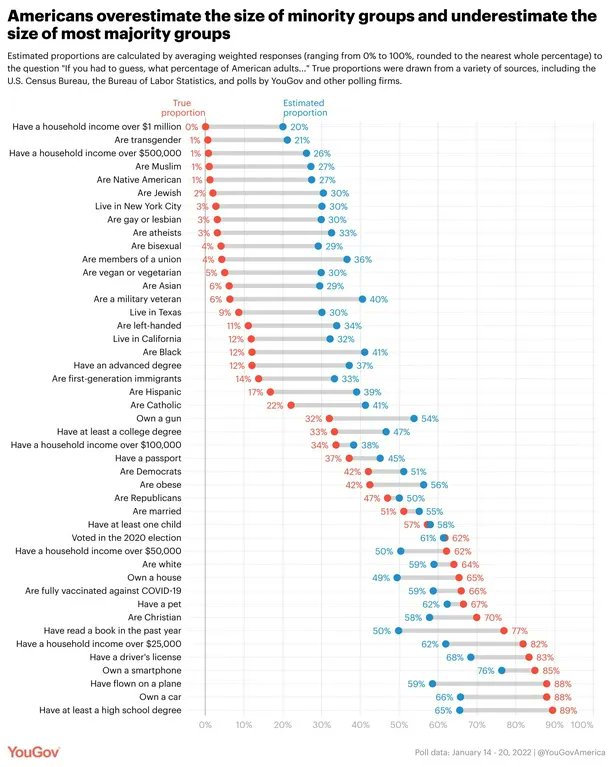
Tom shared a fascinating analysis that looked at how people conceptualize other groups, whether by economic strata, behavior, race, religion, etc.

Taylor Orth is Director of Survey Data Journalism at YouGov. They looked at what various people believed when it came to the size of different subgroups of Americans. There are two enormous takeaways from this.

The first is simply how worng people were. Two YouGov polls “Asked respondents to guess the percentage (ranging from 0% to 100%) of American adults who are members of 43 different groups, including racial and religious groups, as well as other less frequently studied groups, such as pet owners and those who are left-handed.”

American vastly overestimate the size of minority groups, including sexual minorities,  the proportion of gays and lesbians (estimate: 30%, true: 3%), bisexuals (estimate: 29%, religious minorities, racial and ethnic minorities, etc.

And, people tend to underestimate majority groups. 

Looking at the chart above, we can see that the average answer ranges from very wrong to laughably wrong. None of this is complex or hard to find information; its all readily available to anyone who wnats to know it, Our car fulk of economists and fund managers did pretty well answering Tom’s Q&A on what actual and estiamted numbers were.

But the seocnd aspect of this is even more fascinating. Why don’t peiople simply say I DONT KNOW  when they don’t know?

We discussed whether COVID escaped from a Lab or the Wet Market. My answer: “As someone who is neither a virologist nor an intelligence operative, I do not have the tools needed to render an expert judgment about the origins of Covid. Also, I tend to disbelieve conspiracy theorists’ ability to keep most big secrets for all that long.”

Dave Nadig stated “Social media has made it mandatory for everyone to have an opinion about everything.”

We should all ask ourselves why?

https://ritholtz.com/2024/08/another-reason-why-polling-is-so-bad/

Medtronic upped to Neutral from Sell by UBS

Target to $90 from $76

https://finviz.com/quote.ashx?t=MDT&p=d

Biden-Harris administration using taxpayer money to mask Medicare premium hikes before election

 In a move critics say is designed to shield the Biden-Harris administration from election fallout, the administration has leveraged taxpayer funds to mask upcoming increases in Medicare premiums.

Under the Inflation Reduction Act (IRA), which was intended to cap out-of-pocket drug costs for Medicare beneficiaries, insurers are poised to significantly hike monthly premiums, with average bids for Part D plans expected to triple by 2025.

In response to potential voter backlash, the Centers for Medicare and Medicaid Services (CMS) rolled out a three-year "demonstration project" to subsidize these premiums, aiming to keep them artificially low. However, despite the appearance of relief, some critics are saying that taxpayers will fund a dramatic increase in subsidies — from $30 per recipient per month in 2024 to $142.70 in 2025 — raising concerns about the long-term impact on government spending and debt.

Former President Trump adviser Joe Grogan has criticized the maneuver, arguing that it merely shifts costs rather than providing real relief.

"They've destroyed Part D premiums," Grogan told Fox News Digital in an interview. "I'm not sure it'll survive legal scrutiny if someone were to sue. Objectively, it shouldn't be done. It's just interjecting $5-$10 billion of taxpayer dollars, while the taxpayers are paying the price 85 days before an election. It's sickening."

"This is only going to get worse in 2025, 2026," Grogan continued. "The program is in a death spiral. They announced a three-year demo. It's already broken. The demo is going to fail. Premiums are still going to go up."

Paragon Health Institute, a health care research group, called the CMS demo plan a "fake, costly demonstration," in a recent analysis. 

"Fearing the premium increases that the IRA redesign will impose on Part D plans, CMS has now launched a new voluntary, nationwide demonstration program that is neither a demonstration nor voluntary. Unlike this massive subsidization scheme, demonstrations are supposed to be limited in nature and test alternative features of program design," the institute wrote. "As a result of the IRA changes, insurers that don’t participate are expected to either be uncompetitive from a price perspective or face significant losses — hardly a choice for insurers."

Research published by Fidelity, an investment research group, shows that a 65-year-old retiring today can expect to spend $165,000 on health care in retirement, a 5% increase from last year and more than double the estimate from 2002.

Yet, there appears to be a disconnect for many Americans between the actual projected cost of health care in retirement and how much they expect to spend on those expenses. The average American thinks they will spend about $75,000 on health care and other medical expenses, less than half of Fidelity's calculation, according to the research.

The estimate assumes that an individual is enrolled in Medicare — including Part A and Part B, which cover most hospital care and doctor's visits — and Part D, which covers prescription drugs. Other expenses such as Medicare premiums, over-the-counter medications, dental and vision care and other costs typically not covered by Medicare are "left to retirees to manage on their own," the report said.

As of April of this year, about 67.3 million Americans were enrolled in Medicare, according to the Centers for Medicare and Medicaid Services. Of those, about half were enrolled in a Medicare Advantage plan, while about 80% were covered by Medicare Part D.

"They just want to get through the election," Grogan said. "They're hoping after the election they can face it, but it's gonna need to be dealt with in the next 12 to 18 months. They did not believe it would be this bad and it's only gonna get worse." 

Americans are also dealing with a spike in the cost of prescription drugs, which has surged nearly 40% over the past decade, easily outstripping the pace of inflation. 

Fox News Digital has reached out to CMS for comment. 

https://www.foxnews.com/politics/biden-harris-administration-using-taxpayer-money-mask-medicare-premium-hikes-before-election-critics