Search This Blog

Monday, January 13, 2025

Starbucks Reverses Open Public Bathroom Policy After Junkie Influx Created Unsafe Environment

 Newly appointed Starbucks CEO Brian Niccol has reportedly reversed a seven-year policy that allowed the general public to use store bathrooms without making a purchase. The policy had resulted in widespread drug use at certain store locations, particularly in lawless, Democrat-controlled cities.

The Wall Street Journal obtained a copy of a memo sent to employees outlining the new code of conduct being rolled out across stores in North America. 

"There is a need to reset expectations for how our spaces should be used and who uses them," Starbucks North America President Sara Trilling said in the memo. 

The updated policies also include adding signs prohibiting harassment, violence, threatening language, outside alcohol, smoking, and panhandling in its stores.

In 2018, former CEO Howard Schultz transformed Starbucks into America's "largest public restroomby allowing non-customers to use the chain's bathrooms across thousands of US stores. 

Schultz's bathroom policy backfired...

Ensuring safety with new bathroom policies is just part of Niccol's turnaround strategy to save the struggling coffee chain, which has suffered from three straight quarters of declining sales. 

https://www.zerohedge.com/markets/need-reset-expectations-starbucks-reverses-open-public-restroom-policy-after-junkie-influx

Russia's Shadow Shipping Fleet: How It Works And Why It Is Hard To Tackle

 by Chris Summers via The Epoch Times,

Russia has been growing its so-called shadow shipping fleet for several years but concerns have escalated in the last few months after some of them were linked to a series of incidents involving undersea infrastructure.
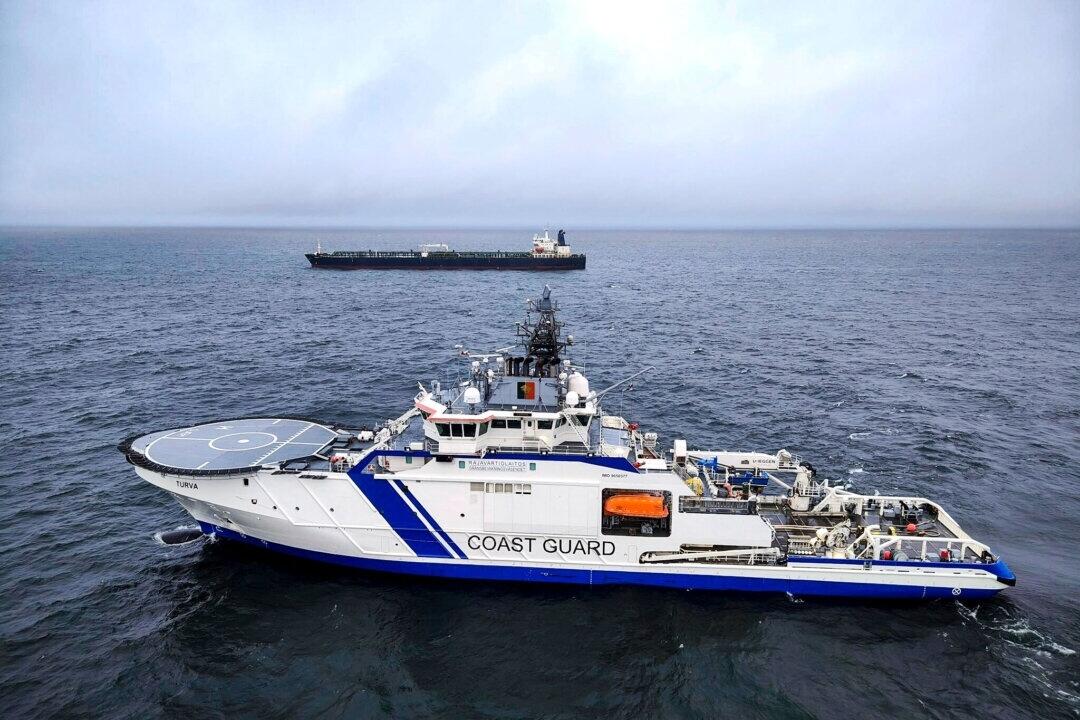
Germany, Britain, and 10 other European countries agreed in December on measures to “disrupt and deter” Russia’s shadow fleet.

“The shadow fleet presents risks to the environment, maritime safety and security, international seaborne trade, as well as international maritime law and standards. It also works to circumvent our sanctions and soften their impact,” the countries said in a joint statement.

But what is the shadow fleet, why does Russia need it, and can it be disrupted without breaking the international laws of the sea?

Neil Roberts, head of Marine & Aviation at Lloyd’s Market Association, said Russia may control around 1,100 ships—a mixture of oil tankers, container ships, and bulk carriers—but he said it’s something of a misnomer to call them a shadow fleet.

4 Types of Fleet

He told The Epoch Times there are four types of fleet.

“There’s the Western-administered A1 fleet which has all the right insurance and controls. Then, there’s a parallel fleet, run by China, India, and the Asian countries, which is well-maintained but does not follow sanctions.”

“Then, there’s the ‘gray fleet’, which is ships used for smuggling drugs and arms, completely illegal. But then you have the Russian fleet, which they have acquired. Some of it is of a reasonable quality but other vessels are older,” Roberts said.

The term shadow suggests they are secretive but Roberts notes they operate openly and use international shipping lanes, including the Suez Canal.

The ships—which often have a confusing array of aliases—have been plying the world’s seas since long before Russia invaded Ukraine in February 2022. But the conflict and the growing tension with NATO has drawn them into focus.

Not only is the shadow fleet suspected of breaking sanctions but some of the ships are alleged to have tampered with undersea infrastructure, and others are feared to be so old or poorly maintained that they might cause marine pollution.

Last month, the state-owned news agency Tass reported that two Russian ships, the Volgoneft 212 and Volgoneft 239, caused an “oil spill emergency” in the Black Sea after colliding. Both ships were reportedly over 50 years old.

On Dec. 26, a Russian-owned ship, the Eagle S, flying the flag of the Cook Islands, was stopped by the Finnish Border Guard after it was suspected of cutting an undersea cable, Estlink-2, which supplies power to Estonia.

The following day, the Estonian Navy was drafted in to protect the Estlink-1 cable, and the European Union’s foreign policy chief Kaja Kallas said the Eagle S incident was “the latest in a series of suspected attacks on critical infrastructure.”

Last month, Britain, Denmark, Sweden, Poland, Finland, and Estonia said they would begin checking insurance documents of vessels in the English Channel, the Gulf of Finland, and the Kattegat—the strait between Denmark and Sweden.

Estonian Prime Minister Kristen Michal said, “If the ships do not cooperate, next steps will be taken. They will be put on a list for prohibition, or they will be boarded in certain areas.”

Roberts said those actions bring up the question of legality, “which might be a moot point if you’re in a conflict, but we’re not in a declared conflict.”

During World War II, Allied ships would frequently board and take over German, Japanese, and Italian commercial vessels—or sink them—but because the only countries who are at war here are Russia and Ukraine, there is no “declared conflict” that would permit such action by third parties.

Roberts also pointed to a treaty—posted on the CIA’s website—that prevents ships heading to or from Russia from being intercepted.

The 1857 Copenhagen Treaty states no ship is to be stopped while traveling through the straits between Denmark and Sweden. It was a clause that was scrupulously adhered to throughout the Cold War, when Soviet submarines and battleships would pass through on their way to the open seas.

He said one of the biggest concerns of the Western shipping industry is what would happen if a shadow vessel collided with a ship, or caused a major pollution event.

Lloyd’s of London is the one of the world’s biggest shipping insurance markets in the world, and the Lloyd’s Market Association represents 55 managing agents who together insure 52.6 billion pounds ($64.2 billion) worth of shipping and other assets.

Roberts said, “The question that everyone is asking is: ‘What happens if an insured vessel collides with a sanctioned vessel?’”

Shadow fleet vessels are often subject to obscure ownership, and an insurance structure that allows them to evade detection and sanctions.

But Roberts said while shadow fleet ships need a higher grade of insurance to enter a Western port, all they need to sail the high seas was protection and indemnity insurance, known as P&I.

Last month, Lloyd’s List reported that the European Union had sanctioned another 52 ships, bringing the total under sanctions to 79. Among them was the liquefied natural gas (LNG) tanker Pioneer, which flies the flag of the tiny Pacific nation of Palau, and is also sanctioned by the United States.

Another ship, also called the Pioneer but now known as Hero II, is an oil tanker sanctioned by the U.S. Office of Foreign Assets Control (OFAC) for its links to Iran.

‘Bankroll His Illegal War’

In its statement on Jan. 6, the British government said it had now sanctioned more than 100 Russian ships, including 93 oil tankers that “Putin has been using to soften the blow of sanctions and bankroll his illegal war in Ukraine.”

Among them were the tankers Ocean Faye, Andaman Skies, and Mianzimu, which Britain claims each carried more than four million barrels of Russian oil in 2024.

Another sanctioned ship is the Feng Shou, a crude oil tanker that flies the flag of Panama and is currently in the Russian Far East. The ship, previously known as the Andromeda Star, was also sanctioned by the European Union in June 2024.

The Open Sanctions website, which is part-funded by the German government, said, “In March 2024, the vessel crashed near Denmark when it was on its way to load Russian oil in the [Baltic] port of Primorsk.

British Defense Secretary John Healey confirmed on Jan. 6 that Britain would lead a 10-nation Joint Expeditionary Force (JEF) to track potential threats to undersea infrastructure, and monitor Russia’s shadow fleet.

Britain’s Ministry of Defence (MOD) released a statement saying the new system, called Nordic Warden, was activated last week.

The MOD said Nordic Warden “harnesses AI to assess data from a range of sources, including the Automatic Identification System (AIS) ships use to broadcast their position, to calculate the risk posed by each vessel entering areas of interest.”

The statement said, “Specific vessels identified as being part of Russia’s shadow fleet have been registered into the system so they can be closely monitored when approaching key areas of interest.”

The MOD added, “If a potential risk is assessed, the system will monitor the suspicious vessel in real time and immediately send out a warning, which will be shared with JEF participant nations as well as NATO allies.”

It said JEF’s operational headquarters in Northwood, on the outskirts of London, was currently monitoring 22 areas of interest, including the English Channel, the North Sea, the Baltic Sea, and the Kattegat.

Roberts said, “There’s a lot of spoofing going on, which is where you say you’re in one place, and you’re somewhere else. And that’s being done in the eastern Mediterranean a lot, and in the Black Sea.”

There is a legal system governing the world’s seas and oceans, called the United Nations Convention on the Laws of the Sea (UNCLOS), which was adopted in 1982 but only came into force in 1994.
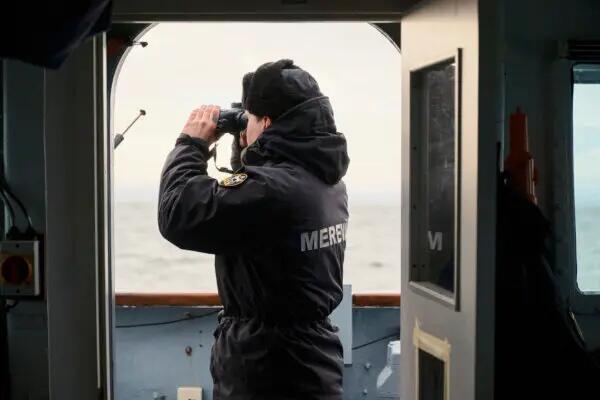
A sailor keeps watch on an Estonian naval ship patrolling in the Baltic Sea on Jan. 9, 2025. Hendrik Osula/AP

Russia is one of 170 signatories to UNCLOS, but the United States has never signed or ratified it, despite several presidents, including most recently President George W. Bush in 2007, urging the Senate to do so.

Roberts said the convention states clearly the different gradations of water boundaries, from inland waters to oceans.

He said there is no “right of innocent passage” for foreign ships in a country’s lakes, canals, rivers, or ports and they need permission to enter.

“Then, you have your territorial waters where you’ve got full sovereignty, up to 12 nautical miles. Then there’s a contiguous zone up to 24 nautical miles, where you’ve got some ability to intervene if there’s been an offense in your territorial waters,” Roberts said.

“Now, past that, is the EEZ (exclusive economic zone) where, as a country, you’re able to use and exploit marine resources in that area,” he said, referring to the area up to 200 nautical miles from a country’s coast.

“Then, there’s the continental shelf. Not everyone has that, but that’s out to 350 miles, and beyond that is the high seas,” he said.

“Anything outside 12 nautical miles, you haven’t got full power. If you start boarding vessels in what would be considered to be international waters without due cause, that would be antagonistic to the country of the vessels that you’re boarding.”

He said the shadow fleet vessels do not all have the same flag.

They have a variety of flags, so the number of states that you are likely to offend is quite wide, unless you’ve negotiated with them, unless you can prove that you have due cause,” Roberts said.

He said the 10 countries seeking to “disrupt and deter” Russia’s shadow fleet will have to prove the vessels are not engaged in “innocent passage.”

“How that’s done is quite hard,” Roberts said.

There is also the danger that Russia could retaliate by boarding Western ships in areas such as the Black Sea, or the White Sea, north of Murmansk.

Roberts said he questions whether sanctions against Russia can be effective, especially considering Moscow’s trade links with China.

“There’s a Western desire to show support for Ukraine ... and they chose to use sanctions as a way of showing that support. And I think there was an expectation they'd be more effective than they were,” he said.

Roberts said President Woodrow Wilson’s idea in 1919 to use economic sanctions was based on the premise that “they should be more terrible than war.”

But Roberts said, “Unless you’re targeting a very small area, you need international support. And this is where the weakness is: they haven’t got everybody onside.”

https://www.zerohedge.com/geopolitical/russias-shadow-shipping-fleet-how-it-works-and-why-it-hard-tackle

Texas Sues Allstate For Secretly Tracking Drivers Through Apps, Using Data To Raise Rates

 The state of Texas has sued Allstate and a subsidiary, Arity, accusing the insurance giant of illegally tracking drivers through cell phone apps without their consent and then using the data to charge more for car insurance.

Photo: Smith Collection/Gado/Getty Images

According to Texas AG Ken Paxton, Allstate created the "world's largest driving behavior database," which collected information on more than 45 million Americans after paying mobile app developers millions of dollars to secretly incorporate tracking software. The software was designed beginning in 2015 by Allstate's data analytics unit, Arity, and integrated into several apps such as Fuel Rewards, GasBuddy, Life360 and Allstate-owned Routely.

In a Monday complaint filed in a Texas state  court near Houston, Texas says Allstate also profited by selling the data to other insurers.

According to a press release from Paxton, These actions violated the Texas Data Privacy and Security Act (“TDPSA”), which created heightened protections for Texans’ sensitive data, including but not limited to precise geolocation information. The law requires clear notice and informed consent regarding how a company will use Texans’ sensitive data. Allstate never provided notice or obtained Texans’ consent to collect or sell their sensitive data. This is the first enforcement action ever filed by a State Attorney General to enforce a comprehensive data privacy law.

In addition, Texas has accused Allstate of purchasing data about vehicles' whereabouts directly from automakers in order to more accurately determine - not based on cellphone locations - when policyholders are actually driving.

Participating manufacturers allegedly include; Toyota, Lexus, Mazda, and Stellantis' Chrysler, Dodge, Fiat, Jeep, Maserati and Ram.

The lawsuit seeks restitution and other damages for consumers, along with civil fines of up to $10,000 per violation, and the destruction of illegally collected data.

Paxton filed a similar lawsuit in August accusing General Motors of installing tracking technology on over 14 million vehicles since 2015 to collect driver data, which the company sold to insurers and other companies without drivers' consent.

https://www.zerohedge.com/technology/texas-sues-allstate-secretly-tracking-drivers-through-apps-using-data-raise-rates

AtriCure Prelims, Upcoming Analyst & Investor Day

 AtriCure, Inc. (Nasdaq: ATRC), a leading innovator in surgical treatments and therapies for atrial fibrillation (Afib), left atrial appendage (LAA) management and post-operative pain management, today announced preliminary financial results for the fourth quarter and full year 2024 and provided 2025 financial guidance. Additionally, AtriCure announced that it will host an Analyst & Investor Day at its headquarters in Mason, Ohio on Wednesday, March 26, 2025.

Preliminary, unaudited revenue for fourth quarter 2024 is expected to be $124.3 million, reflecting growth of approximately 17% as reported and on a constant currency basis over the fourth quarter of 2023. U.S. revenue is expected to be $101.6 million, reflecting growth of approximately 14%, and international revenue is expected to be $22.7 million, an increase of approximately 28% as reported and on a constant currency basis. Fourth quarter revenue was driven by strong growth in our cryoSPHERE® devices for pain management, AtriClip® devices in open chest procedures, and the EnCompass® clamp.

Preliminary, unaudited revenue for full year 2024 is expected to be $465.3 million, reflecting growth of approximately 17% as reported and on a constant currency basis over full year 2023. As previously communicated, management expects full year 2024 positive adjusted EBITDA of approximately $26 million to $29 million, and full year 2024 adjusted loss per share of approximately $0.74 to $0.80. Adjusted EBITDA, adjusted loss per share and constant currency revenue growth are non-GAAP measures. AtriCure will provide a reconciliation of non-GAAP measures to the related GAAP measure in the release of audited 2024 results. Management will discuss financial results on the fourth quarter and full year 2024 conference call in February.

2025 Financial Guidance

Management projects 2025 revenue of approximately $517 million to $527 million and full year 2025 positive adjusted EBITDA of approximately $40 million to $44 million. Additionally, management expects modest cash flow generation for the full year 2025.

Analyst and Investor Day

AtriCure will host an Analyst & Investor Day at its headquarters in Mason, Ohio on Wednesday, March 26, 2025.

“Our team is excited to highlight our leading portfolio of products and innovative pipeline for market expansion at our Analyst and Investor Day. We also look forward to bringing perspectives from key opinion leaders as well as sharing longer-term financial goals as we continue driving growth and expanded profitability,” said Michael Carrel, President and Chief Executive Officer of AtriCure.

A webcast of the presentation and Q&A sessions will be available on the “Investors” section of the company’s website at https://ir.atricure.com.

https://www.businesswire.com/news/home/20250113069942/en/

Matterport, Surmodics drop amid news of FTC closed door meeting

 Shares of Matterport (NASDAQ:MTTR) and Surmodics (SRDX) fell as the Federal Trade Commission set a closed-door meeting for Thursday. 

While the exact subject of the meeting wasn't disclosed, investors are often concerned that the FTC may be voting on ongoing deals that are being reviewed. CoStar (CSGP) agreed to buy Matterport (NASDAQ:MTTR) and Surmodics (SRDX) agreed to a sale to private equity firm GTCR. The MTTR/CSGP deal received a 2nd request from the FTC in July and Surmodics dreqwa 2nd request in August.

Surmodics (SRDX) dropped 3.6% on Friday, while Matterport (MTTR) declined 3.7%.

The FTC meeting may include as many as a dozen items, according to a CTFN item on Friday, which cited people familiar with the regulator. One person downplayed speculation that the HashiCorp (HCP) sale to IBM (IBM) would be on the agenda as well as the Surmodics (SRDX) transaction was unlikely to be a topic at the meeting. Shares of HashiCorp (HCP) ticked lower by 0.5% on Friday.

The FTC meeting will be the final session under current FTC Chair LIna Khan, who is set to be replaced by Andrew Ferguson with the incoming Trump administration.

https://www.msn.com/en-us/money/companies/matterport-surmodics-drop-amid-news-of-ftc-closed-door-meeting-next-week/ar-BB1rf3cU

Alignment Healthcare Touts Industry-Leading Membership Growth


  • Achieves 35% year-over-year growth to 209,900 members on Jan. 1, showing how Medicare Advantage can be done right
  • Announces year-end 2025 health plan membership of 225,000 to 231,000 and reiterates confidence in achieving consensus adjusted EBITDA of $40 million in 2025

'New rule meant to slash nicotine levels in tobacco products'

The Biden administration is poised to try to lower the amount of nicotine in tobacco products, an eleventh-hour effort that’s been years in the making.  

The move would give the White House one last chance to try to regulate tobacco, as it previously punted on finalizing a long-standing pledge to ban menthol-flavored cigarettes

The rule has not been made public, so the specific language isn’t known, but it’s expected to require tobacco companies to slash the amount of nicotine in cigarettes and potentially other products to make them less addictive.  

It could be published as early as Monday by the Food and Drug Administration (FDA), after it cleared regulatory review earlier this month.

But that would only begin a bureaucratic journey that anti-tobacco advocates worry an incoming Trump administration may derail.

Smoking is the leading preventable cause of disease, death and disability in the United States, according to the Centers for Disease Control and Prevention (CDC), killing more than 480,000 people each year. More than 16 million Americans are living with a smoking-related disease. 

Most adults who smoke cigarettes want to quit, and half report trying to quit in the past year, according to a CDC survey from September. Yet less than 1 in 10 adults who smoke cigarettes succeed in quitting, drawn back in because of highly addictive nicotine that changes people’s brain chemistry so they want to smoke more.  

“Lowering nicotine levels will help millions of people quit smoking and prevent countless others from becoming addicted, sparing families nationwide from the devastating consequences of tobacco-related illnesses and death,” Nancy Brown, CEO of the American Heart Association, said in a statement to The Hill. 

Public health advocates said the policy has enormous potential if the Trump administration follows through. No limits currently exist, so setting any standard would be considered a major step forward. 

“If finalized, it would be such a game changer because that would mean kids who experiment with tobacco products, with smoking, are not signing themselves up for a lifetime addiction,” said Erika Sward, assistant vice president of national advocacy for the American Lung Association. 

The FDA has been talking about plans to lower nicotine levels since the first Trump administration in 2018. 

Under President Biden, the FDA in 2022 announced it was developing a proposed rule on the matter, set for release in May 2023. 

More than a year and a half later, the proposal is finally almost ready for publication. 

The FDA in 2022 estimated that reducing nicotine levels could keep more than 33 million people from becoming regular smokers, that about 5 million additional smokers would quit within a year and that 134 million years of collective life would be gained.   

Studies show that cigarettes with lower nicotine content reduce people’s dependence on nicotine and can help alleviate some of the cravings associated with withdrawal.  

“Lowering nicotine levels to minimally addictive or nonaddictive levels would decrease the likelihood that future generations of young people become addicted to cigarettes and help more currently addicted smokers to quit,” FDA Commissioner Robert Califf said in 2022. 

There won’t be any immediate changes to tobacco products. The proposal is just the first step.  

It will be up to the Trump administration to write, issue and put into effect a final rule, and it could be dialed back.

“We see this as a very important step for public health, but we are clear-eyed and knowing that this is just really the first step, because there’s going to be multiple efforts to try to either make the rule completely ineffective, to roll it back, to cancel it, to delay it. And we’ll be monitoring it at every step,” said Avenel Joseph, interim executive vice president at the Robert Wood Johnson Foundation. 

There will also be significant tobacco industry opposition, which has helped to sink numerous other potential regulations. 

Tobacco companies donated heavily to President-elect Trump’s campaign, and his chief of staff, Susie Wiles, worked as a tobacco lobbyist.  

“The tobacco companies have been fighting every sort of rulemaking from the FDA related to their products, and something that would actually make their products … less effective at being an addictive tool is going to be something that they’re going to throw every ounce of effort and money behind to try to defeat,” Joseph added.  

If the rule moves beyond the proposed stage, there will likely be industry lawsuits arguing the government overstepped. 

Yet public health advocates said they were not writing off Trump moving forward with the rule. 

While it did not happen during his first term, reducing nicotine aligns with the “Make America Healthy Again” movement championed by Robert F. Kennedy Jr., Trump’s pick to be Health and Human Services secretary. 

“As a nation, we are having a discussion about chronic disease, and certainly the Trump administration has brought that to the forefront,” Sward said. “Tobacco use is number one when it comes to chronic disease that can be prevented, and how Americans can be healthier.” 

“Few actions would do more to fight chronic diseases such as cancer and cardiovascular disease that greatly undermine health in the United States and that the incoming administration has indicated should be a priority to address,” Yolonda Richardson, president and CEO of the Campaign for Tobacco-Free Kids, said in a statement to The Hill. 

On the flip side, conservative free market groups and law enforcement associations argue the proposal would amount to a ban on cigarettes, supercharging a black market for illicit products.  

“For all intents and purposes, [the rule will] make cigarettes unregulated and throw it back out into the illicit market through a ban,” said Diane Goldstein, executive director of the Law Enforcement Action Partnership. 

“Anytime you create a law where you ban something, you put law enforcement in charge of the enforcement of that. And … we’re seeing that bans don’t work for their intended purposes of potentially reducing smoking.”  

Goldstein pointed to the proliferation of illicit products that followed FDA efforts to curb youth vaping. 

“Bans don’t affect people’s behavior; they just go to the underground market in order to find what they need,” she said.  

https://thehill.com/policy/healthcare/5080356-biden-administration-nicotine-levels/