Search This Blog

Wednesday, February 12, 2025

Trump Should Reinstate President Obama's Moratorium on Risky Biological Research

 President Trump is reportedly preparing an executive order to halt funding of risky viral gain-of-function research—lab experimentation designed to genetically manipulate biological agents to make them more transmissible and pathogenic.

Trump is right to do so. Following the Covid-19 pandemic, which killed more than an estimated 15 million globally, the rationale for such a moratorium is stronger than ever. It is highly likely that the deadly SARS-CoV-2 virus originated in the Wuhan Institute of Virology, a prominent Chinese lab and the epicenter of gain of function research on bat coronaviruses.

Current funding restrictions, evident in grant funding for research in China, are clearly inadequate. To address this, President Trump should quickly adopt a variant of President Barack Obama’s 2014 funding moratorium on gain-of-function research.

But that’s not enough. Given well-documented federal failures to effectively monitor risky research grants, as well as the emergence of serious bio-security threats from abroad, there is an urgent need for a comprehensive review and assessment of these experiments, at home and abroad.

Many scientists have long favored such research, arguing that it is necessary to create more pathogenic viruses so we can study their evolution and design vaccines to counter them. Nonetheless, in the interests of public health and safety, Obama wisely imposed the 2014 moratorium following several “biosafety incidents” at federal research facilities and then launched a review to assess the risks and benefits of gain-of-function research.

The Wuhan Chinese lab was a subcontractor of Eco Health Alliance, a controversial New York-based firm that had long received substantial federal funding, and which, to bipartisan applause, was recently banned from participating in federal research programs.

Moreover, the National Institutes of Health (NIH) also failed to effectively monitor federal grant funding for such overseas research.

The NIH research grant review process also proved dangerously weak. Congressional investigators reported that Dr. Anthony Fauci, the former Director of the National Institute of Allergy and Infectious Disease, repeatedly denied that his agency ever funded any gain-of-function research program in China. And they also reported  that Fauci would sign off on federal grants without actually reviewing them.

Beyond Covid-19, there have been other lapses. For example, NIH officials also failed to be transparent about a recent case of gain-of-function research on the MPXV virus, which causes the dangerous disease called Monkeypox. Remarkably, NIH officials misled congressional investigators about the status of that research for approximately 17 months.

We must clear up the confusion. Gain-of-function research has become a flashpoint in the debates over the origin of COVID-19, largely because of federal officials’ inadequate responses to legitimate congressional inquiries.

In its recent report on Covid-19 oversight, the House Select Subcommittee on the Coronavirus Pandemic observed, “Throughout the Covid-19 pandemic many scientists and government officials categorically denied that taxpayer funds were used for gain of function research in Wuhan at the Wuhan Institute of Virology. These assertions rested on semantics and the misapplication of understood definitions.”

NIH officials’ poor performance in responding to congressional inquiries on the topic has further undermined trust among lawmakers and the general public alike. For example, as of October 20, 2021, the NIH website described gain of function as “a type of research that modifies a biological agent so that it confers a new or enhanced activity to that agent.” On that very same day, following a congressional inquiry on the subject, that definition mysteriously disappeared from the agency’s website. Naturally, congressional investigators and the public have every right to be suspicious of NIH officials’ behavior.

The gain-of-function controversy came to a head in 2021. In congressional testimony, Fauci—rather than cite the established NIH definition of these experiments on its website—consistently relied on a separate regulatory definition, the 2017 PC30 Framework, that restricted federal dollars for gain-of-function experimentation to a subset of pathogens that were already dangerous to humans, i.e., “highly transmissible” and “highly virulent” and capable of “wide and uncontrollable spread’ thus inflicting high morbidity and mortality on human populations.

As we have noted previously, this regulatory definition of “gain of function of concern” does not render such viral research less risky under the generic, or non-regulatory, definition of such laboratory experiments. A virus in the wild that is not naturally dangerous to humans—as distinct from the deadly viruses categorized under the PC30 Framework—can be made very lethal to humans by genetically manipulating it and inserting that modified virus into a mammal engrafted with human cell receptors, such as we believe was the case with COVID-19.

The risks of a pandemic are even greater if such lab work is being conducted under substandard safety conditions, which was certainly the case at the Wuhan Institute of Virology. And in China, under the terms of the NIH generic definition, American taxpayers did indeed fund gain-of-function research on bat coronaviruses and using “humanized” mice. Among others, Lawrence Tabak, acting Director of NIH, conceded that such research would fit the traditional, or generic definition of gain-of-function research as initially defined on the NIH website.

Andrew Noymer, professor of public health at the University of California in Irvine, has argued, “ To avoid a repeat of COVID, we need better regulation of gain-of -function virology, and full transparency about coronavirus research in the years leading up to the pandemic.”

While the global Covid-19 pandemic has now unfortunately become endemic, the case for enhanced biosecurity is even more urgent. Today, policymakers should especially be on guard against the threat of a genetic manipulation of the H5NI virus, an avian influenza already dangerous to human beings. H5N1 has rapidly emerged as a major agricultural threat to the poultry and dairy industry affecting both egg and milk production.

Earlier gain-of-function research conducted in Europe figured out how to modify H5N1 so it could now be modified to infect humans by aerosol and droplet transmission. H5N1 has already infected more than 25 mammal species in the US, bird to mammal, however it has not yet learned how to go mammal to mammal.

H5N1 will continue to try to learn how to transmit among mammals. No one knows how long it will take for a natural spillover to occur. That said, in the laboratory with gain-of-function research techniques, this is easily accomplished in weeks. Once the virus is made, the risk of a lab leak will be imminent.

Next Steps. We must learn from the missteps that led to the COVID-19 pandemic and halt this dangerous research until society can engage in a broader debate to determine its value to protect public health compared to its risk. And, assuming such research can be justified, we need to figure out how best, and under what circumstances, it could be conducted in a safe, effective and responsible way.

In the face of potentially grave threats, the Trump administration should update President Obama’s policy of “pausing” gain-of-function research and go further by renewing a comprehensive assessment of the state of that research. This would at least include the value of that research and its risks and benefits, clarity on the different levels of risk entailed by such research, and the standards and protocols that must govern the permissible conduct of any such research at home and abroad.

Needless to say, any such research should be limited and conducted at the highest levels of laboratory safety in our nation’s most secure laboratories, such as the Centers for Disease Control and Prevention (CDC) or Fort Detrick.

Moreover, given the well documented lapses in the NIH review process, policymakers should also remove final approval of any gain-of function research grants from NIH and, as congressional investigators have recommended, transfer that responsibility to an independent commission. Such a commission should be comprised of top-tier scientific advisors and national-security experts free of any government agency biases or private financial interests.

Congress should also restrict federal and private sector biotechnology investments in China, as recommended by the nonpartisan Commission on China and Covid-19,as well as any other state actor that could pose a bioweapons threat to the United States and its allies.

Biosecurity is one of our country’s greatest national security threats. The incoming Trump administration is right to take urgent action to scrutinize gain of function research. In the process, Trump officials can ensure the public health and safety of millions of Americans, as well as people around the globe, strengthen our biosecurity defenses, and restore ordinary Americans’ trust in public health—a crucial objective if we are to have an effective public health system.


Robert R. Redfield, MD, served as Director of the Centers for Disease Control and Prevention (CDC) during the first Trump administration. Robert E. Moffit, PhD, is a Senior Research Fellow in the Center for Health and Welfare Policy at the Heritage Foundation.

https://www.realclearhealth.com/articles/2025/02/11/president_trump_should_reinstate_president_obamas_moratorium_on_risky_biological_research_1090852.html

Mothers Support Robert F. Kennedy, Jr.’s Plan to Make America Healthy Again

 With the pending confirmation of Robert F. Kennedy, Jr., as secretary of Health and Human Services this week, some mothers may be concerned about what his leadership means for the future of their children’s health. Despite some concerns from the mainstream media, his success will mean better health for all of us.

A top concern of many, including some doctors and medical experts, has been Kennedy’s stance on vaccinations. While most antagonistic reports have labeled the well-known environmentalist as “anti-vax,” Kennedy insists he is pro-safety and pro-good science. During his two confirmation hearings, he reiterated he would not reverse the childhood vaccine schedule, particularly the MMR vaccine.

Most traditional doctors insist that vaccines are safe and effective and that, as Senator Margaret Hassan (D-NH) said during her line of questioning to Kennedy, “the science is settled.”

However, Senator Rand Paul (R-KY) along with Senator Markwayne Mullin (R-OK) questioned their Democrat colleague, asking if they want every possible cause of autism in the past decades investigated. According to Kennedy, one in 36 children has autism. “If that’s not a pandemic, I don’t know what is,” Senator Mullin stated. “That scares the living daylights out of me.”

Kennedy, with the strong support of many mothers across the country, simply wants to get to the bottom of the massive increase in childhood disease, including autism and cancer. We should let him.

While vaccinations remain a hotly contested topic within the health community, food additives and flavorings are a different story. According to most doctors, vaccines offer a substantial benefit—that of disease prevention—against which any risk must be weighed. However, ingredients such as the recently banned red dye 03 and many “natural flavors” offer no nutritional value to food. Rather they are used for the sole purpose of making food more attractive and enticing, particularly to younger children.

This leaves parents wondering whether food companies are putting profits over safety, and whether the FDA doing enough to prevent that. Parents clearly aren’t satisfied with the current regulatory framework and the amount and level of testing currently required for food additives.

Kennedy shares these concerns and will likely require the FDA to more regularly test ingredients that are used by food manufacturers to ensure their continued safety as well as requiring the agency to do a better job of sharing that information with parents so that they can make the best decision for themselves, and in the case of parents, for their families.

Mothers, who hold 85% of household purchasing power, make a myriad of these decisions, both small and large. From what kind of toys to which cars are the safest, from the television shows they watch to the school they attend. Why should this be any different for what goes into their child’s body whether consumed through food or pharmaceuticals?

This is what MAHA Moms, as they have become affectionately known, are demanding. As Zen Honeycutt, the head of Moms Across America stated: “We just want to see these businesses be accountable for their products, to be responsible for safe product. The interests of the corporations should not precede our children’s safety. Period.”

Food companies shouldn’t actively be employing deceptive marketing tactics and using unnecessary food additives—like dyes—at the expense of children’s health. We can’t turn back the clock to the days when cooking from scratch was the norm. Yet, we can restore peace of mind when preparing food for our families by restoring the faith and trust we have in our public health institutions—the very institutions charged with keeping us and our families safe.

Kennedy’s commitment to this goal may require some tools from the federal government, but our children are worth it.

Jennifer Galardi is a visiting fellow at Independent Women and a leading voice and influencer in the health and wellness industry. She produces and hosts the podcast Connection with conversations that address health, culture, and policy. She is a frequent guest on the Jesse Kelly show, and her work can be seen in The Federalist, The American Spectator, Epoch Times, the Blaze and other publications. 

https://www.realclearhealth.com/articles/2025/02/12/mothers_support_robert_f_kennedy_jrs_plan_to_make_america_healthy_again_1091023.html

A Kindergarten Teacher in California Breaks Her Silence on DEI


Today, during an argument with a colleague about DEI, I was once again called a “white supremacist.” I am, of course, no such thing. What had I said? I dared to say that I agree with President Trump’s stance on eliminating all forms of DEI in schools. It’s not the first time I’ve been slandered, and I’m sure it won’t be the last. But I’ve had enough.


In the past few months, especially after the incredible victory of President Trump in this election, I’ve decided to stop staying silent.

I’ve resolved not to be afraid to speak my mind, to say what I believe, to share my views, and to voice my disagreements—even if it means being looked at differently or being despised by those around me. The kids I teach deserve no less.

I am a teacher in Silicon Valley, one of the most liberal places in the United States. At my school and among my colleagues, the dominant opinion aligns with the so-called “woke ideology,” which is very different from what I believe. For months, I felt stayed silent. I sat restlessly through DEI (Diversity, Equity, and Inclusion) meetings and listened in silence to insults aimed at President Trump and anyone who supported him. I endured endless discussions about land acknowledgments, skin color, and gender ideology without expressing what I truly felt. It felt worth having a debate about DEI’s pedagogical impact on children. But no one wanted a real debate.

Then something changed.

After Trump’s victory in November, I realized I was not necessarily part of a minority. The majority of Americans shared my opinions, and perhaps yet more did –– both in our school and in the homes of the families who entrust their children to us. That gave me the courage to start speaking out.

The day after the election, while everyone around me expressed sadness and disappointment over Trump’s win, I decided to say simply, “I’m happy.” From that moment on, I’ve been called names—white supremacist, racist, stupid. It’s odd to me that the same people who preach “Diversity, Equity, and Inclusion” have decided to exclude and insult me simply because I hold different beliefs. It seems those principles don’t apply to diverse perspectives or ways of thinking. That’s a disservice to children. The amount of raw material we convey to children in school –– a few historically important artists here, a few composes there –– is minimal compared to the reading and learning these kids will do at home, with friends, and on their own. They, therefore, must develop critical reasoning capabilities that allow them to judge the credibility and even the moral worth of everything they consume.

As a teacher, I’ve observed that DEI does the opposite. It can strip children of those faculties. I strive to teach my students genuine respect and inclusion—regardless of their skin color, gender, beliefs, or culture. In fact, beneficent inclusion is their natural tendency. What is missing is critical thinking. Herd mentality is the default, and that is why I aim to teach my students to speak their minds, to express themselves without fear, and to listen to others with respect, even when they disagree. Especially when they disagree.

I believe it’s through listening to different views and dissent that critical thinking is developed. I also aim to teach my students that success is based on merit. If they want to achieve something, they must work hard for it. Nothing worthwhile comes without effort, and I want them to understand the value of perseverance, dedication, and hard work. Our value lies far more in work than in the mere circumstances of our birth.

Above all, I want my students to be free—free to choose, free to speak, and free to think. That is what I want for myself as well. Freedom is the cornerstone of this country, and it’s a principle I will always stand by and uphold. In education, typically slow to change, it is beginning to feel like a new era.


Michelle Bal is a Kindergarten teacher in Palo Alto, California, originally from Milan, Italy.


https://www.realcleareducation.com/articles/2025/02/10/a_kindergarten_teacher_in_california_breaks_her_silence_on_dei_1090509.html

NIH must make these 8 reforms right now

 by Vinay Prasad

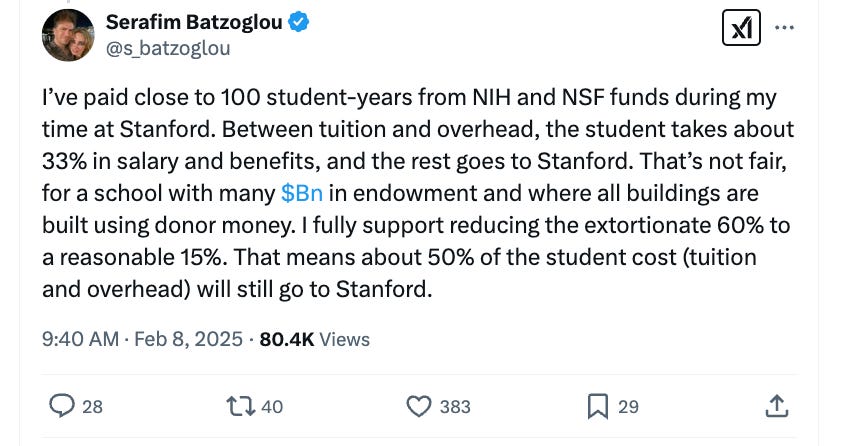
For years university researchers have complained that high indirects mean their institution takes a large portion of the money they earned, but now that Trump’s NIH is cutting indirects from 60 or even 90% to 15%, researchers are up in arms.

One argument they make is that each dollar given to the NIH has return on investment. It earns 2-3 dollars back. Let us set aside for a moment the low quality (and NIH funded) evidence used to make this claim— I don’t doubt that science has massive ROI because it generates technology. But this says nothing about waste. You could be earning 5 to 10 dollars instead of 2-3, if we trim the waste. Why not do that?

Here are 8 reforms the NIH must do

  1. Indirects - Trump was right to go after indirects. This money is largely unaccountable to the American people. A famous researcher liked to say that “an NIH dollar is more valuable than any other dollar” precisely because the money can be used for any purpose. For people running computational labs, the indirects are insane. How can you justify 65% to sit at home on your computer? For some training grants, only a fraction of the money reaches the intended purpose. How can we allow this:

  1. Some universities launder indirects. They take a portion of the indirect money and give it back to the researcher, who can use it as unrestricted funds. This is used for travel, including business class travel to Europe, and events with alcohol. It's hard to justify the use of taxpayer money in this fashion. It's again hard to justify taxing a plumber so that an upper middle class scientist can lie down on their flight to Geneva. This should be banned.

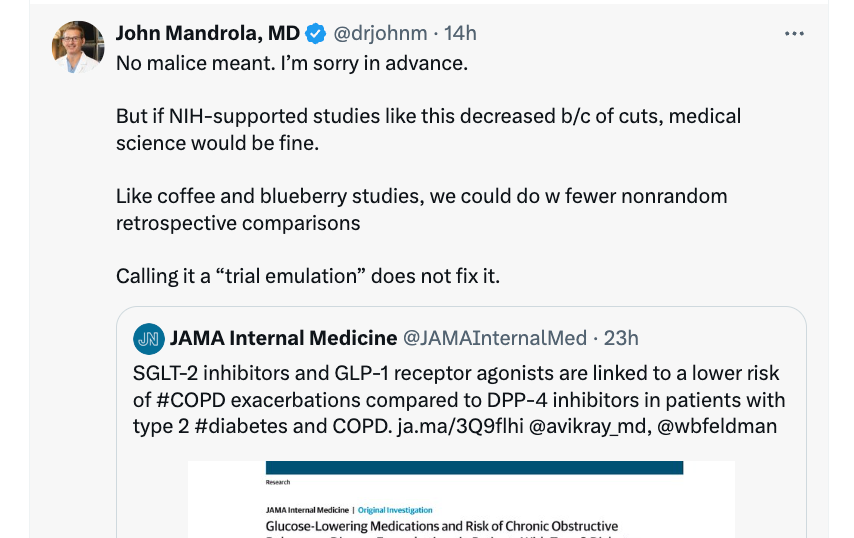
  2. Stop funding bad science. I don’t know why many have a hard time admitting but most of science is neither true nor useful. Here is an NIH funded paper.

It uses observational data to claim DPP-4 drugs are worse for your diabetic COPD pt than GLP-1 wrt COPD exacerbations. But, as John tells us, it proves literally nothing. In fact, if you really wanted to know what order to initiate diabetic medications in a diabetic COPD pt, you should randomize them to GLP1RA then DPP-4 if poor control or vice versa, or perhaps 10 different treatment strategies, then measure the range of outcomes (COPD/ mortality/ etc). That study can be done with or without this retrospective study— i.e. this is not even hypothesis generating. The NIH funds so many studies like this. Waste.

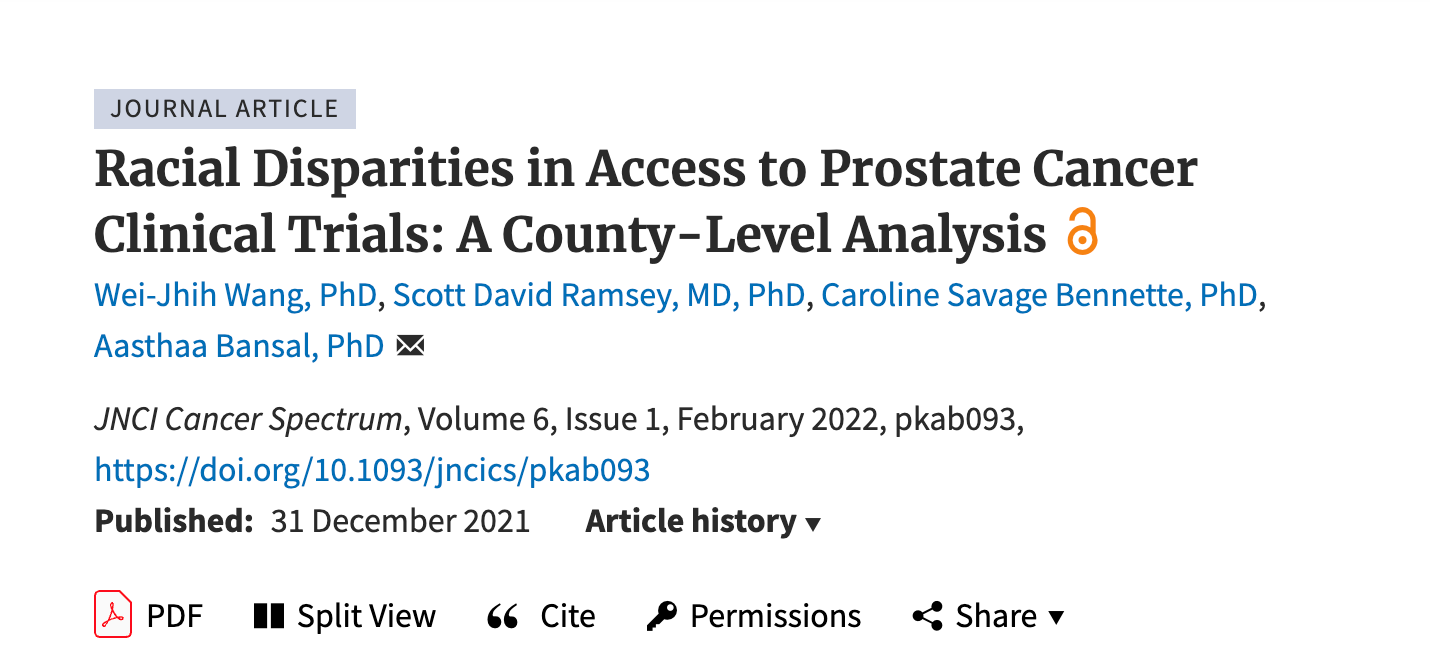
  1. Stop funding science the American people are sick of. This is an NCI funded study.

First, it is a county level analysis. It shows that counties that have more Blacks have fewer cancer centers and fewer trials. What is the purpose of this research? This has been known for decades. The article doesn’t tell us what we can do to fix it. Build more centers? Have target enrollment criteria for Blacks? But what about the bigger question: is it even a good thing to enroll on trials? Some prostate trials are really bad. I call PROFOUND, profoundly bad. Many use unethical control arms. I wouldn’t want my father to enroll on many of these trials. Why should we increase the number of Blacks who enroll on them? This research smells to me like the classic: NIH funds the buzzword ‘diversity’, whether the research is useful or not.

  1. Don’t kill mice, dogs or monkeys without knowing if we are getting valuable information. Each year, millions of mice are killed at universities to cure cancer. The trouble is we have no idea if this is helpful. A common method to screen cancer drugs for their success and toxicity in human beings is to take genetically engineered mice, grow cancer under their skin, and then administer the drugs to see how effective they are. The trouble with this is that we have been able to successfully cure these mice for decades. But many times, the successful drugs don't work in people. The NIH has never studied whether or not these animal models are broadly predictive of human outcomes, and which ones are needed and which can be cut. How can we kill millions of mice to screen candidate compounds when we don't know if that screen actually helps us select better drugs to advance? Finally, there is an element of moral anguish as some of the people who have to crack the necks of these mice do not enjoy doing that, and only do so under the uncertain premise this is needed.

    In medical school, my colleague had to put a tourniquet around the neck of dogs, to strangle them to cause a stroke, so he could give drugs that don’t work, and have no possibility of working, to try to fix them. He was so broken by the experience, he hated neurology/ neurosurgery, and worked in an animal shelter to pay penance. We owe it to animals and people to understand if this work is necessary (I suspect it is not only unethical, but scientifically useless to boot).

  2. Randomize grant giving. It's astonishing to me how much researchers criticize the current system of study sections, without admitting that it is completely unproven. The NIH has a duty to know whether or not the cumbersome and complicated method by which money is allocated is superior to a lottery. Take $200 million, and randomize it to the current system or a lottery, and follow outcomes. I strongly suspect, given the limitations of the study section membership, given the idiosyncrasies of grant making, that a lottery would achieve similar results.

  3. Audit the intramural branch. The intramural branch syphons off 4 billion dollars, and it is unclear if the productive justifies its existence. It needs independent audit and likely strict downsizing.

  4. The NIH should explore whether or not to penalize universities that restrict the first amendment rights of faculty, or fail to uphold academic freedom. It is imperative for science to have a free exchange of ideas, but that was broadly abandoned in the pandemic. Stanford famously censured Scott Atlas for saying schools should be open and kids shouldn’t mask, and many faculty were discouraged from speaking. Right now some universities have sent gag orders to faculty to comment on indirects while they fight this in court. These actions are un-American, and the NIH should consider commitments to academic freedom/ freedom of speech as it funds institutions.

  5. Penalize labs that do work that can’t replicate. The NIH should audit grants, and randomly pick basic science experiments. It should then commission other groups to replicate those studies. With time, each researcher can get a “replication” score card. If you run lab studies that fail to replicate much worse than your peers, you should lose funding. We should defund labs where people say, “Don’t worry, everything is looking great now, Dr. Tessier-Lavigne.”

The NIH generates return on investment, but that means waste has been tolerated for decades. The American people deserve to know that each dollar they spend has been MAXIMIZED and OPTIMIZED. This has never been attempted, despite decades and hundreds of billions in funding. Thankfully, the opportunity for reform has never been better, as the American people know that scientists cannot be blindly trusted.

https://www.drvinayprasad.com/p/the-nih-must-make-these-8-reforms

Medical Student Research

 I was recently having lunch with a friend who is a first-year medical student, one year behind myself. He had been working with a few professors on clinical research projects and was hoping to first-author a project of his own soon.

“My research mentors all tend to give me a lot of room to take my own initiative for projects,” he was explaining.

“Does that mentorship style work for you?” I asked.

“No,” he smiled sheepishly and went on to talk about how it had been challenging adjusting to doing medical research. He often felt research meetings were rushed, leaving him with a few next steps and no clear idea why the question he was told to ask mattered in the grand scheme of things. What he did know, however, was that to be competitive for his desired specialty, he needed publications. So, while this arrangement wasn’t the ideal research relationship, it was a mutually beneficial one. The professor provided a question about which a paper could be published, and the medical student did the legwork.

“Publish or perish” refers to an academic’s need for output to continue in his or her career. This is a necessary, perhaps even useful incentive in academia. However, for students, I have to ask: Has this gone too far?

As students, we struggle to find time to meet research demands while mastering the curriculum. What’s more, the very research we do is often of little interest. It often takes the form of an analysis of some dataset in the hope of finding a publishable result.

Maybe I am too early in my career for this, but I ask myself, “is this the training path we want for the next generation of academic clinicians?” The answer may be yes—perhaps hours in the library trying to more deeply understand what is taught is no longer necessary. Perhaps medical student research is just supposed to get one’s “feet wet”, with the real hypothesis generation and question-asking beginning later in training.

In this article, I want to suggest that we need to clearly articulate fundamental questions for medical training: what does it take to be a good doctor? What does it mean to be a good academic doctor? For the medical student aspiring to these goals, where should his or her focus be during the preclinical and clinical years?

Students beginning medical school are talented, driven, and want to use their training to help people in a meaningful way. But they’re also looking for direction: practically, how can I make the most of my preclinical years? More fundamentally, what are the ideals of good medicine to strive for? This vision is typically presented to students by doctors who are striving for the same thing.

The modern medical student probably does need to spend time on research to succeed in an academic medical center. But understanding what the point of this early-stage research is — in the broader context of a training plan towards becoming an excellent, reliable doctor in a rapidly evolving medical landscape — would give students the opportunity to dive into these experiences with their whole heart.

Jonathan Sutkowski is a medical student at Northwestern University with an interest in internal medicine, particularly pulmonary and critical care medicine.


https://www.sensible-med.com/p/medical-student-research