Search This Blog

Thursday, June 5, 2025

Medicare’s Drug Price Negotiation And Innovation: What’s Off The Table


The Inflation Reduction Act of 2022 marked a significant shift in US health care policy, granting the Centers for Medicare and Medicaid Services (CMS) the authority to establish a program to negotiate Medicare drug prices with manufacturers. The goal is to make prescription drugs more affordable and accessible for patients, and to maintain the sustainability of the Medicare program. In August 2023, CMS identified the first 10 drugs for price negotiation. In August 2024, CMS announced the new prices for these drugs, which are slated to take effect in 2026.

The pharmaceutical industry has voiced concerns over CMS’s negotiation program. Specifically, some critics believe that the potential reduction in revenue from new drug prices would curtail investment in research and development (R&D) and restrict patient access to novel treatments. This apprehension is not new. The impact on innovation is a common refrain against policies to affect pharmaceutical profits. Although profitability has a direct impact on drug innovation, marginal change in revenue is not necessarily proportional to marginal change in R&D spending for individual pharmaceutical companies, given the complex dynamics between drug development and investment.

The relationship between the new drug negotiation program and likely future pharmaceutical innovation is further complicated by the fact that a long list of drugs is exempted from the program. This is not the case in other countries that have long practiced drug price negotiation. This article examines the potential impact of these exemptions on future drug innovation.

First and foremost, drugs with total annual spending under Medicare Part B (which covers drugs that are administered in a medical setting) and Part D (which covers retail drugs) combined of less than $200 million are exempted from the price negotiation. The program targets high-expenditure prescription drugs that have a considerable market presence and have been without generic or biosimilar competition for a substantial period following approval by the Food and Drug Administration (FDA) (nine years for small-molecule drugs and 13 years for biologics). The first 10 drugs selected for negotiation have been on the market for an average 16.8 years, ranging from 11 to 28 years. The total cost of these drugs was $56.2 billion, accounting for 20 percent of CMS Part D spending in 2023. Spending on individual drugs ranged from $2.57 billion to $16.48 billion between June 2022 and May 2023. That same year, patients paid `1234 for these drugs. To put these numbers into context, the average R&D costs from drug discovery to launch were estimated at $2.3 billion.

With current eligibility criteria, 80 percent of the 250 drugs with the highest 2022 US domestic net revenue would not be eligible for negotiation. Viewed another way, if the program had started in 2012, only $43.2 billion, representing 4 percent of $1.14 trillion in 2022 global pharmaceutical industry revenue, or 6 percent of $742 billion in global revenue for the affected companies, would have been subject to negotiation.

In August 2024, CMS announced the Maximum Fair Prices (MFPs) negotiated for the 10 drugs and estimated that net Part D spending would have decreased by 22 percent had the new prices been in effect in 2023. Discounts ranged from 38 percent (Imbruvica) to 79 percent (Januvia). While some of the negotiated prices appear to have steep discounts compared with list prices, such a comparison is misleading. This is because the list prices presented by CMS are wholesale acquisition costs (WACs). WACs do not include discounts and rebates, and therefore do not reflect the actual price Medicare paid for a drug—which is considered confidential and proprietary. In a testimony before the US Senate, Merck CEO Robert Davis reported that the weighted average net price (post-discount/rebate) for Januvia is 90 percent less than its list price. While there may be differences in rebates among Medicare, Medicaid, and other programs, many of the drugs selected for the first round of negotiation are older products nearing the end of their patent exclusivity (for example, Stelara, Eliquis) and would likely already have deep discounts. Together with the exemption, this dynamic helps limit the actual impact of the negotiations on revenue received by manufacturers.

Small Biotech Exemption

second exemption, which could impact innovation in as-yet unknown ways, is for small biotech drugs with less than or equal to 1 percent of Part D spending (and eventually Part B) and 80 percent or more of the Medicare program expenditures for the drug’s manufacturer. This is probably in recognition of the fact that small biotech companies are often a driving force for developing groundbreaking therapies that are later marketed by big pharmaceutical companies. Between 2011 and 2016, 65 percent of 170 new molecule entities approved by the FDA originated from small or mid-size biotech companies. Large companies tend to either partner with or acquire smaller companies that developed the drug. There is speculation that few small biotech companies would be eligible for this exemption. To date, CMS has approved four drugs originating from small biotech.

The intent of the exemption is to allow these small biotech companies to maintain higher revenue compared to large pharmaceutical companies and ensure they are not disproportionally affected by the new pricing policy. However, many small companies responsible for initial drug development may not have the infrastructure necessary for commercialization as they are often dealing with a single product instead of an entire portfolio. It may be in their best interest to sell the new product to a larger company that can commercialize it more efficiently. Yet, qualifying single source drugs are not eligible for the exemption if they are acquired by a large drug manufacturer after 2021. This removes a major source of revenue for small companies oriented toward drug discovery. To this end, the “small biotech” exemption potentially disincentivizes innovation among small biotech firms.

For small biotech companies that decide to commercialize, the criteria of the single source drug consisting of “80 percent or more of the Medicare program expenditures for the manufacturer” may cause further disincentive for innovation. These companies likely do not have another blockbuster drug, and having a single product is a vulnerable time for them. They may seek to build their portfolio in other ways. Approximately one-third of therapies originating from large pharmaceutical companies are later sublicensed to small firms for production. This is especially common for therapies for rare diseases. The gain in revenue by licensing an existing product for a small patient population may not offset the cost of losing the price negotiation exemption for their qualifying drug. Thus, the exemption could also disincentivize small companies seeking to build their portfolio and ultimately compete with large companies to create a more diverse and competitive ecosystem. As the pharmaceutical industry is in a transitional period (due to the upcoming patent cliffchanges in the regulatory environment, and so forth), more research on the impact of this exemption on innovation among small biotech is required.

Orphan Drug Exemption

A third exemption is for drugs that are designated for only one rare disease or condition and approved for an indication (or indications) only for that disease or condition. This exemption includes drugs that have been FDA-approved for multiple indications within the same disease (for example, for children, adults, or other subgroups). It does not, however, include drugs that have indications for multiple diseases. Drugs for single indication, rare disease are generally not subject to price negotiation, making them attractive to investors. For instance, there has been significant deal activity around antibody drug conjugates (ADCs). These drugs are designed to target specific types of cancers, rather than being used for multiple indications. The number of ADC trials has risen in recent years, accompanied by increased acquisitions.

Nevertheless, of the 282 orphan drugs approved by the FDA between 2003 and 2022, 63 (23 percent) had at least one follow-on indication. One potential impact of this exemption is that it may disincentivize pharmaceutical companies from conducting the additional trials required to obtain follow-on indications. Pharmaceutical companies have long been criticized for making R&D decisions based on financial considerations, not unmet need. However, if a large pharmaceutical company decides not to pursue an additional indication for financial reasons related to the CMS negotiation program, it may open doors for small biotech, government or patient groups interested in developing other therapies in these areas with a high unmet need.

Some stakeholders have also questioned whether this exemption is even necessary given the original intent of the Orphan Drug Act, which is to provide incentives to develop drugs for conditions affecting fewer than 200,000 individuals in the US that have “no reasonable expectation” that revenues will offset development costs. Yet, drugs approved for rare diseases earn similar revenues to drugs for common conditions. From 2012 to 2021, total Medicare Part B and Part D spending on the 95 high-spending Orphan Drug Act–designated drugs was $517 billion (25 percent of Medicare drug spending). The median sole orphan drug in this cohort was projected to earn revenues of $21.9 billion, which far exceeds published estimates of drug development costs. When it comes to these financially successful orphan drugs (that is, achieving greater than $200 million in spending), CMS is leaving a significant amount of savings (for themselves and patients) off the negotiating table.

Conclusion

The future of health care hinges on striking a delicate yet crucial balance between ensuring affordability for payers and incentivizing innovation within the pharmaceutical industry. The CMS drug price negotiation program represents a pivotal shift in US health care policy, promising to lower prescription drug prices. However, the anticipated reduction in revenue from lower prices for drugs that already have a considerable market presence may not significantly hinder drug innovation, while the orphan drug exemption could leave significant savings off the table. The exemption on small biotech companies could have unintended consequences as these companies, as a key driving force in drug innovation, are often engaged in distributed partnerships with large pharmaceutical companies, leading to a more profound impact on the pharmaceutical ecosystem.

https://www.healthaffairs.org/content/forefront/medicare-s-drug-price-negotiation-and-innovation-s-off-table-matters-too

Insurers Are Covering Up Wide-Scale Medicaid Fraud


New Mexico’s program is just the tip of the iceberg.

While experts have long dismissed large-scale Medicaid fraud as improbable, evidence from New Mexico tells a different story. This discovery presents an unprecedented opportunity to offset part of the $880 billion budget deficit without cutting healthcare services for enrollees.

As the most powerful stakeholders, insurers frame fraud as an issue with hospitals, physicians, and enrollees while quietly escaping scrutiny themselves. A 2020 Health and Human Services report claimed that fraud in Medicaid fee-for-service stood at 12.3%, compared to just 0.3% in Medicaid managed care, reinforcing the industry’s message that managed care is highly efficient. However, the Government Accounting Office offers a starkly different interpretation, arguing that fraud in managed care is simply escaping detection.

Unlike fee-for-service, managed care payments are issued in advance based on projected costs. When actual costs turn out to be lower, insurers are legally required to return excess funds. The failure to do so amounts to fraudulent retention—and this is where a massive financial recovery opportunity lies.

New Mexico’s Medicaid program provides a striking case study:

  • A 2019 report from the New Mexico Legislative Finance Council revealed that the state recovered $660 million in overpayments made to Medicaid insurers between 2014 and 2017.
  • The recovery occurred well after the 60-day deadline imposed by the Affordable Care Act, violating False Claims Act provisions.
  • Under the False Claims Act, insurers must not only return overpaid funds, but also pay treble damages, which happens when a court awards a plaintiff three times the amount of actual damages assessed by a jury. Applying this rule, an additional $2 billion remains uncollected from New Mexico’s Medicaid insurers.

New Mexico’s case highlights a national loophole: 34 other states that expanded Medicaid under the Affordable Care Act received similar deliberate overpayments—yet they have taken no action to reclaim excess funds.

A conservative estimate based on New Mexico’s findings suggests that at least $100 billion remains uncollected nationwide. Including treble damages, the total potential recovery could exceed $400 billion.

Another major issue stems from how Medicaid premium rates are calculated:

  • Rates are based on previous years’ premiums—meaning that if overpayments go unnoticed, future premiums carry inflated costs.
  • This results in persistent excessive payments to insurers, sustaining inflated costs for over a decade since the implementation of the Affordable Care Act.
  • While it remains unclear whether the Affordable Care Act allows recovery of inflated premiums from previous years, addressing these errors today would significantly reduce future Medicaid costs.

By enforcing existing laws, it is possible to cut Medicaid costs without reducing services.

For instance, the Affordable Care Act mandates that 85% of managed care premiums must be used for medical costs. If costs fall below this threshold, insurers are legally required to return excess funds to the government. New Mexico proved this rule works—other states must follow suit.

Yet, insurers have manipulated the fraud conversation to shift blame elsewhere. Their lobbying influence ensures media narratives that vilify low-income patients, physicians, hospitals, and labs, while shielding their own financial misconduct. This is a classic case of the fox guarding the henhouse—and it must end.

Perhaps the Centers for Medicare & Medicaid Services finds it politically awkward to enforce these rules given its direct partnership with insurers in providing care. To remove conflicts of interest, the best solution is to separate enforcement from administration.

This issue isn’t just an opportunity—it’s an obligation. If policymakers fail to act, they will knowingly allow fraud to persist on a historic scale, threatening the ability of Medicaid to provide medical care to its intended beneficiaries.

Billions can be recovered for taxpayers, premiums reduced, and Medicaid costs contained—all without hurting enrollees. The federal government must act now.

 are, respectively, a Senior Fellow at The Claremont Institute and a New Mexico scientist using patented software to forecast healthcare costs and uncover fraud.

https://americanmind.org/salvo/insurers-are-covering-up-wide-scale-medicaid-fraud/

A Trillion Reasons to Ignore CBO Projections

 When the Congressional Budget Office reported that the Republicans’ “big, beautiful” reconciliation bill would boost deficits and throw millions off insurance rolls, it was treated as gospel truth.

The CBO is, after all, a “non-partisan” agency, staffed by just-the-facts-ma’am budget and economic experts who don’t have any axes to grind.

Maybe that’s true. But it’s not partisan bias that is the problem. It’s the CBO’s terrible track record when it comes to predicting the impact of tax and health care policies.

By the CBO’s accounting, the House reconciliation bill would cut tax revenue by $3.7 trillion and cut spending by $1.3 trillion over the next 10 years, resulting in deficits that are $2.4 trillion larger than they’d otherwise be.

First, it’s important to note that the bulk of the “tax cuts” aren’t tax cuts at all. The Republican bill would simply prevent a massive tax increase that would take place if Congress were to let the 2017 tax cuts expire.

The CBO assumes that, should those tax cuts expire, nothing else will change. The economy will keep rolling along, businesses and individuals won’t change their behavior in the face of a sudden tax hike, job growth will remain unchanged.

That is a fantasy. More likely, a sudden spike in taxes would cause a recession, which would explode federal deficits and throw millions out of work.

What’s more, the CBO’s attempt to forecast tax revenues has already been proved deeply flawed. In early 2018, it projected tax revenues that would result from Trump’s tax cuts, which he signed in late 2017.

Before the Trump tax cuts were enacted, the CBO forecast that revenues from 2018 through 2024 would total $28.2 trillion. After the tax cuts, it said revenues would be $27 trillion. The actual result: $28.5 trillion. In other words, the Trump tax cuts more than paid for themselves, and that’s despite the intervening COVID recession, which cratered tax revenues in 2020.

Why was the CBO so far off the mark? Because it didn’t account for the extra economic growth that the Trump tax cuts, along with his energy policies and deregulatory push, generated.

Well, surely the CBO is better at predicting the impact of Medicaid spending cuts, right?

Let’s check the record.

When Obamacare was enacted in 2010, the CBO said that the law’s expansion of Medicaid would increase the number of enrollees by 16 million in 2019. The actual number was 34 million. And that, mind you, is despite the fact that not every state expanded Medicaid as the CBO expected.

The CBO also predicted that 24 million people would be getting insurance through the subsidized Obamacare “exchanges” by 2019. Turns out, only 14 million were.

And it projected that only 23 million people would be uninsured in 2019. Actual number: 30 million.

Even by government standards, those are massive forecasting mistakes.

This isn’t to say that the CBO is run or staffed by dunderheads. It’s that any 10-year forecast is going to be completely unreliable. No one can competently predict how things will unfold a decade from now with any degree of accuracy.

So, what good are the long-term projections the CBO is making now? And why in the world does anyone pay attention to them? Feel free to offer your answers in the comment section below.

https://issuesinsights.com/2025/06/05/the-cbo-isnt-partisan-its-just-incompetent/

Peter Daszak’s Smokescreen Attack on Dr. Bhattacharya

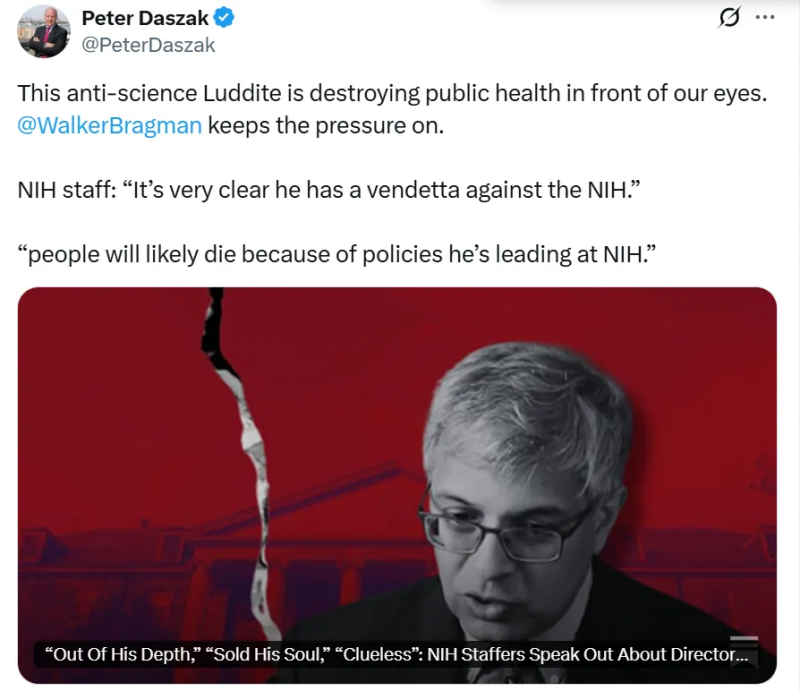
 Peter Daszak’s recent X posts (June 2, 2025) labeling Dr. Jay Bhattacharya, the new NIH Director, an “anti-science Luddite” who is “destroying public health” are a masterclass in projection.

Daszak, former head of EcoHealth Alliance (facilitator and co-conspirator of that recent pandemic, what was it called? Oh yes, SARS CoV-2 Covid-19), accuses Bhattacharya of having a “vendetta against the NIH” and claims his policies will cost lives, while pointing fingers at organizations like Brownstone Institute for being part of a right-wing conspiracy (how original!) to dismantle science. Let’s cut through the noise.

Calling Bhattacharya anti-science is absurd. Erstwhile Stanford professor and co-author of the Great Barrington Declaration, Bhattacharya has consistently championed evidence-based public health, advocating for open scientific debate over dogmatic policies. His focus on data-driven approaches—like considering natural immunity and the harms of lockdowns—earned him censorship under the previous administration. His leadership at the NIH promises transparency and rigor, both of which seem to terrify Daszak—operating without (his previous sponsor) Dr. Fauci’s golden parachute of a Biden/autopen pardon.

Now, let’s talk about Daszak’s version of “science.” EcoHealth Alliance, under his watch, funneled US. taxpayer dollars to the Wuhan Institute of Virology (WIV) for gain-of-function research on bat coronaviruses—research that may have contributed to the unleashing of the novel coronavirus in Wuhan. 

As I detailed in my Brownstone articles, Daszak’s collaboration with WIV’s “Bat Woman” Zhengli-Li Shi involved modifying coronaviruses to make them more infectious to humans, fitting the NIH’s own definition of gain-of-function despite his denials. That second article of mine only came about after EcoHealth Alliance’s bullying. When I had pointed out EcoHealth’s complicity in my original Dr. Anthony Fauci’s Own Gain-of-Function, Daszak’s minions tried to bully Brownstone into retracting the reference. 

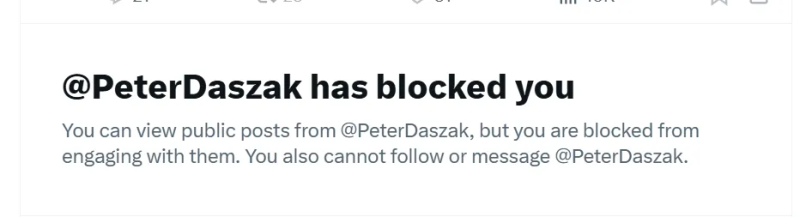
When that failed, he blocked me on X to dodge accountability.

How “science-y” is that? Blocking someone for raising legitimate questions about your role in a global pandemic isn’t the mark of a scientist—it’s the mark of someone with something to hide.

Daszak’s attacks on Bhattacharya are a distraction from his own failures. Why were US funds sent to a CCP-controlled lab with poor oversight instead of trusted allies? Why the lack of transparency? These questions remain unanswered, and his attempts to silence critics—like me—only deepen the suspicion around EcoHealth’s actions.

Science thrives on open debate, not censorship. Bhattacharya represents a return to that principle at the NIH, while Daszak’s behavior—blocking dissenters and evading tough questions—shows what anti-science really looks like. The public deserves better, and with Bhattacharya leading the NIH, we might finally get it.

NEVER FORGET: Peter Daszak’s EcoHealth Alliance tried to quash and have Brownstone retract my: Dr. Anthony Fauci’s Own “Gain-of-Function”—October 9, 2023.

Instead, I researched further, doubled down, and produced this: “EcoHealth Alliance’s Wuhan-Virus Dalliances” October 22, 2023.

After which, crickets…Peter Daszak blocked me on X.com. The essence of bullies is cowardice.

Please see also my Fauci’s ‘DNA of Caring’ By Randall Bock, August 9, 2024, Brownstone.org.

Trump Tries to Save Science

 by John Hinderaker

Science has fallen into disrepute. Widespread fraud, studies that can’t be replicated, corruption in the World Health Organization, politics masquerading as science, the covid disaster–these and other developments have severely damaged the public’s trust in science and scientists.

Can trust in science be restored? President Trump is going to try. On May 23, he issued an Executive Order titled “Restoring Gold Standard Science,” which hasn’t gotten as much attention as it deserves.

The order begins with a statement of Policy and Purpose:

Over the last 5 years, confidence that scientists act in the best interests of the public has fallen significantly. A majority of researchers in science, technology, engineering, and mathematics believe science is facing a reproducibility crisis. The falsification of data by leading researchers has led to high-profile retractions of federally funded research.

Unfortunately, the Federal Government has contributed to this loss of trust. In several notable cases, executive departments and agencies have used or promoted scientific information in a highly misleading manner. For example, under the prior Administration, the Centers for Disease Control and Prevention issued COVID-19 guidance on reopening schools that incorporated edits by the American Federation of Teachers and was understood to discourage in-person learning. This guidance’s restrictive and burdensome reopening conditions led many schools to remain at least partially closed, resulting in substantial negative effects on educational outcomes — even though the best available scientific evidence showed that children were unlikely to transmit or suffer serious illness or death from the virus, and that opening schools with reasonable mitigation measures would have only minor effects on transmission.

More examples follow. So, what does the Executive Order actually do? It mandates “Gold Standard Science” in all federal agencies:

Sec. 3. Restoring Gold Standard Science. (a) Within 30 days of the date of this order, the Director of the Office of Science and Technology Policy (OSTP Director) shall, in consultation with the heads of relevant agencies, issue guidance for agencies on implementation of “Gold Standard Science” in the conduct and management of their respective scientific activities. For the purposes of this order, Gold Standard Science means science conducted in a manner that is:

(i) reproducible;
(ii) transparent;
(iii) communicative of error and uncertainty;
(iv) collaborative and interdisciplinary;
(v) skeptical of its findings and assumptions;
(vi) structured for falsifiability of hypotheses;
(vii) subject to unbiased peer review;
(viii) accepting of negative results as positive outcomes; and
(ix) without conflicts of interest.

There is more to the order, but that is the objective. Can an executive order actually do much to reform a corrupt scientific establishment? A friend who is more knowledgeable in this area than I am is optimistic. He writes:

This is an EO that actually would have to be followed by agencies, since it is purely procedural. If followed, it would drastically limit the use of junk science. I actually drafted up a proposed bill years ago and sent it to some Congress people with a lot of the same provisions. … The reaction is hilarious, scientists know they won’t be able to use shoddy research to advance their ideology.

Let’s hope he is right. In any event, Donald Trump is to be applauded for recognizing the crisis in scientific research and trying to restore integrity to government-sponsored science.

https://www.powerlineblog.com/archives/2025/06/trump-tries-to-save-science.php

UnitedHealthcare accuses the Guardian of trying to ‘capitalize’ on CEO’s killing: defamation lawsuit

 UnitedHealthcare slapped the Guardian with a defamation lawsuit over a story by the publication related to its billing for nursing home residents.

At issue is the Guardian’s May 21 story, which alleged that the health care giant made secret payments to nursing homes to reduce hospital transfers in an effort to save money.

The lawsuit, which was filed in Delaware Superior Court late Wednesday, claims that the Guardian had knowingly published “demonstrably false” information and tried to capitalize on media interest in the killing of its then-CEO Brian Thompson last year in New York.

UnitedHealthcare is suing the Guardian for a May 21 piece alleging that the health care giant made secret payments to nursing homes to reduce hospital transfers in an effort to save moneyAFP via Getty Images

The health care company alleged that the Guardian used internal emails — from which it published excerpts — that were quoted out of context. UnitedHealthcare also disputed some of the Guardian’s characterizations of medical events detailed in its exposé

“The Guardian knowingly published false and misleading claims about our Institutional Special Needs Program, forcing us to take action to protect the clinician-patient relationship that is crucial for delivering high-quality care,” a rep for UnitedHealthcare claimed. “The Guardian refused to engage with the truth and chose instead to print its predetermined narrative.”

A rep for the Guardian shot back at UnitedHealthcare’s lawsuit, telling The Post that it stands by its May 21 reporting and that it intends to defend itself in court.

“The Guardian stands by its deeply-sourced, independent reporting, which is based on thousands of corporate and patient records, publicly filed lawsuits, declarations submitted to federal and state agencies, and interviews with more than 20 current and former UnitedHealth employees — as well as statements and information provided by UnitedHealth itself over several weeks,” the rep claimed.

“It’s outrageous that in response to factual reporting on the practice of secretly paying nursing homes to reduce hospitalizations for vulnerable patients, UnitedHealth is resorting to wildly misleading claims and intimidation tactics via the courts,” he added.

In the story, the Guardian claimed internal emails revealed that UnitedHealth supervisors gave their teams “budgets” showing how many hospital admissions they had “left” to use up on nursing home patients.

An excerpt from the Guardian’s May 21 article.

The outlet also reported that leaked emails showed that the company also monitored nursing homes that had smaller numbers of patients with “Do not resuscitate” and “Do not intubate” orders in their files.

“The article used a heavily cropped screenshot of an internal UnitedHealth email to knowlingly and falsely accuse UnitedHealth of coercing nursing home residents into signing ‘do not resuscitate’ papers as a ‘cost cutting tactic … even when patients had clearly expressed a desire that all available treatments be used to keep them alive.’ This is unquestionably defamatory,” the lawsuit alleged.

“The Guardian knew these accusations were false, but published them anyway, brazenly trying to capitalize on the tragic and shocking assassination of UnitedHealthcare’s then-CEO, Brian Thompson,” the suit added.

UnitedHealthcare claimed that the Guardian, in publishing its article, was trying to “capitalize” on the
murder of its then-CEO Brian Thompson.UnitedHealth Group
Accused killer Luigi Mangione was arrested for Thompson’s murder and has pleaded not guilty to state and federal charges.Steven Hirsch for NY Post

Thompson was gunned down on a Manhattan sidewalk on Dec. 4 last year.

Accused killer Luigi Mangione, 27, was arrested and has pleaded not guilty to state and federal charges.

The embattled UnitedHealthcare has been in the hot seat in recent weeks.

The Department of Justice revealed in May that it is investigating UnitedHealthcare for Medicare fraud.

Shares of the insurance company have cratered nearly 26% in the last month as a result.

https://nypost.com/2025/06/05/media/unitedhealthcare-accuses-the-guardian-of-trying-to-capitalize-on-ceos-killing-lawsuit/

Hamas didn’t need chat rooms to direct campus protests: All openly pre-programmed

 Local anti-Israel protester Tarek Bazrouk was in direct touch with Hamas spokesman Abu Obeida, federal documents allege. It’s a fascinating story, but let’s be honest: Hamas’ cheerleaders at Columbia and across the West didn’t need chat-room instructions to parrot the terrorists’ propaganda.

Learning chants like “From the River to the Sea” is practically part of freshmen orientation at countless colleges.

At Columbia, you can basically major in anti-Israel propaganda, though they call it “Middle Eastern Studies.”

And of course a host of “activist” groups on and off campus works to “educate” in radical worldviews: National Students for Justice in Palestine, Within Our Lifetime, US Palestinian Community Network the Palestinian Youth Movement and on and on.

Via outfits like the Tides Foundation, most are funded by wealthy left-wing Westerners like the Soros family and Shanghai-based Neville Roy Singham.

The House has been investigating these “charities” for some time now, with nine nonprofits including the New York-based People’s Forum  and Westchester Peace Action Committee Foundation (WESPAC) flagged for special IRS attention.

The propaganda’s been flowing openly for decades now.

That’s why the demonstrations began the day after the Oct. 7, 2023, terror attacks in Israel — at first, simply to cheer Hamas on.

Even though the terrorists literally broadcast their atrocities, which they proudly filmed with their GoPros — and Israel’s response was still weeks off.

None of which stopped the protesters from instantly painting Hamas as the victim.

Nor prevented Western media (largely seeped in the same propaganda) from routinely presenting Hamas’ wartime propaganda as fact.

Such are the benefits of a liberal education at a modern elite university.

These schools are now reeling from such Trump administration actions as challenging Columbia’s accreditation because of its “indifference to antisemitism,” but those moves only look drastic because they’re targeting institutions that got deeply radicalized long ago.

https://nypost.com/2025/06/04/opinion/hamas-didnt-need-chat-rooms-to-direct-campus-protesters/