Search This Blog

Wednesday, October 1, 2025

UK’s ‘Credibility Challenge’ Hinders Attempts To Reverse Pharma’s Flight


Talks between pharma and successive U.K. governments have failed to deliver the market access terms that the industry wants, contributing to a pullback in investment.

The U.K. life sciences sector was rocked by a series of major blows in September. In a matter of days, Merck pulled out of a $1.3 billion project and AstraZeneca—a U.K.-based firm—paused plans to invest around $270 million in an R&D site. Sanofi and Eli Lilly similarly pulled back on investment plans for the country. The quadruple whammy brought long-festering tensions between pharma and the government into the open and raised doubts about the U.K.’s place in the global life sciences industry.

AstraZeneca and Merck revealed the changes to their U.K. spending plans weeks after drug pricing talks between the pharma industry and government collapsed. A Parliament committee held in response to the changes shed light on the situation. Tom Keith-Roach, U.K. president at AstraZeneca, said problems have been “building and accumulating over the last 20 years” as the country has become an increasingly challenging place to launch drugs. Those problems are now influencing where companies invest.

“What we are increasingly seeing is discretionary investment and new investment in R&D and in capital manufacturing is flowing into countries who are seen to value innovation and seem motivated to pull that through into patients,” Keith-Roach said at the hearing.

Pharma no longer sees the U.K. as such a viable option. The question now is whether the U.K. government can change the narrative and save an industry that it recently called “one of our greatest national assets.”

Why the UK Lost Credibility

The recently collapsed talks between the U.K. government and pharma focused on the Voluntary Scheme for Branded Medicines Pricing, Access and Growth (VPAG). Through VPAG, drugmakers provide rebates to cover government spending on branded medicines above a certain threshold. The current rate is higher than expected, leading the industry and government to pull forward a mid-scheme review.

Keith-Roach and Richard Torbett, CEO of the Association of the British Pharmaceutical Industry (ABPI), both used the Parliament committee meeting to warn the government that the industry wants more than just a resolution to the VPAG impasse. To Keith-Roach, VPAG is “a symptom of the problem rather than the cause.”

“We can negotiate about VPAG, but in the long term, this needs to be a country that is committed to investing in innovation, to making innovation available to patients and to providing a front door to the NHS through which innovative medicines can pass,” Keith-Roach said.

Torbett said the government needs to fix VPAG, change the threshold the U.K. uses for cost-effectiveness and provide a sustained commitment to bringing investment up to the level of comparable countries. At the committee, Lord Patrick Vallance, the former GSK executive who now serves as Minister for Science, Innovation, Research and Nuclear, showed that the government knows the problem goes beyond VPAG. “The real crunch issue is the appropriate uptake, access and payment on medicines,” Vallance said.

As part of its attempt to fix the issue, the government proposed putting £1 billion (roughly $1.35 billion) into the market over three years. However, with the industry calculating it would still need to pay back £13.5 billion (more than $18 billion), talks collapsed without an agreement being reached.

The collapse of the drug pricing negotiations came months after U.K. Prime Minister Keir Starmer reportedly said he would “sort the VPAG” in a meeting with pharma CEOs. Starmer’s failure so far to follow through on that commitment has added to doubts about the government’s capacity to back up talk with action.

“I might categorize it as a credibility challenge,” Ben Lucas, managing director for the U.K. and Ireland at Merck, told the committee. “We have been having this continued conversation with successive governments about the potential of the U.K. to be able to pull down and realize—in an economic growth way—the talent that it has. But we failed, and that has been a collective failure across the board.”

The failures have colored how overseas pharma executives see the U.K. Lucas, who works with Merck’s U.S.-based executive team, said, “The challenge I continually get is, ‘Well, we’ve heard that plan before, Ben, but it hasn’t necessarily delivered.’”

Where Investment Is Going

Other countries are capitalizing on the U.K.’s failure to deliver change. Torbett said the U.K. is losing out to a variety of countries, including the U.S., Belgium, Ireland, Singapore and Germany. ABPI has “lots of examples of decisions that have been in the balance, and those are the sorts of countries that we have lost out to,” Torbett said.

The losses are adding up. Sanofi, which recently froze investment in the U.K., has reduced its headcount in the country from more than 2,000 in 2013 to below 600 today. Over a similar period, the headcount at Sanofi’s Genzyme Ireland unit has grown from 477 to 905. The shifts have added to the pressure on the government to retain AstraZeneca and GSK, the other U.K.-based multinational. Each of these two pharma powerhouses employ close to 10,000 people in the U.K.

“We cannot afford to lose this industry from the U.K.,” Vallance said. “It is very important that we have two global companies; it matters that it is two. It is very important that we have a very thriving startup and SME sector here as well, and that is not only important for the economy; it is important for health. We must come to an agreement on the right way forward.”

https://www.biospace.com/drug-development/how-the-uks-credibility-challenge-hinder-attempts-to-reverse-pharmas-flight

Novo Breaks $598M Heartseed Pact Amid ‘Decisive Restructuring’


Novo Nordisk and Heartseed first partnered in 2021 to develop an investigational cell therapy for heart failure.

Novo Nordisk has turned its back on cell therapy specialist Heartseed, terminating a four-year-old contract amid a broader strategic realignment.

Tokyo-based Heartseed announced the termination of the partnership in a securities filing on Tuesday, noting that Novo’s decision was driven by its push to “further concentrate on its core business areas of diabetes and obesity.” It is not clear when the agreement will formally end, but Heartseed will no longer be eligible for milestone payments when that date does come.

“We applaud CEO Mike Doustdar’s decisive restructuring and strategy shift,” analysts at BMO Capital Markets told investors in a note Tuesday evening, though they weren’t explicitly reacting to the Heartseed termination. “After witnessing the boon and subsequent fall of NVO shares, we’re starting to see green shoots of a new, refined, and refocused strategy.”

Novo and Heartseed linked up in June 2021, with Novo putting down $55 million in upfront and near-term payments to collaborate on the biotech’s lead asset HS-001, an investigational cell therapy for heart failure. Novo also put more than $540 million on the line in milestone commitments.

In exchange for its investments, Novo gained the exclusive right to advance, manufacture and commercialize HS-001 outside Japan, giving Heartseed the chance to earn high-single-digit to low-double-digit royalties on net sales. The biotech retained development rights to the asset in Japan.

Following the deal’s termination, all intellectual property related to HS-001 will return to Heartseed, which will now “explore options including partnerships” for the overseas development of the asset, according to Heartseed’s securities filing. While the biotech reviews its overseas strategy, it will focus its efforts on HS-001’s Japanese development. “For the time being, we have the resources to continue development as planned using our existing funds,” Heartseed wrote.

The decision to break off the Heartseed pact comes in the thick of Novo’s sweeping and aggressive restructuring initiative. Shares of the pharma are down 35% year-to-date and Novo recently completed a high-profile executive shuffle: In May, former CEO Lars Fruergaard Jørgensen stepped down from his post and was replaced by Doustdar, who had previously served as the company’s executive vice president of international operations.

During Novo’s Q2 earnings call, where Doustdar had the opportunity to address investors before he formally assumed the CEO role, he said he would focus on execution and promised to trim the fat. “We need to reallocate and look at our cost base and really put the money where the growth is,” he said, in order to “not fall behind the competition.” Earlier this month, Novo announced it would be laying off 9,000 employees worldwide.

https://www.biospace.com/business/novo-breaks-598m-heartseed-pact-amid-decisive-restructuring-by-new-ceo

Reddit Plunges On New Traffic Data Suggesting ChatGPT "Massively Reduced Citations"

 Reddit shares are sinking in New York premarket trading, and if the losses hold into the cash session, it would mark the steepest decline in six months. The drop comes after new Similarweb data indicated that ChatGPT has either scaled back or completely stopped using Reddit as a source for answer generation. Who would have ever guessed that relying on Reddit posts to generate chatbot answers was a brilliant idea?

Several X users are citing Similarweb data that shows Reddit's collapsing web traffic. This includes one X user by the name of "Bert Tian" who states:

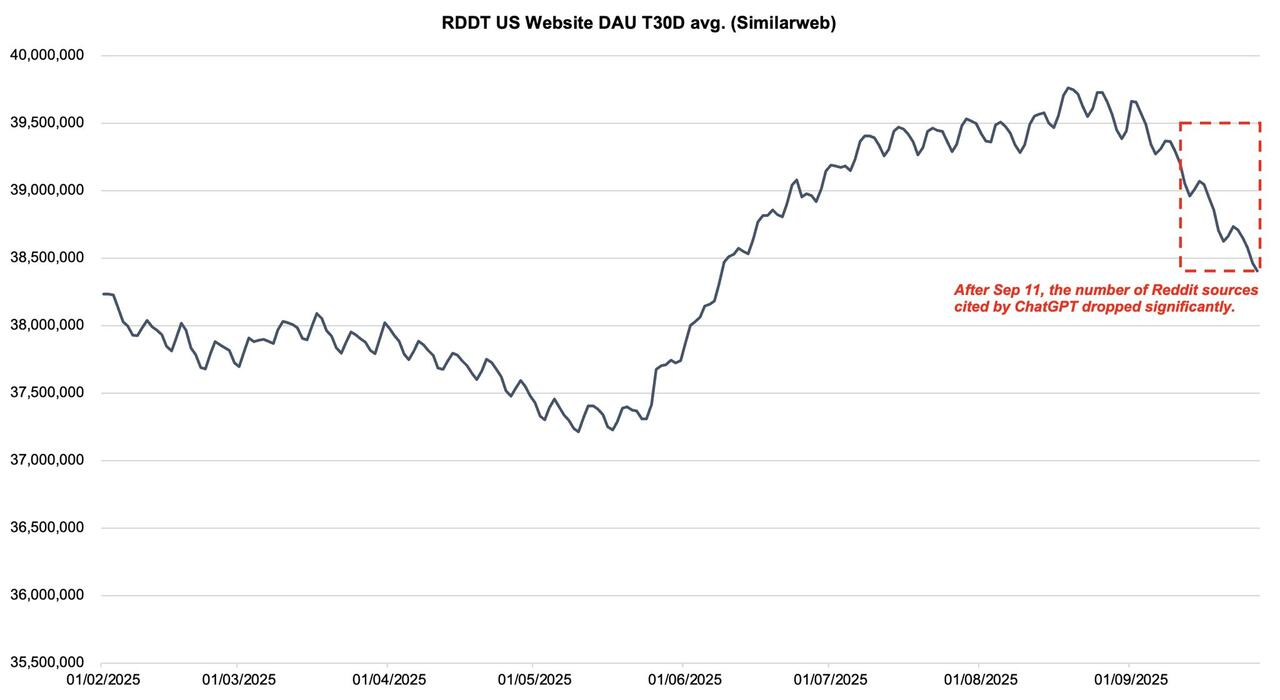
$RDDT US Website DAU (source @Similarweb ) has dropped sharply after ChatGPT massively reduced Reddit citations — traffic is now even close to early-year levels.

Multiple data vendors are all picking up the shift in ChatGPT citation patterns. Reasons still unclear, but one guess is that ChatGPT may be limiting web search for free accounts as a cost-cutting move to push monetization.

Tian posted an image showing Reddit's U.S. daily active users on a 30-day average, indicating that around September 11 was the point when Reddit sources cited by ChatGPT dropped sharply.

Source: X user Bert Tian

Tian was quoting another X user by the name of "Andrea Bosoni," who pointed out:

Apparently ChatGPT is not using Reddit much anymore for their answers. I guess they realized that what random people say can't be considered a trusted source after all. You can all stop spamming it with your fake brand mentions now.

Source: Andrea Bosoni

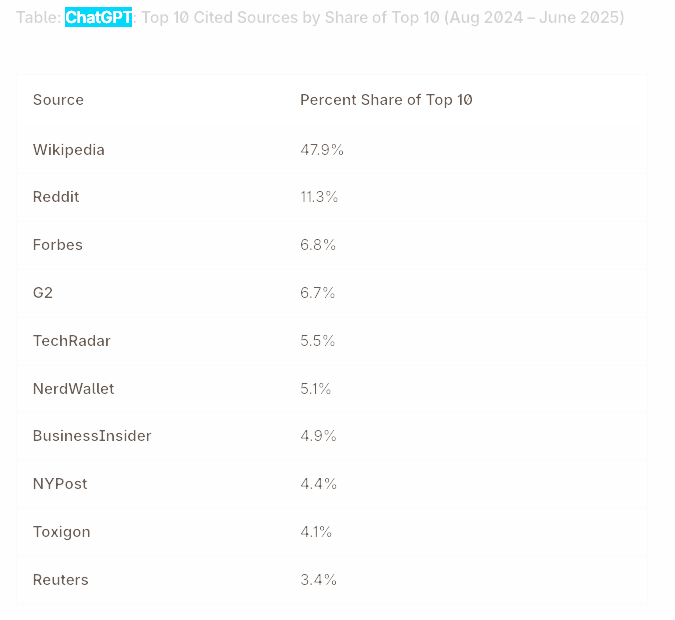
TryProfound blog cited a dataset between August 2024 and June 2025 that showed Reddit accounts for 11.3% of ChatGPT's citations within its top 10 most-cited sources.

Source: TryProfound

Reddit shares dropped as much as 13% in premarket trading. If losses hold through the cash session, this would mark the largest decline since early March.

So, ChatGPT relies heavily on Wikipedia and Reddit… enough said. That's why Elon Musk revealed on Tuesday his plans to launch "Grokpedia."

https://www.zerohedge.com/markets/reddit-plunges-new-traffic-data-suggesting-chatgpt-massively-reduced-citations

DEA Arrests 670, Seizes Nearly 77,000 Kilograms Of Drugs in NY In Operation Targeting Notorious Cartel

 by Travis Gillmore via The Epoch Times (emphasis ours),

The Drug Enforcement Administration (DEA) arrested 670 individuals and seized nearly 77,000 kilograms of narcotics during a five-day operation targeting a Mexican drug trafficking organization, according to an agency statement on Sept. 29.

Drug Enforcement Administration agents seized nearly 77,000 kilograms of illegal drugs during a weeklong operation targeting the Jalisco New Generation Cartel, the agency announced on Sept. 29, 2025. Courtesy of Drug Enforcement Agency

Agents sought to dismantle the Jalisco New Generation Cartel, designated as a foreign terrorist organization in February with an executive order from President Donald Trump for its role in orchestrating illegal drug distribution.

Let this serve as a warning: DEA will not relent,” agency administrator Terrance Cole said in a statement.

Every arrest, every seizure, and every dollar stripped from [the cartel] represents lives saved and communities protected. This focused operation is only the beginning—we will carry this fight forward together until this threat is defeated.”

The cartel operates across the globe in at least 40 countries, with tens of thousands of individuals helping produce, manufacture, and distribute dangerous narcotics, according to the DEA.

Cole said the operation, which ran from Sept. 22 through Sept. 26, involved collaboration between DEA agents in 23 domestic and seven foreign divisions, a Department of Homeland Security Task Force, other federal agencies, and state and local law enforcement partners.

Investigations led to the seizure of nearly 100 kilograms of fentanyl—enough to kill about 50 million people, by the agency’s calculations.

More than 1.1 million counterfeit pills were seized, along with more than 6,000 kilograms of methamphetamine, almost 23,000 kilograms of cocaine, and 33 kilograms of heroin.

Photos from the agency’s Atlanta office show tables piled high with confiscated packages filled with seized narcotics. Another image shows roughly 300,000 counterfeit pills, pressed in a variety of colors, seized in New York.

Approximately $19 million in cash and currency was recovered, and the agency estimated the value of assets impounded at nearly $30 million.

Also confiscated were 244 firearms, officials said.

Hundreds of cartel members and associates were detained, but the group’s leaders have eluded capture.

The U.S. Department of State is offering a $15 million reward for information that leads to the apprehension of co-founder Nemesio Rubén Oseguera Cervantes, known as El Mencho.

Oseguera Cervantes was indicted in the United States in 2017, and again subsequently on multiple occasions, for conspiracy to commit drug trafficking crimes.

According to the State Department, he has also allegedly been involved in assassination attempts on Mexican government officials.

Drug Enforcement Administration agents display approximately 300,000 counterfeit pills seized in an operation targeting the Jalisco New Generation Cartel in September 2025. Courtesy/Drug Enforcement Administration

Among other groups that have been designated foreign terrorist organizations by the federal government are the Noreste cartel—previously known as Las Zetas—the Sinaloa cartel, Tren de Aragua, and Mara Salvatrucha, better known as MS-13.

The terrorist designations “expose and isolate” suspects and provide law enforcement with more leverage to investigate and disrupt transnational criminal networks, according to the State Department.

https://www.zerohedge.com/geopolitical/dea-arrests-670-seizes-nearly-77000-kilograms-drugs-operation-targeting-notorious

 The British government has issued a new order to Apple to create a backdoor into its cloud storage service, this time targeting only British users' data, the Financial Times reported on Wednesday.

Britain dropped a mandate for the iPhone maker to provide a backdoor that would have enabled access to the protected encrypted data of American as well as British citizens, U.S. Director of National Intelligence Tulsi Gabbard said in August.

U.S. lawmakers had raised concerns that such a move could allow encrypted user data to be exploited by cyber criminals and authoritarian governments.

The feature allows iPhone and Mac users to ensure that only they — and not even Apple — can unlock data stored on its cloud.

"Apple is still unable to offer Advanced Data Protection (ADP) in the United Kingdom to new users, and current UK users will eventually need to disable this security feature," Apple said on Wednesday.

"ADP protects iCloud data with end-to-end encryption, which means the data can only be decrypted by the user who owns it, and only on their trusted devices."


The company said it was committed to offering users the highest level of security and it was hopeful it would be able to do so in the future in Britain.

"As we have said many times before, we have never built a backdoor or master key to any of our products or services and we never will," it added.

GOP leaders blame ‘Schumer Shutdown’ on top Senate Dem’s caving to ‘far-left activist groups’

 Senate Majority Leader John Thune (R-SD) at the same presser accused his Democratic counterpart of having shut down the government "at the behest of a bunch of liberal, far-left activist groups."

Senate Majority Leader John Thune (R-SD) (C) leads a news conference with Speaker of the House Mike Johnson (R-LA) (C-L) and House and Senate GOP Leadership on the Upper West Terrace of U.S. Capitol Building on October 1, 2025 in Washington, DC.
The "government shutdown that the Democrats wanted," Senate Majority Leader John Thune (center) said.Getty Images

The "government shutdown that the Democrats wanted," Thune added, has put their party "into a box canyon."

Three Democrats joined 52 Senate Republicans to vote to keep the government open before the federal shutdown started at 12:01 a.m. Wednesday.

Senate Minority Leader Chuck Schumer, D-N.Y., attends a news conference about the government shutdown, Tuesday, Sept. 30, 2025, on Capitol Hill in Washington.
Senate Minority Leader Chuck Schumer led the opposition.AP

Senate Minority Leader Chuck Schumer (D-NY) led the opposition to the funding bill, in part because it didn't extend Obamacare subsidies that expire at the end of this year.


https://nypost.com/2025/10/01/us-news/trump-live-updates-news-oct-1-2/

White House pulls Antoni's nomination to head Bureau of Labor Statistics - report

 The White House confirmed to FOX Business that President Donald Trump has withdrawn his nomination of E.J. Antoni to lead the Bureau of Labor Statistics (BLS).

CNN first reported the withdrawal of Antoni’s nomination, citing three sources. One source said Sens. Susan Collins, R-Maine, and Lisa Murkowski, R-Alaska, declined to meet with Antoni. That signaled possible concerns about his nomination.

The BLS came under scrutiny after a weaker-than-expected July jobs report showed just 73,000 jobs added, far short of the 110,000 estimated by LSEG economists. Employment in May and June was also reduced by a combined 258,000 jobs.

Trump fired BLS Commissioner Erika McEntarfer, alleging the jobs data was politically manipulated.


President Donald Trump and BLS nominee EJ Antoni in the Oval Office

President Donald Trump and economist E.J. Antoni in the Oval Office after Antoni's nomination to head the Bureau of Labor Statistics. (White House / Fox News)

Afterward, Trump nominated Antoni, chief economist at the Heritage Foundation, for the role. In an Aug. 4 interview with Fox News Digital, Antoni argued the BLS’s methodology, economic modeling and statistical assumptions were fundamentally flawed.

Senate Health Education, Labor and Pensions (HELP) Committee Chairman Bill Cassidy told FOX Business he appreciated meeting with Antoni and was looking forward to his hearing and discussing ideas to reform BLS.

"The status quo is not working. When BLS fails to deliver accurate jobs data, it has serious implications for families’ pocketbooks," Cassidy said. "As Chairman of the HELP Committee, I will work with President Trump to fix BLS so it can deliver accurate, reliable economic data to the American people."

Trump’s choice of Antoni sparked concerns among economists about the integrity of BLS data under his leadership.

"The nominee will result in a surge in demand for private label data," Joe Brusuelas, chief economist at RSM US, told Reuters in August.

Alex Jaquez, head of policy and advocacy at Groundwork Collaborative, told Reuters the nomination was a "clear assault on independent analysis" with far-reaching implications for the reliability of U.S. economic data.

In August, before his nomination, Antoni told Fox News Digital the flaws in BLS data had been evident for three years and remain unresolved.

The BLS process includes revisions meant to improve accuracy over time as more data is collected. Each monthly jobs report revises the prior two months once additional employer information is received.

The system offers the public an early snapshot of economic conditions, followed by a fuller picture through later revisions.

Falling response rates over the past decade have left smaller samples, increasing the size of revisions — especially during volatile periods.

https://www.foxbusiness.com/politics/white-house-pulls-nomination-ej-antoni-head-bureau-labor-statistics