Search This Blog

Tuesday, February 3, 2026

XLB Trading Alert: Key Pivot Points Identified


  • The S&P Select Materials SPDR (XLBFinancial) has identified critical pivot points, signaling potential bullish or bearish trends.
  • XLB's financial health is supported by strong margins and a stable balance sheet.
  • Valuation metrics suggest a moderate market sentiment with room for growth.

For the S&P Select Materials SPDR (XLB), critical pivot points have been identified with a high of $49.88 and a low of $49.04. These figures are derived using the DeMark method, a popular analytical tool. When the price surpasses the pivot high, it typically signals a bullish trend, whereas a drop below the pivot low suggests a bearish outlook. Investors often use these pivot points to gauge potential price movements and make informed trading decisions.

The State Street Materials Select Sector SPDR ETF, represented by the ticker XLB, is a prominent player in the materials sector. Although the company description is not available, the ETF is known for its focus on providing exposure to the materials sector, which includes industries such as chemicals, construction materials, and packaging. With a market capitalization of $5.94 billion, XLB is a significant entity within its sector, offering investors a diversified approach to materials investments.

Financial Health Analysis

XLB's financial health is underscored by several key metrics:

The balance sheet reflects a robust position with a current ratio of 1.7 and a debt-to-equity ratio of 0.81, indicating a healthy liquidity position and manageable debt levels. The Altman Z-Score of 3.35 suggests a low risk of financial distress.

Valuation & Market Sentiment

Valuation metrics provide insight into XLB's market positioning:

These metrics are within historical ranges, suggesting a moderate valuation. The RSI (14) of 62.75 indicates a neutral market sentiment, while moving averages such as the SMA (50) at 46.18 and SMA (200) at 44.6 provide additional context for trading trends.

Risk Assessment

Financial health grades from the JSON data highlight XLB's strengths:

Sector-specific risks include volatility, with a volatility measure of 13.5, and a beta of 0.97, indicating that XLB's price movements are slightly less volatile than the market. While no upcoming catalysts such as earnings dates are specified, investors should remain vigilant of sector trends and macroeconomic factors that could impact the materials sector.

https://www.gurufocus.com/news/8573313/xlb-trading-alert-key-pivot-points-identified

Defunding ICE Is A Politically Toxic Position For The Democrats

 In recent weeks, calls to defund or even abolish ICE have ramped up from the Democratic Party, particularly after the shootings of Renee Good and Alex Pretti. However, despite their rhetoric, American voters are far more aligned with Trump’s immigration crackdown. In fact, it looks like their views on immigration enforcement are so far out of touch with mainstream America that it could cost them the midterm elections.

The latest Cygnal survey has made some rather telling discoveries: enforcement is popular, defunding ICE is toxic, and Democrats are walking straight into an electoral buzz saw by pretending otherwise.

Cygnal, widely regarded as one of the most accurate private pollsters in the country, polled likely 2026 midterm voters and found that voters still see the border as a question of law, not vibes. A full 73 percent of voters say that entering the United States illegally is, in fact, breaking the law, which means most Americans still accept the basic premise behind the word “illegal.” 

Voters also back deportation of people in the country illegally by a margin of 61 percent to 34 percent, nearly two to one. Support for actual enforcement is just as clear. Fifty-four percent want ICE to enforce federal immigration laws and remove illegal immigrants, and 58 percent oppose efforts to defund the agency. 

The biggest problem for Democrats hoping to win back control of the House and Senate in November is that the opposition to defunding ICE includes majorities of independents and undecided voters.

Nearly two-thirds of likely midterm voters, 64 percent, say illegal immigration is a national problem. Among swing voters, it’s 71 percent. Republicans are almost unanimous at 97 percent, and 60 percent of independents agree, while Democrats are the only group in which a large share insists it is not a problem at all.

The data shows that Democrats have a significant problem with one of their most prominent policy positions ahead of the midterm elections, and it will likely cost them.

According to Cygnal’s polling, Democrats hold a modest four-point edge on a generic congressional ballot. The problem for them is that this advantage disappears once voters are told Democrats want to defund ICE or weaken enforcement. In that scenario, the race becomes tied. If Democrats push a government shutdown to defund ICE, Republicans gain a two-point lead, a six-point swing driven by a single issue. Among swing voters, the backlash is even sharper, producing a 16-point shift toward Republicans.

 That kind of shift points to a deeper problem than messaging. It exposes a structural blind spot in the Democrat coalition: The activist wing’s demands to confront or abolish ICE alienate the very voters needed to win close races, particularly in swing districts. 

Cygnal’s data show Republicans gain whenever they draw a clear contrast between enforcing immigration law and Democrat efforts to weaken or defund enforcement. Voters reward candidates who back deportation and strong ICE enforcement and punish those who side with activists against it.

 “Voters see illegal immigration as a simple question of law and order,” Brent Buchanan, the founder and CEO of Cygnal, said in a statement. “Americans want the law enforced, they want illegal immigrants removed, and they punish politicians who try to block ICE from doing its job.” The data show little ambiguity in how voters process the issue. 

The numbers paint a clear picture heading into the midterm elections. Most voters support enforcing immigration law and oppose efforts to defund or hamstring ICE. Despite all the negative publicity, this issue is a winning issue for the GOP.

https://www.zerohedge.com/political/defunding-ice-politically-toxic-position-democrats

Illegal Biolabs In Vegas & California Linked To Chinese National With Alleged Military-Civil Fusion Ties

by The Bureau's Sam Cooper

Federal and local authorities are investigating suspected illegal biological laboratories in Las Vegas and California’s Central Valley linked to a Chinese national accused by Congressional investigators of ties to a PRC military-civil fusion enterprise, who spent a decade operating what Canadian courts found was a systematic technology-theft operation from British Columbia before fleeing south with a $330 million fraud judgment against him.

The FBI and Las Vegas Metropolitan Police Department executed search warrants over the weekend at two residences connected to Jiabei “Jesse” Zhu, a 62-year-old Chinese citizen already under federal indictment for operating an illegal biolab in Reedley, California that contained labeled samples of at least 20 infectious agents including HIV, tuberculosis, and what the House Select Committee on the Chinese Communist Party described as “the deadliest known form of malaria.”

Las Vegas Metro Sheriff Kevin McMahill confirmed Monday that investigators recovered over 1,000 samples of biological material “consistent in appearance” with items found in the California facility.

“This can’t keep happening,” Congressman Kevin Kiley said after the Las Vegas raid, calling for immediate hearings on bipartisan legislation he introduced with Representatives Costa and David Valadao. “The illegal bio lab just raided in Las Vegas was operated by the same LLC and Chinese nationals as the one discovered in Reedley.”

In the Reedley case, investigators discovered nearly 1,000 bioengineered laboratory mice, infectious agents including E. Coli, malaria, various chemicals, medical waste, blood, tissue, serum, body fluid samples, and illegal pregnancy tests, Congressman Jim Costa noted, citing the Select Committee’s review.

Property records show both the Reedley warehouse and the Las Vegas homes are owned by the same limited-liability company whose officers include Zhu and his business partner Zhaoyan Wang, both Chinese citizens facing federal trial in April 2026 on charges of distributing hundreds of thousands of misbranded COVID-19 and other testing kits.

The House Select Committee on the Chinese Communist Party’s investigation frames Zhu as a Chinese citizen from Canada “associated with PRC-government linked companies” and with direct ties to state enterprises and military-civil fusion networks.

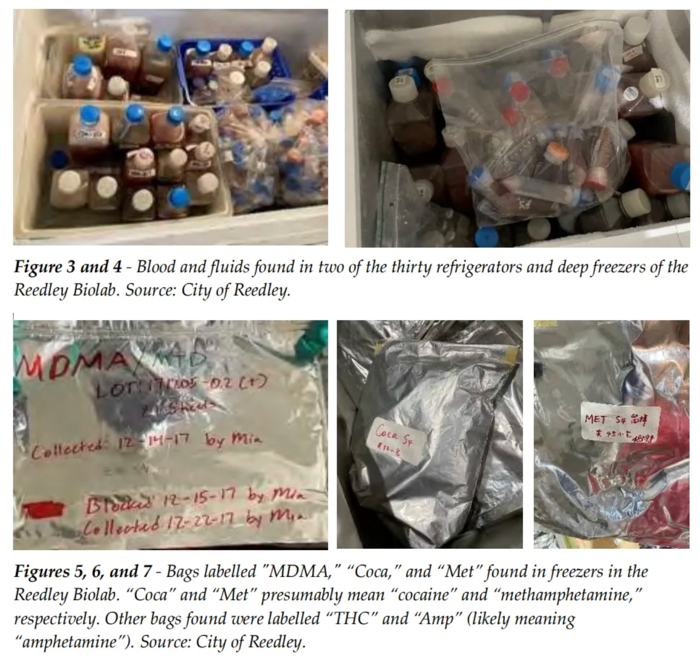
Photos from their review show freezers packed with numerous small bottles and sample containers holding what the caption identifies as blood and other fluids, plus sealed bags labeled with apparent drug shorthand (for example “MDMA,” “Coca,” and “Met”), suggesting the freezers were being used to store both biological materials and suspected narcotics-related items.
The report states that in the early 2000s, Zhu served as vice chairman of Henan Pioneer Aide Biological Engineering Company Limited, a PRC state-controlled enterprise whose corporate ownership structure the Committee mapped to show interlacing with state-linked financing channels running through China Development Bank and its affiliated funds, the National Council for Social Security Fund, and the State-owned Assets Supervision and Administration Commission.

The report explicitly flags Chinese military exposure, noting that beneficial owners operated through passthrough joint-venture companies including Henan Investment Group Company Limited, which the Committee describes as “involved in military-civil fusion.”

The Select Committee documented that Zhu’s work in cattle genetics connected to strategic PRC priorities.

As Zhu stated in documents obtained from the Reedley Biolab, “the Company is looking to seize the opportunity to develop the operational platform for the rapid growth in the Chinese dairy industry, fulfilling [PRC] Premier [and CCP Politburo Member] Wen Jiabao’s wish to ‘provide every Chinese, especially children, sufficient milk every day.’”

At that time, China faced a pressing milk crisis.

Long before federal agents discovered thousands of vials in Reedley in December 2022, Zhu had established himself in British Columbia as the architect of a sprawling transnational operation touching everything from cattle sex-sorting technology to the genetic production—or fraudulent representation of such—of prized Wagyu cattle famous for producing Kobe beef, leaving Canadian courts documenting systematic fraud spanning from Beijing to Quebec.

Court testimony established that Zhu, operating from Vancouver while maintaining direct control of a Beijing-based biotech entity, built a network across four countries involving genetic manipulation of cattle embryos, reverse-engineering of American proprietary technology, falsification of production records, and maintenance of what one witness described as “two sets of books”—one to report to the American licensor, another reflecting actual operations.

As sole shareholder and director of Vancouver-based International Newtech Development Incorporated since 1994, court testimony established Zhu operated through at least nine entities: four Canadian companies, five Chinese entities, Cayman Islands holding companies, and U.S. subsidiaries. Those U.S. subsidiaries included IND Lifetech (California) Inc., incorporated in 2007 and operated from Fresno—the same California city where federal authorities would discover his illegal biolab fifteen years later.

At the operational center sat Beijing IND Embryontech Co. Ltd., a company Zhu identified himself as directing in a March 2008 sworn affidavit, confirming he was “the boss” of the Beijing entity. The court record establishes Zhu maintained direct corporate presence and control in the capital of the People’s Republic of China while simultaneously holding Canadian citizenship and residing in British Columbia.

The 2012 British Columbia trial judgment upheld claims by XY LLC, a Colorado-based biotechnology firm, that JingJing Genetics and associated Zhu-controlled entities systematically deceived the company and vastly under-reported production to deprive XY of substantial royalties owed under licensing agreements for proprietary cattle sex-sorting technology. Senior engineer Kevin Xu, who worked for the IND group in both Canada and China from 2006 to 2014, testified that Zhu directly instructed him to copy specific XY proprietary components and send damaged nozzle tips to Chinese manufacturers as early as 2008 with instructions to reverse-engineer and replicate them.

On January 1, 2008—as litigation intensified—all JingJing shares were sold to Zhu’s brother-in-law and a friend, both China residents, in a transaction the court found was designed to evade liability. In Quebec, financial manager Selen Zhou testified their embryo production lab began producing Wagyu cattle embryos, but a lab doctor testified he was never told about this switch and continued signing export certificates for Holstein embryos. The court found the lab was actually continuing to produce Holstein IVF embryos using XY’s licensed technology, not Wagyu as falsified production records indicated.

The court found this pattern of coordinated deception, reverse-engineering of proprietary technology, falsification of production records, concealment of assets through sham transactions, and corporate maneuvering across multiple jurisdictions constituted what the judge characterized as “fraud on an epic scale.” The resulting $330 million Canadian dollar judgment reflected systematic technology diversion from North America to Chinese manufacturing partners under Zhu’s centralized direction. Then Zhu fled to the United States.

The Reedley facility received millions in unexplained wire transfers from Chinese banks while the supposed business—selling medical test kits—consisted entirely of importing counterfeit kits from China for resale, according to American lawmakers.

“While the supposed purpose of the lab was to sell test kits, in fact all the company did was buy counterfeit kits from China and re-sell them in the United States,” Kiley stated.

The CDC’s response triggered sharp Congressional criticism. The agency initially refused to take phone calls from local officials and declined to test samples with unknown contents. “At first, the CDC refused to investigate, and even hung-up on local officials who asked for help,” Kiley recounted. “After Rep. Costa got involved, the CDC did an inspection and found ‘at least 20 potentially infectious agents, including HIV, Tuberculosis, and the deadliest known form of Malaria.’ Yet the CDC did not bother to test any samples, even those with unknown contents.”

*   *   * 

Congressman Kevin Kiley (R-CA) expanded more on the insane illegal bio lab story:  

The illegal bio lab just raided in Las Vegas was operated by the same LLC and Chinese nationals as the one discovered in Reedley, CA. Here's what we know about the Reedley lab from a highly disturbing report I requested by the Select Committee on the Chinese Communist Party.

It was run by an international fugitive from China named Jiabei "Jesse" Zhu. After running various state-connected companies in China, he moved to Canada, where he set up dozens of corporations to "steal valuable American intellectual property and unlawfully transfer" it to China. The Supreme Court of British Columbia found he committed "fraud on an epic scale," resulting in a $330 million judgment. He then fled to America, assumed the alias David He, and set up several more companies, including the one behind the bio lab. He was indicted in 2023 and has been in custody ever since, but his partner and other associates have not been.

The Reedley lab was discovered in December of 2022, when a code inspector came upon a suspicious warehouse. Inside, she found many Chinese nationals "wearing white lab coats, glasses, masks, and latex gloves," along with "thousands of vials of biological substances" and 1,000 mice. It was later learned these were "transgenic" mice "genetically engineered to catch and carry the COVID-19 virus." A further inspection found "blood, tissue and other bodily fluid samples and serums" along with thousands of vials of "suspected biological material." Some of the vials were labeled with the names of infectious agents, while others were labeled in a "code" that was never deciphered.

At first, the CDC refused to investigate, and even hung-up on local officials who asked for help. After Rep. Costa got involved, the CDC did an inspection and found "at least 20 potentially infectious agents, including HIV, Tuberculosis, and the deadliest known form of Malaria." Yet the CDC did not bother to test any samples, even those with unknown contents, making it "impossible for the Select Committee to fully assess the potential risks that this specific facility posed to the community." The Select Committee report calls this "baffling." Later, local officials discovered a refrigerator in the lab labeled “Ebola.”

While the supposed purpose of the lab was to sell test kits, in fact all the company did was buy counterfeit kits from China and re-sell them in the United States. Thus, there was a "lack of apparent legitimate (or even profit-motivated criminal) motive in the operation of the illegal facility."  Meanwhile, Jesse Zhu, its operator, was "receiving unexplained payments via wire transfer" from Chinese banks.

The report concluded that "no one knows whether there are other unknown biolabs because there is no monitoring system in place." Now we know that there was at least one other, but we still don't know how many more. That is why it is critical for Congress to pass my bipartisan legislation, authored with Rep. Costa and Rep. Valadao, to find these labs and shut them all down.

China's Rare Earth 'Monopoly' - And Why Markets Will Break It

 by Walter Donway via The Epoch Times (emphasis ours),

Commentary

With its recent announcement of a trade deal with China, the White House intended to reassure markets, manufacturers, and the military that China would not sever the supply lines of “rare earths” to the United States. Among other concessions, Beijing committed itself to avoid restricting exports of rare earth elements and related critical minerals essential to advanced manufacturing, clean “green” energy, and modern weapons systems. The agreement was described as a win for American economic strength and national security. But the very need for such a promise reveals an uncomfortable truth: the United States, long the world’s leading industrial power, has become dependent on the goodwill of a strategic rival for materials central to its economy and its defense.

That dependence did not arise because rare earth minerals are scarce. They are not. Nor did it arise because China alone possesses the technical capacity to mine or refine them. It arose from a long chain of economic and political decisions—made largely in free societies—that concentrated production in a country willing to accept costs others would not.

Understanding how that happened is essential to understanding why China’s apparent monopoly is far less “coercive,” and far less durable, than it looks.

Not Rare, Just Hell to Process

Rare earth elements are a group of seventeen metals mostly in the first row below the main periodic table in the lanthanide series (elements 57–71), plus Scandium (Sc, #21) and Yttrium (Y, #39), which share similar properties and are found in the same deposits as the lanthanides. They are “transition metals” with distinctive magnetic and fluorescent characteristics. The first was identified in 1787, and by 1947 all had been identified. (“Earths” is an archaic term for oxides, the form in which these elements are found.)

Think of these elements not as bulk materials but as metallurgical spices, used in tiny quantities to produce dramatic improvements in performance. Add neodymium to iron and boron and get the strongest permanent magnet known. Add yttrium to turbine alloys and jet engines can tolerate extraordinary heat. Europium makes modern display screens possible; terbium enables efficient electric motorssamarium strengthens guidance systems and sensors.

Despite their name, rare earths are widespread. Significant deposits exist in the United States, Australia, Brazil, India, and elsewhere. What makes them challenging is not their scarcity but their processing. The essential problem is that they are chemically almost identical, so how do you devise subtly different processes to separate them? More generally, they are chemically stubborn—for example, often intermingled with radioactive materials, and require dozens—sometimes more than a hundred—separation and purification steps. Each step consumes energy and produces toxic waste, making rare earth refining among the most environmentally punishing metallurgical processes in the modern economy.

The crux of the matter is straightforward. Mining rare earths is manageable. Processing them cleanly and at scale is hard, expensive, and politically fraught.

How China Built Dominance

China’s rise to dominance in rare earths was neither accidental nor inevitable. Beginning in the 1980s and accelerating through the 1990s and 2000s, China’s one-party dictatorship made a deliberate choice to invest heavily in mining and processing capacity. It did so under the conditions of a command economy that differed starkly from those in the West. Environmental controls were lax or poorly enforced. Local opposition carried little weight. State support absorbed losses and encouraged long-term specialization.

The outcome was leadership—at a price paid largely by Chinese communities and ecosystems. In Inner Mongolia, the world’s largest rare-earth mining region, toxic tailings ponds and contaminated water became infamous. Workers there suffered severe health issues from chronic exposure to toxic dust, heavy metals, and radioactive materials. There were—and are—high rates of respiratory, bone, and other diseases, compounded by environmental devastation and working conditions in the heavily polluting industry. Those costs, however, paid by workers and nearby communities for decades, translated into lower global prices. Western manufacturers benefited as consumer electronics became cheaper, and electric motors became smaller and more efficient. Companies like Apple could embed rare earth magnets throughout their products because the marginal cost was low. Magnets made of rare earth alloys like neodymium, the strongest by weight we know, give that satisfyingly decisive “click” when your laptop closes—and have uses in EVs, phones, and defense systems.

Over time, markets adapted rationally to these price signals. Western processing facilities closed. The United States, once a major producer, allowed its separation capacity to disappear. Even when rare earths were mined in California or Australia, the ore was shipped to China for refining. By the early 2020s, China accounted for roughly 70 percent of global rare-earth mining and more than 90 percent of processing and finished metal production.

Laissez-faire indifference did not produce this concentration. It owed as well to asymmetric regulation. Western governments imposed strict pollution controls and heavy liability that raised domestic costs, while China tolerated environmental and human damage in pursuit of strategic advantage. Markets responded to prices and rules as they existed, and production flowed—over time—to where it was cheapest and easiest to operate, even when that ease was politically manufactured. In this sense, China’s dominance was market-mediated, but politically orchestrated.

(In fact, a few analysts warned for years that China’s tolerance for environmental damage and state-directed investment would translate into strategic leverage. They included Jack Lifton of Technology Metals Research, Dudley Kingsnorth of Industrial Minerals Company of Australia, and researchers at the Congressional Research Service and RAND Corporation—warnings that were widely noted but largely discounted at the time.)

From Specialization to Vulnerability

For years, this arrangement appeared stable. Rare earths are used in surprisingly small quantities, even at scale, and the total global market is modest—comparable in value to the North American avocado market. Shortages were rare. Prices generally trended downward. Supply chains became hyper-specialized, optimized for cost rather than resilience.

The strategic implications were visible, but easy for businessmen and politicians alike to ignore—until China began to test its leverage.

In 2010, during a diplomatic dispute with Japan, Chinese rare-earth exports suddenly slowed. Prices spiked. Panic followed. Although China denied imposing a formal embargo, the message was unmistakable.

A decade later, amid rising trade tensions with the United States, Beijing made its intentions clearer. Export controls were tightenedLicensing requirements expanded. Restrictions on rare-earth processing technologies were imposed.

By 2025, China was openly treating rare earths as a strategic asset, one that could be weaponized in response to tariffs, sanctions, or military pressure. The risks could no longer be ignored. Modern defense systems depend heavily on rare earths. An F-35 fighter jet contains hundreds of pounds of rare-earth materials. Missiles, radar, satellites, and secure communications systems all rely on specialized magnets and alloys for which there are no easy substitutes.

And 2026 continues the uncomfortable dilemma. The United States has the resources, capital, and technical expertise to rebuild domestic capacity—but not quickly. Processing facilities take years to permit and construct. Skilled labor must be trained. Supply chains must be reassembled. In the short run, dependence remained. Trump’s sudden tariff war, framed by Beijing as yet another affront to China’s long-promised redemption from its “century of humiliation,” sharpened the confrontation between what the Chinese Communist Party perceives as a resurgent Middle Kingdom and a declining hegemon.

All of this helps explain the White House’s eagerness to secure Chinese assurances. The deal bought time. It did not solve the problem.

Coercive Monopolies Are Fragile

It is tempting to describe China’s position as a market failure or a natural monopoly. Neither description is quite right. China’s dominance is better understood as a coercive monopoly—one sustained not by insurmountable efficiencies, but by political and regulatory asymmetries. It exists because the command economy of one country accepted environmental and social costs that others rejected, and because governments elsewhere constrained domestic production without fully accounting for strategic consequences.

Coercive monopolies are inherently unstable. They persist only so long as the costs of entry exceed the perceived risks of dependence. Once that balance shifts, the monopoly begins to erode. China’s own actions are now accelerating that shift.

Export restrictions and licensing regimes raise prices and introduce entrepreneurial uncertainty. Those effects are painful in the short term, but they also activate powerful counterforces. Higher prices make alternative supply economically viable. Unreliable supply makes diversification valuable. Strategic risk becomes something investors and manufacturers are willing to pay to avoid. This is the market logic that China cannot escape. By tightening its grip, Beijing invites others to loosen it.

From the American Institute for Economic Research (AIER)

https://www.zerohedge.com/commodities/chinas-rare-earth-monopoly-and-why-markets-will-break-it

Singapore’s GIC, Temasek Revamp How They Deal With Hedge Funds


Singapore’s two largest state-owned investors are making major changes to the way they work with hedge funds, in moves that could affect billions of dollars in allocations.

Sovereign wealth fund GIC Pte is in the midst of a shakeup of its external managers department, replacing its veteran head and hiring additional staff, according to people familiar with the matter. Temasek Holdings Pte has been contacting a wider pool of hedge funds for potential investments, people familiar said.

https://www.bloomberg.com/news/articles/2026-02-04/singapore-s-gic-temasek-revamp-how-they-deal-with-hedge-funds

California's Hospice Fraud Explosion: Billions Drained From Taxpayers

 by Steve Watson via Modernity.news,

The massive hospice fraud racket thriving under California’s lax oversight is finally getting the spotlight it deserves, as the Trump administration’s CMS chief Dr. Mehmet Oz hits the streets of Los Angeles to call out the billions in stolen taxpayer dollars.

With organized crime rings, including Russian-Armenian mafia elements, infiltrating the system through ghost patients and fake companies, the scam highlights how globalist policies have opened the door to foreign exploitation of U.S. resources. As fraudsters traffic beneficiaries like commodities, real Americans suffer denied care while the deep state looks the other way.

Los Angeles County alone accounts for 18% of the entire country’s home health care billing, a staggering figure that screams foul play.

One California physician billed the government $120 million in a single year, claiming to oversee 1,900 patients—a workload that defies logic and reeks of corruption.

The county boasts almost 2,000 hospice agencies, more than 36 states combined and 30 times the number in Florida or New York.

Dr. Oz, administrator for the Centers for Medicare and Medicaid Services, was forthright during his on-the-ground tour: “Hospice is crazy here… You’ve got hospice that’s grown seven-fold in the last five years. They represent about three and a half billion dollars of fraud, we believe, just in LA County.”

California Attorney General Rob Bonta has admitted the problem’s scale, calling it “an epidemic in California, specifically in the greater Los Angeles area.”

The fraud operates through recruiters who lure seniors with freebies like walkers or cash, harvest their Medicare numbers, and sell them to providers for $1,000 to $3,000 each. Providers then bill the feds $260 per day per patient, often for nonexistent services, while shuffling enrollees between sham outfits to evade detection.

In LA’s San Fernando Valley, particularly Van Nuys, the density is absurd: 210 agencies crammed into one square mile, with one building listing 112 hospices showing no actual operations.

Sheila Clark, president of the California Hospice and Palliative Care Association, exposed the human cost: “A Medicare MIB number is more lucrative than a credit card… They’re human traffickers. They’re trafficking beneficiaries in and out of hospices, home health.” She added, “We need to listen to these people when they say, ‘I’ve been scammed.'”

A notorious example is the Mirzoyan-Terdjanian ring, where 73 members were prosecuted for $100 million in fraud using phantom clinics, netting light sentences for racketeering and money laundering.

This constitutes a direct assault on American seniors and the integrity of the U.S. healthcare system, enabled by years of Democrat-led neglect that prioritized open borders over accountability.

While Governor Gavin Newsom claims credit for a 2021 moratorium on new hospice licenses and revoking over 280, the damage was done under his watch, with fraud ballooning unchecked for years. Critics point out that the Trump administration’s renewed federal push, including DOJ investigations, is what’s truly turning the tide against these scams.

Newsom has responsed by filing a civil rights complaint against Dr. Oz for highlighting Armenian community ties to the fraud, a move that reeks of deflection rather than real reform.

This mess underscores the failures of unchecked immigration and weak enforcement, allowing foreign actors to siphon billions meant for American citizens. It’s time for America First policies to root out these parasites and protect seniors from exploitation.

https://www.zerohedge.com/political/californias-hospice-fraud-explosion-billions-drained-taxpayers

US & Israel Flex From Afar In Joint Red Sea Naval Drills

 This past several days saw Iran conduct limited 'live fire' war drills in the Strait of Hormuz, and prior to that there were some joint Iran-China-Russia naval maneuvers - but with the USS Lincoln carrier group reportedly moving away from the potential flashpoint, into waters off Yemen, there remains an uneasy de-escalation (for now) in anticipating of Turkish-hosted US-Iran nuclear negotiations.

Israel and the United States have still flexed back, as the partner forces kicked off the week Monday with joint naval military drills in the Red Sea. The war games come amid fears of a potential US attack on Iran.

AP via Getty Images

"A joint exercise was conducted yesterday between a U.S. Navy destroyer and Israeli Navy vessels. The drill was held as part of the ongoing cooperation between the Israeli Navy and the US Fifth Fleet in the Red Sea arena," The IDF posted on X Monday.

"The destroyer docked at the port as part of a pre-planned, routine visit and within the framework of the strategic and close cooperation between the two navies and respective militaries," it said.

The US meanwhile continues to send cargo planes, fighter jets, and advanced air defense systems into the Gulf region to prepare for a potential coming conflict with Iran.

Maximalist demands are still being made of Tehran. While it is willing to talk about its nuclear program, Iranian leaders have balked at Washington demands to give up or at least reduce the Islamic Republic's ballistic missile program.

All the while, Israeli defense officials have traveled to the US for meetings with top military officials. The Netanyahu government is reportedly lobbying for robust Pentagon action against Iran.

One astute Middle East observer has noted, "There is a persistent and unresolved gap between Trump and Prime Minister Netanyahu — a gap that was not closed even during the recent 12 day war."

The same analyst lays out the following:

Moreover, even when Trump gave Israel the green light to carry out strikes bacm in June, he did so with the assumption that military pressure would increase Iran’s willingness to accept a deal, not as part of a strategy aimed at regime change. Until recently, Trump rarely spoke in terms of overthrowing the Iranian regime.

Iran is naturally deeply distrustful and suspicious of US motives - especially given it was the first Trump administration which unilaterally pulled out of the Obama-era JCPOA nuclear deal to begin with.

Now Iran is being asked to scrap everything and start afresh, but including ballistic missiles on the agenda will be a non-starter. If Iran gives up or reduces its missile capability, it will have nothing to defend against in the next Israel conflict. The June war saw the Islamic Republic get attacked without warning.

https://www.zerohedge.com/geopolitical/us-israel-flex-afar-joint-red-sea-naval-drills