Pfizer Inc. (NYSE: PFE) today announced the pricing of a debt offering consisting of six tranches of notes:
$300,000,000 aggregate principal amount of floating rate notes due 2023
$1,000,000,000 aggregate principal amount of 3.000% notes due 2021
$1,000,000,000 aggregate principal amount of 3.200% notes due 2023
$1,000,000,000 aggregate principal amount of 3.600% notes due 2028
$700,000,000 aggregate principal amount of 4.100% notes due 2038
$1,000,000,000 aggregate principal amount of 4.200% notes due 2048
Pfizer intends to use the net proceeds for general corporate purposes, including to refinance, redeem or repurchase existing debt and to repay a portion of its outstanding commercial paper.
The closing of the offering is expected to occur on September 7, 2018, subject to satisfaction of customary closing conditions.
Citigroup Global Markets Inc., Credit Suisse Securities (USA) LLC, Merrill Lynch, Pierce, Fenner & Smith Incorporated and Morgan Stanley & Co. LLC are acting as joint book-running managers for the offering.
On August 29, Chicago-based Tempus, which focuses on data analytics for molecular and clinical data, announced it had raised $110 million in Series E financing. This brought total money raised so far to $320 million. This also gave the company a valuation of $2 billion. The round included Baillie Gifford, T. Rowe Price, Revolution Growth, New Enterprise Associates (NEA) and other existing investors. A venture-backed private company with a valuation of at least $1 billion is dubbed a “unicorn.” (So far, no one has started calling companies with $2 billion in valuation a “rhinoceros.”)
Tempus is also noted for being founded by Eric Lefkofsky in 2015. Lefkofsky is the co-founder of Groupon.Forbes writes, “Propelled to start Tempus after, Lefkofsky says, he noticed during his wife’s cancer treatment a few years ago that there was a lack of data to inform her treatment options, his company now collects both molecular and clinical data from hospitals around the country and analyzes it within a database with the aim of improving treatment for patients with cancer. So far, they’ve partnered with some 250 hospital systems and have collected 2 million clinical records.”
The company expects to use the Series E funds to expand beyond oncology into healthcare areas like cardiovascular disease and diabetes, as well as to push outside the U.S. into Europe, Australia and Asia.
According to CB Insights, there are only 100 “unicorns” in the U.S. and about 200 worldwide. In the Chicago area, there are only a handful, including Avant, ExteNet, SMS Assist and Uptake Technologies. Uptake was founded by Lefkofsky’s longtime business partner, Brad Keywell.
In biotech, probably thebest-known “unicorn” is Cambridge, Massachusetts-based Moderna Therapeutics, which focuses on messenger RNA (mRNA) technology. Another is Ginkgo Bioworks, whichhit the “unicorn” status this year.
Tempus employs almost 500 people. Lefkofsky told Crain’s Chicago Business, “We’re in a period of rapid growth and acceleration. This capital allows us to look more broadly than just cancer in the United States. We’ve begun to think about Europe, Asia and Australia, and how our model would extend there. We’ll be cautious in any step we take. These tools and our lab are operating at scale, so we feel like we’re in a unique position to extend our platform into other areas.”
Without disclosing specific data, Lefkofsky told Crain’s, “In general, we’re now sequencing tens of thousands of patients. We hope to shortly be sequencing hundreds of thousands of patients. Clinicians are getting these tests. They’re using it as an important tool in prescribing therapeutic treatments for patients.”
Tempus is working in an area where two other big companies are focused—Flatiron Health, which was acquired by Roche earlier this year, and Foundation Medicine a few months later.It has several areas, including a laboratory that sequences tumor genetics in addition to inherited genes to determine which mutations affect an individual’s cancer. It also collects and analyzes clinical data from doctors, hospitals and clinical trials in an attempt to analyze patterns and standardize the information. Its products and services fall into four broad categories: genomic sequencing, clinical data structuring, image recognition, and biological modeling.
Forbes points out that Tempus’ valuation had doubled in the last six months. Per Pitchbook, it was valued at a bit more than $1 billion after its Series D financing in March. The Flatiron deal was for $1.9 billion. Roche picked up Foundation Medicine in June for $2.4 billion.
Mohamad Makhzoumi, general partner and head of New Enterprise Associate’s healthcare services and healthcare IT division, told Forbes, “I don’t know how long this is going to take, and I don’t know what the right kind of business model is going to be, but it’s undeniable that this is going to be a huge chunk of the healthcare economy in the U.S.”
Gilead Sciences and Trianni announced that the companies have entered into a license agreement that grants Gilead the use of the Trianni transgenic human monoclonal antibody discovery platform to support the company’s drug discovery efforts. “We look forward to integrating Trianni’s technology into our research and development program,” said Bill Lee, PhD, Executive Vice President of Research, Gilead. “This platform will help enhance our ability to discover human antibodies and to develop new therapies in areas of unmet medical need.” No financial details were disclosed.
Dova Pharmaceuticals announced the submission of a supplemental New Drug Application, sNDAto the U.S. Food and Drug Administration for DOPTELET, avatrombopag, the Company’s second generation, orally administered thrombopoietin receptor agonis, TPO-RA, seeking approval for the treatment of adult patients with immune thrombocytopenia (ITP) who have had an insufficient response to a previous treatment. The FDA previously granted orphan drug designation to avatrombopag for this indication. DOPTELET was recently approved by the FDA in May 2018 for the treatment of thrombocytopenia in adult patients with chronic liver disease who are scheduled to undergo a procedure. “Following the exciting last few months with the approval and launch of DOPTELET for patients with CLD, Dova continues its forward momentum with the submission of our sNDA for DOPTELET for the treatment of patients with ITP,” said Alex C. Sapir, President and CEO of Dova. “This represents another significant achievement for Dova that has the potential to expand the treatment applications for DOPTELET and validate its use for an additional indication. Despite the availability of two approved TPO receptor agonists for the treatment of chronic ITP, there remains an important unmet medical need.” “Given DOPTELET’s convenient oral route of delivery, combined with its lack of hepatotoxicity or need for strict dietary restrictions with its administration, we believe DOPTELET, if approved by the FDA, is well-differentiated and has the potential to capture a meaningful share of the $1.5 billion global ITP market,” Mr. Sapir added.
TESARO announced it has initiated the second stage of the JASPER study that is designed to assess clinical benefit of ZEJULA in combination with an anti-PD-1 antibody in first-line non-small cell lung cancer, NSCLC, patients. The decision to advance the trial was based on achieving the protocol defined response criteria in the initial cohort of 16 treated patients with high PD-L1 expression, of which 14 were evaluable for a response. Nine of the 14 patients had objective responses by RECIST criteria at the time of the analysis1; with all 14 patients experiencing tumor shrinkage.”These JASPER data provide preliminary evidence that the combination of ZEJULA and an anti-PD-1 antibody could be active as a first-line treatment for patients with non-small cell lung cancer and high levels of PD-L1 expression,” said Mary Lynne Hedley, Ph.D., President and COO of TESARO. “In the second stage of the trial, 36 additional patients will be enrolled and treated with ZEJULA in combination with TSR-042, our anti-PD-1 antibody. TSR-042 is the foundation of our lung cancer strategy, and is also being studied as a monotherapy in our GARNET trial in anti-PD-1 naive patients who have progressed on chemotherapy, and in combination with TSR-022, our anti-TIM-3 antibody, in AMBER, a study in late-line NSCLC patients that have progressed after anti-PD-1 therapy. We look forward to sharing lung cancer data from both GARNET and AMBER at the Society for the Immunotherapy of Cancer, SITC, Annual Meeting in November.”
Agios Pharmaceuticals announced that effective February 1, 2019, David Schenkein, M.D., will transition to the role of executive chairman of the board of directors and serve as a member of the board’s Science & Technology Committee, after a successful decade-long tenure as chief executive officer. Jacqualyn Fouse, Ph.D., a member of the company’s board, has been named as Agios’ next chief executive officer. Prior to joining Agios’ board in December 2017, Dr. Fouse served as president and chief operating officer of Celgene Corporation, a global biopharmaceutical company, until April 2017, and as a member of its board through June 2017. Dr. Fouse joined Celgene in 2010 as chief financial officer and was named president of the company’s global hematology and oncology franchise in 2014. Prior to joining Celgene, Dr. Fouse served as chief financial officer of Bunge Limited, a leading agribusiness and food company. Earlier in her career, she held senior roles at Alcon Laboratories and various international companies.
Research funders from France, the United Kingdom, the Netherlandsand eight other European nations have unveiled a radical open-access initiative that could change the face of science publishing in two years — and which has instantly provoked protest from publishers.
The 11 agencies, who together spend €7.6 billion (US$8.8 billion) in research grants annually, say they will mandate that, from 2020, the scientists they fund must make resulting papers free to read immediately on publication (see ‘Plan S players’). The papers would have a liberal publishing licence that would allow anyone else to download, translate or otherwise reuse the work. “No science should be locked behind paywalls!” says a preamble document that accompanies the pledge, called Plan S, released on 4 September.
“It is a very powerful declaration. It will be contentious and stir up strong feelings,” says Stephen Curry, a structural biologist and open-access advocate at Imperial College London. The policy, he says, appears to mark a “significant shift” in the open-access publishing movement, which has seen slow progress in its bid to make scientific literature freely available online.
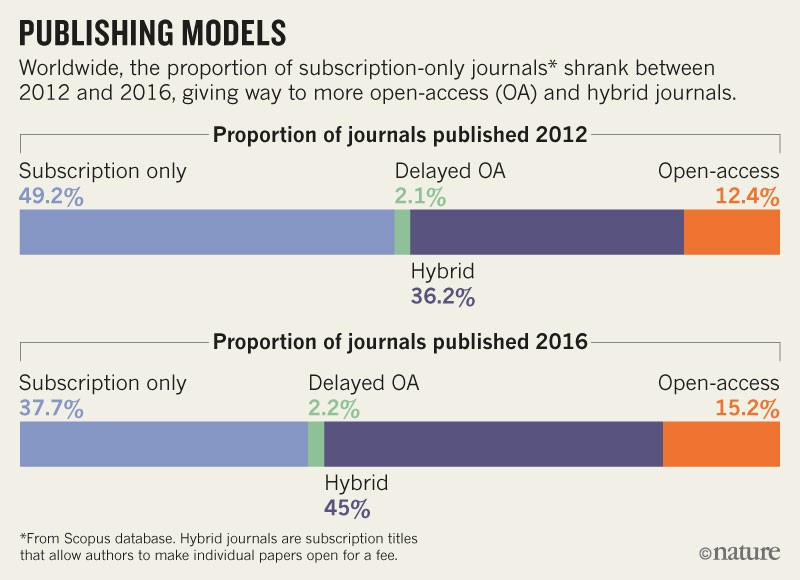
As written, Plan S would bar researchers from publishing in 85% of journals, including influential titles such as Nature and Science. According to a December 2017 analysis, only around 15% of journals publish work immediately as open access (see ‘Publishing models’) — financed by charging per-article fees to authors or their funders, negotiating general open-publishing contracts with funders, or through other means. More than one-third of journals still publish papers behind a paywall, and typically permit online release of free-to-read versions only after a delay of at least six months — in compliance with the policies of influential funders such as the US National Institutes of Health (NIH).
And just less than half have adopted a ‘hybrid’ model of publishing, whereby they make papers immediately free to read for a fee if a scientist wishes, but keep most studies behind paywalls. Under Plan S, however, scientists wouldn’t be allowed to publish in these hybrid journals, except during a “transition period that should be as short as possible”, the preamble says.
Source: Universities UK
“Hybrid journals were always viewed as a step towards full open access. They haven’t succeeded as a transitionary measure,” says David Sweeney, who chairs Research England, one of the funding agencies subsumed under UKRI, the United Kingdom’s national research funder. The plan also states that funders will cap the amount they are willing to pay for open-access publishing fees, but doesn’t lay out what charge would be too much.
Putting the ‘s’ in Plan S
The initiative is spearheaded by Robert-Jan Smits, the European Commission’s special envoy on open access. (The ‘S’ in Plan S can stand for ‘science, speed, solution, shock’, he says). In addition to the French, British and Dutch funders, national agencies in Austria, Ireland, Luxembourg, Norway, Poland and Slovenia have also signed, as have research councils in Italy and Sweden.
“Paywalls are not only hindering the scientific enterprise itself but also they are an obstacle [to] the uptake of research results by the wider public,” says Marc Schiltz, president of Science Europe, a Brussels-based advocacy group that represents European research agencies and which officially launched the policy.
PLAN S PLAYERS
So far, 11 national funding agencies in Europe have signed up to Plan S.
Austrian Science Fund
French National Research Agency
Science Foundation Ireland
National Research Fund (Luxembourg)
Italian National Institute for Nuclear Physics
Netherlands Organisation for Scientific Research
Research Council of Norway
National Science Centre (Poland)
Slovenian Research Agency
Swedish Research Council for Environment, Agricultural Sciences and Spatial Planning
Despite Smits’ role, the European Commission hasn’t itself signed the plan. But Smits says that he expects the requirements to be integrated into the terms and conditions of future research grants from the commission. That hasn’t happened yet because policymakers are still debating the details of its next research and innovation programme, Horizon Europe, which begins in 2021 and will be worth €100 billion over 7 years. Smits says he expects more funding agencies to join, and that he will discuss the plan in the United States next month with White House officials, scientific academies and universities.
“The plan is roughly what one would want after about 15 years of funder experimentation with weaker policies,” says Peter Suber, director of the Harvard Open Access Project and the Harvard Office for Scholarly Communication in Cambridge, Massachusetts. “We are very supportive of the ambition set out in Plan S,” adds Jeremy Farrar, director of the Wellcome Trust, a large private biomedical charity in London. He says the funder is finalizing a new open-access policy.
But national research agencies in some of Europe’s leading scientific nations, such as Switzerland, Sweden and Germany, have not yet signed. In Sweden’s case, this is because it has doubts over the tight timetable, says Sven Stafström, head of the country’s research council. He says the council agrees with the aims of Plan S and will review its position on the document at a board meeting later this month. Peter Strohschneider, president of Germany’s national research council, the DFG, says his council hadn’t signed because of the way the plan mandates recipients of public funding to specific forms of open access. “We request our researchers to publish their findings from DFG grants open access but we do not mandate them,” he said. He also cautioned that if researchers were all told to publish in open-access journals, costs of publishing could increase.
Sweeney says that, in the United Kingdom, it isn’t possible to calculate how much funders will need to pay under open-access publishing without a fuller picture of how publishers will respond. “What it costs depends on the reaction of the industry. This is a statement about principles, it is not a statement about [publishing] models,” he says.
And for Stan Gielen, president of the Netherlands Organisation for Scientific Research (NWO), Plan S goes beyond the economics of publishing. “This is part of a bigger transition towards open science and a re-evaluation of how we measure science and the quality of scientists,” he says.
Publisher concerns
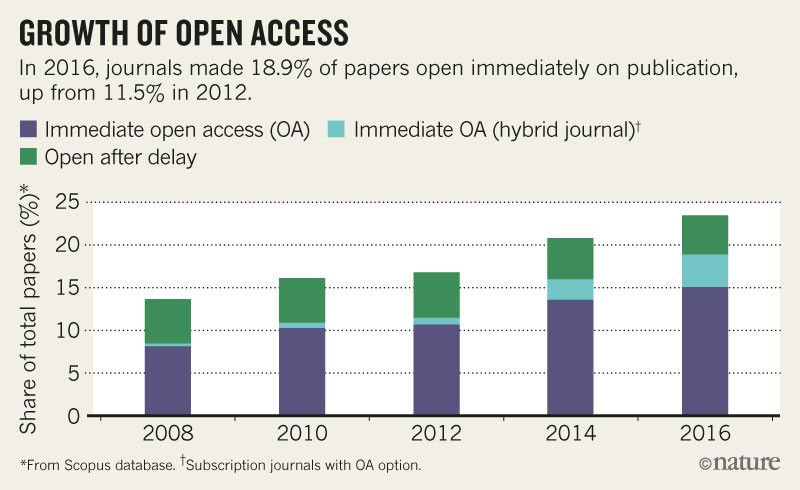
Asked for comments ahead of the plan’s launch, publishers said they had serious concerns — particularly around the banning of hybrid journals. A spokesperson for the International Association of Scientific, Technical and Medical Publishers (STM), based in Oxford, UK, which represents 145 publishers, told Nature’s news team that although it welcomed funders’ efforts to expand access to peer-reviewed scientific works, some sections of Plan S “require further careful consideration to avoid any unintended limitations on academic freedoms”. In particular, the STM spokesperson said, banning hybrid journals — which have delivered a lot of growth in open-access articles (see ‘Growth in open access’) — could “severely slow down the transition”. The publishing giant Elsevier said it supported the STM’s comments.
Source: UUK (2017)/BMC Med. 10, 124 (2012).
In another statement, a spokesperson for Springer Nature said: “Research, and the communication of it, is global. We urge research funding agencies to align rather than act in small groups in ways that are incompatible with each other, and for policymakers to also take this global view into account.” Removing publishing options from researchers “fails to take this into account and potentially undermines the whole research publishing system”, the statement added. (Nature’s news team is editorially independent of its publisher).
Meanwhile, the American Association for the Advancement of Science (AAAS), a non-profit organization that publishes the journal Science, said that the model outlined in Plan S “will not support high-quality peer-review, research publication and dissemination”. Implementing the plan would “be a disservice to researchers” and “would also be unsustainable for the Science family of journals”, the AAAS says.
Smits, however, says that it is essential that high-quality peer review remains part of the science publishing system under Plan S. “Publishers are not the enemy. I want them to be part of the change,” he says.
S for sanction?
Only a few funding agencies currently punish researchers who decide not to follow their open-access policies — including the Wellcome Trust and the NIH. But under Plan S, funders promise to “sanction non-compliance”, the initiative states. Smits suggests that a possible sanction for researchers who don’t comply could be withholding the final instalment of a grant, which is usually paid once a project is completed. But this, and other details such as the amount that funders are willing to pay to publish each article, will be worked out by the coalition in the run-up to 2020, he says.
Many European funders have been trying to make research free to read by brokering new ‘read-and-publish’ contracts with publishers, in which a single fee is paid to cover both the costs of reading paywalled research and of authors publishing under open-access terms. But some of the funders who have signed Plan S — including those in the Netherlands and Norway — now say they don’t intend to pay any more subscription fees beyond a transitionary period.
If other funders follow the Plan S idea, it could spell the end of scientific publishing’s dominant subscription business model, says John-Arne Røttingen, the head of Norway’s research council. “Subscription journals will see the opportunity to flip their business models into a system where what is paid for is the solid peer review, editorial reviewing and electronic dissemination of research results,” he says.
But Curry cautions that shifting from a subscription to an open-access business model around the world, as Plan S signers advocate, could bring a new challenge — how scientists in poorer nations will be able to afford to publish open-access work. “That has to be part of the conversation,” he says.