Search This Blog

Saturday, February 2, 2019

The 3 Elements of Charisma: Presence

Are you a senior in high school running for Student Council President?
Are you an entrepreneur looking to make a successful pitch and attract investors?
Are you a military officer working to win your men’s loyalty?
Are you a salesman trying to land some new clients?
Are you a college professor wanting to get through to your students?
Are you a single guy looking for love?
No matter your situation in life and your individual aims, one of the most important tools for success is your personal charisma. Charisma is what allows you to command a room, draw others to you, and convince people of your ideas. It’s an essential part of being the kind of leader who wins devoted followers who are willing to go to the ends of the earth for you. Charismatic men are perceived as both likeable and powerful, a dynamic, irresistible combination that opens endless doors to them.
Charisma may seem like a mysterious quality — something that some men are born with and some are not. But this is happily not the case. You don’t need to have hit the genetic charisma lottery in order to develop yourself into a man with powerful magnetism.
Far from being a magical and inexplicable trait, charisma can be broken down into a set of concrete, largely nonverbal behaviors that can be learned, practiced, and made natural. Olivia Fox Cabane, author of The Charisma Myth, places these behaviors into three categories: Presence, Power, and Warmth. When deftly combined, these three components produce strong personal magnetism.
We will be devoting an entire post to each of these three components of charisma. Each will provide an overview of the component, as well as practical tips for developing and implementing it. Later on, we will cover charismatic body language, and, because not every “style” of charisma is appropriate for every situation, we’ll discuss what behaviors to use or de-emphasize in different situations.
For today, we’ll start off by talking about the first component of charisma: Presence.

Charisma Component #1: Presence
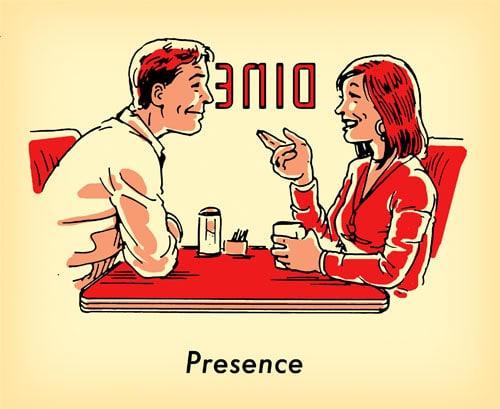
man woman together at old school diner illustration
Have you ever been in a conversation with someone and you could tell you didn’t have their complete attention?
How did it make you feel?
Probably a bit annoyed.
Sadly, it seems fewer and fewer people are fully present and engaged with the individuals they’re interacting with. Being completely engaged in a conversation has likely always been a challenge, as we all have a bit of the conversational narcissist in us.
Now that smartphones have saturated modern life, being fully present is even harder. People today try to (unsuccessfully) switch their attention between two worlds — the real world populated by the people they are physically present with and the cyber world which sends them dispatches through their phone. Go to any restaurant in America and you’re bound to see tables of people staring blankly at their smartphones and hardly engaging with each other. This video that circulated the intertubes a few weeks ago perfectly captures the way in which technology has created a society of non-present screen gawkers. Pretty poignant.
The good news about all this is that it’s now incredibly easy to set yourself apart from the pack simply by being fully present with people and giving them your complete attention.
When you think of charisma, you might think of trying to make yourself seem super awesome to others. But the paradoxical secret of charisma is that it’s not about trumpeting your good qualities, but making the other person feel good about himself. Real charisma makes the other person feel important; when they finish an interaction with you, they feel better about themselves than they did before.
Focusing your mental and emotional energy on someone as you interact is how you create that feeling of importance. People fundamentally want attention – they want to be recognized and acknowledged.
And you don’t have to be an outgoing, uber-social extrovert in order to have and display charisma. In The Charisma Myth, Cabane cites tech-entrepreneur Elon Musk as an example of someone who has mastered the art of charismatic presence. He’s incredibly intelligent and a pretty quiet guy by nature; however, he counterbalances his introverted inclinations with intense focus and presence. He doesn’t need to be the extroverted life of the party to seem magnetic; instead of chatting everybody up and offering a little of himself to a lot of people, he concentrates on giving his full, intense attention to a few; in so doing, he makes them feel incredibly special. Charisma isn’t necessarily about quantity, but quality.
Conveying presence is a simple concept, but oftentimes difficult to actually achieve. You can’t just fake it. People are surprisingly adept at deciphering your feigned interest. To truly convey presence, you must actually be present. It takes a significant amount of willpower to focus all your attention on the person you’re with at the moment. But like all things, with practice, it becomes significantly easier.
Below are some tips on developing your charismatic presence:
Bring yourself to the here and now. Presence begins in your mind. If you feel like your mind is off somewhere else while engaging with someone, try this little exercise to bring you back to the here and now. Focus on physical sensations in your body that you often ignore. It could be your breath or it could be the sensation of your feet touching the ground. You don’t have to spend very long meditating on these sensations. Just a second or two will bring you back into the moment you’re sharing with this person.
Make sure you’re physically comfortable. It’s hard to be fully present with someone when all you’re thinking about is how uncomfortably tight your pants are or how hot it is. To that end, do what you can to ensure you’re as comfortable as possible. As Antonio has emphasized numerous times — wear properly fitting clothes! Besides helping you look better, clothes that fit well make you feel better. Other things you can do to increase your physical comfort include getting enough sleeplaying off the caffeine (be calm instead of jittery), and adjusting the thermostat (when you can) to a more agreeable temperature.
Set your devices on silent and put them out of sight. This serves two purposes. First, it reduces the temptation for you to check them while you’re engaging with someone. Second, it sends a strong message to the person you’re with that they have your complete attention and they’re not sharing it with the smartphone placed on the table. (Here’s a complete guide to shaking your smartphone habit.)
Look the person in the eye when they’re talking. Numerous studies have shown that people who make higher levels of eye contact with others are perceived as possessing a load of desirable traits, including warmth, honesty, sincerity, competency, confidence, and emotional stability. And not only does increased eye contact make you seem more appealing in pretty much every way to those you interact with, it also improves the quality of that interaction. Eye contact imparts a sense of intimacy to your exchanges, and leaves the receiver of your gaze feeling more positive about your interaction and also more connected to you.
It’s important to note that while eye contact works well in building intimacy in friendly situations, recent research suggests it may backfire when you’re trying to persuade someone who’s skeptical of your point of view.
To learn more about the importance of eye contact, click here. To learn how to make eye contact the right way, click here.
Nod to show that you’re listening. Besides eye contact, an easy way to convey presence is through body language, and more specifically, nodding your head. But be judicious with the noggin nods. An over abundance can indicate you’re trying too hard to please and agree with the person, which decreases their perception of your power. Also, only nod at appropriate times; you’ll need to be truly listening to know when a nod makes sense.
Ask clarifying questions. An easy way to show someone that you’re completely there with them is to ask clarifying questions after he or she has spoken. For example, you could ask, “When you say ________, what exactly do you mean?”
Another great clarifying question comes to us from Dr. Stephen Covey’s The Seven Habits of Highly Effective People. Basically, you paraphrase what the person just said and add, “Am I understanding you correctly?”
In more casual conversations, ask people questions like, “What was your favorite part of that?” or “What was the hardest part of that for you?” People really enjoy reflecting on and answering such questions.
For more info on how to ask questions that show you’re really listening, click here.
Avoid fidgeting. Fidgeting signals to the other person that you’re not comfortable or content and that there’s somewhere else you’d rather be. So don’t twiddle your thumbs or your phone. And avoid looking around for what else is going on, which signals to the other person that you’re searching for a better opportunity than your current one.
Don’t think about how you’re going to respond while the person is still talking. We all have a tendency to do this. Our inner conversational narcissist wants to be ready to jump in and start talking as soon as there’s an opening. But if you’re thinking about what you’re going to say, you’re obviously not fully listening to what the other person is saying. It’s natural to want to have an idea of what you’re going to say before you say it, but it’s okay to work through your response as you’re giving it; embrace the pause. As we’ll discuss in the article on Power, it’s low-status individuals that talk the most and feel the need to fill every silence.
Wait two seconds before responding. Breaking in the very instant a person pauses or stops talking signals to them that you were doing the above; thinking about what you were going to say instead of fully listening to them. Nonverbal behaviors are more powerful than verbal ones, so use this trick from Cabane to show you’re really tuned in:
When someone has spoken, see if you can let your facial expression react first, showing that you’re absorbing what they’ve just said and giving their brilliant statement the consideration it deserves. Only then, after about two seconds, do you answer.
The sequence goes like this:
  • They finish their sentence
  • Your face absorbs
  • Your face reacts
  • Then, and only then, you answer
Bone up on your other listening skills. Make sure to check out our post on active listening for more tips on improving this vital skill. Follow them and you’ll make vast improvements in your charismatic presence.

Listen to my podcast with Olivia Fox Cabane about charisma:


Read the Entire Series

Drug Supply Chain Falls as Some on Wall Street Say Shake It Off

Sell-side analysts at Wall Street firms are having mixed reactions to the roll-out of a proposal to limit the legal status of rebates in U.S.-run drug plans, as health-care supply chain stocks slide in trading Friday.
Those at Citigroup and SVB Leerink have told investors not to fret after shares started falling after the proposed rule was released late Thursday, while strategists at Goldman Sachs and Evercore ISI took a more cautious tone.
CVS Health, UnitedHealth Group and Cigna — through its recent acquisition of Express Scripts — all have less than 4 percent of their earnings tied to keeping those rebates, Citi analyst Ralph Giacobbe estimated in a note to clients. The “long awaited” drug pricing proposal excluding rebates “falls largely inline with one of the options outlined in the president’s blueprint for lowering drug prices in May,” he said.
On the flip side, Evercore ISI’s Michael Newshel believes that legislation targeting rebates under commercial insurance plans is “quite possible,” and Goldman’s Robert P. Jones agrees. “We question how it might impact the use of inflation-protection, rebate-linked admin fees, and agreements with manufacturers that could span the government and commercial market,” Jones said.
The Department of Health and Human Services released a plan that would roll back so-called safe-harbor protections for rebates under government-run programs like Medicare, which the Trump administration has blamed for helping to keep prices high. Cigna, which also reported earnings this morning, fell as much as 5.6 percent. Drug distributors including AmerisourceBergen, Cardinal Health and McKesson were each down at least 2 percent. CVS and UnitedHealth also declined.
President Trump is set to deliver his State of the Union address on Tuesday. The not-yet-finalized plan targets changes in 2020 and is subject to a 60-day comment period.
Here’s what analysts are saying:

SVB Leerink, Ana Gupte

“Fears overblown; buy the weakness!”
“We see the impact as more than manageable for the Medicare Advantage-Part D, Stand-alone Part D, as well as PBMs in our coverage and would view any weakness as a buying opportunity,” Gupte said of outperform-rated Cigna, CVS, UnitedHealth, Humana, and Anthem.
“The new rule portends changes in commercial may be likely and it is not impossible for rebate elimination legislation to be passed.” Gupte said “this would be manageable” as the well known PBMs have said they pass on 95 percent or more of rebates to employers. “D.C., however, could face backlash from employers who are keen on keeping rebates as they are largely used to offset healthcare costs.”

Goldman, Robert Jones

“We expect the market to interpret this rule negatively for the PBMs, which over the past several years have successfully leveraged scale and competition to create a growing pool of rebates as a primary means of reducing drug costs. However, the PBMs have been weaning themselves off rebates,” Jones wrote, “and they have proven capable of shifting compensation away from rebates, such that this rule might not have the same impact as it would have had several years ago.”
“If the PBMs are under greater pressure to find savings for clients, the drug retailers may be one place they could look. The more fragmented nature of the retail pharmacy market leaves retailers with little leverage in negotiating reimbursement rates with the PBMs.”
For biopharmaceutical companies, “this proposal could be a positive” in the short-term and neutral over the longer-term. The drugmakers focused on biosimilars may wind up being hurt as branded drug prices may become more competitive.
Wholesalers, which have spent the last few years weaning off of reliance on branded drug price inflation, are likely to remain “‘in the center of the debate” until a rule is solidified. AmerisourceBergen and Cardinal would lose as much as 4 percent of earnings, McKesson as much as 3 percent, if list prices on drugs no longer inflated.

Evercore ISI, Michael Newshel, Ross Muken

“The proposal reads as an indictment of the current rebate system, and HHS clearly wants to see broader change.” Evercore cautions that “with bipartisan momentum on drug pricing building already, we think legislation targeting commercial rebates is quite possible.”
“There is already a broad push underway toward more transparent pricing in the PBM industry based on fees instead of retained rebates or spread differences between prices charged health plans and paid to the pharmacy.” Both Cigna’s Express Scripts and CVS have made transparent offerings for employers, with little uptake so far. Evercore estimates that after recent acquisitions, roughly 2 percent of CVS’s 2019 earnings would be from retained rebates and 4.7 percent of Cigna’s.
Drug distributors are likely to suffer with the rest of the supply chain, although it may be “short-term pain.” Specialty pharmacies are most at risk as “compensation is largely based on cost plus pricing.” Traditional pharmacies would also take a hit.

Height Capital Markets, Hunter Hammond

“If the proposed rule is finalized – which we think can happen as soon as 3Q 2019 – we expect that beneficiaries will face higher premiums and lower cost-sharing payments.”
PBMs including CVS, UnitedHealth, Cigna and Diplomat Pharmacy “will likely face near-term headline risk from the proposal and long-term risk if the proposal is implemented as their business models adapt,” the policy analyst wrote.
“Drug manufacturers and health insurers will likely face positive to mixed reactions in the near-term as the administration’s gaze turns to PBMs and would see long-term benefits if the rule was finalized as beneficiaries will enter the coverage gap slower and premiums will rise.”

No sweat: Issue for home-schooled children?

Parents who home-school their children may think putting them into organized sports and physical activities keeps them fit, but Rice University researchers say young people need more.
Faculty at the Rice Department of Kinesiology studied data gathered from 100 home-schooled  age 10-17 to back up their assumption that such activities are sufficient to keep children physically fit. The data, however, proved them wrong.
The Rice researchers’ results are available in an open-access paper in the Journal of Functional Morphology and Kinesiology.
Laura Kabiri, a sports medicine lecturer at Rice, said the problem lies in how much activity is part of organized regimens. According to the World Health Organization, children should get about an hour of primarily aerobic activity a day, but other studies have noted children involved in non-elite sports actually get only 20 to 30 minutes of the moderate to vigorous exercise they require during practice.
The Rice researchers decided to quantify it through statistics Kabiri gathered about home-schooled children and adolescents as a  and postdoctoral researcher at Texas Woman’s University.
“We assumed—and I think parents largely do as well—that children enrolled in an organized sport or  are getting the activity they need to maintain good body composition, cardiorespiratory fitness and muscular development,” Kabiri said. “We found that is not the case. Just checking the box and enrolling them in an activity doesn’t necessarily mean they’re meeting the requirements they need to stay healthy.”
Kabiri said the researchers suspect the same is true for public school students in general physical  classes, where much of the time is spent getting the class organized. “When you only have 50 minutes, it’s very easy for half that time or more to go to getting them in, out and on-task,” she said.
While public school data would be easier to gather, home schooling presents a different problem for researchers. “There’s a lot that’s not known about this population, and the population is expanding,” Kabiri said. “Home school is becoming very popular in the United States. It’s grown steadily.
“And now that Texas students can have a free online public education starting in grade 3, I think this population is going to expand. I want to make sure that the health aspect and the physical activity and exercise components of their education don’t fall through the cracks,” she said.
“My understanding is that the state program addresses physical education, but if you’re a general home-school student in the state of Texas, there is no requirement at all for physical activity, and physical education, nutrition and exercise information is largely left up to the parents,” she added.
The authors concluded parents would be wise to give their children more time for unstructured physical activity every day.
“Parents know if they attend activities and don’t see their kids breathing and sweating hard, then they’re not getting enough exercise,” Kabiri said. “So there should be more opportunities for unstructured activity. Get your kids outside and let them run around and play with the neighborhood kids and ride their bikes.
“If I learned one thing about home-school families, it’s that they are really dedicated to the entire education of their children,” she said. “If there’s an issue, they will want to know and will make adjustments as needed.”

Explore further

More information: Laura Kabiri et al, Organized Sports and Physical Activities as Sole Influencers of Fitness: The Homeschool Population, Journal of Functional Morphology and Kinesiology (2019). DOI: 10.3390/jfmk4010013

How type 1 diabetes gradually destroys insulin production

Using the new Imaging Mass Cytometry method, researchers of UZH have investigated the pancreas of healthy organ donors and those with type 1 diabetes. The study shows that many beta cells, which normally produce insulin, are still present in the early stages of the disease, but look very different. These beta cells could potentially be rescued for the benefit of the patient and the progression of the disease could be slowed down or even stopped.
The  of Langerhans play a key role when it comes to regulating how the body metabolizes sugar. The β located there monitor the blood sugar levels and secrete insulin as required. Insulin in turn triggers the uptake of sugar into cells. In  suffering from type 1 diabetes, these β cells are attacked and destroyed by the body’s own white blood cells.
Research only possible with donated organs
Little is known about what happens inside of the pancreas when diabetes develops, since performing biopsies or imaging of the organ is not feasible when patients are alive. “Much of what we know about type 1 diabetes in humans is based on pancreases from organ donors, and these are very rare,” says Bernd Bodenmiller from the Institute of Quantitative Biomedicine of the University of Zurich. This is why researchers are keen to gain as many insights as possible from every single organ that is donated.
Wealth of information from a single sample
Bodenmiller and his team, working together with research groups in Geneva and in the US, have now for the first time used imaging mass cytometry to investigate donated pancreases: “This allows us to visualize β cells, other types of cells in the Langerhans islets as well as invading  at the same time,” says Bodenmiller about the advantages of the method, which was developed under the lead of the University of Zurich. “This has previously not been possible using traditional approaches.”
For their study Nicolas Damond, first author of the publication from the Institute of Quantitative Biomedicine, analyzed 12 donated pancreases – four from healthy donors, four from patients in the early stages of type 1 diabetes and four from patients with advanced type 1 diabetes. The scientists used the findings to develop a map that shows the location of the different cell types in the pancreatic islets and the state the β cells were in.
Starting point to develop therapy for early stages of diabetes
Damond then compiled the data from the various donated organs in a pseudo timeline. This allowed him to reconstruct the changes in the pancreatic tissue from the onset of type 1 diabetes right up to the final stages of the disease.
One of the findings was particularly interesting: There was still a surprisingly high number of β cells in the pancreatic islets of Langerhans during the disease’s early stages. These cells might look different and produce less insulin than healthy cells, but they could possibly still be saved from complete destruction. “If we succeed in stopping the autoimmune attack this early, the cells could maybe regain their function and help with regulating the blood sugar levels of patients,” says Damond.
New insights into autoimmunity
Through imaging mass cytometry the research group also located the special type of white blood cells which, according to current scientific knowledge, are responsible for β cell destruction. The researchers found these immune cells mainly in the pancreases of patients in early stages of the disease, especially in pancreatic islets that contained a high number of surviving β cells. Pancreatic islets whose β cells had been mostly destroyed, in contrast, had fewer white blood cells.
These results could help to shed light on the mechanism of the autoimmune reaction, about which there are currently still many open questions. “Our study demonstrates that imaging mass cytometry can make a valuable contribution to a better understanding of how type 1  progresses. It provides a basis for planning further experiments and developing new hypotheses,” believes Bodenmiller.

Explore further

More information: Nicolas Damond et al. A Map of Human Type 1 Diabetes Progression by Imaging Mass Cytometry, Cell Metabolism (2019). DOI: 10.1016/j.cmet.2018.11.014

TCR2 Therapeutics Launches Proposed IPO

TCR2 Therapeutics Inc., a clinical-stage immunotherapy company developing the next generation of novel T cell receptor therapies for patients suffering from cancer, today announced that it has launched an underwritten initial public offering of 5,000,000 shares of its common stock at an initial public offering price expected to be between $14.00 and $16.00 per share. TCR2 also intends to grant the underwriters a 30-day option to purchase up to an additional 750,000 shares of common stock. All of the shares to be sold in the proposed offering will be offered by TCR2. TCR2 has applied to list the shares on the Nasdaq Global Market under the symbol “TCRR”.
Jefferies, SVB Leerink and BMO Capital Markets are acting as joint book running managers for the offering. Wedbush PacGrow and China Renaissance are acting as co-managers for the offering. The offering is subject to market and other conditions, and there can be no assurance as to whether or when the offering may be completed.

US IPO Week Ahead: 2 billion-dollar biotechs in a 4-IPO week

Four IPOs plan to raise $523 million in the week ahead. Biotechs are still a strong force in the IPO market with three early-stage immunotherapy plays on the docket, including two with proposed billion-dollar valuations. A micro-cap Florida bank rounds out the group. Two blank check companies are also on the week’s IPO calendar.
Several deals may launch on Monday, mostly biotechs, like Stealth BioTherapeutics (MITO), Kaleido Biosciences (KLDO), Cirius Therapeutics (CSTX), and Poseida Therapeutics (PSTX), as well as medical device maker Avedro (AVDR).
U.S. IPO CALENDAR
ISSUER
BUSINESS
DEAL SIZE
MARKET CAP
PRICE RANGE
SHARES FILED
TOP
BOOKRUNNERS
Alector (ALEC)
South San Francisco, CA
$176M
$1,391M
$18 – $20
9,250,000
Morgan Stanley
BofA ML
Phase 1 biotech developing therapies for neurodegeneration.
Monocle Acquisition (MNCLU)
New York, NY
$150M
$193M
$10
15,000,000
Cowen
Chardan
Blank check company formed to acquire an aerospace & defense or industrial business.
Gossamer Bio (GOSS)
San Diego, CA
$230M
$1,010M
$16
14,375,000
BofA ML
Leerink
Developing in-licensed immunotherapies for asthma and other indications.
Harpoon Therapeutics (HARP)
South San Francisco, CA
$76M
$377M
$13 – $15
5,400,000
Citi
Leerink
Phase 1 biotech developing T cell immunotherapies for various cancers.
BankFlorida (BFL)
Palm Beach Gardens, FL
$42M
$51M
$9.50 – $10.50
4,200,000
B. Riley FBR
Community bank with one branch in Southern Florida.
Wealthbridge Acquisition (HHHU)$50M
$65M
$10
5,000,000
Chardan
Blank check company targeting the air transportation industry in China.
Alector (ALEC) plans to raise $176 million (48% from insiders) at a $1.4 billion valuation. While Alzheimer’s is notoriously difficult to treat, it has remained an area of high interest, and Alector offers a novel approach focused on repairing the brain’s immune system. Backed by Polaris and OrbiMed, it has secured a collaboration with AbbVie worth up to $1.2 billion, including $205 million paid upfront.
Gossamer Bio (GOSS) is targeting a $230 million capital raise at a $1.0 billion valuation. The company’s experienced management team previously sold Receptos for $7.2 billion, and its asthma and PAH targets are each multi-billion dollar markets. However, the company’s candidates are all in-licensed or acquired, and it only commenced operations in 2017. Insiders
Formed by MPM Capital, Harpoon Therapeutics (HARP) is developing T cell immunotherapies for cancers. New investors do not have much clinical data to go on, but AbbVie has committed up to $600 million in milestones, plus royalties.
After postponing in the 4Q, BankFlorida (BFL), re-launched its IPO with lower terms. It plans to raise $42 million at a market cap of $51 million.
IPO Market Snapshot
The Renaissance IPO Indices are market cap weighted baskets of newly public companies. As of 1/31/19, the Renaissance IPO Index was up 18.0% year-to-date, while the S&P 500 had a gain of 8.0%. Renaissance Capital’s IPO ETF (NYSE: IPO) tracks the index, and top ETF holdings include VICI Properties (VICI) and Spotify (SPOT). The Renaissance International IPO Index was up 4.6% year-to-date, while the ACWX was up 7.6%. Renaissance Capital’s International IPO ETF (NYSE: IPOS) tracks the index, and top ETF holdings include SoftBank and China Tower.

Pricing pressure ‘a hard pill’ to swallow, Barron’s says

President Donald Trump and Democrats in Congress agree on almost nothing, except for doing something about prescription drug prices, and the political pressure and a broader public backlash against price increases have already rattled the pharmaceutical industry, Avi Salzman writes in this week’s edition of Barron’s. House Democrats have cited 19 drugs in their scrutiny of the industry, drugs commercialized by AbbVie (ABBV), Amgen (AMGN), AstraZeneca (AZN), Celgen (CELG), Eli Lilly (LLY), Johnson & Johnson (JNJ), Mallinckrodt (MNK), Novartis (NVS), Novo Nordisk (NVO), Pfizer (PFE), Sanofi (SNY), and Teva Pharmaceutical (TEVA), the report notes. Further, the gross list price growth for the top six companies in U.S. prescription drug sales – Roche (RHHBY), Pfizer, AbbVie, J&J, Amgen and Merck (MRK) – has fallen sharply in recent years, the publication adds.