Search This Blog

Sunday, February 3, 2019

Will Juul Will Be Enough For Altria?

Juul vaping cartridge sales were on fire this past year, giving Wells Fargo a buzzy feeling about Altria Group Inc. MO 0.53% following this week’s earnings report. But Morgan Stanley wasn’t convinced vaping will offset the continuing decline in traditional cigarettes.
Altria reported fourth-quarter adjusted earnings per share of 95 cents, roughly in line with Street expectations. But the part of its report that got the most notice was the spike in Juul Labs revenue, which passed $1 billion, seven times what it was the previous year. The legacy Big Tobacco company’s earnings call was closely watched because it was its first since acquiring a 35-percent stake in Juul last year.
The Analysts
Wells Fargo Securities analyst Bonnie Herzog was the more bullish on Altria, reiterating an Outperform rating and a $65 price target, seeing strong opportunity for the company once known for Marlboros with its stake in Juul.
Morgan Stanley’s Pamela Kaufman was decidedly more bearish and kept her Underweight rating and $45 price target on the stock, saying vaping won’t offset (and will even help speed up) the demise of the cigarette.
Altria shares traded at $48.96 Friday afternoon.
Wells Fargo
Herzog likes the high visibility of Juul and the opportunity she sees for the vaping company to boost overall Altria fortunes. The rest of the market, Herzog said, is missing the degree to which the product could save a company previously pinned to what some see as a dying tobacco industry.
“We…are incrementally more bullish on MO’s decision to acquire a 35 percent stake in JUUL,” Herzog wrote in a note. She acknowledged a speed-up in the decline of cigarette sales, but said Juul’s strong U.S. share and margin growth, along with good prospects internationally, present upside that is underestimated.
Herzog did acknowledge some uncertainties, including the possibility of stronger federal regulations on e-cigarettes. But, she said, strong Juul growth internationally combined with a working cost reduction program in the larger Altria operation should enable earnings growth for several years to come.
Morgan Stanley
Kaufman isn’t yet hooked on Juul.
Kaufman noted that Altria expects Juul’s international business to represent about half the company’s revenue by 2023, but is more concerned about the risks.
“While MO will benefit from JUUL’s growth, we see risk from higher cigarette cannibalization, the impact from lower nicotine caps/lower barriers to entry in international markets, and FDA risk,” Kaufman wrote in a note. Even modeling in Juul growth, Kaufman said, Morgan Stanley believes “the contribution will be offset by weaker growth in MO’s core business.”

Raymond James Raises PT On Scotts Miracle-Gro Following Q1

Analysts at Raymond James reiterated their rating on Scotts Miracle-Gro Co SMG 0.17%, even though the company’s fiscal first quarter results were “somewhat” below their expectations. Nevertheless, the analysts saw a number of “encouraging” signs in the earnings report.

The Analyst

Joseph Altobello reiterated his Outperform rating on the Scotts Miracle-Gro and raised the price target from $71 to $80.

The Thesis

Scotts Miracle-Gro posted an adjusted net loss of $1.39 per share, which was 29 percent lower than Raymond James’ estimate of $1.15 and below the consensus of $1.25. Altobello pointed out that the miss was mostly due to temporary Cost of Goods Sold and non-operating items such as a lower tax rate and diluted share count.
The company’s earnings of $298.1 million grew by 35 percent on the year, slightly lower than the 38 percent the analyst had expected.
Altobello also pointed out that Scotts Miracle-Gro’s U.S. consumer segment enjoyed a 9-percent sales growth during the quarter, which was above their estimates of a 1-percent growth.
The cannabis-focused Hawthorne subsidiary grew its sales by 84 percent, versus Raymond James’ expectations of 108 percent. Hawthorne sales were boosted by the acquisition of Sunlight Supply, but on a comparable basis the sales fell by less than 10 percent on the year, which is an improvement from the previous quarters’ drops of 30-40 percent.
In this way, Altobello said, Scotts Miracle-Gro is showing solid trends for its U.S. consumer segment and the integration of Sunlight is well on track to provide synergies of around $0.60 per share.

Geron, Mesoblast, Supernus called buys

Supernus Pharmaceuticals (NASDAQ:SUPN) resumed with Buy rating and $55 (48% upside) price target at Janney.
Mesoblast Limited (NASDAQ:MESO) initiated with Buy rating and $6.50 (43% upside) at H.C. Wainwright.
Geron (NASDAQ:GERN) upgraded to Buy with a $3.25 (216% upside) price target at B. Riley FBR. Shares up 10% premarket.

Saturday, February 2, 2019

Two Ways for Startups and Corporations to Partner

Although some large corporations invest in or acquire startups, a growing approach to corporate innovation involves partnering with small, high-growth companies. When a large corporation partners with a start-up the result should, in theory, be a win-win. Corporations possess resources and legitimacy that startups aspire for, while startups have agility and novel ideas that corporations value. For information technology (IT) corporations, the motive may partly be the adoption of their technology platforms as building blocks; for non-IT corporations a driver could be pain points resulting from disruptive digitalization.
But vast interorganizational asymmetries mean it is often not straightforward for such different firms to collaborate. Disparities in size, structure and power make it difficult for startups to connect with the right department and individuals within a large corporation. It is therefore imperative for corporations to provide startups with viable interfaces. In my research I have discovered two such approaches: cohorts and funnels.
In a cohort, a set of startups participate in a programmatic initiative, such as an accelerator, over a pre-specified period, usually a few months. Peer engagement among the startups is often a key part of the process. While gaining entry into a cohort may be competitive, once in, participating startups generally complete the process. To illustrate, Microsoft established accelerators that provide cohorts of startups with four months of access to technological and business infrastructure, mentoring, and network-building opportunities, culminating in a demo day attended by Microsoft managers and partners, as well as external investors. Also, Bayer’s Grants4Apps (G4A) program offers a 100-day accelerator program for digital health startups based in its premises in Berlin. SwissRe’s insuretech accelerator, launched first in Bangalore, is yet another example.
By contrast, in a funnel, many fewer startups complete the process than begin it. Startups get screened out as the process unfolds, often not being aware of other startups that are participating. A funnel essentially has a built-in contest for a limited set of collaborative opportunities. To illustrate, SAP Startup Focus was established to work with promising startups developing new applications on the corporation’s database platform (SAP HANA) and help accelerate their market traction with its enterprise customers. Around 15% of startups are then provided technical assistance to build enterprise-centric solutions, with a further subset that successfully validated their solutions then receiving go-to-market support. Another example is BMW’s Startup Garage which offers startups the opportunity to work with it as a “venture client” on an innovation project after screening them for technical quality, strategic fit and the potential to become a market leader through a stage-gate process. Also operating as a funnel is Unilever Foundry which puts forward challenges, frequently relating to digital marketing, that start-ups are invited to pitch solutions for.
While the mere existence of a cohort or funnel does not guarantee partnering success, creating an effective interface gives startups a first port of call that overcomes the difficulty of establishing a connection in the first place and increases the odds of meaningful relationships ensuing by giving both parties a shared understanding of the nature of collaboration that might be feasible. Executing an effective startup partner interface calls for genuine and thoughtful effort – not mere lip service – from corporations. Here are three lessons.
Ensure fit with partnering goals. Although neither interface is inherently superior, they are qualitatively distinctive. Cohorts have the advantage of being able to, potentially, give rise to previously unconsidered opportunities through brainstorming and experimentation. Funnels can be especially effective at delivering tangible outcomes based on perceived pain points because of the process of elimination leading to joint activity with a startup that is tightly aligned with the corporation’s agenda. Thus one factor in choosing between a cohort and funnel might be how diffuse or specific the underlying partnering goals are. As the sophistication of startup partner interfaces grows, corporations may also seek to balance the benefits of cohorts and funnels. For instance, a funnel-based interface might selectively add a cohort dimension, such as Unilever Foundry’s Level 3 co-working space in Singapore.
 Span boundaries externally and within. A corporation’s partner interface, be it a funnel or cohort, is only as good as its ability to connect high-quality external startups with relevant internal line managers. Once an interface is created, the team running that unit must be skilled at building bridges with entrepreneurs, whose decision-making styles and strategic orientations may differ considerably from those of managers in large corporations. They must also be able to connect startups with their own corporation’s business unit leaders who have the ability to realize the prospect of collaborating with startups, yet may view this as a distraction. Co-locating an internal innovation team with external startups in a corporate accelerator, as Infiniti Lab has done in Hong Kong, may help in spanning boundaries.
Make adjustments to the interface. Ongoing tweaking can continuously improve the interface. In the second year of Bayer’s G4A program, the cohort’s scope was broadened to include global startups and internal employees’ startup ideas. The following year, a more concerted effort was made to link the expertise of the startups with Bayer’s areas of interest. In other cases, more fundamental changes may ensue. Microsoft switched from accelerators to scaleups, no longer welcoming early-stage startups but rather seeking to nurture more mature ones. And some interfaces may run their course. SAP has recently retired the Startup Focus program, merging it with SAP PartnerEdge, its flagship partner engagement program for partners of all types.
Following these lessons can yield effective interfaces that are more likely to produce successful corporation-startup partnering outcomes, like the recent collaboration around a proof of concept in the area of B2B online transactions between Silicon Valley-based startup Crowdz and Barclays Bank. This was the result of that startup’s stint in the Barclays London accelerator, part of an ongoing multi-location program that reflects all three lessons above, run by the corporate accelerator specialist Techstars.
Corporations are increasingly battling for the hearts and minds of the best startup partners – and building an effective interface is vital to a winning strategy.

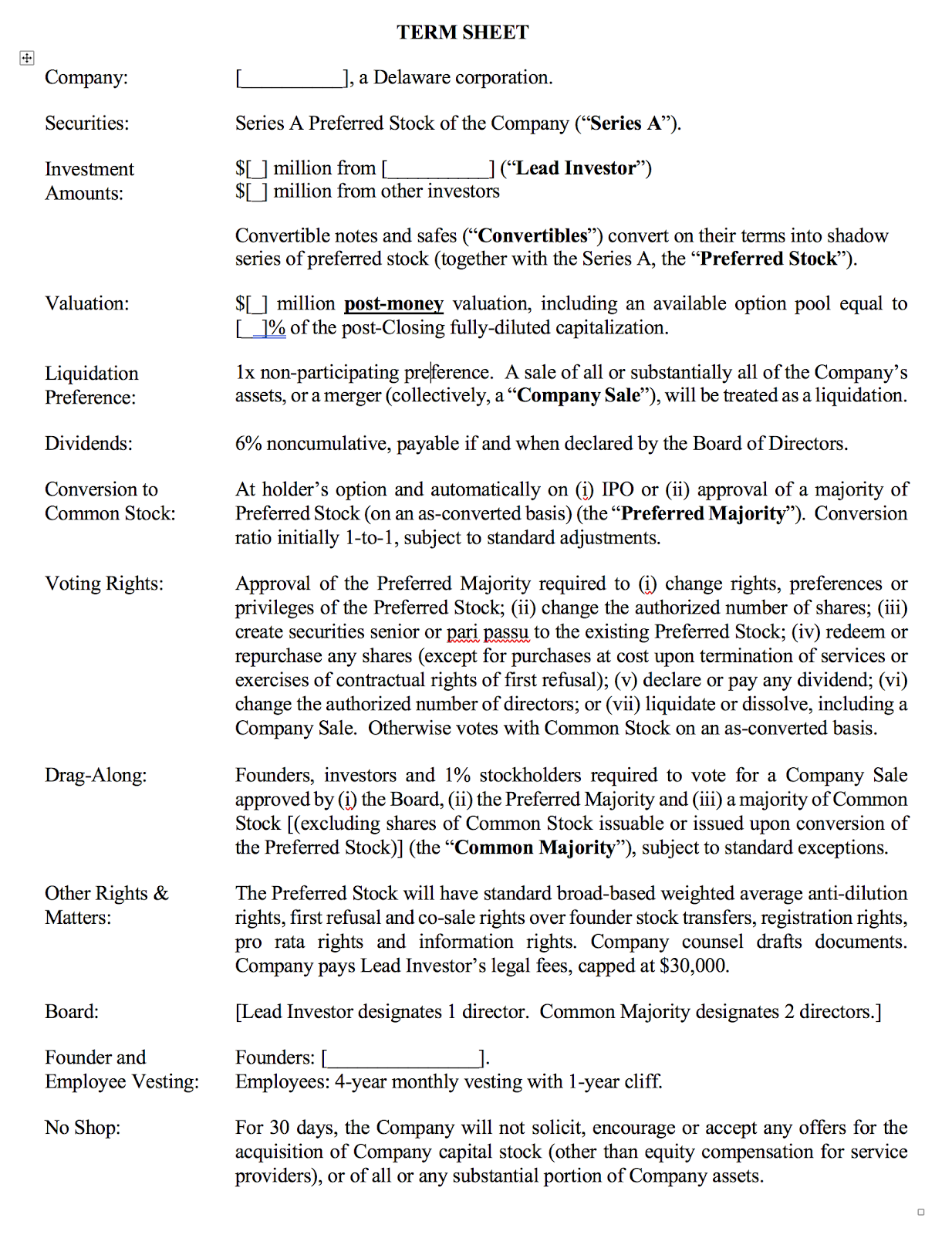
A Standard and Clean Series A Term Sheet

While working with companies in YC’s Series A program, we’ve noticed a common problem: founders don’t know what “good” looks like in a term sheet. This makes sense, because it is often, literally, the first time in their careers that they’ve seen one. This puts founders at a significant disadvantage because VCs see term sheets all the time and know what to expect. Because we’ve invested in so many founders over the years and have seen hundreds of Series A term sheets, we know what “good” looks like. We work with our founders to understand where terms diverge from “good”, what they can do about that divergence, and when and how it makes sense to negotiate.
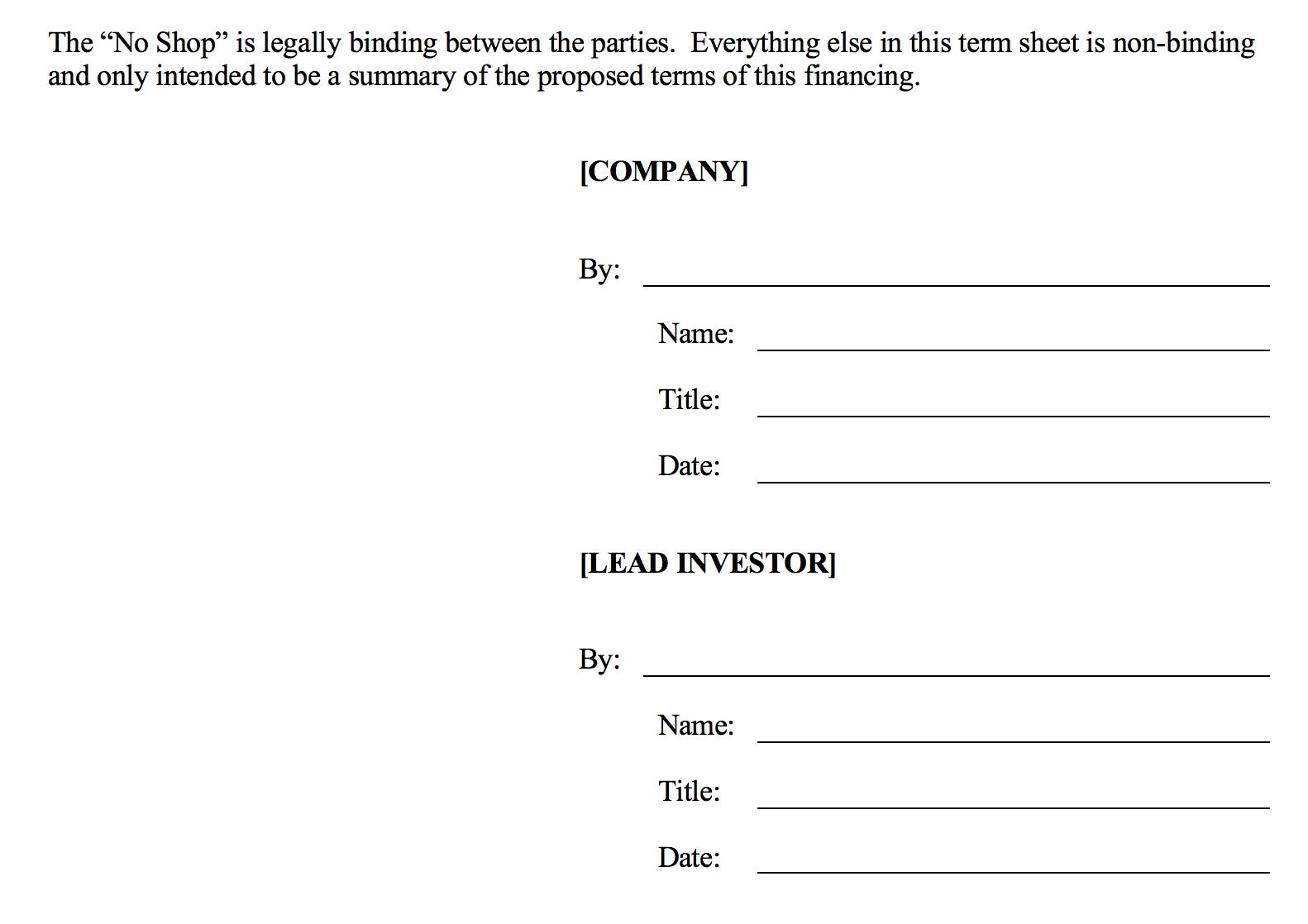
Below is what a Series A term sheet looks like with standard and clean terms from a good Silicon Valley VC. Bracketed items (besides the names of the company and lead investor) are always or frequently negotiated. Items not in brackets are sometimes negotiated, but this has more to do with the idiosyncratic features of the company or the situation, and generally aren’t terms that parties intend to heavily bargain over during the negotiation.
One of the critical things you’ll notice is that we didn’t put in standard pricing. While the lead in a Series A round generally wants 20% of the company, pricing can flex up and down depending on the leverage held by each side. We think price is an important term, but too specific to each raise to try to create a standard. We’re more concerned with terms around control and structure that are less familiar to founders, and therefore more prone to cause confusion and trouble.
Note: this term sheet doesn’t belong to any particular VC — we drafted it — but it does substantively reflect what we see most often. Founders with a lot of negotiating leverage can sometimes do better, and the converse is true too.
You can also download the Word version of the doc here.
It may be surprising to see everything covered in a single page.1 This wasn’t always the case, but became common over the last decade as some investors decided to make their term sheets more user friendly by shortening the legalese as if to say, “We aren’t going to get bogged down in the minutiae. We’re going to make this easy, friendly, standard and fast.”
This leads us to the most important thing to understand about the term sheet: it’s another way in which your Series A investor might be telling you something. A contract allocates risks between the parties, so the terms the investor insists on can sometimes say a lot about the investor’s perceived risks. These perceived risks show up in a couple of ways.
The first way relates to control terms. We don’t mean the set of investor vetoes in the “Voting Rights” section, which are pretty standard fare,2 but rather issues of board composition and the investor’s ability to block or dictate operational decisions made by the board. The board structure in this term sheet is founder-friendly because the founders retain board control 2-1.3 The way in which founders most often lose control at the Series A is with a 2-2-1 board structure, i.e. 2 founders, 2 investors and an independent board member. The loss of board control is most significant because it means the founders can be fired from their own company.4Another way in which founders lose some control is a term that doesn’t appear in the standard example above, which is a separate provision that says the investor director’s approval is required for operational decisions like setting the annual budget, hiring/firing executives, pivoting the business, adding new lines of business, etc. When boards are set up to take power away from founders, the investor’s outward justification will frequently be reasons of governance or accountability. But the more power that’s taken away, the more it’s undeniable that the investor is attempting to structure away a perceived risk. So when an investor says that they’re committed to partnering with you for the long-term – or that they’re betting everything on you – but then tells you something else with the terms that they insist on, believe the terms.
The other way perceived risks manifest is if a term sheet includes non-standard or “dirty” economic terms. Here, the term sheet example is instructive not for what it contains but what it doesn’t. Examples of such terms would be:
  • Liquidation preference greater than 1x — the investor gets back more than its invested capital first.
  • Participating preferred — the investor double-dips by getting its money back plus its pro rata portion of exit proceeds, rather than choosing between the two.
  • Cumulative dividends — the investor compounds its liquidation preference every year by X%, which increases the economic hurdle that has to be cleared before founders and employees see any value.
  • Warrant coverage — the investor gets extra fully diluted ownership without paying for it at the agreed upon valuation.
These are all ways of adding structure to reduce typical venture risk, either directly by boosting the investor’s downside economics, or indirectly by juicing the upside outcomes. The investor is essentially saying, “I’m sort of afraid of losing my money.” It can also foreshadow how they might behave when things aren’t going well, such as pushing you to sell when you don’t want to, or dial back risk when it’s important to take it. Good investors would rather address economic risks by negotiating valuation, and are otherwise happy to give standard terms because they know that the real money in venture is not made with structure, but by building long-term value, which they are confident in their ability to help you do.
The last thing to remember is that your Series A documents are a foundation and precedent for the terms of future rounds. Good foundations make the next term sheet and financing round fast and simple, as future investors just step into the same straightforward terms. Doing the opposite complicates future fundraises, such as future investors asking for the same structure-heavy terms, existing investors refusing to drop terms that subsequent investors want removed as a precondition of investing, etc. Unwinding bad terms is difficult, and oftentimes impossible.
That said, the point is to get a clean deal, not to cycle a lot to get the perfect deal. No one ever built an enduring company just by winning their Series A negotiation. Also, even if you can’t get everything right or the way you want it, you always have the power to execute. If you do that, the value you build can outrun suboptimal terms or establish leverage to renegotiate later. So don’t lose sight of the ultimate goal: closing fast and getting back to work.
Notes
1. Some great investors still send longer term sheets, but this has more to do with their preference for going a bit deeper into the details at this stage, rather than deferring this until the definitive documents. The definitive documents are derived from the term sheet and are the much longer (100+ pages) binding contracts that everyone signs and closes on. It’s common to negotiate a few additional points at this stage, though deviation from anything explicitly addressed in the term sheet is definitely re-trading. Also, in a few places, this term sheet refers to certain terms as being “standard.” That may seem vague and circular, but term sheets frequently do describe certain terms that way. What that really means is that there’s an accepted practice of what appears in the docs for these terms among the lawyers who specialize in startups and venture deals, so make sure your lawyer (and the investor’s lawyer) fit that description.↩
2. The two most impactful investor vetoes in this section are the veto on a financing, which is covered by clauses (ii) and (iii), and the veto on a sale of the company, which is in clause (vii). We point these out because the concrete implications of these clauses aren’t facially obvious, and because most term sheets use similar technical jargon for these vetoes.↩
3. The founders implicitly control those 2 seats because they’re designated by a majority of common, and founders generally control a majority of common for a long time. In even more founder-friendly term sheets, those 2 seats may be designated by the founders themselves (as individuals).↩
4. Whether being fired from the company as an employee also triggers the removal of the founder from the board is a separate question and depends on what was negotiated in the financing documents. Sometimes a founder’s right to vote her shares to appoint a director will be conditioned on the founder being currently employed by the company. Whenever conditions are attached to your rights to vote on anything, make sure to ask your lawyer to walk you through the various scenarios in which those conditions matter and how they can hurt you.↩
This is not legal advice.

Excited About Super Bowl? Just Beware The Dangers Of This Age-Old Elixir

The Super Bowl is one of the most popular television sporting events in the world, with over 100 million people expected to watch the Big Game. Super Bowl Sunday also happens to be one of the largest drinking festivities of the year. According to the digital savings destination, RetailMeNot, the average viewer will spend $44 on alcohol for the game. In addition, increased access to alcohol will be facilitated by the Atlanta City Council which unanimously passed the “Pour until Four” measure, allowing local establishments to extend serving hours from 2:30am to 4:00am. So, in the midst of this year’s football-viewing frenzy, it’s important to be mindful of the consequences of unsafe drinking.
According to the 2015 National Survey on Drug Use and Health, 15 million U.S. adults experienced alcohol use disorder (AUD). That same year, 27% of people over 18 engaged in binge drinking in the past month, according to the National Institute on Alcohol Abuse and Alcoholism (NIAAA).

Beer and football often go hand-in-hand. GETTY
 
These two events – the Super Bowl and alcohol consumption – were the subject of this week’s blog post, by NIAAA Director, George Koob, PhD, who pointed out three common consequences of excess alcohol consumption

Hangover symptoms can include headaches, body aches, nausea, vomiting, sweats and impaired concentration.GETTY
  1. Binge Drinking - Some people may binge drink while watching the game. “Binge drinking,” Dr. Koob explains, “is a pattern or drinking that brings blood alcohol concentration (BAC) to 0.08% – the legal limit for driving in the U.S. – or higher.” For women, this BAC level is reached after four drinks in two hours; for men, it’s five drinks.
  2. Hangovers – In describing his own miserable hangover experience, British writer William Hickey once wrote, “I do not believe in the world there existed a more wretched creature than myself. I passed some moments in a state little short of despair.” Depictions of hangovers trace far back to writings from ancient Greece, Egypt and the Old Testament. “Attention, decision-making and muscle coordination can all be impaired,” states Dr. Koob. The cure? Well, there really is none. Some companies market intravenous fluids containing vitamins and anti-nausea meds ranging from $300-500 as “hangover cures.” Unless you’re experiencing vomiting-induced severe dehydration, save your money. The best remedy? Prevention – drink small amounts, pace yourself or don’t drink at all. And stay hydrated: alternate a drink with a glass of water.
  3. Unintentional Injuries – heavy drinking can lead to motor vehicle accidents (MVAs), falls, crimes such as theft and assault, including a troubling rise in domestic violence. Other unintended consequences include unsafe sexual practices which can lead to sexually transmitted infections (HIV, chlamydia, syphilis, etc.) and unintentional pregnancies, as pointed out by Dr. Koob.

Driving under the influence can have dire consequences.GETTY
As an addiction medicine physician, I treat patients with all types of substance use disorders. However, approximately 50% of my patients experience AUD. Some started drinking as young as ten (if not younger), some had a family history of alcoholism, and most if not all had some type of trauma history (divorce, unemployment, physical/sexual abuse, death of a loved one, etc.) Car accidents, I discovered, were very common among my patients who were heavy drinkers. This prompted me to dig deeper into MVAs and football.
Spike In Car Crashes After Super Bowl Games
According to researchers at the University of Toronto (my alma mater) who studied U.S. accident data from 27 Super Bowls, automobile fatalities increased 41% in the hours following the Big Game, mostly in the losing team’s city. Lead author, Daniel Redelmeier, MD, theorized that heartbroken fans were distracted by their team’s defeat, impairing their concentration while driving. As a result of these findings, published in the New England Journal of Medicine, the National Highway Traffic Safety Administration created the slogan, “Fans don’t let fans drink and drive.” This increase, noted Redelmeier, is greater than the post-New Year’s Eve volume of car crashes.

Designate a driver if you're going to drink.GETTY
How To Avoid Alcohol-Related Risks
As a doctor who has treated far too many alcohol-related complications (including death) AND who’s also a huge sports buff (I’m a diehard Toronto Maple Leafs fan), I believe the following recommendations will help everyone enjoy an exciting and safe Super Bowl:
  1. If you’re going to consume alcohol, do so at a moderate pace. Alternate a drink with a glass of water. Be sure to eat food and/or snacks. Both water and food can slow the absorption of alcohol in the body and lower the BAC.
  2. If you know you’re going to drink more than your usual amount, please find a designated driver or stay over at your friend/relative’s place.
  3. Replace the booze with a club soda, soft drink or other non-alcoholic beverage. You really don’t need to drink to have fun. Or to drown your sorrows.
Best of luck to the Los Angeles Rams and the New England Patriots, and safe-viewing to football fans far and wide!
https://www.forbes.com/sites/lipiroy/2019/02/02/excited-about-the-super-bowl-just-beware-the-dangers-of-this-age-old-elixir/#69f0745f3700

Missouri Supreme Court suspends second talc cancer trial in weeks

The Missouri Supreme Court on Thursday halted an upcoming trial in a case brought by women who claim talc supplied by Imerys Talc America for use in Johnson & Johnson products gave them cancer, saying it wanted to consider a jurisdictional challenge by Imerys.
It is the second major talc case the Missouri high court has stayed in recent weeks on jurisdictional grounds. Both were in the St. Louis’ 22nd Circuit Court, which has issued several large verdicts against J&J and Imerys, including one for $4.7 billion in July.
The vast majority of the plaintiffs in the St. Louis cases are from other states, and the defendants have repeatedly challenged their right to sue in Missouri as opposed to their home states or in states where the companies are headquartered or have a substantial presence. J&J is based in New Jersey and Imerys, a unit of Imerys SA, is based in California.

In the case stayed on Thursday, which had been scheduled to go to trial on April 8, only two of the 24 plaintiffs were from Missouri.
The plaintiffs claim asbestos in Johnson’s Baby Powder and other cosmetic talc products caused their cancer, alleging that J&J and Imerys knew of asbestos contamination since at least the 1970s, but failed to warn consumers.
Reuters on Dec. 14 published a Special Report detailing that the company knew that the talc in its raw and finished powders sometimes tested positive for cancer-causing asbestos from the 1970s into the early 2000s – test results the company did not disclose to regulators or consumers.
J&J and Imerys, a unit of Imerys SA, deny those allegations and have repeatedly said decades of studies have shown their talc products to be safe and free of asbestos.
“Imerys Talc America is pleased the Missouri court has ordered the trial court to take no further action while it reviews the merits of whether the Missouri court has personal jurisdiction over the company in this product liability matter,” the company said in a statement on Thursday.
Mark Lanier, the plaintiff’s lawyer in the case stayed on Thursday, did not immediately respond to a request for comment. He also represented the plaintiffs in the $4.7 billion case, most of whom were also from outside Missouri.
J&J, which is a co-defendant with Imerys, said it had also asked to postpone the upcoming trial and its petition remained pending. The company declined comment on Thursday.
The Missouri Supreme Court previously stayed a talc case against J&J and Imerys that was due to begin on Jan. 21 on the same jurisdictional grounds.
A number of multi-million-dollar talc verdicts against J&J and Imerys in the St. Louis court have been thrown out following a 2017 U.S. Supreme Court decision limiting state courts’ jurisdiction over claims by non-residents against out-of-state companies.
However, the St. Louis trial court has allowed many out-of-state plaintiffs, including most of those who won the $4.7 billion verdict, to proceed based on state ties the defendants say are tenuous. That verdict is now under appeal at an intermediate court.