Search This Blog

Tuesday, June 4, 2019

Pfizer had clues its blockbuster drug could prevent Alzheimer’s, kept it secret

Why didn’t it tell the world? Drug companies frequently have been pilloried for not fully disclosing negative side effects of their drugs. What happens when the opposite is the case?
The results were from an analysis of hundreds of thousands of insurance claims. Verifying that the drug would actually have that effect in people would require a costly clinical trial – and after several years of internal discussion, Pfizer opted against further investigation and chose not to make the data public, the company confirmed.
Researchers in the company’s division of inflammation and immunology urged Pfizer to conduct a clinical trial on thousands of patients, which they estimated would cost $80 million, to see if the signal contained in the data was real, according to an internal company document obtained by The Washington Post.
“Enbrel could potentially safely prevent, treat and slow progression of Alzheimer’s disease,″ said the document, a PowerPoint slide show that was prepared for review by an internal Pfizer committee in February 2018.
The company told The Post that it decided during its three years of internal reviews that Enbrel did not show promise for Alzheimer’s prevention because the drug does not directly reach brain tissue. It deemed the likelihood of a successful clinical trial to be low. A synopsis of its statistical findings prepared for outside publication, it says, did not meet its “rigorous scientific standards.″
Science was the sole determining factor against moving forward, company spokesman Ed Harnaga said.
Likewise, Pfizer said it opted against publication of its data because of its doubts about the results. It said publishing the information might have led outside scientists down an invalid pathway.
Pfizer’s deliberations, which previously have not been disclosed, offer a rare window into the frustrating search for Alzheimer’s treatments inside one of the world’s largest drug companies. Despite billions spent on research, Alzheimer’s remains a stubbornly prevalent disease with no effective prevention or treatment.
Some outside scientists disagree with Pfizer’s assessment that studying Enbrel’s potential in Alzheimer’s prevention is a scientific dead end. Rather, they say, it could hold important clues to combating the disease and slowing cognitive decline in its earliest stages.
Pfizer did share the data privately with at least one prominent scientist, but outside researchers contacted by The Post believe Pfizer also should at least have published its data, making the findings broadly available to researchers.
“Of course they should. Why not?″ said Rudolph Tanzi, a leading Alzheimer’s researcher and professor at Harvard Medical School and Massachusetts General Hospital.
“It would benefit the scientific community to have that data out there,″ said Keenan Walker, an assistant professor of medicine at Johns Hopkins who is studying how inflammation contributes to Alzheimer’s. “Whether it was positive data or negative data, it gives us more information to make better informed decisions.″
Internal discussions about possible new uses of drugs are common in pharmaceutical companies. In this case, Pfizer’s deliberations show how decisions made by industry executives – who are ultimately accountable to shareholders – can have an impact well beyond corporate board rooms.
As its Enbrel deliberations ended early last year, Pfizer was getting out of Alzheimer’s research. It announced in January 2018 that it would be shutting down its neurology division, where Alzheimer’s treatments were explored, and laying off 300 employees.
Meanwhile, Enbrel has reached the end of its patent life. Profits are dwindling as generic competition emerges, diminishing financial incentives for further research into Enbrel and other drugs in its class.
“I’m frustrated myself really by the whole thing,″ said Clive Holmes, a professor of biological psychiatry at the University of Southampton in Great Britain who has received past support from Pfizer for Enbrel research in Alzheimer’s, a separate 2015 trial in 41 patients that proved inconclusive.
He said Pfizer and other companies do not want to invest heavily in further research only to have their markets undermined by generic competition.
“Someone can pop up and say, ‘Look, I’ve got a me-too drug here,’ ″ Holmes said, referring to the advent of generic versions of Enbrel. “I think that is what this is all about.″
– – –
The broader market forces that critics say discouraged Pfizer from investing in Alzheimer’s clinical trials are rooted in Enbrel’s “life cycle,″ the 20-year period of patent exclusivity when a brand manufacturer reaps monopoly profits from a drug. By industry standards, Enbrel, an injectable biologic drug, is relatively old, with FDA approval for rheumatoid arthritis in 1998. It also has been approved to treat psoriasis.
Pfizer got rights to market it internationally when it acquired drugmaker Wyeth in 2009. But Enbrel, which earned Pfizer $2.1 billion in 2018, now faces generic competition.
Drug companies often are criticized for extending the patent life of a drug – and winning new profits – by merely tweaking a drug’s molecule or changing the method of delivery into the body. But it is a “heavy lift″ for a company to win regulatory approval to use a drug for a completely different disease, said Robert Field, a professor of law and health care management at Drexel University.
“Our patent laws do not provide the appropriate incentives,″ Field said. Drug therapy for early Alzheimer’s “would be a godsend for American patients, so we should be doing everything we can as a country to encourage development of treatments. It’s frustrating that there may be a missed opportunity.″
As Enbrel’s life cycle winds down, Pfizer has introduced a new rheumatoid arthritis drug, Xeljanz, that works differently from Enbrel. Pfizer is putting its marketing muscle behind the new treatment. While Enbrel revenue is shrinking, Xeljanz revenue is growing. The Xeljanz patent expires in 2025 in the United States and 2028 in Europe, according to Pfizer’s public disclosures. The drug is on track to make Pfizer billions more each year for the foreseeable future.
Wagering money on a clinical trial of Enbrel for an entirely different disease, especially when Pfizer had doubts about the validity of its internal analysis, made little business sense, said a former Pfizer executive who was aware of the internal debate and spoke on the condition of anonymity to discuss internal Pfizer matters.
“It probably was high risk, very costly, very long term drug development that was off-strategy,″ the former executive said.
Another former executive, who also spoke on the condition of anonymity to discuss Pfizer operations, said Pfizer offered virtually no explanation internally for opting against further investigation in early 2018, when the internal debate ended.
“I think the financial case is they won’t be making any money off of it,″ the second former executive said.

Drug companies frequently have been pilloried for not fully disclosing negative side effects of their drugs. What happens when the opposite is the case? What obligation does a company have to spread potentially beneficial information about a drug, especially when the benefits in question could improve the outlook for treating Alzheimer’s, a disease that afflicts at least 500,000 new patients per year?
A medical ethics expert argued that Pfizer has a responsibility to publicize positive findings, although it is not as strong as an imperative to disclose negative findings.
“Having acquired the knowledge, refusing to disclose it to those who might act upon it hides a potential benefit, and thereby wrongs and probably harms those at risk of developing Alzheimer’s by impeding research,″ said Bobbie Farsides, professor of clinical and biomedical ethics at Brighton and Sussex Medical School in London.
Another health-care ethics specialist cautioned that the demand for drug company disclosure should remain focused on information collected during clinical trials.
“I do think you have to draw some limits, and say that not every piece of information they have in their files has to be disclosed with others,″ said Marc Rodwin, a law professor at Suffolk University Law School in Boston.
Pfizer markets Enbrel outside North America. Another drug company, Amgen, which holds rights to market Enbrel in the United States and Canada, says it knew of the Pfizer data and similarly decided the findings held little promise. Amgen said market factors played no role in its deliberations.
“Unfortunately, our exploratory work did not yield results strong enough to warrant further studies,″ Amgen said.
Sometimes doctors prescribe drugs for uses that have not been approved by the Food and Drug Administration. But none of the experts interviewed for this story said such “off-label″ use of Enbrel would be appropriate for Alzheimer’s, because of the very limited nature of the data thus far. Nor, they said, do they believe such prescribing is happening to any significant extent.
The role of brain inflammation in Alzheimer’s recently has been getting closer attention among academics after the failure of multiple experimental drugs that targeted the buildup of plaques on brain tissue. In 2016, researchers from Dartmouth and Harvard universities published a study of insurance claims data – similar to Pfizer’s internal findings – that showed a potential benefit of Enbrel. Enbrel “shows promise as a potential treatment″ for Alzheimer’s, the study found.
Pfizer’s analysis about potential Enbrel benefits in the brain sprang from the company’s division of immunology and inflammation, based in a large Pfizer office complex in Collegeville, Pennsylvania.
Statisticians in 2015 analyzed real world data, hundreds of thousands of medical insurance claims involving people with rheumatoid arthritis and other inflammatory diseases, according to the Pfizer PowerPoint obtained by The Post.
They divided those anonymous patients into two equal groups of 127,000 each, one of patients with an Alzheimer’s diagnosis and one of patients without. Then they checked for Enbrel treatment. There were more people, 302, treated with Enbrel in the group without Alzheimer’s diagnosis. In the group with Alzheimer’s, 110 had been treated with Enbrel.
The numbers may seem small, but they were mirrored in the same proportion when the researchers checked insurance claims information from another database. The Pfizer team also produced closely similar numbers for Humira, a drug marketed by AbbVie that works like Enbrel. The positive results also showed up when checked for “memory loss″ and “mild cognitive impairment,″ indicating Enbrel may have benefit for treating the earliest stages of Alzheimer’s.
A clinical trial to prove the hypothesis would take four years and involve 3,000 to 4,000 patients, according to the Pfizer document that recommended a trial. The document said Pfizer would gain a positive public relations “halo effect″ by investigating an Alzheimer’s treatment.
Enbrel reduces inflammation by targeting a specific protein called TNF-a. The Pfizer claims data analysis added to a growing body of evidence that broadly targeting TNF-a in the body has the potential to prevent Alzheimer’s, said Holmes, the professor of biological psychiatry at the University of Southampton.
Holmes is among the few researchers who has gained access to the Pfizer data; he won the company’s permission to use it in a grant application for a small clinical trial he is undertaking in England.
“If it’s true in reality, if you did it in a clinical trial setting, it’s massive – it would be huge,″ Holmes said. “That’s why it’s so exciting.″
One reason for caution: another class of anti-inflammatory therapies, called non-steroidal anti-inflammatory drugs (NSAIDS), showed no effect against mild-to-moderate Alzheimer’s in several clinical trials a decade ago. Still, a long-term follow-up of one of those trials indicated a benefit if NSAID use began when the brain was still normal, suggesting the timing of therapy could be key.
Pfizer said it also was skeptical because Enbrel has only a limited effect on the brain. The Enbrel molecule is too large to pass through the “blood-brain barrier″ and directly target TNF-a in brain tissue, the company said.
Yet Alzheimer’s researchers believe inflammation outside the brain – called peripheral inflammation – influences inflammation within the brain.
“There is a lot of evidence suggesting that peripheral or systemic inflammation may be a driver of Alzheimer’s disease,″ said Walker, the Johns Hopkins researcher. It is a fair hypothesis that fighting inflammation outside the brain with Enbrel will have a similar effect inside the brain, he said.
“I don’t believe Enbrel would need to cross the blood brain barrier to modulate the inflammatory/immune response within the brain,″ Walker said.
“There is increasing evidence that peripheral inflammation can influence brain function,″ said rheumatologist Christopher Edwards, of the University of Southampton in Britain.
“It’s important that that’s published, and in the public domain,″ Edward added of the Pfizer data. “It needs to be out there.″

‘Meatless companies are struggling to meet demand’

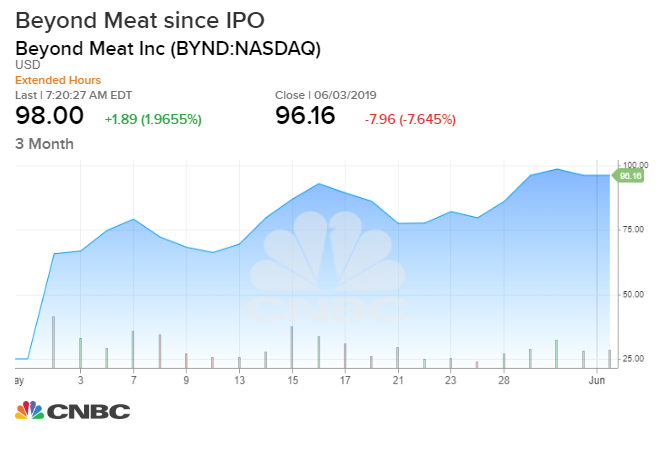
Shares of meat alternative company Beyond Meat closed up more than 7% on Tuesday, after the Wall Street Journal reported that plant-based burger companies are struggling to meet surging demand.
Due to limited production capacity, the two leading purveyors of meat-alternatives, Beyond Meat and Impossible Foods, have been unable to meet the high frequency of orders from restaurants adding meatless products to their menus.
Beyond Meat’s stock is up nearly 300% since its initial public offering in May.
Beyond Meat and Impossible Foods are served in almost 20,000 restaurants across the country, according to the report. TGI Fridays, Del Taco Restaurantsand Red Robin have joined the list, adding pea-based or soy-based burgers to their meat-heavy menus.
Burger King and White Castle have also added the meat-alternatives to their menus to attract more customers, the Journal said.
The rise in popularity in planet-based burgers has caught more than just the eyes of restaurant chains.
Barclays predicted the alternative meat industry could be worth $140 billionover the next decade and food giant Nestle is planning to launch its own plant-based burger in the U.S. through its brand called Sweet Earth.
Beyond Meat surged 163% on its first day of trading at the Nasdaq on May 2. The day prior, the company priced its shares at $25 a share, but opened at $46 a share. The stock has nearly quadrupled its price since the IPO.
Beyond Meat will report first-quarter earnings after the bell Thursday in the company’s first earnings report since becoming a public company.

Trading Psychology Techniques – 7: Facing Your Fears


A while back, I worked with a trader and reviewed his P/L statistics.  Keeping good statistics on your trading is a universal best practice.  The patterns of wins and losses–and the progress over time–reveals a great deal about your trading–and your trading psychology.
What made this trader unusual was a pattern of small wins and small losses.  He had a daily loss limit and never came near that number, either on the downside or the upside.
When we examined his trading, it was clear that he had profit targets on his trades and he had stop loss levels.  These were appropriate, given his daily limits.  He gave himself room to be wrong with his stops and also gave room to trades to run if they worked out.
So what’s the problem?
As we examined his trading, we quickly saw that he rarely let his trades stop out and he rarely hit his profit targets.  He stopped out of trades quickly when they went against him and he took profits quickly when trades went his way.
In short, his trading was an exercise in fear.  When he feared loss, he quickly exited.  When he feared losing gains, he quickly exited.  Over time, that had him playing small ball as a trader.  Psychologically, it meant that he was always acting on fear.
We reinforce what we act upon.  If we act on fear, we reinforce fear.  If we act out of frustration, we reinforce frustration.  Is it any wonder that, fearfully exiting one trade after another, this trader never developed confidence in what he was doing?
An important psychological rule is that we can only overcome our fears by directly facing them.  If I am afraid of going outdoors, I cannot develop confidence by staying indoors.  What I need is to experience the very thing that I’m afraid of and see–in my own experience–that nothing terrible happens if there is an adverse outcome.  In that sense, we don’t gain confidence from success alone.  We gain confidence by failing–and seeing that we can bounce back.
This is where the use of imagery is tremendously helpful.  We can visualize, in great detail, having a winning trade reverse on us or having a trade hit its stop, and mentally rehearse how we would like to deal with that situation.  If we mentally rehearse these scenarios again and again, they become familiar to us and no longer so threatening.  That reinforces confidence, because we’re telling ourselves that we can fail and bounce back.
Note that what we’re doing with such imagery methods is sustaining a state of self-awarenesswhile talking ourselves through the fearful episode.  With sufficient practice, we can become quite good at invoking the self-awareness in real time.  What we’ve rehearsed with imagery comes back to us during actual trading.
The trader I met with learned to redefine his fears.  Once he realized that playing small ball guaranteedhe would never reach his goals, he became fearful of being fearful.  In other words, he changed his perspective.  The problem wasn’t losing money; the problem became preventing himself from making money!  In the state of self-awareness, he now viewed his situation differently, and that enabled him to trade very differently.

HCA subsidiary buys supply chain management company

HealthTrust Purchasing Group, a subsidiary of Nashville, Tenn.-based HCA Healthcare, has signed a definitive agreement to acquire Resource Optimization & Innovation, the supply chain management division of St. Louis-based Mercy.
The transaction, which is subject to regulatory approval, is expected to close by late summer 2019. After the acquisition closes, HealthTrust will be the group purchasing organization for Mercy and ROi’s other partner members, Orlando (Fla.) Health and Baton Rouge, La.-based Franciscan Missionaries of Our Lady Health System.
“Mercy founded ROi in 2002 to manage our supply chain and we’ve watched it grow and innovate to become a highly-recognized supply chain organization,” Mercy President and CEO Lynn Britton said in a press release. “As part of HealthTrust, ROi has the opportunity to accelerate its progress and strengthen its capabilities in support of Mercy, other ROi members and HealthTrust members.”
Financial terms of the transaction were not disclosed.

Proteostasis Gains After Cystic Fibrosis Drug Is Granted Orphan Status

Micro-cap biotech Proteostasis Therapeutics Inc PTI 4.67% was up strongly Tuesday morning.

What Happened

Proteostasis, which focuses on therapies for dysfunctional protein processing, specifically for cystic fibrosis, announced Tuesday its PTI-428 has been granted orphan drug designation, or ODD, by the European Commission, for treating cystic fibrosis.
PTI-428 is the Boston-based biotech’s lead product candidate. It’s the company’s proprietary cystic fibrosis transmembrane conductance regulatory amplifier in clinical development.
The pipeline asset has also secured ODD, Breakthrough Therapy Designation and Fast Track Designation from the U.S. Food And Drug Administration.

Why It’s Important

Orphan drug designation is granted by the EU based on a positive opinion by the EMA’s Committee’s Orphan Medical Products, bestowing regulatory and financial incentives for companies developing therapies to treat serious disorders affecting no more than five in 10,000 persons in the EU.
The notable among the benefits are 10-year market exclusivity in the EU upon approval, eligibility for protocol assistance, reduced fees and access to the EU’s centralized marketing authorization procedure.

What Next

Proteostasis said it will advance PTI-428 in the clinic later this year, as part of the planned 28-day Phase 2 studies of its proprietary combination CFTR modulator treatments.

Gene mutation evolved to cope with modern high-sugar diets

A common gene mutation helps people cope with modern diets by keeping blood sugar low, but close to half of people still have an older variant that may be better suited to prehistoric diets, finds a new study.
The gene variant became more common in humans after cooking and farming became widespread, and might now help people avoid diabetes, according to the findings published in eLife.
“We found that people differ in how efficiently their bodies can manage blood sugar levels, resulting from an evolutionary process that seems to have been brought about by changing diets,” said the study’s lead author, Professor Frances Brodsky, Director of UCL Biosciences.
The researchers were investigating the CLTCL1 gene, which directs production of the CHC22 protein that plays a key role in regulating a glucose transporter in our fat and muscle cells.
After people eat, the hormone insulin reacts to higher levels of blood glucose by releasing the transporter to remove glucose from the blood, taking it into muscle and fat tissue. Between meals, with the help of the CHC22 protein, the glucose transporter remains inside muscle and fat so that some blood sugar will continue to circulate.
The research team, consisting of specialists in population genetics, evolutionary biology, ancient DNA and cell biology, analysed human genomes as well as those of 61 other species, to understand how the gene producing CHC22 has varied throughout evolutionary history.
In humans, by looking at the genomes of 2,504 people from the global 1000 Genomes Project, they found that almost half of the people in many ethnic groups have a variant of CHC22 that is produced by a mutated gene, which became more common as people developed cooking and farming.
The researchers also looked at genomes of ancient humans, and found that the newer variant is more common in ancient and modern farming populations than in hunter-gatherers, suggesting that increased consumption of carbohydrates could have been the selective force driving the genetic adaptation.
By studying cells, the researchers found that the newer CHC22 variant is less effective at keeping the glucose transporter inside muscle and fat between meals, meaning the transporter can more readily clear glucose out of the blood. People with the newer variant will therefore have lower blood sugar.
“The older version of this genetic variant likely would have been helpful to our ancestors as it would have helped maintain higher levels of blood sugar during periods of fasting, in times when we didn’t have such easy access to carbohydrates, and this would have helped us evolve our large brains,” said first author Dr Matteo Fumagalli, who began the study at UCL before moving to Imperial College London.
“In more recent years, with our high-carb diets that often provide us too much sugar, the newer variant may be advantageous,” Dr Fumagalli added.
The researchers say that while this genetic variant does not play a direct role in the development of diabetes, having the older variant may make people more likely to develop diabetes, and it may also exacerbate insulin resistance involved in diabetes.
“People with the older variant may need to be more careful of their carb intake, but more research is needed to understand how the genetic variant we found can impact our physiology,” added Professor Brodsky.
Co-author Professor Mark Thomas (UCL Genetics, Evolution & Environment) added: “Our analyses strongly suggest that we have found yet another example of how prehistoric changes in dietary habits have shaped human evolution. Understanding how we have adapted to these changes doesn’t only inform us about why people lived or died in the past, but also helps us to better understand the relationship between diet, health and disease today.”
The study was funded by the National Institutes of Health (USA), Wellcome and the Medical Research Council (UK).
Story Source:
Materials provided by University College LondonNote: Content may be edited for style and length.

Journal Reference:
  1. Matteo Fumagalli, Stephane M Camus, Yoan Diekmann, Alice Burke, Marine D Camus, Paul J Norman, Agnel Joseph, Laurent Abi-Rached, Andrea Benazzo, Rita Rasteiro, Iain Mathieson, Maya Topf, Peter Parham, Mark G Thomas, Frances M Brodsky. Genetic diversity of CHC22 clathrin impacts its function in glucose metabolismeLife, 2019; 8 DOI: 10.7554/eLife.41517

Quest, Now LabCorp, Customers Hit in Collections Firm Breach

Medical testing giant LabCorp. said today personal and financial data on some 7.7 million consumers were exposed by a breach at a third-party billing collections firm. That third party — the American Medical Collection Agency (AMCA) — also recently notified competing firm Quest Diagnostics that an intrusion in its payments Web site exposed personal, financial and medical data on nearly 12 million Quest patients.
Just a few days ago, the news was all about how Quest had suffered a major breach. But today’s disclosure by LabCorp. suggests we are nowhere near done hearing about other companies with millions of consumers victimized because of this incident: The AMCA is a New York company with a storied history of aggressively collecting debt for a broad range of businesses, including medical labs and hospitals, direct marketers, telecom companies, and state and local traffic/toll agencies.
In a filing today with the U.S. Securities and Exchange Commission, LabCorp. said it learned that the breach at AMCA persisted between Aug. 1, 2018 and March 30, 2019. It said the information exposed could include first and last name, date of birth, address, phone, date of service, provider, and balance information.
“AMCA’s affected system also included credit card or bank account information that was provided by the consumer to AMCA (for those who sought to pay their balance),” the filing reads. “LabCorp provided no ordered test, laboratory results, or diagnostic information to AMCA. AMCA has advised LabCorp that Social Security Numbers and insurance identification information are not stored or maintained for LabCorp consumers.”
LabCorp further said the AMCA has informed LabCorp “it is in the process of sending notices to approximately 200,000 LabCorp consumers whose credit card or bank account information may have been accessed. AMCA has not yet provided LabCorp a list of the affected LabCorp consumers or more specific information about them.”
The LabCorp disclosure comes just days after competing lab testing firm Quest Diagnostics disclosed that the hack of AMCA exposed the personal, financial and medical data on approximately 11.9 million patients.
Quest said it first heard from the AMCA about the breach on May 14, but that it wasn’t until two weeks later that AMCA disclosed the number of patients affected and what information was accessed, which includes financial information (e.g., credit card numbers and bank account information), medical information and Social Security Numbers.
Quest says it has since stopped doing business with the AMCA and has hired a security firm to investigate the incident. Much like LabCorp, Quest also alleges the AMCA still hasn’t said which 11.9 million patients were impacted and that the company was withholding information about the incident.
The AMCA declined to comment for this story, and instead referred requests for comment to an outside PR firm. Representatives with that firm declined to answer any questions about whether the breach of the AMCA’s payment’s page impacted anyone who entered payment data into the company’s site during the breach.
“We are investigating a data incident involving an unauthorized user accessing the American Medical Collection Agency system,” reads a written statement attributed to the ACMA. “Upon receiving information from a security compliance firm that works with credit card companies of a possible security compromise, we conducted an internal review, and then took down our web payments page.”
The statement continues:
“We hired a third-party external forensics firm to investigate any potential security breach in our systems, migrated our web payments portal services to a third-party vendor, and retained additional experts to advise on, and implement, steps to increase our systems’ security. We have also advised law enforcement of this incident. We remain committed to our system’s security, data privacy, and the protection of personal information.”

ANALYSIS

The AMCA also does business under the name “Retrieval-Masters Credit Bureau,” a company that has been in business since 1977. Retrieval-Masters also has an atrocious reputation for allegedly harassing consumers for debts they never owed.
A search on the company’s name at the complaints page of the Consumer Financial Protection Bureau (CFPB) turns up almost 700 complaints for Retrieval-Masters. The company has an abysmal “F” rating from the Better Business Bureau, with 60 complaints closed against it in the last three years.
Reviewing a number of those complaints reveals some of the AMCA’s other current and/or previous clients, including New Jersey’s EZPass system. Recent consumer complaints about the AMCA also invoke the name of American Traffic Solutions, which services rental car fleets and processes some 50 million toll transactions per year. ATS did not respond to requests for comment.
My guess is we will soon hear about many other companies and millions more consumers impacted by this breach at the AMCA. Certainly, companies like Quest and LabCorp. have a duty to ensure contractors are properly safeguarding their patients’ personal, medical and financial information.
But this AMCA incident is the latest example of a breach at a little-known company that nevertheless holds vast quantities of sensitive data that was being shared or stored in ways that were beyond the control of affected consumers.
On May 24, KrebsOnSecurity broke the news that the Web site for Fortune 500 real estate title insurance giant First American Financial [NYSE:FAF] leaked 885 million documents related to mortgage deals going back to 2003, until notified by KrebsOnSecurity. The digitized records — including bank account numbers and statements, mortgage and tax records, Social Security numbers, wire transaction receipts, and drivers license images — were available without authentication to anyone with a Web browser.
Many readers wrote in to say they’d never heard of First American, but it is the largest title insurance company in the United States. Title insurance is generally required for all home mortgages, and it protects the buyer from any previously unknown claims against the property. First American currently handles about one in every four title insurance transactions — usually as part of the mortgage closing process — which means tens of millions of Americans were potentially exposed by the company’s inexplicably lax security.