Search This Blog

Tuesday, October 15, 2019

Fewer emergency surgeries, more deaths in British hospitals vs U.S.

When patients in England or the U.S. have abdominal emergencies like appendicitis or a ruptured aneurysm, half as many in England get surgery and many more die, a new study suggests.
Deaths in the hospital were significantly higher in England for all seven types of abdominal emergencies analyzed in the study, suggesting that some of these deaths might be attributable to not having received surgery to correct the problem, researchers write in Annals of Surgery.
Differences between England’s publicly-funded National Health Service and the private medical centers of the U.S. may influence the availability of resources and services, “including life-saving treatment in an emergency setting,” Sheraz R. Markar of Imperial College London and St. George’s University of London and colleagues write.
Past research has found higher mortality rates for several cancers and for hospitalized patients with certain conditions in England compared with the U.S., but these studies have not “clearly identified the differences in clinical practices that are responsible,” the authors note.
They did not respond to requests for comment.
Markar’s team reviewed data from 2006 to 2012 on patients admitted with ruptured abdominal aortic aneurysm, aortic dissection, appendicitis, perforated esophagus, peptic ulcer perforation, small intestine or large intestine perforation, or an incarcerated or strangulated abdominal or groin hernias.
There were 136,047 admissions in England and 1.8 million in the U.S.
“Noncorrective care” – meaning no surgical correction – was more common than surgery for all conditions in England, as were deaths in hospital.
Patients in England, for example, were 4.25 times as likely as those in the U.S. to receive noncorrective care for ruptured aortic aneurysm and 8.53 times as likely with appendicitis.
For a perforated esophagus, 42% of patients in England received noncorrective care compared with 31% in the U.S. The overall hospital mortality rate for this condition was 11% in England versus 6% in the U.S. Patterns were similar for the other conditions.
When researchers looked only at patients who did not receive surgery, death rates were higher in England for four conditions: aortic dissection, peptic ulcer perforation, small bowel or large bowel perforation and incarcerated or strangulated hernias.
Some of the differences between the countries might be explained by factors the study could not measure, the authors acknowledge.
“This type of study contains many potential sources of bias that can mislead the reader into believing results are better in the U.S. than the UK,” said Dr. Derek Alderson, emeritus professor of surgery at the University of Birmingham and president of the Royal College of Surgeons of England.
“The study only looked at ‘in-hospital’ mortality – a term that might mean death within 30 days of surgery or any time during that admission,” Alderson, who was not involved the study, told Reuters Health by email.
“Attitudes to ongoing care and further interventions may well be different in an insurance-led system versus one that is free at the point of access, especially patients who have undergone an intervention,” he added.
The researchers say limited resources in England’s socialized healthcare system could explain a more “frugal approach to utilization of interventional treatment,” but they note they did not look at the role of doctors’ choices about care.
There appears to be a difference in thresholds for surgical intervention in England and the U.S., and factors around this are “extremely complex and cannot be identified by a study of this nature,” the authors write.
Alderson agrees.
“In neither country do we know the numbers of patients who were not admitted to hospitals who died from these conditions,” he told Reuters Health.

“It would be unwise to interpret the data as implying some form of rationing of surgery by surgeons in the UK.”
Societal attitudes, investment in healthcare and resource limitations must all play some part in decisions to intervene, he said.
SOURCE: bit.ly/2prrXHf Annals of Surgery, online October 9, 2019.
https://www.reuters.com/article/us-health-surgery/fewer-emergency-surgeries-more-deaths-in-british-hospitals-vs-u-s-idUSKBN1WU2H5

Michigan judge blocks flavored vape ban

A Michigan judge on Tuesday blocked the state’s ban on flavored e-cigarettes about two weeks after it took effect, a victory for retailers who are challenging the ban in court.
Michigan Governor Gretchen Whitmer had ordered the ban in September, declaring that teenagers’ use of e-cigarettes, known as vaping, was a public health emergency.
Judge Cynthia Diane Stephens of the Michigan Court of Common Claims said that vaping was a public health concern, but agreed with the retailers that there was likely no basis for the governor to use her emergency powers.
The ruling is a preliminary injunction, meaning it will remain in effect while the retailers and the state continue to litigate the dispute.
Whitmer’s office had no immediate comment.
Michigan is one of several states, including New York and Rhode Island, that have moved to restrict sales of flavored e-cigarettes on the grounds that they pose a health risk to teenagers.
https://www.reuters.com/article/us-health-vaping-michigan/michigan-judge-blocks-flavored-vape-ban-idUSKBN1WU2PB

NeuroMetrix Announces Updates to Quell 2.0 Commercial Strategy

NeuroMetrix, Inc., (Nasdaq:NURO), a health technology company that develops and commercializes products for the chronic pain and diabetes markets, today announced important updates to its Quell® 2.0 commercial strategy.  This novel wearable device for the symptomatic relief of chronic pain is central to the Company’s vision of helping people reclaim their lives from chronic pain through neuroscience and technology.
The Company is shifting to an exclusively direct-to-consumer model delivered via the QuellRelief.com website, that will allow it to offer the innovative Quell 2.0 system at accessible price points.  This streamlined distribution model will allow more people with chronic pain to benefit from the advanced Quell pain relief technology.  The new approach will also open the door for more people to take advantage of electrode savings through a subscription service.
This new business model is an outcome of extensive consumer research and in-market validation that started earlier this year.  The Company expects to see improved economics through reduced customer acquisition costs, distribution channel savings, and higher retention rates, resulting in increased customer lifetime value.
“Our vision is a world where people can live their best life despite chronic pain,” said Shai N. Gozani M.D., Ph.D., President, and Chief Executive Officer, NeuroMetrix.  “To achieve this goal, we believe that everyone living with chronic pain should have the opportunity to experience Quell and determine if it is beneficial to their particular form of chronic pain.  Therefore, we have worked over the past several quarters to refine our business model and distribution system to position us to deliver Quell 2.0 at widely attainable price points.”
About Quell
Quell is an advanced, wearable technology for the symptomatic relief and management of chronic pain. It can be worn during the day while active and at night while sleeping. Quell is drug-free.  Quell users can personalize and manage therapy discreetly via the Quell app.  Quell also offers health tracking metrics relevant to chronic pain sufferers, including pain, sleep, activity, and gait. Quell users can synchronize their data with the Quell Health Cloud™, which provides customized feedback and powers one of the world’s largest chronic pain databases.  Visit QuellRelief.com for more information.
https://www.biospace.com/article/releases/neurometrix-announces-updates-to-quell-2-0-commercial-strategy/

FDA OKs Hisamitsu Pharma’s asenapine patch for schizophrenia

Hisamitsu Pharmaceutical Co. (OTCPK:HTSUF) subsidiary Noven Pharmaceuticals announces the FDA nod for SECUADO (asenapine) transdermal patch for the treatment of adults with schizophrenia.
Market launch will commence shortly.
Asenapine is marketed in the U.S. as a sublingual tablet under the brand name Saphris by Allergan (NYSE:AGN) under a license from Merck (NYSE:MRK).
https://seekingalpha.com/news/3505759-fda-oks-hisamitsu-pharmas-asenapine-patch-schizophrenia

Sanofi Opens Its First Digital Manufacturing Facility in Massachusetts

Paris-based Sanofi announced it has inaugurated the opening of its first new digital manufacturing facility for biologics production in Framingham, Massachusetts. The digital-enabled aspect of the manufacturing plant is designed to leverage better use of data to optimize manufacturing processes and increase efficiencies.
The company indicates that the factory will speed up the company’s recent transformation of its Industrial Affairs organization, focusing on biologics. The facility will be paperless and is expected to decrease the time it takes for products to transfer from development laboratories to the manufacturing plant and then to the marketplace.
“We have been investing for some years to prepare for Sanofi’s future,” said Philippe Luscan, executive vice president, Global Industrial Affairs at Sanofi. “Our Framingham facility leads the way in delivering the next generation of biologics manufacturing, leveraging intensified, continuous processing in a fully integrated digitally powered facility. This opening demonstrates we are at the leading edge of innovation and manufacturing excellence, helping us to shape the future of both our company and the industry.”
Sanofi indicates that it has several pilot programs across its network of facilities, but Framingham is “the first ‘digitally born’ facility.” Similar digital changes have been made in legacy plants. The company indicates it plans to move forward with digital transformation initiatives in Toronto, Canada; Suzano, Brazil; Waterford, Ireland; Sisteron, France; and Geel, Belgium.
The announcement comes about a month after Paul Hudson took over the company’s chief executive officer position. Hudson came from Novartis, replacing Olivier Brandicourt, who retired on September 1. Hudson was chief executive officer of Novartis Pharmaceuticals and member of the company’s executive committee. Before Novartis, Hudson had roles with Schering Plough and AstraZeneca.
Hudson is currently on a “listening tour,” visiting all of its sites around the world. The plan is to develop a strategy to reveal at a special investors event later this year.
There is speculation that one of the areas Hudson will make changes is the company’s diabetes program. Sanofi is paying Lexicon Pharmaceuticals $260 million to end a deal for diabetes drug Zynquista. This deal was inked in 2015, with Sanofi paying $300 million upfront and up to $1.4 billion in milestones. However, the drug hasn’t met expectations.
Competition in the diabetes market is fierce, with major market share held by Eli Lilly, Novo Nordisk and AstraZeneca. Lilly’s Trulicity is expected to double by 2024 to more than $7 billion and Novo Nordisk’s Ozempic is projected to bring in $5.25 billion by 2024. But Sanofi’s Lantus is projected to lose about 50% of sales from 2018’s $4.21 billion to a projected $2.19 billion in 2024.
Although that may not happen, the company is clearly focusing on improving and streamlining its manufacturing base for biologics. The hub in Framingham has been central to the company’s manufacturing strategy for 30 years and the company’s pipeline is dominated by biologics. The most promising is its Dupixent (dupilumab) for asthma and eczema.
The company generally gains most of its biologics from its U.S.-based Genzyme division.
https://www.biospace.com/article/sanofi-opens-first-digital-manufacturing-facility-in-massachusetts/

Health Insurers May Have Bottomed as Investors Tire of Politics

The worst may be past for managed-care stocks this year, barring any major surprises, as investors are growing fed up with the political rhetoric in Washington, according to Wall Street analysts.
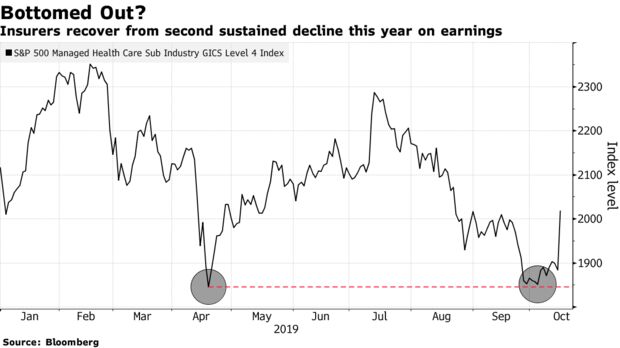
UnitedHealth Group Inc.’s solid third-quarter earnings on Tuesday sparked the sector’s biggest rally in a decade as it helped ease concerns about rising medical costs. While expectations were low heading into the report, the magnitude of the move illustrates just how negative sentiment has gotten. Also roiled by fears of a single-payer system, health insurers appear to have found their footing as investors turned more optimistic about the industry’s business outlook, according to BMO analyst Matthew Borsch.
“Until something significantly new happens, I think we’re sort of stabilized for the moment,” he said in a telephone interview. “Investors are kind of fatigued with the political side of this.”
Insurers recover from second sustained decline this year on earnings
The S&P 500 Managed Care Index, which has plunged into two corrections this year, has rebounded to its highest level since August. The gauge jumped as much as 7.5% on Tuesday, the most since November 2009. It’s still trading down 4.7% for the year.
Tuesday’s Democratic presidential primary debate will serve as a key test for investors’ renewed optimism. Observers are looking to see whether Senator Elizabeth Warren, who polls show is tied for the lead with former Vice President Joe Biden, will elaborate on her plans for health care. She supports “Medicare-for-All” and has blasted insurers in previous debates, but has remained notably vague on the specifics.
It would be difficult to see a reversal of the rally following the debate as investors are familiar with Democrats’ health-care proposals, according to Borsch. Warren could get pushed for more specifics on her plans, but it’s unlikely that will impact investors’ views, he said. “We know what we know at this point.”
Other analysts are less sanguine. Bloomberg Intelligence’s Glen Losev said he wouldn’t be surprised to see health insurance stocks pull back from Tuesday’s gains after the debates and stay range-bound in the near term. “The Washington overhang remains and will continue” to be there until a Democratic nominee emerges, he said by telephone.
Scott Fidel of Stephens agrees that the sector is not clear of the political uncertainties, saying Tuesday’s rally just reflects investors’ increased comfort with fundamentals.
“The market is still pricing in a lot of uncertainty with these stocks, just not at the extreme levels that we had” heading into UnitedHealth’s earnings, Fidel said.
https://www.bloomberg.com//news/articles/2019-10-15/health-insurers-may-have-bottomed-as-investors-tire-of-politics?srnd=markets-vp

ProQR’s sepofarsen nabs Rare Pediatric Disease status in U.S. for LCA10

The FDA grants Rare Pediatric Disease designation for ProQR Therapeutics’ (NASDAQ:PRQR) sepofarsen for the treatment of Leber congenital amaurosis type 10 (LCA10).
Rare Pediatric Disease designation provides for the issuance of a rare pediatric disease priority review voucher following FDA approval. The voucher can be use for accelerated approval of a future application or it can be sold to a third party.
Shares are down 12% after hours in response to its $50M equity offering. Price, volume and terms have yet to be announced.
https://seekingalpha.com/news/3505929-proqrs-sepofarsen-nabs-rare-pediatric-disease-status-u-s-lca10