Investigators at the Case Western Reserve University School of Medicine identified
a previously unknown gene and the resultant protein that may
potentially slow the progress of Alzheimer’s disease. The team has named
the protein aggregatin and they believe that if the gene or protein
could be suppressed, it could possibly slow the development of the
disease.
“Based on the data we have, this protein can be an unrecognized new
risk factor for Alzheimer’s disease (AD),” said Xinglong Wang, associate
professor of pathology at Case Western. “We also see this as a
potential novel therapeutic target for this devastating disease.”
Which is all very early in any development phase. The research team,
led by Wang and Xiaofeng Zhu, a professor of Population and Quantitative
Health Sciences at Case Western, has filed a patent via the
university’s Office of Research and Technology Management for “novel
Alzheimer’s disease treatments and diagnosis based on this and related
study,” according to Wang. The research was published in thejournalNature Communications.
Alzheimer’s disease is marked by the accumulation of amyloid plaques
in the brain. Another abnormal protein, tau, is also associated with the
disease, which results in loss of memory and cognition.
The newly identified gene is FAM222A, which the researchers
associated with imaging genetics to AD-related regional brain atrophy.
The protein, aggregatin, that the gene codes for is mostly expressed in
the central nervous system and is increased in the brains of AD patients
as well as in an AD mouse model. Aggregatin
accumulates inside amyloid deposits, and with the way it physically
interacts with beta-amyloid, helps the accumulation of beta-amyloid.
“This protein characteristically accumulates, or aggregates, within
the center of plaque in AD patients, like the yolk of an egg—which is
part of the reason we named it ‘aggregatin,’” Wang said.
The research was supported with grants from the National Institutes
of Health (NIH) and the Alzheimer’s Association. The Alzheimer’s Disease
Neuroimaging Initiative supplied genomic and brain imaging data, which
is also supported by the NIH.
The so-called amyloid theory of Alzheimer’s disease has been under
fire in recent years. Although it’s clear that an accumulation of
amyloid in the brain is related to the disease, dozens of drugs that
cleared or prevented amyloid accumulation failed to improve cognitive
symptoms of the disease muddied the waters. Currently, the theory has
regained at least some supportwith
Biogen’s aducanumab. The drug failed a clinical trial in March 2019,
but further analysis of the data at a higher dose suggested it actually
worked, and will soon be submitted to the U.S. Food and Drug
Administration (FDA), although there is still quite a bit of skepticism
among scientists about the effectiveness of the drug.
Perhaps more realistically, many researchers believe that amyloid and
tau are only part of the story, and that other factors, some unknown,
and others likely related to neuroinflammation, are important.
Although it’s not completely understood how amyloid-beta leads to
plaque formation, this new research appears to shed some light on the
subject.
“We’re very excited about this because our study is likely the first
systematic work combining the identification from a genome-wide
association study of high dimensional brain-imaging data and
experimental validation so perfectly in Alzheimer’s disease,” Zhu said.
The research team correlated about one million genetic markers with
brain images. This allowed them to identify a specific single-nucleotide
polymorphism in the FAM222 gene that was associated with patterns of
regional brain atrophy. They then injected mouse models with the
aggregatin protein, which caused amyloid plaque formation to accelerate
in the animals’ brains, causing more neuroinflammation and cognitive
problems. When they suppressed the protein, the plaques shrank and
neuroinflammation and cognitive impairment lessened. https://www.biospace.com/article/new-gene-identified-linked-to-alzheimer-s/
China put on lockdown on Jan. 23 three cities at the epicenter of a new coronavirus outbreak that has killed 17 people and infected nearly 600, as health authorities around the world scramble to prevent a global pandemic.
Health officials fear the transmission rate will accelerate as
hundreds of millions of Chinese travel at home and abroad during
week-long holidays for the Lunar New Year, which begins on Saturday.
The previously unknown virus strain is believed to have emerged late
last year from illegally traded wildlife at an animal market in the
central Chinese city of Wuhan.
Most transport in Wuhan, a city of 11 million people, was suspended
on Thursday morning and people were told not to leave. Hours later,
state media in neighboring Huanggang and Ezhou are reported to be
imposing a similar lockdown.
Chinese authorities gave no new details on the numbers of virus
infections but it has been reported in Beijing, Shanghai and Hong Kong,
and several other countries including the United States, stoking fears
it is already spreading worldwide.
Wuhan’s city government said it would shut down all urban transport
networks and suspend outgoing flights from 10 a.m. Domestic media said
some airlines were operating after the deadline, however.
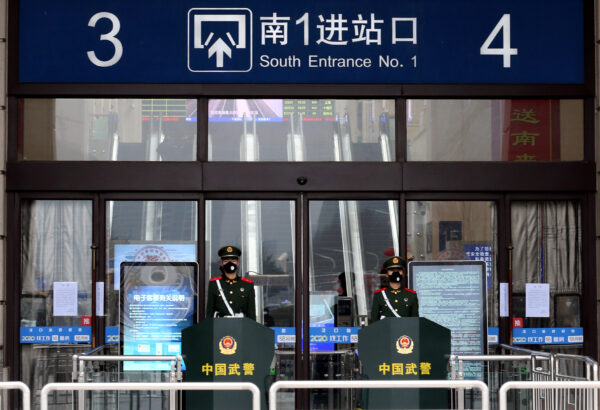
State media broadcast images of one of Wuhan’s transport hubs, the
Hankou rail station, nearly deserted, with gates blocked or barred. The
government is urging citizens not to leave the city. Chinese
paramilitary officers wearing masks stand guard at an entrance of the
closed Hankou Railway Station after the city was locked down following
the outbreak of a new coronavirus in Wuhan, Hubei province, China, on
Jan. 23, 2020. (China Daily via Reuters)
State media reported highway toll booths around Wuhan were closing
down, which would effectively cut off road exits. Guards were patrolling
major highways, one resident told Reuters.
As the city slipped into isolation, residents thronged into hospitals
for checks and scrambled for supplies, clearing out supermarket shelves
and queuing for petrol.
Authorities in Huanggang ordered indoor entertainment venues
including cinemas and internet cafes to close and were asking citizens
not to leave other than under special circumstances, state media said.
Authorities had confirmed 571 cases and 17 deaths by the end of
Wednesday, China’s National Health Commission said. Earlier, it said
another 393 suspected cases had been reported.
Of eight known cases worldwide, Thailand has confirmed four, while
Japan, South Korea, Taiwan and the United States have reported one each.
In a report on Wednesday, Imperial College London said it estimated a
total of 4,000 cases of the coronavirus in Wuhan alone as of Jan. 18,
an infection rate based on the number of cases reported in China and
elsewhere.
Virus Spreading
In contrast with its secrecy over the 2002-03 Severe Acute
Respiratory Syndrome (SARS) that killed nearly 800 people, China’s
communist government has provided regular updates to avoid panic ahead
of the holidays.
During a visit to Wuhan, Vice Premier Sun Chunlan said authorities
needed to be open about the virus and efforts to contain it, the
official Xinhua news agency said.
The World Health Organization (WHO) has said it will decide on
Thursday whether to declare the outbreak a global health emergency,
which would step up the international response.
If it does so, it will be the sixth international public health emergency to be declared in the last decade.
Some experts believe the new virus is not as dangerous as previous
coronaviruses such as SARS and Middle East Respiratory Syndrome (MERS),
which has killed more than 700 people since 2012.
“The early evidence at this stage would suggest it’s not as severe,”
Australia’s Chief Medical Officer Brendan Murphy told reporters.
WHO Director-General Tedros Adhanom Ghebreyesus told reporters in
Geneva that China’s actions were “very strong” but called on it to take
“more and significant measures to limit or minimize the international
spread”.
“We stressed to them that by having a strong action not only they
will control the outbreak in their country but they will also minimize
the chances of this outbreak spreading internationally. So they
recognize that,” he said.
Despite China’s response, stock markets across Asia were on the back
foot on Thursday, led by drops of roughly 1.5 percent in Hong Kong and
Shanghai while China’s yuan fell to a two-week low.
Flights, Rail Suspended
There is no vaccine for the virus, which can spread through
respiratory transmission. Symptoms include fever, difficulty in
breathing and cough, similar to many other respiratory illnesses.
Preliminary research suggested the virus was passed on to humans from
snakes, but government medical adviser Zhong Nanshan has also
identified badgers and rats as possible sources. Confirmed sufferers
include 15 medical workers.
Many Chinese were cancelling trips, buying face masks and avoiding
cinemas and shopping centers, and even turning to an online plague
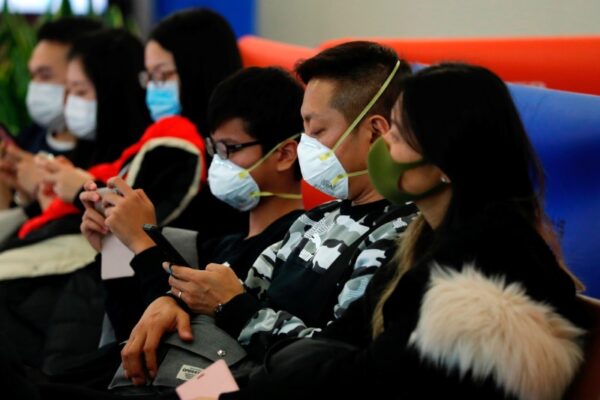
simulation game as a way to cope. Passengers
wear masks to prevent an outbreak of a new coronavirus at the Hong Kong
West Kowloon High Speed Train Station, in Hong Kong, China, on Jan. 23,
2020. Tyrone Siu/Reuters)
The release of seven movies over the Lunar New Year has been
postponed. The holiday is the high season for distributors and cinemas
attract huge crowds.
Tivity Health (TVTY+0.1%) is now offering its Prime Fitness program to Walmart’s (WMT-0.2%)
1.5M associates and their dependents in the U.S. Members will have
access to more than 9,000 fitness locations for a little as $9 per
paycheck.
Tivity says it now offers Prime Fitness to 43M
people between the ages of 18-64. Health clubs 24 Hour Fitness and
Planet Fitness are national partners.
The cost of prior authorization requirements on physicians’ practices
has continued to increase—up 60% in 2019 to manually generate a request
to insurers.
The just released CAQH 2019 Index,
which concluded that the healthcare industry can save $13.3 billion on
administrative waste through automation of eight transactions including
prior authorizations, said the medical industry could see potential
annual savings of $454 million by transitioning to electronic prior authorizations.
The Medical Group Management Association (MGMA) said the CAQH report
confirms its own concern about the burden prior authorizations place on
physician practices.
“The just-released CAQH 2019 Index confirms MGMA’s findings that the
financial burden of prior authorization requirements on physician
practices is increasing at an alarming rate,” said Anders Gilberg,
senior vice president of government affairs at MGMA, in a statement.
The CAQH index, put together by the nonprofit alliance, revealed that
the cost for providers to manually generate a prior authorization
increased from $6.61 in 2018 to $10.92 in 2019, Gilberg said. Payer cost
for the same transaction decreased from $3.50 in 2018 to $3.32 in 2019.
At the same time, the cost for providers to generate an electronic
prior authorization transaction dropped from $2.80 in 2018 to just $1.88
in 2019, and the cost for payers stayed steady.
However, overall industry use of electronic transactions increased
only slightly from 12% in 2018 to 13% in 2019, the CAQH report said.
“In 2020, practices should not be forced to rely on fax machines to
complete manual prior authorizations when health plans could modernize
the process,” said Gilberg. The federal government needs to streamline
prior authorization by requiring a national automated approach to
minimize administrative costs and delays in patient care, he said.
New finding confirms @MGMA
data that prior authorization burden is on the rise. It’s 2020…
practices shouldn’t have to rely on fax machines to meet prior auth
requirements. Automation critical to reduce admin costs & delays in
patient care. #MGMAAdvocacyhttps://t.co/hxyK5RIB87https://t.co/vo28DRhV36
Insurers, however, are pledging to do more and just last month launched a new initiative
aimed at expanding the use of electronic prior authorization, hoping to
address an issue most providers say is the most burdensome they face.
The Fast Prior Authorization Technology Highway initiative aims to
use technology from Availity and Surescripts in physicians’ offices to
speed up requests and responses for prior authorization, where a
provider must get permission from an insurer before prescribing a pricey
drug or performing a certain surgical procedure.
The initiative is led by insurance industry group America’s Health
Insurance Plans and several member insurers including Anthem, Cigna and
WellCare. It will have physicians’ offices volunteer to work with
insurers to incorporate the new processes into existing technology.
Having to seek prior authorization from payers is the most burdensome regulatory issue for practice leaders, and it’s only getting worse, according to an MGMA survey taken last year.
The CAQH report said prior authorization is the most costly,
time-consuming administrative transaction for providers. On average,
providers spent almost $11 per transaction to conduct a prior
authorization manually and nearly $4 using a web portal. The cost of an
electronic transaction is $1.88.
Adoption of electronic prior authorization by medical plans remained
low relative to other administrative transactions, with only that one
percentage point increase in electronic adoption from 2018 to 2019, the
report said.
The use of partially electronic transactions through payer’s web
portals rose by almost 20 percentage points after a 21 percentage point
decline, while manual use decreased 18 percentage points. Medical plans
have reported that this shift to partially electronic versus manual
utilization is the result of concerted efforts to encourage providers to
submit prior authorization requests through plan specific portals, the
report said.
The process is time-consuming for practices. On average, a manual
prior authorization required 21 minutes of provider staff time, while
electronic prior authorization transactions can be completed in four
minutes.
Prior authorizations were just one of the changes the CAHQ report
highlighted. The U.S. healthcare industry spends $40.6 billion annually
on just eight healthcare administrative transactions related to
verifying patient insurance coverage and cost-sharing, obtaining
authorization for care, submitting claims and supplemental information
and sending and receiving payments, according to CAQH researchers.
CAQH found that by adopting fully electronic processes for just these
eight transactions the industry can reduce waste by $13.3 billion
annually—33% of administrative spending. Those eight transactions are:
1. Eligibility and benefit verification
2. Prior authorization
3. Claim submission
4. Attachments
5. Coordination of benefits
6. Claim status inquiry
7. Claim payment
8. Remittance advice
Of the $13.3 billion in potential savings through automation, $9.9
billion can be saved by medical plans and providers, while $3.4 billion
can be saved by the dental industry, according to the report. In both
industries, the greatest savings exist for providers as compared to
plans.
The report also found that while the industry has made progress in
automating fee-for-service processes, the industry is transitioning to
value-based payment models. And there is a need now for more
interoperable administrative and clinical systems.
While the industry has already avoided $102 billion annually by
automating administrative transactions, significant opportunities for
additional savings remain for both the medical and dental industries,
CAQH said.
“While a greater percentage of business transactions are now
conducted electronically, the U.S. continues to spend more on healthcare
administration than any other nation,” said Kristine Burnaska, director
of research and measurement at CAQH. “The Index offers a roadmap for
those areas where further automation can drive down costs and burdens
for both providers and plans.”
CAQH called for greater collaboration across industry stakeholders to
harmonize and accelerate approaches that can accommodate emerging
market needs. For example, standards and operating rules must be updated
more quickly to support changing technology, payment models and patient
care delivery strategies.
“While the industry has reduced administrative complexity by
automating fee-for-service processes, our healthcare system is
evolving,” said April Todd, senior vice president, CORE and Explorations
at CAQH. “As the industry transitions to value-based payment models and
the need for interoperable administrative and clinical systems becomes
more acute, we need to adapt in order to maintain and improve upon the
progress made to date.” https://www.fiercehealthcare.com/practices/costs-prior-authorizations-increase-for-physician-practices-at-alarming-rate
Seven years into a strategic alliance in Japan with Astellas Pharma,
Amgen is taking on full control of the local business as the Big Biotech
bets more on the rapidly growing Asian market.
Amgen will purchase the remaining 49% shares it doesn’t yet have in
Amgen Astellas BioPharma—a Japanese joint venture it formed with
Astellas in 2013—on April 1, 2020, the pair announced
(PDF) Thursday. After that, the entity will become Amgen K.K., a wholly
owned Amgen affiliate, and will move its headquarters to Tokyo Midtown.
The move comes on the heels of a $2.7 billion
BeiGene tie-up, a large part of which also ends seven years after
commercialization. Together, they represent Amgen’s growing interest in
the Asia market, from which it’s expecting 25% of growth in the next
decade.
Currently, the Japanese JV is responsible for selling PCSK9 heart
drug Repatha, leukemia therapy Blincyto and osteoporosis med Evenity.
Moving forward, Amgen and Astellas will continue to co-promote these
drugs, with Astellas responsible for distribution and sales. As for
Amgen K.K., it will focus on bringing the company’s remaining innovative
medicines to Japan.
Financial terms were not disclosed. Amgen didn’t immediately respond to a FiercePharma request by publication time.
The move isn’t unexpected; eventually becoming the business’ sole owner was Amgen’s plan when it unveiled
the partnership in 2013. Over the years, the business “has grown into
an organization with over 600 employees and comprehensive functions to
be fully operational as a marketing authorization holder in Japan,” the
companies said.
It follows closely a cancer-focused team-up Amgen established with
BeiGene in China. The two deals bear some resemblance. In the BeiGene
deal, the Chinese biotech will commercialize Xgeva, Kyprolis and
Blincyto in its home country. It will have the right to retain one
product but will return rights to the other two after five years and
seven years respectively.
The pair will also collaborate on developing 20 oncology pipeline
assets, to which BeiGene will oversee selling in China for—you guessed
it—seven years. Beyond that point, BeiGene can keep up to six of those
products. In exchange, Amgen is paying $2.7 billion to acquire a 20.5%
stake in BeiGene.
Just as Amgen was leveraging Astellas’ commercial and regulatory
knowledge in Japan before learning the ropes to run the show on its own
seven years later, the BeiGene pact is meant to tap the company’s oncology knowhow and fast-growing local sales force to gain access to China.
The Astellas JV buyout also follows shortly the unit folding in the
local Otezla business from Celgene by establishing a new inflammation
and immunology business unit.
Astellas isn’t the only company Amgen has teamed up with in Japan. In
early 2018, Amgen paid Kirin Holdings $780 million to gain full control
of Kirin-Amgen, a formerly 50-50 JV founded in 1984, just four years
after Amgen’s establishment in Thousand Oaks, California. That JV was
actually the intellectual property holder for many popular Amgen drugs,
including anemia med Epogen, as well as Neupogen and Neulasta, among
others.
So far, Amgen is deeply reliant on the U.S. market, which made up 77%
of its total sales in 2018. But it’s among a growing number of
multinationals counting on Asia for growth. The company’s expecting 25%
of its growth to come from Asia in the next decade, CEO Robert Bradway told Reuters on the sidelines of the annual J.P. Morgan Healthcare conference.
“China and Japan are the second and third largest markets in our
industry,” Bradway said. “In the case of China, it is a rapidly growing
market. … Japan has an aging population and we expect that will be a
growth market for us.”
He said the Astellas JV is indeed what inspired the BeiGene
partnership—to “work on a basket of drugs together, then after a period
of time, the rights would return to us.” https://www.fiercepharma.com/pharma-asia/amgen-wades-deeper-into-asia-by-assuming-full-control-astellas-japanese-jv
Drinking water contamination with fluorinated chemicals known as PFAS may be more prevalent than previously reported, a new study suggested.
Dozens of cities throughout the country had per- and polyfluoroalkyl substances (PFAS)
— a group of man-made chemicals used to make fluoropolymer coatings and
products that resist heat, oil, stains, and water — in their tap water,
according to independent lab testing commissioned by the Washington
watchdog organization Environmental Working Group (EWG).
“The results confirm that the number of Americans exposed to PFAS
from contaminated tap water has been dramatically underestimated by
previous studies,” Scott Faber, EWG senior vice president for government
affairs, said in a press briefing.
“Of the tap water samples taken from 44 places in 31 states and the
District of Columbia, only one location had no detectable PFAS,” he
added. “On average, six or seven different PFAS chemicals were detected
in these samples. For 34 of the 44 places where the samples were taken,
PFAS contamination was confirmed for the first time.”
CDC scientists have found four PFAS — PFOA, which was found in the
Teflon chemical; PFOS, an ingredient formerly used in 3M’s Scotchgard;
and two others — in the serum of nearly all people tested in the National Health and Nutrition Examination Survey (NHANES), indicating widespread exposure of these “forever chemicals” in the U.S. population.
PFAS are not regulated and utilities that have chosen to test independently are not required to make results public. While the EPA has set a guidance of 70 parts per trillion (ppt) for PFOA and PFOS, many states, including New York, have proposed levels considerably lower.
“The EPA guidance for PFOA and PFOS were based on older studies in
laboratory animals, yet, new epidemiological research studies — studies
of actual people exposed to PFAS chemicals in their environment — show
that PFAS chemicals are much more toxic than what EPA previously
stated,” Olga Naidenko, PhD, vice president of EWG’s science
investigations, told MedPage Today.
“The more the scientific community looks into PFAS and the more
scientific data that emerges, the lower and lower the proposed drinking
water levels are going,” said attorney Rob Bilott, who helped uncover
health risks of PFOA contamination and wrote about this work in his book
Exposure: Poisoned Water, Corporate Greed, and One Lawyer’s Twenty-Year Battle against DuPont.
“Sounding the alarm is important, but that is not enough,” said actor and activist Mark Ruffalo, who produced the movie Dark Waters about citizens of West Virginia who fought DuPont. Ruffalo played Rob Bilott in the film.
“We have not stopped industrial release of PFAS into the air and
water,” Ruffalo said in the EWG press briefing. “We have not stopped
PFAS from being used in food packaging, cookware, cosmetics, and other
everyday consumer products. Nor have we cleaned up any legacy PFAS
pollution. There is still no legal requirement to filter PFAS from tap
water, so more than 100 million Americans are likely drinking water
contaminated with PFAS.”
In the EWG study, 44 tap water samples were collected from May to December 2019 and analyzed by an accredited independent laboratory which used a modified version of EPA Method 537
to detect 30 different PFAS compounds. Overall PFAS detection limits
were set at 1 ppt, and minimum levels were set for each of the 30
compounds.
Some of the highest PFAS levels detected were found in samples from
major metropolitan areas, including Miami, Philadelphia, New Orleans,
and the northern New Jersey suburbs of New York City. PFOA and PFOS were
found in 30 and 34 samples out of 44, respectively.
What this means for human health is unclear. “PFAS have been linked to numerous health conditions already, such as excess weight gain,
poor bone health, diabetes, and certain types of cancer,” noted Qi Sun,
MD, ScD, of Harvard T.H. Chan School of Public Health in Boston, who
wasn’t involved with the EWG study.
And based on what we know from animal experiments, PFAS may be also linked to other conditions, Sun told MedPage Today.
“In addition, these chemicals exert adverse health consequences not only to adults, but to infants and children. However,
we still need much evidence to substantiate or to establish the effects
of PFAS on human health,” especially examining these chemicals in
relation to risks of chronic conditions among people who initially are
free of disease, Sun pointed out.
“With PFAS, the more scientists study this group of chemicals, the
more data comes to light about their toxicity,” said Naidenko, adding
that EWG would be conducting more tests for PFAS in drinking water later
this year. https://www.medpagetoday.com/publichealthpolicy/environmentalhealth/84489
In September 2018, the FDA granted Breakthrough
Device designation for the investigational PFA technology for the
treatment of drug-refractory recurrent symptomatic AF.
PFA uses pulsed electric fields to ablate or
create lesions and scar tissue to interrupt irregular electrical
pathways in the heart and the triggers of AF. PFA is non-thermal and
selectively targets cardiomyocytes (heart muscle cells) while avoiding
other types of tissue.