Search This Blog

Saturday, January 25, 2020

Blood-Based Screening Test May Aid in Detecting GI Cancers

Simultaneous specificity (>99%) of multiple cancer types, including gastrointestinal (GI) cancers across stages at high sensitivity (82%), were observed using targeted methylation analysis of cfDNA, according to an abstract published in the Journal of Clinical Oncology.1
Accurate (92%) localization of cancers to specific regions of the GI tract was also attained. Given this data, detection of multiple GI cancers from a single noninvasive blood test could be a practical method for detecting GI and other cancers, and might facilitate diagnostic workups, according to the researchers.
This blood-based screening test will be presented at the 2020 Gastrointestinal Cancers Symposium, being held from January 23-25, in San Francisco, California.
“The potential of this test is to diagnose cancer earlier, when it’s more treatable. The ability to do that across cancer types could be quite valuable. Many of the cancer types that this test detects don’t currently have screening tests that allow earlier cancer detection before the cancers cause symptoms,” lead investigator Brian M. Wolpin, MD, MPH, Director of the Gastrointestinal Cancer Center and Director of the Hale Family Center for Pancreatic Cancer Research at Dana-Farber Cancer Institute, said in a press release.2
Using the Circulating Cell-free Genome Atlas (CCGA), the researchers included noncancer controls and patients with more than 20 tumor types at all stages of disease. In the second substudy of CCGA, plasma DNA went through targeted methylation analysis to cultivate an algorithm that could pinpoint whether the patient had cancer and the tissue of origin of the cancer, including cancers of the esophagus/stomach (n = 67), pancreas/gallbladder/extrahepatic bile duct (n = 95), liver/intrahepatic bile duct (n = 29), and colon/rectum (n = 121). The data included training and validation sets.
The test had an overall sensitivity of 82% for cancer detection for the training set and 81% for the validation set, with a specificity of more than 99%. The overall accuracy for defining the GI tissue of origin among the samples in which the tissue of origin was assigned was 91% and 89% for the training and validation sets, respectively.
“The data show that evaluating methylation of cell-free DNA within a blood sample may detect a variety of gastrointestinal cancers with good sensitivity and with a low rate of false positives. If further validated with additional testing, this approach has the potential to allow us to diagnose gastrointestinal cancers earlier, when they’re more treatable,” Wolpin said.
The developers of the technology are now conducting 2 large population-based studies to further substantiate the screening potential of the test. The STRIVE study has already enrolled almost 100,000 women undergoing screening mammograms, and the SUMMIT study is in the process of enrolling 50,000 men and women without a known diagnosis of cancer.
According to the American Society of Clinical Oncology, no screening exams are currently available for cancers like gallbladder, bile duct, and pancreatic cancer. Screening tests do exist for other types of GI cancer, like colorectal and stomach cancer, however many of them are invasive. Moreover, when GI cancers are diagnosed, they are frequently at advanced stages that are more challenging to treat.
References:
1. Wolpin BM, Richards DA, Cohn AL, et al. Performance of a blood-based test for the detection of multiple cancer types. J Clin Oncol. NCT02889978.
2. Blood-Based Test Could Help Identify Hard-to-Detect Gastrointestinal Cancers [news release]. Alexandria, Virginia. Published January 21, 2020. asco.org/about-asco/press-center/news-releases/blood-based-test-could-help-identify-hard-detect. Accessed January 22, 2020.
https://www.cancernetwork.com/gastrointestinal-cancer/blood-based-screening-test-may-aid-detecting-gi-cancers

First treatment for pain using human stem cells a success

Researchers at the University of Sydney have used human stem cells to make pain-killing neurons that provide lasting relief in mice, without side effects, in a single treatment. The next step is to perform extensive safety tests in rodents and pigs, and then move to human patients suffering chronic pain within the next five years.
If the tests are successful in humans, it could be a major breakthrough in the development of new non-opioid, non-addictive pain management strategies for patients, the researchers said.
“Thanks to funding from the NSW Ministry of Health, we are already moving towards testing in humans,” said Associate Professor Greg Neely, a leader in pain research at the Charles Perkins Centre and the School of Life and Environmental Sciences.
“Nerve injury can lead to devastating and for the majority of patients there are no effective therapies. This breakthrough means for some of these patients, we could make pain-killing transplants from their own cells, and the cells can then reverse the underlying cause of pain.”
Published today in the peer-reviewed journal Pain, the team used human induced (iPSC) derived from bone marrow to make pain-killing cells in the lab, then put them into the spinal cord of mice with serious neuropathic pain. The development of iPSC won a Nobel Prize in 2012.
“Remarkably, the stem-cell neurons promoted lasting pain relief without side effects,” co-senior author Dr. Leslie Caron said. “It means transplant therapy could be an effective and long-lasting treatment for neuropathic pain. It is very exciting.”
John Manion, a Ph.D. student and lead author of the paper said: “Because we can pick where we put our pain-killing neurons, we can target only the parts of the body that are in pain. This means our approach can have fewer side effects.”
The stem cells used were derived from adult blood samples.

More information: John Manion et al. Human induced pluripotent stem cell-derived GABAergic interneuron transplants attenuate neuropathic pain, PAIN (2020). DOI: 10.1097/j.pain.0000000000001733

Preventing metastasis by stopping cancer cells from making fat

Olivier Feron, a researcher at the University of Louvain (UCLouvain) Institute of Experimental and Clinical Research, seeks to understand how metastases form from a tumor. He previously demonstrated that the most aggressive cancer cells use significant amounts of lipids as energy sources. Now, Prof. Feron has discovered that cancer cells store lipids in small intracellular vesicles called lipid droplets. Cancer cells loaded with lipids are more invasive and therefore more likely to form metastases. Prof. Feron and his team sought to identify the link between lipid storage and metastasization.
They identified a factor called TGF-beta2 as the switch responsible for both lipid storage and the aggressive nature of . Moreover, it appeared that the two processes were mutually reinforcing. In fact, by accumulating lipids—more precisely, cells build up energy reserves, which they can then use as needed throughout their metastatic course.
Researchers have known that the acidity of tumors promotes cancer cells’ invasion of healthy tissue. The process requires the detachment of the cancer cell from its original anchor site and the ability to survive under such conditions, which are fatal to healthy cells.
The UCLouvain researchers have now demonstrated that this acidity promotes, via the same TGF-beta2 switch, the invasive potential and formation of lipid droplets. These provide the invasive cells with the energy they need to move around and withstand the encountered during the metastasization process. It’s like a mountaineer who takes the food and equipment necessary to reach the summit in spite of complex weather conditions.
Concretely, this UCLouvain research opens up new therapeutic avenues thanks to the discovery of the metabolic constituents involved in metastasis. These actors can thus be targeted and combated. Prof. Feron and his team show that it is possible to reduce tumor invasiveness and prevent metastases using specific inhibitors of TGF-beta2 expression, as well as compounds capable of blocking the transport of fatty acids or the formation of triglycerides. Among the latter are new drugs that are being evaluated to treat obesity. Their indications could therefore be rapidly extended to counter the development of metastases, which is the major cause of death among cancer patients.
The findings are published in Nature Communications.
https://medicalxpress.com/news/2020-01-metastasis-cancer-cells-fat.html

Unexpected connection between gliomas, neurodegenerative diseases found

A protein typically associated with neurodegenerative diseases like Alzheimer’s might help scientists explore how gliomas, a type of cancerous brain tumor, become so aggressive.
The new study, in mouse models and human brain tissues, was published in Science Translational Medicine and found a significant expression of the protein TAU in glioma cells, especially in those patients with better prognoses.
Patients with glioma are given a better prognosis when their tumor expresses a mutation in a gene called isocitrate dehydrogenase 1 (IDH1). In this international collaborative study led by the Instituto de Salud Carlos III-UFIEC in Madrid, Spain, those IDHI mutations stimulated the expression of TAU. Then, the presence of TAU acted as a brake for the formation of new blood vessels, which are necessary for the aggressive behavior of the tumors.
“We report that the levels of microtubule-associated protein TAU, which have been associated with , are epigenetically controlled by the balance between normal and mutant IDH1/2 in mouse and human gliomas,” says co-author Maria G. Castro, Ph.D., a professor of neurosurgery and cell and at Michigan Medicine. “In IDH1/2 mutant tumors, we found that expression levels of TAU decreased with tumor progression.”
That means levels of TAU could be used as a biomarker for tumor progression in mutant IDH1/2 gliomas, Castro says.

Explore further
New research findings could be key to improving outcomes for some brain cancers

Map tracks coronavirus outbreak in near real time


Map tracks coronavirus outbreak in near real time
Credit: Johns Hopkins Center for Systems Science and Engineering
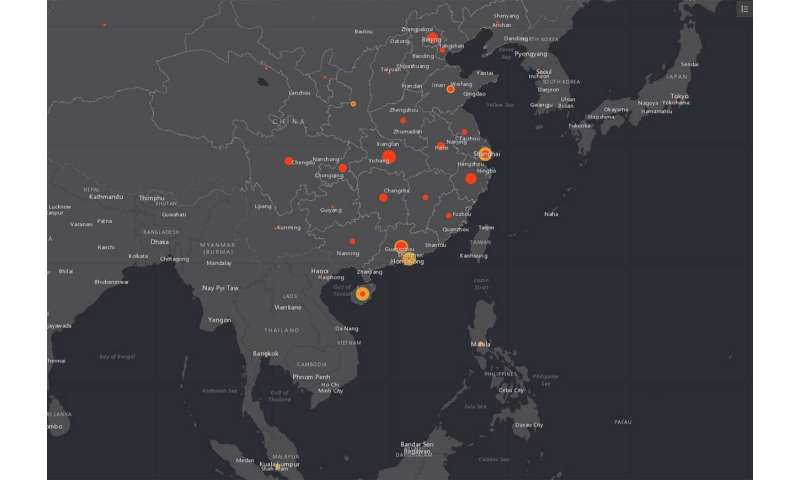
The Johns Hopkins Center for Systems Science and Engineering has built and is regularly updating an online dashboard for tracking the worldwide spread of the coronavirus outbreak that began in the Chinese city of Wuhan.
Lauren Gardner, a civil engineering professor and CSSE’s co-director, spearheaded the effort to launch the mapping website on Wednesday. The site displays statistics about deaths and confirmed cases of coronavirus, or 2019-nCoV, across a worldwide map. It also allows visitors to download the data for free.
“We built this dashboard because we think it is important for the public to have an understanding of the outbreak situation as it unfolds with transparent data sources,” Gardner said. “For the , this data will become more valuable as we continue to collect it over time.”
Making the data available for download is “critical” for researchers, she added.
The statistics behind the data visualization are being collected from the World Health Organization, the Centers for Disease Control and Prevention, the National Health Commission of the People’s Republic of China, and Dingxiangyuan, a social networking site for that provides real-time information on cases.
Gardner said “local level case data” from Dingxiangyuan, , and the local CDC “can provide more timely assessments of the outbreak, compared to the national level reporting organizations, which take longer to filter up.”
The CSSE’s Wuhan Coronavirus Global Cases website on Thursday afternoon reported 18 related deaths and 653 confirmed cases—444 in the Chinese province of Hubei, of which Wuhan is the capital city.
The website provides a link to a downloadable Google Sheet that contains information on confirmed and suspected cases in more than 30 Chinese locations as well as for the nations of Japan, Thailand, South Korea, Vietnam, Singapore, Colombia, Brazil, Australia, Mexico, and the United States. One case has been confirmed in Washington state.
The CSSE website does not yet predict where the flu-like virus is likely to spread.
Last year, Gardner and a team of researchers identified 25 U.S. counties that were most likely to experience measles outbreaks in 2019. The predictive analysis, published in The Lancet Infectious Diseases, was based on international air travel volume, non-medical exemptions from childhood vaccinations, population data, and reported measles information.

Explore further
How the new coronavirus developed

Rotator cuff injuries common but easily remedied

Most rotator cuff injuries are easily remedied and many are even preventable, according to a University of Alberta rehabilitation medicine researcher.
“Over time, the tissue wears out, so the longer you can kind of keep everything mobile and strong, the better,” said physical therapy professor Judy Chepeha. “For that to happen, we need to look at overall shoulder health and a really good balance of muscles.”
Chepeha likens the rotator cuff to a hand coming from the shoulder blade to the front and grabbing onto the ball at the top of the upper arm.
“Four muscles converge together to form this common attachment really deep within the shoulder joint, to stabilize the joint while allowing the arm to rotate,” she said. “You can see why, when it goes down, there are some pretty big consequences.”
Before anyone finds their way onto the rotator cuff injury spectrum, Chepeha said strengthening the muscles along the shoulder blade, as well as the trapezius—a set of three postural muscles that span the entirety of the upper back—can help.
“The rotator cuff lives on the shoulder blade, so the two are absolutely partners in this,” she said. “Strong shoulder blade muscles equal a good environment for a strong cuff.”
Chepeha’s suggested exercises for strengthening the shoulder and back complex include movements and exercises along the lines of shrugs, rowing and lat pulldowns.
“Anything where you squeeze your shoulder blades together is great,” she said.
Most people think rotator cuff injuries are a result of a major episode, such as a “fall on an outstretched hand”—known as a FOOSH injury—where the joint gets compressed and torn. But Chepeha said more often than not, injury comes as a result of repetitive strain. People whose vocation includes tasks done above shoulder height, such as carpenters and painters, are particularly vulnerable, as are athletes.
“We see that one-mechanism rotator cuff injury for sure, but mostly when we put the puzzle pieces together, we realize there’s been a lot of stress on that tissue,” she explained.
Repetitive motion over time can result in inflammation and even minor partial thickness tears, which Chepeha said sound terrible but can be remedied quite well with time and exercise, and rarely require surgery.
In rehabbing such injuries, she said patients will want to follow the same guidelines as for any other —modified rest followed by activity.
“What we really try and get people to do is to move within their pain-free range as soon as they can,” she said. “If you do nothing because you’re scared to move your shoulder, it will adhese or stiffen up, and can lead to a frozen shoulder.”
She explained a favorite rehab exercise of most physiotherapists involves the patient holding their arm at their side with a 90-degree bend at the elbow. They then simply rotate their forearm and wrist inwards and out.
Chepeha noted that shoulder management is very active and doesn’t involve a lot of the physio machines patients may come to expect with other injuries. She added she likens shoulder rehabilitation to strengthening your core.
“I always talk about that area as the upper core of your trunk: the muscles help bring you out of that rounded forward position and the cuff helps stabilize the so we can move our arms efficiently.”

Explore further
Exercises to head off a painful rotator cuff injury

Experts fear too late for China virus lockdown

China’s bid to contain a deadly new virus by placing cities of millions under quarantine is an unprecedented undertaking but it is unlikely to stop the disease spreading, experts warn.
The contagious virus has already reached elsewhere in China and abroad, and even an authoritarian government has only a small timeframe in which trapped residents will submit to such a lockdown, they say.
“I think we have passed the golden period of control and prevention,” said Guan Yi, an expert on viruses at Hong Kong University.
China began its campaign on Thursday, cutting off all transport links out of Wuhan, a city of 11 million people where the coronavirus linked to SARS emerged late last year.
A cascading number of nearby cities has since been added to the travel blacklist, corralling more than 40 million people in a bid to stop those with the disease travelling and infecting others elsewhere.
However, with the at 26 and infections being detected as far away as the United States, there are fears the exercise is too little too late.
Yi, who returned from Wuhan just before the lockdown, pointed out huge numbers of people would have already left ahead of the Lunar New Year holiday, which began Friday.
They could have been incubating the virus “on their way out of Wuhan”, he said.
Symptoms could take several days to emerge—effectively seeding a health time-bomb across the country and abroad.
Escape plans
Meanwhile, new gaps in the security web in Wuhan and its surroundings will likely emerge over coming days, even as China deploys its formidable security forces.
They are manning road blocks that have been set up, while train and plane services have been suspended.
“Especially people with money and connections, they’re going to make a run for it… and they’ll probably be successful,” Zi Yang, a senior analyst at the S. Rajaratnam School of International Studies in Singapore, told AFP.
University of Sydney associate professor Adam Kamradt-Scott, an expert in global health security, said only a “handful” of countries could conceivably pull off the mass quarantine.
He suggested the US was one of the few that may be able to mount a similar operation, using the National Guard, although it would face much stiffer opposition from a population accustomed to more .
China’s communist rulers draw on a deep well of public acquiesence—partly due to control of the internet, no free press and a brutally efficient security apparatus.
“I can’t imagine there would be too many countries that would be able to do something on this scale as quickly as China has done,” Kamradt-Scott said.
Even so, Kamradt-Scott warned a lockdown that extends for a week or more would produce “growing levels of discontent and frustration”.
“The Chinese authorities will be conscious of that, I’m sure, and they’ll be monitoring it very closely to avoid the risk of any sort of social unrest,” he said.
Quarantine ‘illusion’
Kamradt-Scott said that, even though the virus would inevitably spread, the quarantine appeared designed to buy authorities time to put in place other measures.
He cited China’s plans to build a 1,000-bed hospital in Wuhan in just 10 days.
Zi, from the S. Rajaratnam School, also said there was some hope the quarantines would have a level of success in containing the outbreak.
“I believe it is possible given China’s expertise in this area of population control, or urban control,” Zi said.
Yet the history of quarantine suggests controls will be far from watertight.
The concept emerged in Venice in the 14th century, where ships arriving at the city state from infected ports were held offshore for 40 days.
Over the centuries the US attempted quarantines to combat yellow fever, European nations tried to subdue cholera outbreaks, and several West African nations sealed off townships to hem in Ebola in the last decade.
Quarantine is “purely an illusion”, said Bruno Halioua, a historian of medicine at the University of Paris IV.
“Quarantine has never worked. Each time, there have been problems.”
And after seeing the situation in Wuhan first-hand, Guan Yi of Hong Kong University shared an equally pessimistic outlook.
“I’ve never felt scared,” Guan said. “This time I’m scared.”
https://medicalxpress.com/news/2020-01-im-experts-late-china-virus.html