Search This Blog

Monday, July 20, 2020

Oxford Covid vaccine can train immune system

July 20, 2020

A coronavirus vaccine developed by the University of Oxford appears safe and triggers an immune response.
Trials involving 1,077 people showed the injection led to them making antibodies and T-cells that can fight coronavirus.
The findings are hugely promising, but it is still too soon to know if this is enough to offer protection and larger trials are under way.
The UK has already ordered 100 million doses of the vaccine.

How does the vaccine work?

The vaccine – called ChAdOx1 nCoV-19 – is being developed at unprecedented speed.
It is made from a genetically engineered virus that causes the common cold in chimpanzees.
It has been heavily modified, first so it cannot cause infections in people and also to make it “look” more like coronavirus.
Scientists did this by transferring the genetic instructions for the coronavirus’s “spike protein” – the crucial tool it uses to invade our cells – to the vaccine they were developing.
This means the vaccine resembles the coronavirus and the immune system can learn how to attack it.

What are antibodies and T-cells?

Much of the focus on coronavirus so far has been about antibodies, but these are only one part of our immune defence.
Antibodies are small proteins made by the immune system that stick onto the surface of viruses.
Neutralising antibodies can disable the coronavirus.
T-cells, a type of white blood cell, help co-ordinate the immune system and are able to spot which of the body’s cells have been infected and destroy them.
Nearly all effective vaccines induce both an antibody and a T-cell response.
Levels of T-cells peaked 14 days after vaccination and antibody levels peaked after 28 days. The study has not run for long enough to understand how long they may last, the study in the Lancet showed.
Prof Andrew Pollard, from the Oxford research group told the BBC: “We’re really pleased with the results published today as we’re seeing both neutralising antibodies and T-cells.
“They’re extremely promising and we believe the type of response that may be associated with protection.
“But the key question everyone wants to know is does the vaccine work, does it offer protection… and we’re in a waiting game.”
The study showed 90% of people developed neutralising antibodies after one dose. Only ten people were given two doses and all of them produced neutralising antibodies.
“We don’t know the level needed for protection, but we can maximise responses with a second dose,” Prof Pollard told the BBC.

Is it safe?

Yes, but there are side-effects.
There were no dangerous side-effects from taking the vaccine, however, 70% of people on the trial developed either fever or headache.
The researchers say this could be managed with paracetamol.
Prof Sarah Gilbert, from the University of Oxford, UK, says: “There is still much work to be done before we can confirm if our vaccine will help manage the Covid-19 pandemic, but these early results hold promise.”

What are the next steps in the trial?

The results so far are promising, but their main purpose is to ensure the vaccine is safe enough to give to people.
The study cannot show whether the vaccine can either prevent people from becoming ill or even lessen their symptoms of Covid-19.
More than 10,000 people will take part in the next stage of the trials in the UK.
However, the trial has also been expanded to other countries because levels of coronavirus are low in the UK, making it hard to know if the vaccine is effective.
There will be a large trial involving 30,000 people in the US as well 2,000 in South Africa and 5,000 in Brazil.
There are also calls to perform “challenge trials” in which vaccinated people are deliberately infected with coronavirus. However, there are ethical concerns due to a lack of treatments.

When will I get a vaccine?

It is possible a coronavirus vaccine will be proven effective before the end of the year, however, it will not be widely available.
Health and care workers will be prioritised as will people who are deemed at high risk from Covid-19 due to their age or medical conditions.
However, widespread vaccination is likely to be, at the earliest, next year even if everything goes to plan.
Boris Johnson said: “Obviously I’m hopeful, I’ve got my fingers crossed, but to say I’m 100% confident we’ll get a vaccine this year, or indeed next year, is, alas, just an exaggeration.
“We’re not there yet.”

What progress is being made with other vaccines?

The Oxford vaccine is not the first to reach this stage, with groups in the US and China also publishing similar results.
The US company Moderna was first out of the blocks and its vaccine can produce neutralising antibodies. They are injecting coronavirus RNA (its genetic code), which then starts making viral proteins in order to trigger an immune response.
The companies BioNtech and Pfizer have also had positive results using their RNA vaccine.
A technique similar to the Oxford one, developed in China, also seems promising.
However, all these approaches are at the absolute boundary of science and have not been proven to work before.
More traditional methods of vaccine development are also being investigated. The company Valneva is taking the whole coronavirus, inactivating it and then inject it.
In total there are 23 coronavirus vaccines in clinical trials around the world and another 140 in early stage development.

Will the UK get a coronavirus vaccine?

The UK government has struck deals for 190 million doses of different vaccines.
This includes:
  • 100 million doses of the Oxford vaccine made from a genetically engineered virus
  • 30 million doses of the BioNtech/Pfizer vaccine, which injects part of the coronavirus’ genetic code
  • 60 million doses of the Valneva inactivated coronavirus
These have been paid for even though it is uncertain which, if any, of the vaccines may prove effective for immunising a nation with 66m people.
Kate Bingham, chairwoman of the UK Vaccine Taskforce, told the BBC: “What we are doing is identifying the most promising vaccines across the different categories, or different types of vaccine, so that we can be sure that we do have a vaccine in case one of those actually proves to be both safe and effective.
“It’s unlikely to be a single vaccine for everybody.
“We may well need different vaccines for different groups of people.”

Oxytocin could be used to treat cognitive disorders like Alzheimer’s

Alzheimer’s disease progressively degrades a person’s memory and cognitive abilities, often resulting in dementia. Amid efforts to find novel treatments for this disease, a recent breakthrough study by scientists from Japan shows that oxytocin―the hormone that we commonly know to induce feelings of love and well-being―can also effectively reverse some of the damage caused by amyloid plaques in the learning and memory center of the brain in an animal model of Alzheimer’s.
Alzheimer’s disease is a progressive disorder in which the nerve cells (neurons) in a person’s brain and the connections among them degenerate slowly, causing severe memory loss, intellectual deficiencies, and deterioration in motor skills and communication. One of the main causes of Alzheimer’s is the accumulation of a protein called amyloid β (Aβ) in clusters around neurons in the brain, which hampers their activity and triggers their degeneration. Studies in animal models have found that increasing the aggregation of Aβ in the hippocampus―the brain’s main learning and memory center―causes a decline in the signal transmission potential of the neurons therein. This degeneration affects a specific trait of the neurons, called “synaptic plasticity,” which is the ability of synapses (the site of signal exchange between neurons) to adapt to an increase or decrease in signaling activity over time. Synaptic plasticity is crucial to the development of learning and cognitive functions in the hippocampus. Thus, Aβ and its role in causing cognitive memory and deficits have been the focus of most research aimed at finding treatments for Alzheimer’s.
Now, advancing this research effort, a team of scientists from Japan, led by Professor Akiyoshi Saitoh from the Tokyo University of Science, has looked at oxytocin, a hormone conventionally known for its role in the female reproductive system and in inducing the feelings of love and well-being. “Oxytocin was recently found to be involved in regulating learning and memory performance, but so far, no previous study deals with the effect of oxytocin on Aβ-induced cognitive impairment,” Prof Saitoh says. Realizing this, Prof Saitoh’s group set out to connect the dots.
Prof Saitoh and team first perfused slices of the mouse hippocampus with Aβ to confirm that Aβ causes the signaling abilities of neurons in the slices to decline or―in other words―impairs their synaptic plasticity. Upon additional perfusion with oxytocin, however, the signaling abilities increased, suggesting that oxytocin can reverse the impairment of synaptic plasticity that Aβ causes.
To find out how oxytocin achieves this, they conducted a further series of experiments. In a normal brain, oxytocin acts by binding with special structures in the membranes of brain cells, called oxytocin receptors. The scientists artificially “blocked” these receptors in the mouse hippocampus slices to see if oxytocin could reverse Aβ―induced impairment of synaptic plasticity without binding to these receptors. Expectedly, when the receptors were blocked, oxytocin could not reverse the effect of Aβ, which shows that these receptors are essential for oxytocin to act.
Oxytocin is known to facilitate certain cellular chemical activities that are important in strengthening neuronal signaling potential and formation of memories, such as influx of calcium ions. Previous studies have suspected that Aβ suppresses some of these chemical activities. When the scientists artificially blocked these chemical activities, they found that addition of oxytocin addition to the hippocampal slices did not reverse the damage to synaptic plasticity caused by Aβ. Additionally, they found that oxytocin itself does not have any effect on synaptic plasticity in the hippocampus, but it is somehow able to reverse the ill―effects of Aβ.
Prof Saitoh remarks, “This is the first study in the world that has shown that oxytocin can reverse Aβ-induced impairments in the mouse hippocampus.” This is only a first step and further research remains to be conducted in vivo in animal models and then humans before sufficient knowledge can be gathered to reposition oxytocin into a drug for Alzheimer’s. But, Prof Saitoh remains hopeful. He concludes, “At present, there are no sufficiently satisfactory drugs to treat dementia, and new therapies with novel mechanisms of action are desired. Our study puts forth the interesting possibility that oxytocin could be a novel therapeutic modality for the treatment of memory loss associated with cognitive disorders such as Alzheimer’s disease. We expect that our findings will open up a new pathway to the creation of new drugs for the treatment of dementia caused by Alzheimer’s disease.”

Story Source:
Journal Reference:
  1. Junpei Takahashi, Daisuke Yamada, Yudai Ueta, Takashi Iwai, Eri Koga, Mitsuo Tanabe, Jun-Ichiro Oka, Akiyoshi Saitoh. Oxytocin reverses Aβ-induced impairment of hippocampal synaptic plasticity in mice. Biochemical and Biophysical Research Communications, 2020; 528 (1): 174 DOI: 10.1016/j.bbrc.2020.04.046

Bayer Loses Roundup Weedkiller Appeal, Damages Cut

July 20, 2020

Bayer AG lost an appeal in the first case to go to trial linking its Roundup weedkiller to cancer, though the California court greatly reduced the amount of damages awarded to $20.4 million.
The Monday decision by the California Court of Appeal comes in the case of school groundskeeper Dewayne Johnson, who won a 2018 jury trial blaming Roundup for causing his non-Hodgkin lymphoma. The jury’s initial $289.2 million award sent Bayer’s stock tumbling and was followed by an even larger $2 billion award in a second trial.
Bayer, which inherited Roundup’s legal liabilities with its $63 billion acquisition of seed and pesticide maker Monsanto Co. two years ago, recently said it would pay up to $10.9 billion to settle tens of thousands of Roundup lawsuits. The company said at the time it was still pursuing appeals in the three cases that have gone to trial.
Bayer has steadfastly said that Roundup and the weedkiller’s active ingredient, glyphosate, are safe and backed by regulators including the U.S. Environmental Protection Agency. The company had argued to the California court that the jury decision should be thrown out in part because it conflicts with an EPA position preventing the company from putting a cancer-warning label on the product.
The court disagreed, finding that while the EPA currently says glyphosate isn’t harmful to humans and that no cancer warning is needed, “that opinion, in the abstract, isn’t binding on this court.”
In shutting down separate arguments Bayer had made, the three-judge panel also said, “In our view, Johnson presented abundant — and certainly substantial — evidence that glyphosate, together with the other ingredients in Roundup products, caused his cancer.” The judges pointed to experts who told jurors that Roundup could cause non-Hodgkin lymphoma generally as well as Mr. Johnson’s cancer in particular.
The court reduced damages for economic loss to $10.2 million and said any punitive damage should match, granting total damages of $20.4 million. The judge who oversaw the trial had already reduced the original award to $78.5 million.
Brent Wisner, an attorney for Mr. Johnson, called the Monday ruling “another major victory” for Mr. Johnson and his family. He said the reduction in damages is “a function of a deep flaw in California tort law” that makes it difficult to have money awarded for a shortened lifespan, an issue he hopes would be addressed by the California Supreme Court.
Bayer said Monday the reduction in damages “is a step in the right direction” but that it continues to believe the jury’s decision was “inconsistent with the evidence at trial and the law.” The company said it will consider appealing the case to California’s highest court.
Glyphosate’s safety came under scrutiny in 2015 after the International Agency for Research on Cancer, a unit of the World Health Organization, classified glyphosate as likely having the potential to cause cancer.
The court said Monday it was underwhelmed by Bayer’s argument that IARC’s finding was an outlier that the jury shouldn’t have relied on so heavily.
The appellate court’s decision could make it more difficult for Bayer to reach settlements with holdout plaintiffs lawyers who haven’t yet signed on to its recent $10.9 billion deal. Bayer said last month it had agreements with lawyers representing 75% of the known 125,000 cases, and was working to resolve the rest.
Jim Onder, a St. Louis-based lawyer who represents around 24,000 Roundup clients that have yet to settle, said the Monday ruling “keeps us steadfast in our determination to take cases to trial.”
Bayer is also revamping a $1.25 billion component of the deal that is meant to resolve future Roundup lawsuits, after a federal judge indicated he was unlikely to approve the proposal. The company doesn’t need a court’s blessing on the settlement of existing cases, which it said will cost between $8.8 billion and $9.6 billion.

As Covid spreads, potentially deadly fungus hits LA County health care facility

The shortage of medical equipment, including gowns and gloves, triggered by the coronavirus outbreak may be helping to spread dangerous germs within health care facilities, according to officials who warned of a potentially deadly fungus in a Los Angeles County health care facility.
L.A. County officials are warning about multiple reports of the fungus, known as Candida auris, in ; there is also an increase in reports of the fungus in Orange County.
At least one outbreak has been identified at a facility in L.A. County, according to an advisory, intended for health care professionals, issued by the Department of Public Health.
C. auris is a fungus that was first identified in 2009 in Japan but since has been declared by the U.S. Centers for Disease Control and Prevention a “serious global health threat.” The yeast “can cause and even death, particularly in hospital and nursing home patients with serious medical problems,” the CDC said, noting that the fungus causes death in more than 1 in 3 patients who suffer from an invasive infection, such as one affecting the blood, heart or brain.
C. auris is considered particularly dangerous because antifungal medications are often ineffective against it. The fungus can live on surfaces for several weeks and can spread through hospitals and nursing homes by contact with infected people and contaminated surfaces and equipment.
The fungus can survive many routinely used disinfectants, county officials said.
“If a patient is positive for more than one organism, ensure you use an Environmental Protection Agency-registered hospital-grade disinfectant that is effective against all organisms the patient is positive for. Check the label,” health officials said.
The fungus has been found not only in the bloodstream, but also in the urine, respiratory tract, wounds and ear canals of patients.
“People who get invasive Candida infections are often already sick from other medical conditions, so it can be difficult to know if you have a C. auris infection,” according to the CDC.
In L.A. County, officials exhorted health care facilities not to reuse gloves and gowns between patients who may be infected with multi-drug-resistant germs or with COVID-19.

Explore further


Could new sensor detect coronavirus particles in air?

As schools, businesses, and other organizations plan their strategies to reopen during the COVID-19 pandemic, testing people regularly for the coronavirus will be one of the key components in attempts to slow and control new waves of cases.
But current testing technologies can be slow—too slow—for the rapid spread of the virus. A positive test today doesn’t necessarily mean someone is still free of the virus two days later, which is about as long as the test results would take to be delivered if you are in the U.S.
That’s why technology that can perform instant and frequent testing could serve as an important weapon in the fight against a pandemic that has already taken a significant toll on people, markets, and governments around the world.
And it is precisely the technology that Nian Sun, a professor of electrical and computer engineering at Northeastern, is working on.
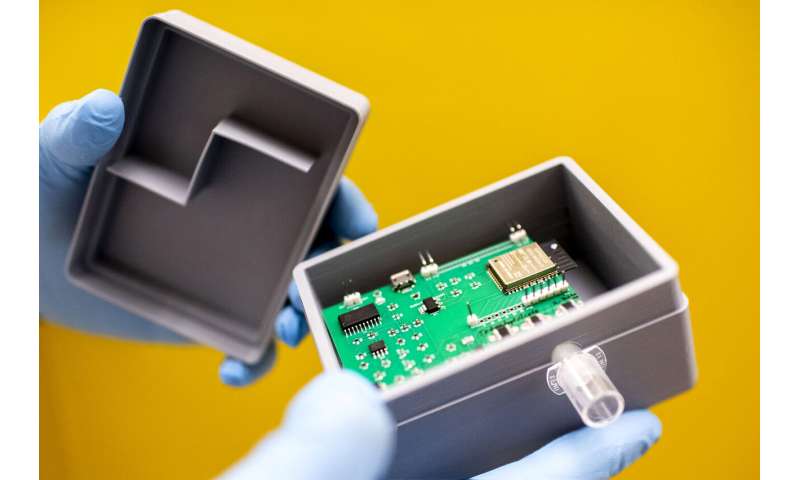
Sun created a for different molecules in the air. It’s a device that can probe the chemistry of airborne pathogens, including the SARS-CoV-2 coronavirus, which causes COVID-19. And, like a breathalyzer that can give results in real-time, it works within seconds, Sun says.
The device uses electrochemical sensors consisting of a special material imprinted with cavities that are the same shape and size as the crown-like structure of proteins that cover the SARS-CoV-2 virus.
Like missing pieces from a puzzle, those proteins (and only those proteins) fit within the cavities of the material. The sensors basically catch those particles from the air. Then, the material reacts with the proteins and sends an indicating that the virus is present.
“When this matter is in the air, it can be very contagious, and land on the environment, like on top of the desk, on a toilet, on door handles—on everything,” Sun says. “We use our sensors to detect those viruses that are in the air or on a surface.”
Because the microscopic imprints on the sensors are the same exact shape as the coronavirus spike proteins, the device provides high sensitivity and accuracy, Sun says.
In his lab, the sensors have shown to be as effective at detecting the coronavirus as the gold standard in current testing, using polymerase chain reactions. The process for that kind of testing involves making millions of copies of the genetic material to detect the coronavirus. But it can take days and highly specialized laboratories to conduct.
Could this new sensor detect coronavirus particles in the air?
A gas sensor used to detect airborne SARS-CoV-2 virus in professor Nian Sun’s lab in Egan Research Center. Credit: Ruby Wallau/Northeastern University
And because of the logistical limitations of needing to swab people’s nostrils and waiting for those samples to be shipped for analysis, that can accurately analyze exhaled breath instantly could be a game changer, Sun says.
“This is technology that can dramatically change the landscape of COVID-19 testing because it is easily two orders of magnitude faster than the best technology nowadays,” Sun says. “In reopening businesses, schools, universities—essentially, it is life-saving technology.”
Sun originally began working on gas-sensing technology to help find illegal drugs and explosives—a job often left to dogs with specialized training.
“Those are trained sniffer dogs, and they can do the job by just simply smelling,” Sun says. “So I thought, ‘why can’t we engineers design something like an electronic sensor that can beat that?'”
In more recent years, Sun and his colleagues have been working on other devices to sense airborne molecules and use them as biomarkers to screen for such as Alzheimer’s disease and lung cancer.
When the pandemic hit, he saw a new use for his technology. The team recently secured funding from the National Science Foundation to improve the sensors and make them available to clinicians to test for the coronavirus.
Together with Jeremy Luban, a professor at the University of Massachusetts Medical School, Sun is working with the medical community to test his device, and get emergency authorization from the U.S. Food and Drug Administration to use it in different settings.
He says he envisions his gadget as a handheld tool used in hospitals, schools, and other types of environments where people can be at risk of inhaling viral particles indoors.
And, because the molecularly imprinted could also be mounted on surfaces, Sun says the device could also help with more efficient testing for viral particles that fall from the air and onto different objects.
“We can easily sense the surface by just laying the sensor directly on it,” Sun says. “We just put a sensor right there, and it can give us [a result] automatically, remotely, wirelessly.”

Explore further

New drug target for dry age-related macular degeneration

Scientists at Sanford Burnham Prebys Medical Discovery Institute have shown that the blood protein vitronectin is a promising drug target for dry age-related macular degeneration (AMD), a leading cause of vision loss in Americans 60 years of age and older. The study, published in the Proceedings of the National Academy of Sciences (PNAS), also holds implications for Alzheimer’s and heart disease, which are linked to vitronectin.
“Our findings suggest that vitronectin, which is shaped like a sticky propeller, orchestrates the formation of the spherical deposits that accumulate and cause dry AMD,” says Francesca Marassi, Ph.D., director of the Cancer, Molecules and Structures Program at Sanford Burnham Prebys and senior author of the study. “With this information, we can look for drugs that prevent the deposits from forming and help people retain their sight for as long as possible.”
More than 11 million Americans have AMD; and this number is expected to double by 2050 as the U.S. population ages. Of the two types of macular degeneration—wet and dry—the dry form is the most common, making up approximately 80 to 90% of cases. While the progression of dry AMD can be slowed with , such as taking , eating healthy, and not smoking, no exists.
New insights into deposit formation
Dry AMD is caused by the progressive accumulation of drusen, pebble-like deposits at the back of the eye, which results in blurry vision and, over time, vision loss. While scientists knew that these deposits contain cholesterol, fats (lipids), proteins such as vitronectin, and a mineralized form of calcium phosphate called hydroxyapatite—the same material that forms teeth and bone—how these deposits form was unknown.
In the study, Marassi and her team used the structure of vitronectin—which was solved by Marassi last year—and various sophisticated biophysical tools to prove that the propeller top tightly clasps calcium and hydroxyapatite. These findings suggest a mechanism by which vitronectin drives the formation of the abnormal deposits—and reveal how this process might be interrupted.
“We know that these deposits have a cholesterol-rich lipid core that is surrounded by a shell of hydroxyapatite and a final topcoat of vitronectin,” says Marassi. “Our study suggests that vitronectin brings all these pieces together in one place to build up this complex assembly. With this information, we can start to figure out how to disrupt these interactions and break up this deposit.”
Forging ahead to drug development
Marassi is already working with scientists at the Institute’s Conrad Prebys Center for Chemical Genomics to identify -targeting compounds that can stop drusen from forming. This drug candidate would hold promise as a treatment that slows the progression of dry AMD and potentially other plaque-related conditions. Vitronectin is also a major component of the amyloid plaques linked to Alzheimer’s disease and the cholesterol-rich plaques that cause .
“For diseases such as dry AMD and Alzheimer’s that have no effective treatment, the need for innovative science is painfully clear,” says Diane Bovenkamp, Ph.D., vice president of Scientific Affairs at BrightFocus Foundation, a nonprofit that advances research on macular degeneration, Alzheimer’s and glaucoma. “We are hopeful that these findings on how disease-associated proteins bind together will help scientists to design better drugs that could lead to treatments for one or more of these diseases with unmet clinical needs.”

Explore further

More information: Calcium and hydroxyapatite binding site of human vitronectin provides insights to abnormal deposit formation, Proceedings of the National Academy of Sciences (2020). DOI: 10.1073/pnas.2007699117

Orchard Therapeutics nabs Orphan Drug tag for neurometabolic disease med

The FDA designates Orchard Therapeutics’ (ORTX -2.2%) OTL-203, an ex vivo autologous hematopoietic stem cell gene therapy, an Orphan drug and rare pediatric disease, for mucopolysaccharidosis type I (MPS-I), a rare neurometabolic disease caused by a deficiency of the alpha-L-iduronidase lysosomal enzyme required to break down sugar molecules.
Among the benefits of Orphan Drug status in the U.S. is a seven-year period of market exclusivity for the indication, if approved
Orchard expects to release full proof-of-concept results and initiate the pivotal study for OTL-203 in 2021.