Search This Blog

Monday, August 3, 2020

AbbVie bails on neurodegenerative disease collaboration with Voyager

Voyager Therapeutics (NASDAQ:VYGR) announces the termination of its tau and alpha-synuclein vectorized antibody collaborations with AbbVie (NYSE:ABBV) thereby regaining all rights to the vectorization technology and certain novel vectorized antibodies developed under the partnership.
The tau agreement was inked in 2018 followed by the alpha-synuclein deal in 2019. 
Voyager does not anticipate any changes to its cash runway guidance from AbbVie’s exit and continues to expect that its current resources will be sufficient to fund operations into mid-2022.

Tenet Healthcare EPS beats by $1.97, misses on revenue

Tenet Healthcare (NYSE:THC): Q2 Non-GAAP EPS of $1.26 beats by $1.97; GAAP EPS of $0.83 beats by $1.54.
Revenue of $3.65B (-20.0% Y/Y) misses by $180M.
Same-hospital adjusted admissions dropped 27.3%; adjusted EBITDA of $732M.

G1 Therapeutics inks trilaciclib pact with Simcere in Greater China

G1 Therapeutics (GTHX +4.6%) has announced a license agreement with Simcere Pharmaceutical, for the development and commercialization of trilaciclib across all indications in Greater China, including mainland China, Hong Kong, Macau and Taiwan.
Under the terms of the agreement, G1 will receive an upfront payment of $14M, and be eligible to receive up to $156M in milestone payments, as well as tiered low double-digit sales-based royalties.
Trilaciclib is a first-in-class myelopreservation agent designed to protect the bone marrow from damage by chemotherapy.

Spain to roll out COVID-19 app twice as effective as human tracers in pilot

Spain aims to roll out a COVID-19 contact-tracing app across the country in September after saying on Monday that a pilot showed it could detect almost twice as many potential infections as human trackers during a simulated outbreak on a tiny island.
In the absence of a vaccine or cure, states are deploying Bluetooth wireless technology to log contacts and alert people when someone they have been near tests positive.
Spain used a new system developed by Google (GOOGL.O) and Apple (AAPL.O) which holds data on individual devices to ensure privacy, to build an app it tested on La Gomera, an island next to the tourist hotspot of Tenerife in the Canary archipelago, in July.
Now the government aims to offer it to regional health authorities who could have it ready by mid-September, and from Aug. 10 to tourism-dependent areas or places where cases are rising, said Carme Artigas, head of the state digital and artificial intelligence unit.
“The app sees more than we see because we only remember contacts with people we know, but the app also remembers contacts with strangers,” Artigas said.
“It is anonymous and much less intrusive than receiving a call from someone who wants to reconstruct everything you have done for the past 15 days,” Artigas added.
Some 3,200 people downloaded the app, just pipping a target of 3,000.
Participants anonymously entered randomly distributed codes into the app, some of which falsely indicated a positive COVID-19 test, which then alerted everyone with whom they had spent a minimum of 15 minutes at a proximity of 2 metres (6.5 ft) or less.
For every virtual positive diagnosis, the app identified an average 6.4 contacts with others, Artigas’s ministry said in a statement, compared with an average 3.5 contacts identified by human tracers in the Canary Islands.
The spread of the disease in Spain slowed as the government imposed one of the strictest lockdowns in Europe and as many countries limited international travel, but new cases have started rising again, hitting a post-lockdown record of 1,525 on Friday.

Fewer parents want full-time, in-person instruction for their children: Gallup

The percentage of parents who say they want full-time, in-person school for their children in the fall has fallen 20 points in recent months, although more still favor it than fully remote classes, according to Gallup.
Thirty-six percent of K-12 parents say they favor resuming in-person, full-time classes in the fall, down from 56 percent in May and early June. Twenty-eight percent are currently in favor of full-time remote classes, up 21 percentage points from earlier in the year. Another 36 percent now favor a combination of the two options.
The results earlier in the year were closely correlated with parents’ experience with distance learning, Gallup noted. In that survey, 56 percent of parents, the same percentage that favored full-time, in-person classes, said they found their children’s remote instruction difficult.
Since then, parents’ concerns about the possibility of their children getting the novel coronavirus have grown, according to Gallup. Sixty-four percent now say they are concerned, compared to 46 percent earlier in the year. This includes 27 percent describing themselves as “very worried,” a 15-percent increase.
While a majority of concerned parents were in favor of hybrid schooling in the fall in the last survey, concerned parents favoring full-time remote learning and those favoring a combination have now moved into a statistical tie, 42 to 44 percent. Concerned parents who favor full-time instruction fell 14 points, from 29 percent to 15 percent.
Eighty-five percent of parents identifying as Democrats say they are concerned about their children getting the virus, compared to 29 percent of Republicans. About 2 in 3 Republican parents want a full return to in-person classes for their children, compared to 13 percent of Democrats.
President Trump and the White House have mounted an aggressive push for full in-person learning in the fall, pointing to the virus’ low infection and mortality rates among children. Critics of the plan have cited the adults those children will come in contact with at school and at home.
Gallup surveyed a random sample of 1,028 parents of U.S. K-12 students July 13-27. The results have a 6-point margin of error for individual samples.

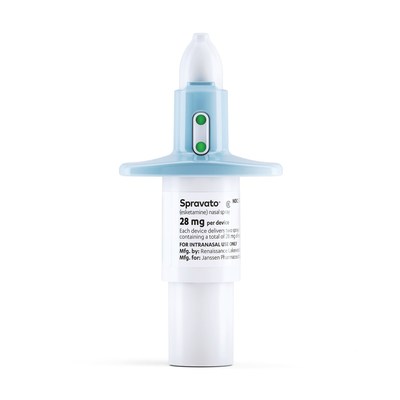
Janssen: FDA OKs Spravato (esketamine) CIII Nasal Spray for Depression

The Janssen Pharmaceutical Inc. Companies of Johnson & Johnson today announced that the U.S. Food and Drug Administration (FDA) has approved the supplemental new drug application (sNDA) for SPRAVATO® (esketamine) CIII nasal spray, taken with an oral antidepressant, to treat depressive symptoms in adults with major depressive disorder (MDD) with acute suicidal ideation or behavior.1 SPRAVATO® is the first and only approved medicine that has been shown to reduce depressive symptoms within 24 hours,1 providing a new option for significant symptom relief until a longer-term, comprehensive treatment plan can take effect.
The effectiveness of SPRAVATO® in preventing suicide or in reducing suicidal ideation or behavior has not been demonstrated. Use of SPRAVATO® does not preclude the need for hospitalization if clinically warranted, even if patients experience improvement after an initial dose of SPRAVATO®. SPRAVATO® carries a Boxed Warning regarding a Risk Evaluation and Mitigation Strategy (REMS) and the risk of suicidal thoughts and behaviors. See below for Important Safety Information. SPRAVATO® will be made available at REMS certified treatment centers. Janssen is working to responsibly educate and certify treatment centers in accordance with the REMS so healthcare providers can offer SPRAVATO® to appropriate patients.

Regeneron and BioNTech Partner on Immunotherapy Combo for Melanoma

Although Mainz, Germany-based BioNTech is getting a lot of attention because of its partnership with Pfizer on a COVID-19 vaccine, the mRNA company has a broader approach than just infectious diseases. Now, Regeneron Pharmaceuticals and BioNTech have inked a strategic collaboration to combine BioNTech’s BNT111 FixVac product candidate and Regeneron and Sanofi’s checkpoint inhibitor Libtayo (cemiplimab) for the treatment of melanoma.
Regeneron and BioNTech plan to run a randomized Phase II trial in patients with anti-PD1-refractory/relapsed, unresectable Stage III or IV cutaneous melanoma. Melanoma is the deadliest form of skin cancer, taking the lives of more than 63,000 people around the world each year.
BNT111 is one of five clinical stage FixVac products in BioNTech’s overall development pipeline. It is an mRNA immunotherapy that targets four molecules often expressed in melanoma—NY-ESO-1, MAGE-A3, tyrosinase, and TPTE. In an ongoing Phase I trial, it has shown anti-tumor activity alone and in combination with checkpoint inhibitors in advanced melanoma after previous checkpoint blockade.
“We believe our FixVac platform represents a powerful new drug class of mRNA immunotherapies against cancer,” said Ugur Sahin, chief executive officer and co-founder of BioNTech. “We look forward to working together with Regeneron to advance this product candidate into potentially registrational clinical trials.”
Under the terms of the deal, the two companies will equally split development costs for the study and will both contribute their compounds for the trial. They will retain full commercial rights for their own products and record revenues separately.
They expect to release more details for the planned Phase II trial in the third quarter, with a goal of beginning the trial in the fourth quarter.
Regeneron and Sanofi recently announced they were no longer developing Libtayo with their own anti-CD38 drug Sarclisa (isatuximab) in melanoma. PharmaPhorum notes that melanoma was the first cancer targeted by checkpoint inhibitors. Both Bristol Myers Squibb’s Opdivo (nivolumab) and Merck’s Keytruda (pembrolizumab) were approved as second-line therapies for melanoma very close together. Since that initial approval, PD-1/PD-L1 checkpoint inhibitors have been approved for the first-line setting, with a combination of Opdivo and Bristol Myers Squibb’s CTLA4 inhibitor Yervoy (ipilimumab), a different type of checkpoint inhibitor, becoming the “go-to therapy” for cancer physicians.
However, about 30% to 40% of melanoma patients respond with a long-lasting response to checkpoint inhibitors, most other drugs either are totally ineffective or stop working over time, resulting in cancer reoccurrence.
Regeneron and BioNTech’s collaboration means they hope that using their two drugs together will overcome the mechanisms of resistance seen in some cancers. The Phase II trial will focus on patients with advanced melanoma that can’t be treated surgically and who are refractory to or have relapsed after PD-1 checkpoint inhibitor therapy.
“The combination of Libtayo and BBNT111 … has the potential to augment the immune system’s ability to effectively recognize melanoma in multiple ways and hopefully improve immune targeting to control the cancer,” said Israel Lowy, Regeneron’s head of translational science.
Sanofi reported Libtayo sales outside the U.S. of $32 million in the first half of this year. Regeneron handles U.S. sales, but has yet to make its second-quarter report. In the first quarter, Regeneron reported slightly under $62 million sales.