Search This Blog

Friday, February 5, 2021

NASH biotech Terns Pharmaceuticals priced upsized IPO at $17 high end

 Terns Pharmaceuticals, a Phase 2 biotech developing small molecule therapies for NASH, raised $128 million by offering 7.5 million shares at $17, the high end of the range of $15 to $17. The company offered 1.3 million more shares than anticipated. At pricing, Terns commands a fully diluted market value of $430 million.


The company's most advanced program is TERN-101, a liver-distributed, non-bile acid FXR agonist. The company initiated a Phase 2a trial of TERN-101 in NASH patients in June 2020 and expect top-line data in the 3Q21. Its second clinical stage program, TERN-201, is a highly selective inhibitor of Vascular Adhesion Protein-1, and the company expects to initiate a Phase 1b trial in NASH patients in the 1H21 with top-line data expected in the 1H22.

Terns Pharmaceuticals plans to list on the Nasdaq under the symbol TERN. J.P. Morgan, Goldman Sachs and Cowen acted as lead managers on the deal.

FDA approves TG Ukoniq for two lymphoma indications

 The FDA granted accelerated approval to umbralisib for two types of relapsed or refractory lymphoma.

The approval applies to use of the agent for adults with marginal zone lymphoma who received at least one prior anti-CD20-based regimen, as well as adults with follicular lymphoma who received at least three prior lines of systemic therapy.

Umbralisib (Ukoniq, TG Therapeutics) is a dual inhibitor of the PI3 kinase-delta and CK1-epsilon.

The FDA based the approval on results of two single-arm cohorts of the open-label, multicenter UTX-TGR-205 trial.

The trial included 69 patients with marginal zone lymphoma who received at least one prior therapy, and 117 patients with follicular lymphoma who received at least two prior systemic therapies.

Patients received umbralisib dosed at 800 mg orally once daily. Treatment continued until disease progression or unacceptable toxicity.

Overall response rate and duration of response as assessed by an independent review committee served as key efficacy outcomes.

In the marginal zone lymphoma subgroup, researchers reported an ORR of 49% (95% CI, 37-61.6), with 16% of patients achieving complete response. Median duration of response was not reached (95% CI, 9.3-not estimable).

In the follicular lymphoma subgroup, researchers reported an ORR of 43% (95% CI, 33.6-52.2), with 3% of patients achieving complete responses. Median duration of response was 11.1 months (95% CI, 8.3-16.4).

The most common adverse events among umbralisib-treated patients included increased creatinine, diarrhea-colitis, fatigue, nausea, neutropenia, transaminase elevation, musculoskeletal pain, anemia, thrombocytopenia, upper respiratory tract infection, vomiting, abdominal pain, decreased appetite and rash.

Eighteen percent of patients experienced serious adverse events, the most common of which were diarrhea-colitis and infection.

The FDA previously granted orphan drug designation to umbralisib for both indications, as well as priority review for the marginal zone lymphoma indication.

https://www.healio.com/news/hematology-oncology/20210205/fda-approves-ukoniq-for-two-lymphoma-indications

Bristol Myers Squibb's CAR-T liso-cel wins long-delayed FDA nod

 After regulatory delays and manufacturing issues caused Bristol Myers Squibb investors to miss out on the lucrative Celgene contingent value right, the closely watched CAR-T drug liso-cel has finally scored an FDA nod. 

On Friday, the agency endorsed the drug, to be called Breyanzi, to treat patients with certain types of large B-cell lymphoma who haven’t responded to two other systemic treatments or who have relapsed after receiving those treatments. 

Like other CAR-T drugs, doses of Breyanzi are individually tailored. They’re created using a patient’s own T cells, which are extracted, genetically modified and then infused back into patients to help the body kill lymphoma cells. 

In a trial of more than 250 patients, 54% of patients who received the CAR-T therapy achieved complete remission. The drug’s label carries a boxed warning for cytokine release syndrome, which can be severe.  Because of safety risks, the FDA is requiring centers that administer the drug have a certification indicating that staff have been trained and are able to recognize side effects. 

On a conference call earlier this week, Bristol's chief commercialization officer Chris Boerner said the company expects the opportunity to launch liso-cel "imminently." The company is "going to be very much focused on ensuring at launch that sites are activated very quickly, that we're able to get patients efficiently moved on to therapy," he added.

Looking forward, the company will look to drive referrals to the medicine and expand the number of sites able to administer it. In the long run, BMS wants to "leverage what we believe to be a differentiated product profile in order to drive brand share," Boerner said.


But while BMS aims to be quick to roll out Breyanzi, the process of getting it approved was anything but. Multiple delays pushed the FDA's decision past the original deadline of mid-August 2020—and ultimately cost investors about $6.4 billion in contingent value rights that came out of BMS' $74 billion Celgene buy.

Nearly 715 million CVRs worth $9 per share were outstanding at the end of the year, and since BMS didn’t meet all of the CVR requirements, they were worthless when the calendar year flipped to 2021. Aside from an approval for liso-cel, the CVRs also required an FDA approval for multiple myeloma CAR-T med ide-cel by March 31, 2021, and an FDA nod for Zeposia, a multiple sclerosis drug. Zeposia scored its FDA approval last March, and ide-cel is set for an FDA decision by March 27.

https://www.fiercepharma.com/pharma/after-delays-and-a-cvr-miss-bristol-s-liso-cel-wins-its-fda-nod

Vor Biopharma prices IPO

  Vor Biopharma (Nasdaq: VOR), a cell therapy company pioneering engineered hematopoietic stem cell (eHSC) therapies combined with targeted therapies for the treatment of cancer, today announced the pricing of its initial public offering of 9,828,017 shares of its common stock at a price to the public of $18.00 per share. The gross proceeds to Vor from the offering, before deducting the underwriting discounts and commissions and other offering expenses payable by Vor, are expected to be approximately $176.9 million. In addition, Vor has granted the underwriters a 30-day option to purchase up to an additional 1,474,202 shares of its common stock at the initial public offering price, less the underwriting discounts and commissions. All of the shares of common stock are being offered by Vor.

The shares are expected to begin trading on the Nasdaq Global Market on Friday, February 5, 2021, under the ticker symbol “VOR”. The offering is expected to close on Tuesday, February 9, 2021, subject to customary closing conditions.

Goldman Sachs and Co. LLC, Evercore ISI, Barclays and Stifel are acting as joint book-running managers for the offering.

https://www.globenewswire.com/news-release/2021/02/05/2170590/0/en/Vor-Biopharma-Announces-Pricing-of-Initial-Public-Offering.html

Biotech passes GameStop as year's best performing retail pick

 Biotech mania has overtaken internet chat rooms, pushing aside recent retail trading stars GameStop Corp. and Express Inc.

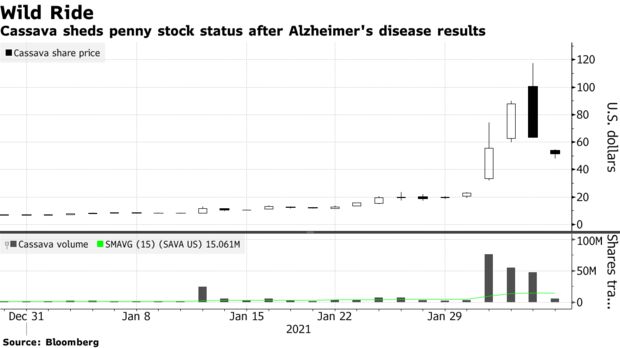
Cassava Sciences Inc. nabbed the top spot as best microcap stock performer this year with an almost 680% rally.

The small drug developer now has a market value of nearly $2 billion after briefly surpassing the $3 billion mark earlier this week. Its surge since the start of the year has displaced GameStop as the leader in the Russell Microcap Index. GameStop’s return had dwindled to about 184% through Thursday’s close, down from more than 1,000% at the end of last week.

Trading in Cassava on Tuesday was frenzied with 76 million shares exchanging hands. Multiple trading halts were triggered after the Austin, Texas-based company released results from a small study of an experimental medicine in Alzheimer’s disease.

One day later, Cassava was among the top seven most purchased stocks by retail investors, according to Eric Liu, the cofounder of Vanda Research. At the same time GameStop retail interest fell back to mid-January levels and Express saw investors flee.

“Retail has basically just been rotating from one hot sector to the next,” Liu said. While retailers and silver funds sold off, pot stock Tilray Inc. and biotech Vaxart Inc. took the lead among the latest retail favorites, according to Vanda’s data.

Pandemic reopening trades have gone out of favor for growth stocks which were later overtaken by electronic vehicles. Now touts on WallStreetBets are poised to take the lead.

Meanwhile, even Cassava’s most bullish analyst was circumspect about the results from a small 100-person study.

“Although encouraging, we interpret these observations with caution being from an non-controlled study,” Charles Duncan, an analyst with Cantor Fitzgerald wrote in a Feb. 2 research note.

Results will have to be confirmed in a much larger placebo-controlled study, and the company plans to pursue a late-stage study in the latter half of this year. Duncan rates the company the equivalent of a buy and has a Wall Street high price target of $24. The stock gyrated on Thursday closing down 28% after gaining 34% intraday.

Cassava sheds penny stock status after Alzheimer's disease results

Cassava was down 16% to $53.21 at 10:12 a.m.

https://www.bloomberg.com/news/articles/2021-02-05/biotech-surpasses-gamestop-as-year-s-best-performing-retail-pick

Twist cut to Underweight from Neutral by JPMorgan

 Target $100

https://finviz.com/quote.ashx?t=TWST

Oxford-AstraZeneca vaccine 'protects against' U.K. Covid-19 variant, trials suggest

 AstraZeneca and Oxford University's Covid-19 vaccine has similar efficacy against the British coronavirus variant as it does to the previously circulating variants, the university said Friday.

The variant, first identified in Kent, southern England, is more easily transmissible, prompting many countries to restrict travel to Britain. It also led to a spike in infections that forced a new national lockdown in England last month.

That lockdown came as Britain started rolling out the AstraZeneca vaccine. Over 10 million people have received a first dose of either AstraZeneca or Pfizer's shot.

Britain had said that it believed the vaccines were effective against variants that are circulating in the U.K.

"Data from our trials of the ChAdOx1 vaccine in the United Kingdom indicate that the vaccine not only protects against the original pandemic virus, but also protects against the novel variant, B.1.1.7, which caused the surge in disease from the end of 2020 across the U.K.," said Andrew Pollard, chief investigator on the Oxford vaccine trial.

Sarah Gilbert, co-developer of the vaccine, said that, although the vaccine had efficacy against the U.K. variant, it might need to be adapted for a future variant.

"We are working with AstraZeneca to optimise the pipeline required for a strain change should one become necessary," Gilbert said.

The findings, released in a preprint paper and not peer-reviewed, also detailed recent analysis showing that vaccination with the shot results in a reduction in the duration of shedding and viral load, which may translate into a reduced transmission of the disease, Oxford University said.

https://www.nbcnews.com/news/us-news/oxford-astrazeneca-vaccine-protects-against-u-k-covid-19-variant-n1256843