Search This Blog

Saturday, February 6, 2021

Biotech week ahead, Feb. 8

 Biopharma stocks advanced in the week ended Feb. 5, driven higher by a slew of catalysts. Large-cap pharma earnings, vaccine updates, M&A activity, IPO news flow and follow-on offerings all served to lift stocks higher.

In an unexpected move, Jazz Pharmaceuticals PLC JAZZ 4.47% agreed to buy plant-derived cannabinoid drug maker GW Pharmaceuticals PLC- ADR GWPH 0.31% for $7.2 billion.

Novavax, Inc. NVAX 3.3% shares found follow-up buying interest amid vaccine updates. Earnings from large-cap biopharma companies can at best be qualified as mixed. The IPO calendar of the week was heavy, with 10 healthcare stocks making their Wall Street debuts this week.

Conferences

  • Transplantation and Cellular Therapy, or TCT, Meeting of the American Society of Transplantation and Cellular Therapy and Center for International Blood & Marrow Transplant Research: Feb. 8-12
  • 17th Annual WORLDSymposium: Feb. 8-12
  • Guggenheim Healthcare Talks: 2021 Oncology Days: Feb. 11-12
  • 2021 ASCO Genitourinary Cancers Symposium: Feb. 11-13
  • Angiogenesis, Exudation, and Degeneration 2021 conference: Feb. 12-13

PDUFA Dates

The Food and Drug Administration is scheduled to rule on Regeneron Pharmaceuticals Inc's REGN 0.03% biologic license application for evinacumab, which is being evaluated for the treatment of homozygous familial hypercholesterolemia, an ultra-rare, inherited form of high cholesterol. The decision is expected by Thursday, Feb. 11.

Clinical Readouts

17th Annual WORLDSymposium Presentations

Regenxbio Inc RGNX 3.3%: interim results from the Phase 1/2 clinical trial of RGX-121 for the treatment of mucopolysaccharidosis type II (Monday, Feb. 8, at 10:06 a.m.)

Orchard Therapeutics PLC – ADR ORTX 18.81%: updated Phase 1/2 data for ex-vivo autologous stem cell gene therapy for mucopolysaccharidosis type IIIA; Phase 1/2 data for ex vivo hematopoietic stem cell gene therapy for mucopolysaccharidosis type I (Tuesday, Feb. 9)

Protalix Biotherapeutics Inc PLX 5.65%: one year of treatment data from BRIDGE, a phase 3 open-label study of pegunigalsidase alfa to treat patients with Fabry disease (Wednesday, Feb. 10, at 2:30-3:30 p.m.)

Avrobio Inc AVRO 6.77%: new phase 1/2 data for AVR-RD-02 ex-vivo lentiviral vector, autologous gene therapy for Gaucher disease (Thursday, Feb. 11, 2:30-3:30 p.m.); updated results from a phase 1/2 study of hematopoietic stem cell gene therapy for cystinosis (Friday, Feb. 12, 11 a.m.); updated Phase 2 data for AVR-RD-01 in Fabry disease (Friday, Feb. 12)

Abeona Therapeutics Inc ABEO 4.88%: updated results from Phase 1/2 study of ABO-101 gene therapy for mucopolysaccharidosis IIIB and Phase 1/2 study of ABO-102 gene therapy for mucopolysaccharidosis IIIA (Friday, Feb. 12)

Denali Therapeutics Inc DNLI 1.25%: data from Phase 1/2 study of DNL310 in mucopolysaccharidosis II patients


TCT Meeting Presentations

Gamida Cell Ltd GMDA 4.14%: results of the Phase 1 study of omidubicel versus standard myeloblative umbilical cord blood transplantation in patients with hematologic malignancies undergoing allogeneic bone marrow transplant (Tuesday, Feb. 9 at 4:45-5 p.m.)

Equillium Inc EQ 8.99%: interim data from the Phase 1b/2 EQUATE study of itolizumab in acute graft-versus-host disease (Friday, Feb. 12, 3 p.m.)

Takeda Pharmaceutical Co Ltd TAK 0.06%: Phase 3 data for TAK-620 in the treatment of transplant recipients with refractory/resistant cytomegalovirus infections (Friday, Feb. 12)

ASCO Genitourinary Cancers Symposium Presentations

Clovis Oncology Inc CLVS 17.15%: Pharmacokinetics and safety data from the phase 1b RAMP study evaluating rucaparib plus enzalutamide in patients with metastatic castration-resistant prostate cancer (Thursday, Feb. 11, 8 a.m.)

Infinity Pharmaceuticals Inc. INFI 6.5%: Preliminary analysis of a phase 2 data for eganelisib in combination with and Bristol-Myers Squibb Co's BMY 1.07% Opdivo compared to Opdivo monotherapy in patients with advanced urothelial carcinoma (Thursday, Feb. 11)

BioXcel Therapeutics Inc BTAI 6.18%: updated Phase 1b/2 data for BXCL701 in combination with Merck & Co., Inc.'s MRK 0.34% Keytruda in men with metastatic castration-resistant prostate cancer (Thursday, Feb. 11, 8 a.m.)

Angiogenesis, Exudation, and Degeneration 2021 Conference Presentation

Kodiak Sciences Inc KOD 3.55%: Clinical data on its investigational therapy KSI-301 in wet age-related macular degeneration and retinal vascular diseases (Saturday, Feb. 13 at 8:30 a.m.)

Earnings

Monday

Corcept Therapeutics Incorporated CORT 0.17% (after the market close)
Enanta Pharmaceuticals Inc ENTA 0.93% (after the market close)

Tuesday

Incyte Corporation INCY 0.74% (before the market open)
Deciphera Pharmaceuticals Inc DCPH 0.58% (before the market open)
SurModics, Inc. SRDX 0.29% (before the market open)

Wednesday

Polypid Ltd PYPD 3.23% (before the market open)
Veru Inc VERU 23.7% (before the market open)
Vanda Pharmaceuticals Inc. VNDA 5.28% (after the market close)
Pacific Biosciences of California Inc PACB 3.46% (after the market close)
Fluidigm Corporation FLDM 5.36% (after the market close)
Exelixis, Inc. EXEL 1.13% (after the market close)
Aethlon Medical, Inc. AEMD 10.84% (after the market close)

Thursday

Karyopharm Therapeutics Inc KPTI 10.79% (before the market open)
Myovant Sciences Ltd MYOV 2.09% (before the market open)
Alnylam Pharmaceuticals, Inc. ALNY 4.56% (before the market open)
Applied Genetic Technologies Corp AGTC 17.37% (before the market open)
Alkermes Plc ALKS 2.62% (before the market open)
Laboratory Corp. of America Holdings LH 1.27% (before the market open)
AVITA Medical Inc RCEL 2.36% (after the market close)
Aytu Bioscience Inc AYTU 0.49% (after the market close)
Otonomy Inc OTIC 1.86% (after the market close)
Illumina, Inc. ILMN 0.06% (after the market close)
Ultragenyx Pharmaceutical Inc RARE 4.66% (after the market close)

Friday

ImmunoGen, Inc. IMGN 3.36% (before the market open)

IPOs

Adagene, Inc., a China-based, clinical-stage biopharmaceutical company developing antibody-based cancer immunotherapies, has filed to offer 7.354 million ADSs, representing 9,1925 million ordinary shares, in an initial public offering. The company expects to price the offering in the $17-$19 range, and has applied for listing its ADSs on the Nasdaq under the ticker symbol ADAG.

French clinical-stage biotech Biophytis S.A., which focuses on development of therapeutics that slow the degenerative processes associated with aging, is proposing to offer 1.2 million ADSs in an IPO. Each ADS represents the right to receive 10 ordinary shares. The offering price is expected to be between $15 and $18 per ADS. The company has applied to list its ADSs on the Nasdaq under the ticker symbol BPTS.

Longeveron LLC, a clinical stage biotech developing cellular therapies for specific aging-related and life-threatening conditions, is offering 2.73 million shares at an estimated price range of $10-$12. The Miami, Florida-based company has applied for listing the shares on the Nasdaq under the ticker symbol LGVN.

Durham, North Carolina-based Bioventus Inc. is planning a 7.53-million-share IPO, with the offering estimated to be priced between $16 and 18 apiece. The medical device company has applied for listing its shares on the Nasdaq under the ticker symbol BVS.

https://www.benzinga.com/general/biotech/21/02/19524632/the-week-ahead-in-biotech-feb-7-13-regeneron-fda-decision-earnings-ipos-and-conference-presentati

Russia's Sputnik V COVID Vaccine A Surprise Global Hit

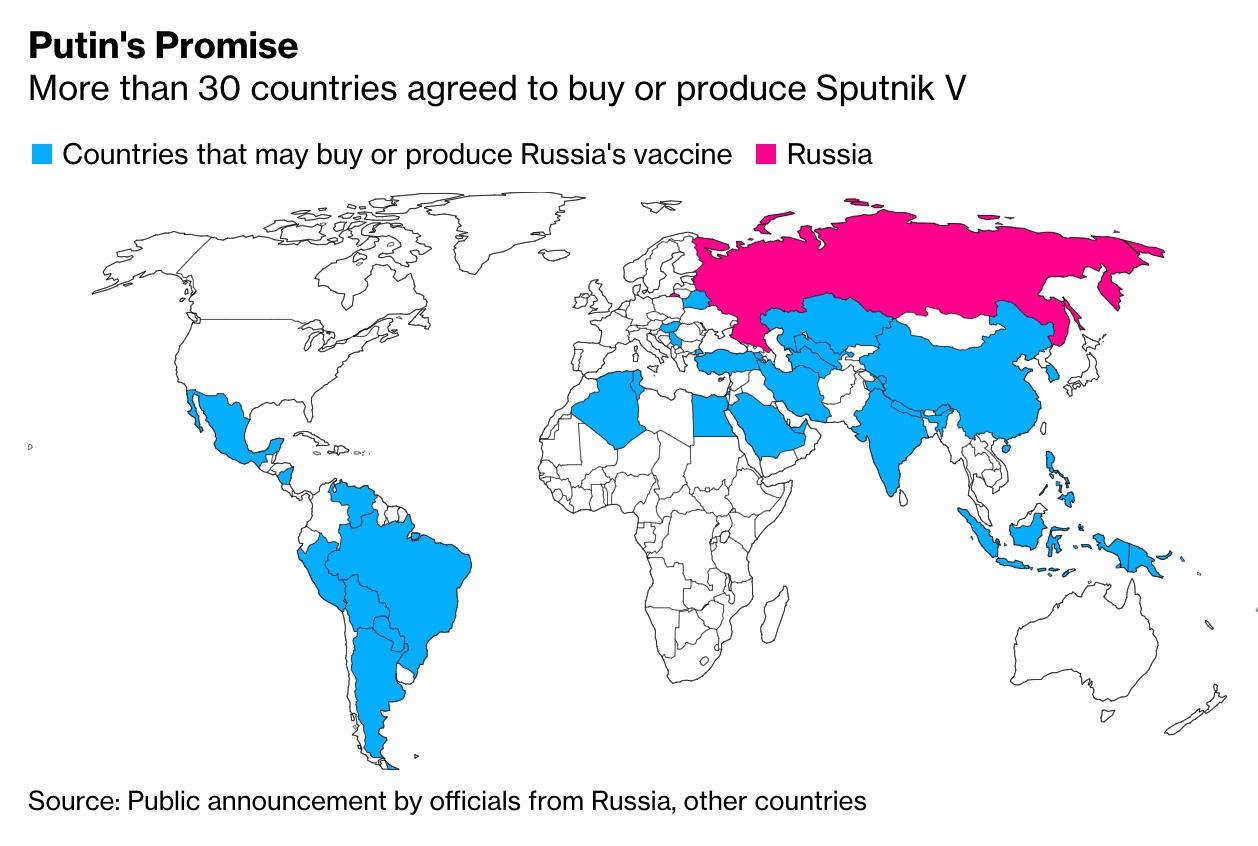
Bloomberg, one of the most implicitly pro-western media outlets in existence, has finally admitted, after months of promoting skepticism, that Russian COVID-19 vaccine trail data published by The Lancet shows that the Kremlin might have a surprise international success. Just days after NYT columnist Thomas Friedman accused President Putin of trusting "what comes out of the ground more than the stuff that might come out of his people's heads," Bloomberg reports that 20 countries, including key markets like India and Brazil, are already lining up to buy the vaccine.

Source: Bloomberg

With an efficacy rate above 90%, Russia's vaccine, developed by the country's Gamelaya Institute with support from Russia's sovereign wealth fund, has been found to be more effective than China's, which is why several countries - including EU member Hungary, are lining up to buy it.

At least 20 countries have approved the inoculation for use, including European Union member-state Hungary, while key markets such as Brazil and India are close to authorizing it. Now Russia is setting its sights on the prized EU market as the bloc struggles with its vaccination program amid supply shortages.

In the global battle to defeat a pandemic that’s claimed 2.3MM lives in little more than a year, the race to obtain vaccines has assumed geopolitical significance as governments seek to emerge from the huge social and economic damage caused by lockdowns imposed to limit the spread of the virus. That’s giving Russia an edge as one of a handful of countries where scientists have produced an effective defense.

The story quoted the head of the Russian sovereign wealth fund which financed the vaccine project.

"This is a watershed moment for us," Kirill Dmitriev, chief executive officer of the state-run Russian Direct Investment Fund, which backed Sputnik V’s development and is in charge of its international roll-out, said in an interview.

Regardless of the success of the vaccine, Bloomberg adds it won't do much to change Putin's reputation in the West.

Sputnik’s success won’t change hostility toward Putin among Western governments, though it could strengthen Russia’s geopolitical clout in regions such as Latin America, according to Oksana Antonenko, a director at Control Risks consultancy.

"With this vaccine, it’s proven itself capable of producing something new that’s in demand around the world,” she said.

Production constraints are the biggest challenge facing all manufacturers as global demand far outpaces supply. Russia, pledging free shots for its 146 million population, began output last year and the vaccine is currently being manufactured in countries including India, South Korea and Brazil.

Yet, despite Russia's supervillain status with the US and Europe, frustration with Putin's tactics has never stopped the EU from buying Russian energy products.

Why should it stop them from buying the vaccine?

https://www.zerohedge.com/geopolitical/russias-sputnik-v-covid-vaccine-surprise-global-hit

Oxford/AstraZeneca COVID Shot Less Effective Against South African Variant

 British drugmaker AstraZeneca said on Saturday its vaccine developed with the University of Oxford appeared to offer only limited protection against mild disease caused by the South African variant of COVID-19, based on early data from a trial.

The study from South Africa's University of the Witwatersrand and Oxford University showed the vaccine had significantly reduced efficacy against the South African variant, according to a Financial Times report published earlier in the day.

Among coronavirus variants currently most concerning for scientists and public health experts are the so-called British, South African and Brazilian variants, which appear to spread more swiftly than others.

"In this small phase I/II trial, early data has shown limited efficacy against mild disease primarily due to the B.1.351 South African variant," an AstraZeneca spokesman said in response to the FT report.

The newspaper said none of the more than 2,000 trial participants had been hospitalised or died.

"However, we have not been able to properly ascertain its effect against severe disease and hospitalisation given that subjects were predominantly young healthy adults," the AstraZeneca spokesman said.

The company said it believed its vaccine could protect against severe disease, given that the neutralising antibody activity was equivalent to that of other COVID-19 vaccines that have demonstrated protection against severe disease.

The trial, which involved 2,026 people of whom half formed the placebo group, has not been peer-reviewed, the FT said.

While thousands of individual changes have arisen as the virus mutates into new variants, only a tiny minority are likely to be important or change the virus in an appreciable way, according to the British Medical Journal.

"Oxford University and AstraZeneca have started adapting the vaccine against this variant and will advance rapidly through clinical development so that it is ready for Autumn delivery should it be needed," the AstraZeneca spokesman said.

On Friday Oxford said their vaccine has similar efficacy against the British coronavirus variant as it does to the previously circulating variants.

https://www.usnews.com/news/top-news/articles/2021-02-06/oxford-astrazeneca-covid-shot-less-effective-against-south-african-variant-study

Cautionary note on recall vaccination in ex-COVID-19 subjects

 Riccardo Levi, Elena Azzolini, 

Chiara PozziLeonardo UbaldiMichele LagioiaAlberto MantovaniMaria Rescigno

Adenovirus-Vector Vaccine Roundup, Feb 5: Sputnik and More

 By Derek Lowe 

We’ve had yet more news in this area in the ten days or so since my last vaccine news roundup post, so here’s a look at the current situation. Most all the news has been in the viral vector area, so I’ll stick to that this time around.

The big news here is the publication of the Gamaleya Institute’s “Sputnik-V” vaccine data. In the end, we have data on about 15,000 patients who were vaccinated, and on about 5,000 in the placebo control group. Volunteers got a dose of an adenovirus-26 vector vaccine, followed 21 days later by a dose of the identical construct in an adenovirus-5 vector. This is to try to avoid the immune response to the vector itself, which has always been a concern with any of the viral-vector vaccines (against the coronavirus and against anything else!) Another concern is the possibility that once you’ve had such an adenovirus-vector treatment, that you might be in trouble for further vaccinations that use the same vector (and this remains an open question).

Counting from the day of the second dose, there were 16 cases of disease in the vaccinated cohort, and 62 cases in the controls. That comes out to a two-dose vaccine efficacy of 91.6%, with a 95% confidence interval of 85.6% to 95.2%. In no subgroup (age, gender, etc.) was it lower than 87%. As with most of the other trials, this is largely based on symptomatic disease – the participants were checked by PCR at the beginning and on the day of the second dose, but at no other times. Importantly, and in line with the other vaccine trial data we’ve seen so far, there were no cases at all of moderate or severe disease in the vaccinated group after the date of the second dose. Figure 2 of the paper shows that the effect of the first shot kicks in around day 16-18 – a bit longer than what’s been seen with the mRNA vaccines, but the curve afterwards shows the same strong protection. Safety looks good, with few adverse events and nothing serious connected with the vaccine itself.

So these data look strong, strong enough that a single-dose trial is underway as well (and that will make an interesting comparison with J&J’s Ad26-vector vaccine, for which we have single-dose data with a two-dose trial underway). We’ll be getting more real-world data on this one, as it’s being deployed in several countries, and it will certainly be worth seeing how it handles the variant strains that we’re seeing now. My expectation is that it will deal with the B.1.1.7 one at nearly the same efficacy and drop down to the 50-60% efficacy range against the B.1.351 strain, as has been seen with the other vaccines where we have such data. Based on the numbers we have, I see no reason why this vaccine can’t make a solid contribution to fighting the pandemic, and I’m very glad to have another efficacious one out there for use.

For updates on the Oxford/AstraZeneca vaccine, I’ll refer everyone to this post, and likewise for updates on the J&J vaccine, this recent post. As for the CanSino Ad5 vaccine, there are reports in Chinese media of positive safety and efficacy data, which means that it’s officially moving into Phase III. That sounds a bit odd, considering that it’s apparently being offered in Pakistan, Malaysia, and other countries already, but these are odd times. There is also word of a combination trial with this one and the Sputnik vaccine as well, which would replace the second (Ad5) dose of the former with the CanSino one. And the AstraZeneca/Gamaleya combination trial was reported just today as ready to start in Azerbaijan and a whole list of other countries.

Of the other viral vectors I reported on in the most recent post, the big news has been on the Vaxart oral candidate. Unfortunately, the company reported that they were unable to detect serum neutralizing antibodies in most trial subjects, which has to be considered an unwelcome development. Their press release sounds a lot more positive than that (as is so often the case), but it’s rather light on actual data. It may be (although it seems less likely) that the real-world efficacy of this candidate will depend on its mucosal immunogenicity and that the lack of neutralizing antibodies in serum is a red herring, but the only way to convince people of that will be with lots of strong efficacy data in human trials.

The Reithera vaccine has had a news report about being available in Italy in September, but on closer inspection it’s “if the Phase II and Phase III trials, which haven’t started yet, go well”, so that’s not too useful. And the Washington Univ./Bharat Biotech intranasal adenovirus vector candidate is set to go into Phase I trials on 75 people in India.

https://blogs.sciencemag.org/pipeline/archives/2021/02/05/adenovirus-vector-vaccine-roundup-feb-5-sputnik-and-more

Protein glycosylation is essential for SARS-CoV-2 infection


Aitor Casas-SanchezAlessandra Romero-RamirezEleanor HargreavesEdward I PattersonGrant L HughesTobias ZechAlvaro Acosta-Serrano